6 Best Crypto Onramp Solutions That Companies Actually Use
Businesses looking to integrate crypto payments can buy crypto through reliable onramp solutions that handle compliance and user experience seamlessly. The digital asset market expansion requires secure methods to convert fiat currencies into crypto and back again, while also ticking all the compliance and security boxes.
We’ve done the research and put together a list of 7 secure onramp solutions that real companies use today. Whether you’re an iGaming company looking to integrate in-game purchases or you’re a global Ecommerce retailer seeking global expansion, crypto onramps are actively supporting the business transition to crypto.
In this guide, we’ll go over our top 7 picks for the best fiat onramp for crypto solutions based on use cases, services, and success stories to help you understand how to choose onramp services.
Table of contents
- Best Fiat Onramp for Crypto Integration
- Best Crypto Onramp Solution Comparison Table
- How to Choose the Right On Ramp Solution for Your Business
- What Should Businesses Know Before Implementing Crypto Onramps?
- What Features Should Your Onramp Solution Include?
- How Do Conversion Rates Impact Your Bottom Line?
- What Compliance and Security Standards Matter?
- How Do You Measure Onramp Success?
- Summing Up
Best Fiat Onramp for Crypto Integration
1. Paybis
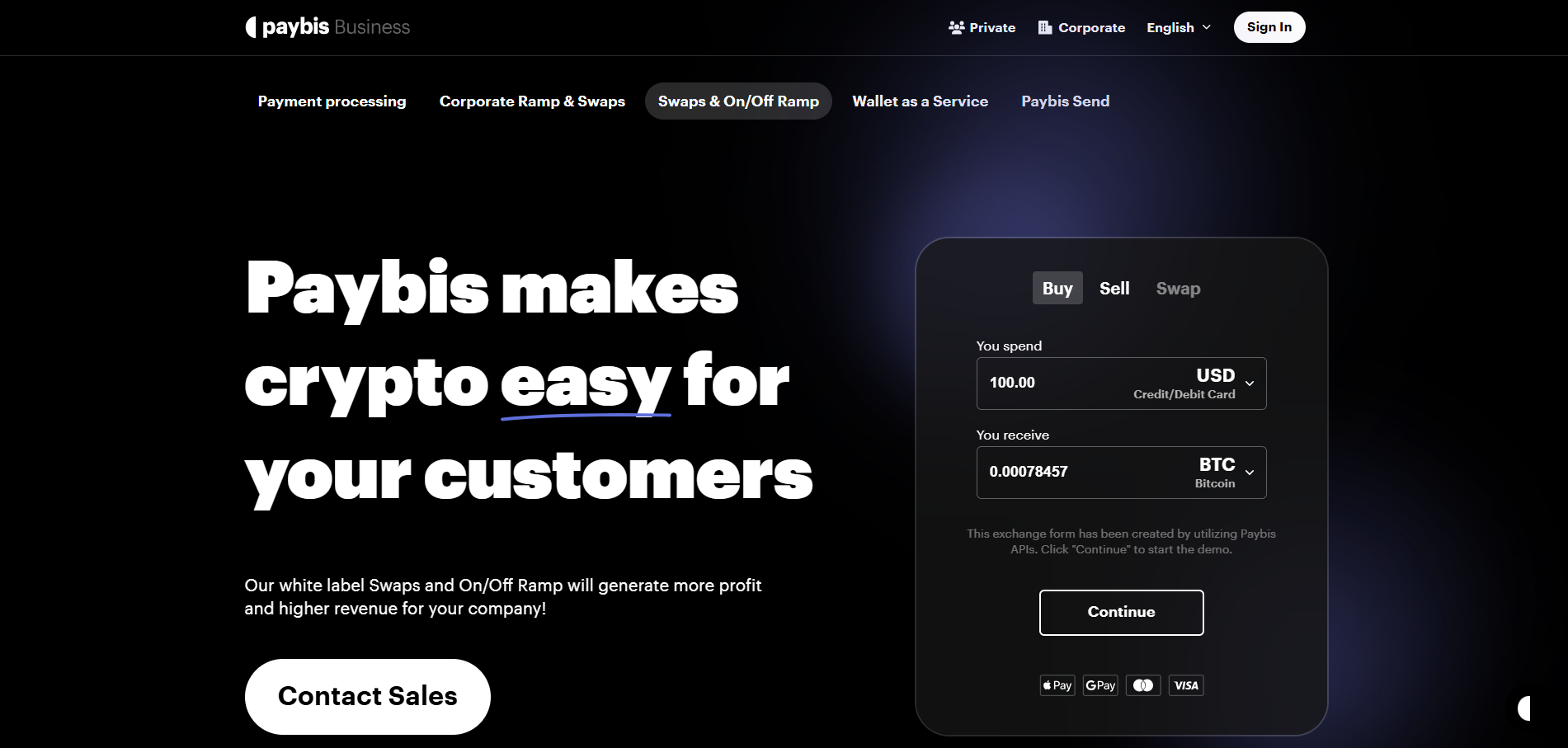
The Paybis On/Off Ramp solution combines seamless fiat-to-crypto and crypto-to-fiat transactions with multiple payment methods spanning from e-wallets to bank transfers, local payment methods, credit/debit cards, and even mobile payments.
Additionally, this product is fully white-labeled, allowing you to customize the Paybis On/Off Ramp solution to not only fit your brand but also to boost approvals, user satisfaction, revenue, and growth.
To ensure business satisfaction and high success rates, Paybis guarantees fast onboarding, full adherence to regulatory requirements, a wide list of popular payment methods, and smooth integration options.
Key Features
- Access to 180+ countries and support for 80 fiat currencies
- White label capabilities for extensive customization
- Seamless URL integration, API-based checkout, and full-screen overlay mode
- Subscription-based payments
- Onboarding in under 24h with 0% foreign exchange fees
- PCI-DSS Level 1 certification
- Full AML (Anti-Money Laundering) and KYB (Know Your Business) compliance
- Pricing starts from 0.49% per transaction, with a tiered-pricing model that grows with your business
2. Coinbase Onramp
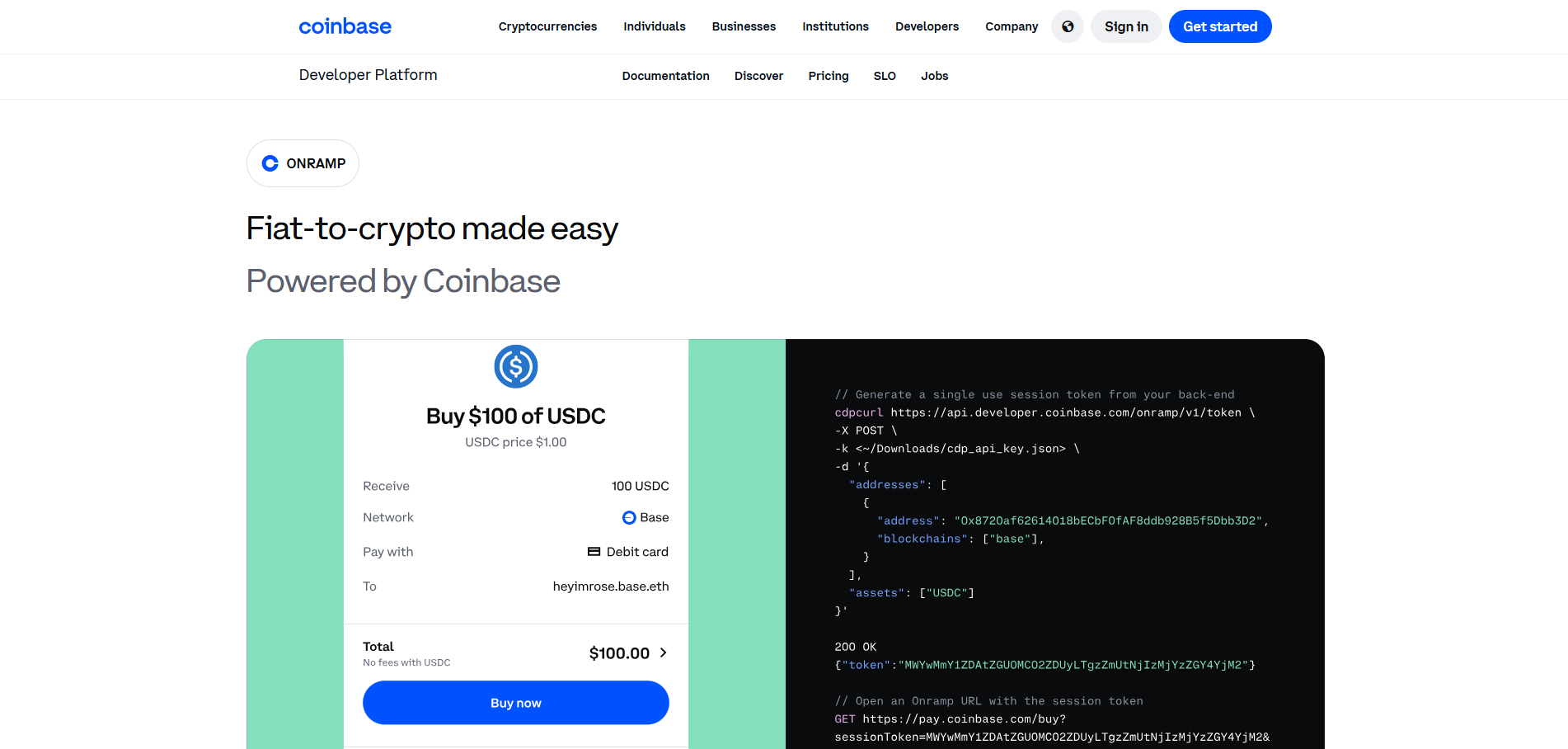
Coinbase, a publicly traded crypto company, provides high-quality fiat-to-crypto solutions backed by an established crypto exchange infrastructure. The platform helps businesses add crypto onramp features directly into their apps, so users can adopt crypto more easily.
Coinbase also provides both API and SDK options. Developers can use either a customizable React component or create a one-click-buy URL for applications with backend capabilities. Powered by high-profile partnerships like Stripe and embedded in Coinbase’s ecosystem and third-party apps, it’s a top choice for businesses looking to offer smooth onboarding and off-ramping to end users.
Key Features
- Simple and intuitive user experience
- Zero fees for buying and transferring USDC on the Base network
- Coinbase handles all fraud claims and customer support cases on behalf of partners
- Built-in KYC and compliance
- Global reach allowing to buy over 100 tokens with 60+ fiat currencies
- Seamless integration
- Auto-enrolled 2-factor authentication, password protection, and multi-approval withdrawals
- Coinbase Onramp is free to integrate, and users typically pay ~0–2.5% in fees depending on payment method
3. Transak
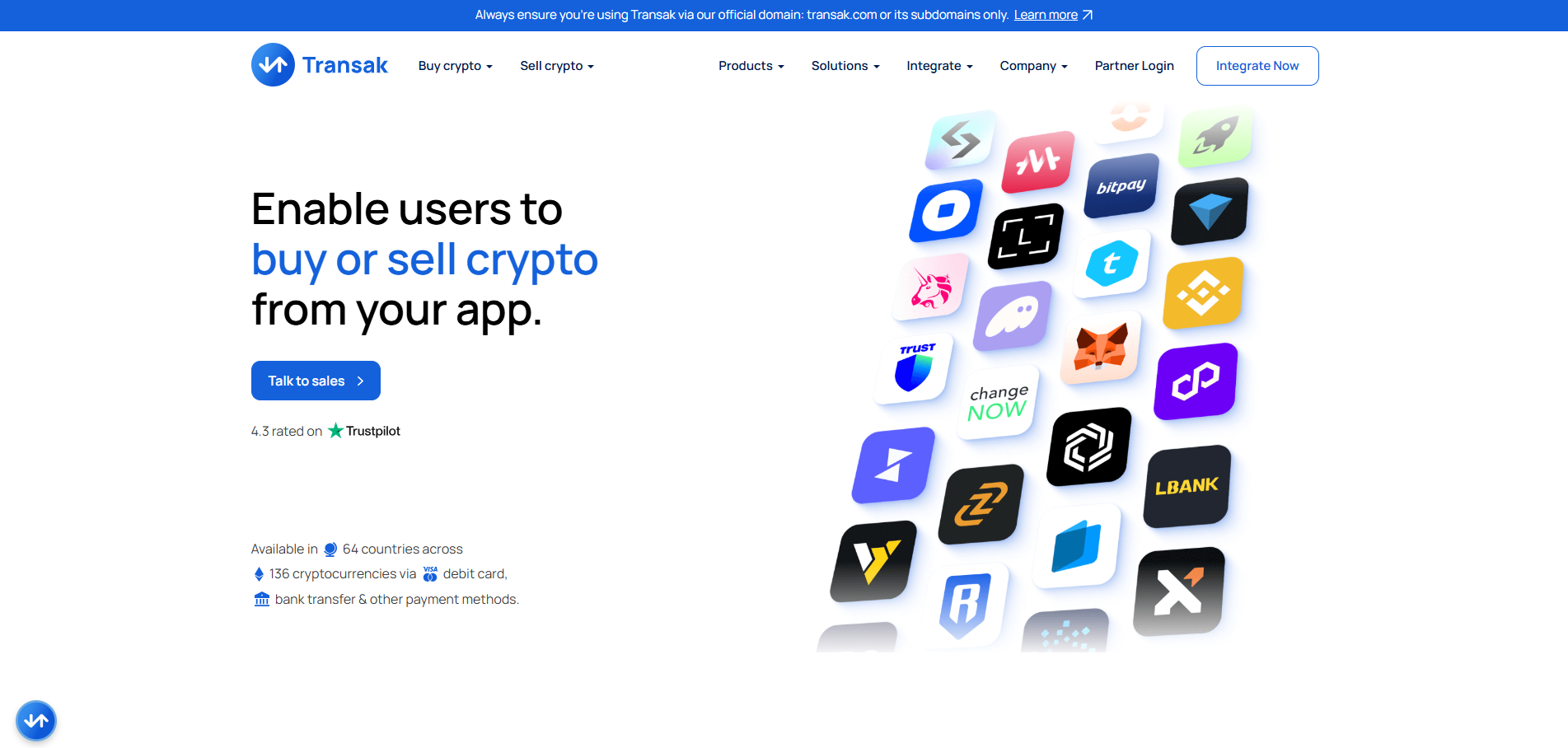
Transak On‑Ramp is a known fiat-to-crypto gateway designed to simplify the onboarding process for Web3 platforms. With support for over 136 cryptocurrencies and local payment methods in 64 countries, Transak enables developers to embed a customizable widget or SDK into wallets, dApps, NFT marketplaces, gaming platforms, and exchanges.
Transak powers fiat-to-crypto purchases in MetaMask, and supports DeFi and NFT ecosystems like Uniswap, PancakeSwap, Immutable, Decentraland, Sequence, and SushiSwap.
Key Features
- Modular white-label API
- Smart contract integration
- Multi-exchange liquidity from 10+ exchanges
- Robust risk engine
- Partner apps get user verification information to make onboarding smooth
- Single-step transactions
- SOC 2 Type II compliance
- ISO/IEC 27001:2022 certification
- Transak On‑Ramp typically charges around 1% per transaction plus optional configurable partner fees, network/gas fees, and a small exchange spread
4. Ramp Network
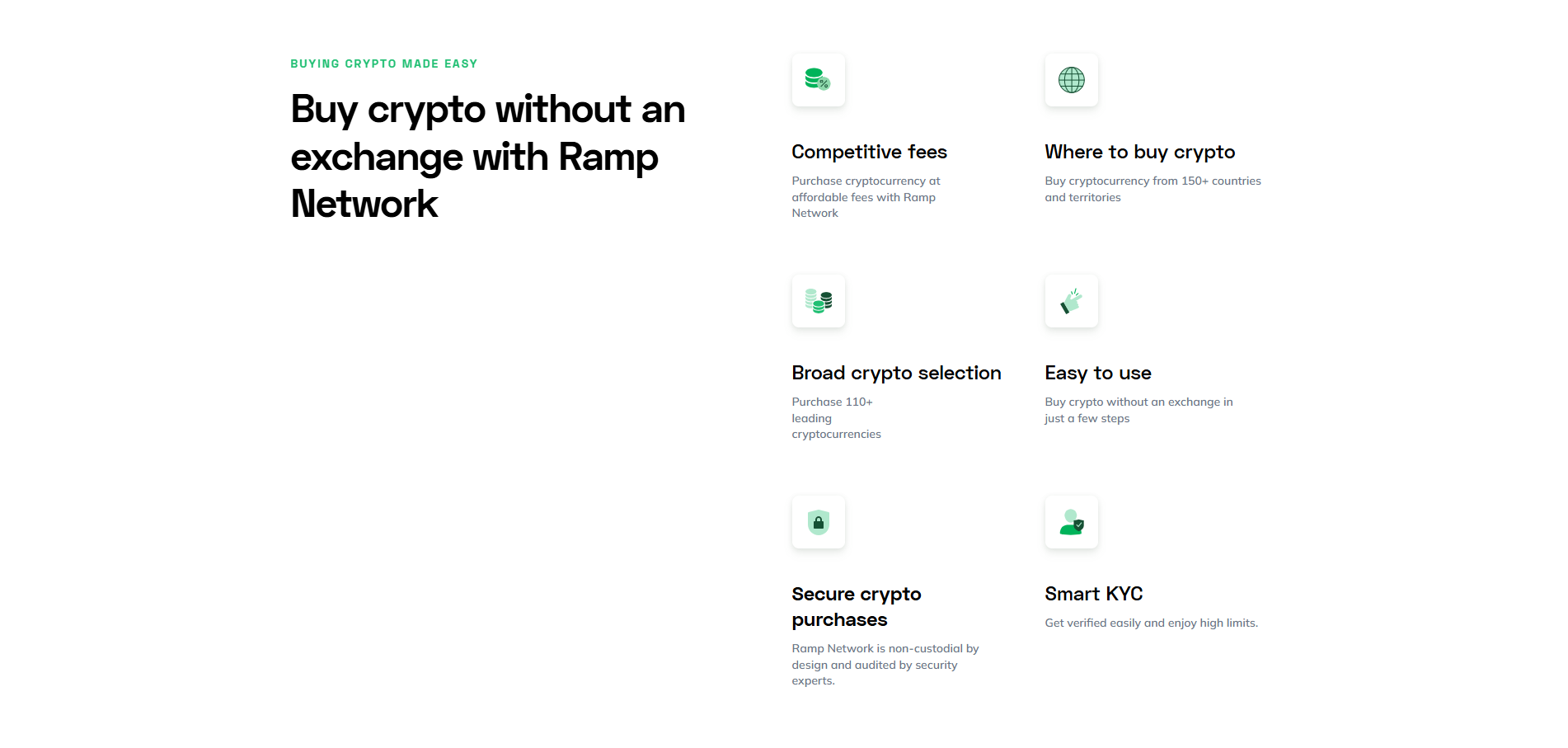
Ramp Network is another popular fiat-to-crypto (and crypto-to-fiat) infrastructure platform built to onboard users into Web3 ecosystems and support off-ramp flows easily. Operating in over 150 countries, Ramp supports a wide range of payment methods, including Visa/Mastercard debit and credit cards, Apple Pay, Google Pay, SEPA Instant, PIX, and Open Banking transfers.
Developers can integrate Ramp via a lightweight, customizable widget, SDK, or API with minimal code, while Ramp handles compliance (KYC/AML), liquidity aggregation, and payout routing. Notable ecosystem integrations include Polygon, Fantom, Solana, Loopring, Arbitrum, Optimism, Avalanche, ImmutableX, Telos, SWEAT Wallet, Coco Wallet, and others.
Key Features
- Non-custodial design
- Widget integration options with overlay (SDK), hosted, and embedded solutions for web applications
- Single sign-on (SSO)
- Tokenization technology
- SCIM provisioning
- SOC 2 Type II compliance
- Information Security Control Framework
- Ramp Network typically charges a fee of around 0.49% to 2.9% per transaction, depending on payment method and region, plus a network fee
5. MoonPay
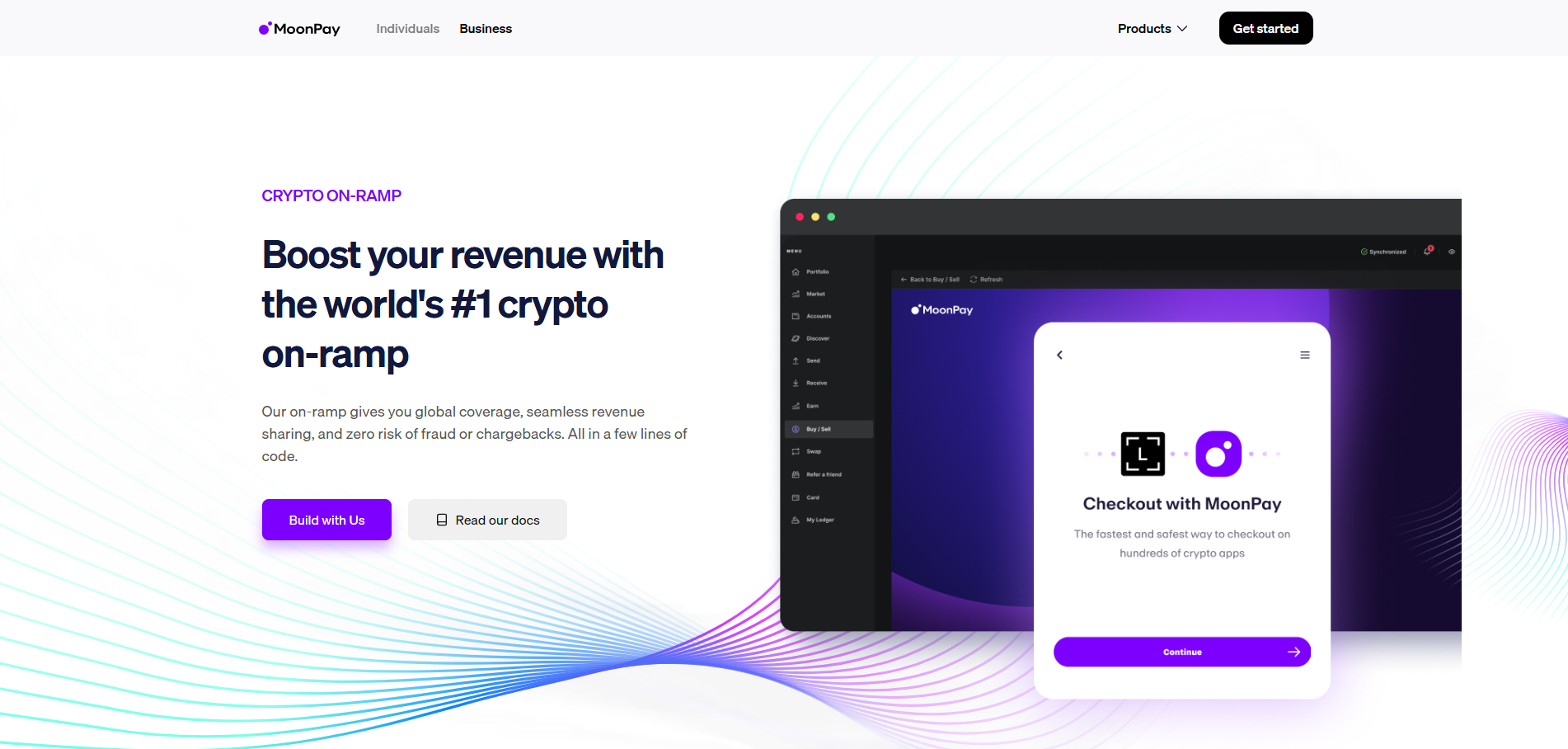
MoonPay On‑Ramp is a global fiat-to-crypto gateway for users to buy and sell cryptocurrencies using traditional payment options such as credit/debit cards, Apple Pay, Google Pay, PayPal, bank transfers (including local methods like PIX or Yellow Card), and more.
MoonPay’s partnership ecosystem includes integrations with OpenSea, imToken, CoinGate, and Gaia, an AI‑agent developer network, to power token purchases and AI agent monetization via its Helio payments infrastructure.
Key Features
- Non-custodial framework
- Widget customization
- Wallet creation for new users
- Social sign-in through Google or Apple accounts
- Users can add fiat money to buy crypto without fees
- Follows PCI DSS 4.0, SOC 2 Type II, ISO 27001, and ISO 27018 standards
- Protects all data with TLS 1.2+ during transfer and AES-256 when stored
- MoonPay On‑Ramp charges around 1% for bank transfers and up to ~4.5% for credit/debit card or mobile payments, plus applicable network fees
6. Mercuryo
Mercuryo On‑Ramp is a global fiat-to-crypto and crypto-to-fiat infrastructure provider trusted by 200+ Web3 businesses. Its turnkey widget, SDK, or API enables platforms like decentralized exchanges, wallets, NFT marketplaces, DeFi apps, and neobanks to integrate seamless buy/sell flows.
Features include compliance (KYC/AML), fraud protection, chargeback management, liquidity aggregation, a merchant dashboard, webhooks for transaction tracking, and customizable branding options. Key partnerships include companies like MetaMask, PancakeSwap, Binance, Haru Invest, and Injective (INJ) Bridge.
Many onramp providers also offer integrated crypto wallet solutions, allowing businesses to manage both fiat-to-crypto conversions and asset storage within a single platform.

Key Features
- Quick integration like SDK, API, or iFrame
- Branded designs and merchant dashboard
- Non-custodial system
- Complete payment system
- Flexible settlement options
- Anti-fraud monitoring
- Regulatory framework
- Mercuryo On‑Ramp charges up to 3.95% per transaction for buying or selling crypto with a debit/credit card, plus applicable network fees
Key Features
- Smart recommendations on optimal conversions based on fees, user location, and KYC requirements
- Single code integration
- Unified analytics across all integrated onramps
- URL signing security
- Returning-user routing
- Mandatory URL signing
- Personal data protection
Best Crypto Onramp Solution Comparison Table
|
Provider |
Coverage & currencies |
Integration options |
Compliance & security |
Pricing |
Key strengths |
|---|---|---|---|---|---|
|
Paybis |
180+ countries, 80 fiat currencies |
URL, API, overlay, white-label |
PCI-DSS L1, AML/KYB compliant |
From 0.49% per transaction |
✅ White-label customization ✅ Fast onboarding (<24h) ✅ 0% FX fees ✅ Subscription payments |
|
Coinbase Onramp |
100+ tokens, 60+ fiat |
API, SDK, one-click buy |
Built-in KYC, 2FA, fraud protection |
~0–2.5% |
Backed by major exchange, seamless UX, Coinbase handles fraud/support |
|
Transak |
136+ cryptos, 64 countries |
Widget, SDK, API |
SOC 2 Type II, ISO/IEC 27001 |
~1% + network/partner fees |
Integrated with MetaMask & Web3 dApps, single-step transactions |
|
Ramp Network |
150+ countries |
Widget, SDK, API |
SOC 2 Type II, non-custodial |
0.49%–2.9% + network fee |
Strong Web3 integrations, tokenization tech, SSO |
|
MoonPay |
Global, many local methods |
Widget, API |
PCI DSS 4.0, SOC 2, ISO 27001/27018 |
1% (bank) – 4.5% (card/mobile) |
Popular with NFT marketplaces, strong compliance, wide payments |
|
Mercuryo |
Global, fiat & crypto |
SDK, API, widget |
KYC/AML, anti-fraud, non-custodial |
Up to 3.95% + network fees |
Trusted by 200+ Web3 companies, branded dashboard |
How to Choose the Right On Ramp Solution for Your Business
Choosing the right on-ramp solution is crucial for any business operating in Web3, DeFi, or crypto fintech. The right solution ensures a smooth user experience, compliance with regulations, and scalability as your platform grows.
Here’s a step-by-step checklist for choosing the right on-ramp solution for your business:
Step 1. Identify your business needs. Consider your target audience, operating region, which cryptos and networks you need, and what integration options are best for you.
Step 2. Check regulatory compliance. Research whether or not your preferred provider is licensed in key jurisdictions (e.g., US, EU, UK), and adhere to KYC and AML procedures.
Step 3. Evaluate payment methods and currency coverage. Verify support for credit/debit cards, bank transfers, Apple Pay/Google Pay, and local payment methods.
Step 4. Assess fees and pricing transparency. Compare transaction fees, spread, and network fees, and choose providers with clear fee structures and no hidden costs.
Step 5. User experience and UX integration. Look for minimal steps from fiat to crypto conversion, ensuring fast KYC onboarding.
Step 6. Security and fraud prevention. Ask about encryption, anti-fraud tools, and transaction monitoring. A good rule of thumb is to look for partnerships with compliance vendors like Chainalysis, Sumsub, or Elliptic.
Step 7. Scalability and support. Review provider uptime guarantees and SLAs, and check if they offer 24/7 technical support.
Step 8. Reviews and track record. Read online reviews to check proven reliability and years in the market, positive feedback, and other trust signals.
What Should Businesses Know Before Implementing Crypto Onramps?
Crypto onramps convert fiat to crypto. Offramps do the reverse. For businesses new to crypto payment integration, understanding crypto on/off ramps is essential before selecting a provider that fits your specific operational needs. Complete on-ramp solutions support both on-ramp and off-ramp functionality, enabling users to withdraw USDT to bank accounts seamlessly.
Your users don’t care about blockchain complexity. They want simple purchases. The best onramps hide technical details behind familiar payment flows. Credit card, bank transfer, digital wallet – whatever method users already trust.
Compliance isn’t optional. KYC and AML requirements vary by jurisdiction. Your onramp provider handles this, but you’re still responsible for choosing compliant partners. Check their licenses. Verify their regulatory standing in your operating markets.
Fee structures impact conversion rates. Users abandon checkout when fees surprise them. Transparent pricing matters. Show total costs upfront. Some providers charge percentage-based fees (0.5-5%). Others use spreads. Compare total user costs, not just your integration fees.
Integration complexity varies wildly. APIs offer full control but require developer resources. SDKs provide pre-built components with less flexibility. URL redirects need minimal technical work but give users an external experience. Match integration method to your technical capacity.
Support for multiple cryptocurrencies matters for different use cases. Beyond Bitcoin, many businesses enable users to buy Ethereum and other popular cryptocurrencies through integrated onramp solutions. Businesses looking to integrate crypto payments can use a Bitcoin calculator to help customers estimate conversion rates in real-time before making purchases.
What Features Should Your Onramp Solution Include?
Payment method diversity determines coverage. Credit cards reach most users globally. Bank transfers cost less but take longer. E-wallets appeal to specific markets. Local payment methods dominate certain regions. The more options you support, the higher your conversion rates.
Geographic coverage defines your addressable market. An onramp serving 50 countries won’t help if your users live elsewhere. Verify supported regions match your user base. Check fiat currency support too – USD and EUR are standard, but what about BRL, INR, or NGN?
White-label capabilities maintain brand consistency. Users should feel they’re buying from you, not a third-party processor. Custom logos, colors, and domains keep users in your experience. Generic checkout pages increase abandonment.
Compliance infrastructure protects your business. PCI-DSS certification for card handling. AML screening for fraud prevention. KYC verification for regulatory requirements. SOC 2 audits for security. Your provider should handle this burden, not pass it to you.
Many onramp providers also offer integrated crypto wallet solutions, allowing businesses to manage both fiat-to-crypto conversions and asset storage within a single platform.
Settlement speed affects user experience. Instant settlements let users access crypto immediately. Batch settlements take hours or days. Faster settlements improve satisfaction but might cost more. Balance user expectations with operational costs.
Customer support determines how problems resolve. When transactions fail, who helps users? Some providers offer 24/7 support. Others rely on documentation. If your users can’t reach help, they’ll blame you regardless of whose fault it is.
How Do Conversion Rates Impact Your Bottom Line?
Every user who abandons checkout is revenue lost. Onramp friction kills conversions. Complicated KYC processes. High fees. Failed transactions. Long loading times. Each adds drop-off risk.
Industry benchmarks show wide variation. Simple flows convert 60-80% of users. Complex flows drop to 30-40%. The difference compounds fast. At 100,000 monthly onramp attempts, improving from 40% to 60% conversion means 20,000 additional successful transactions.
Fee transparency affects completion rates significantly. Hidden fees discovered at checkout cause abandonment. Users prepared for total costs complete purchases. Display fees upfront. Calculate final amounts before users enter payment details.
Implementing frictionless crypto-to-fiat conversions helps reduce user drop-off and improves overall satisfaction with your payment infrastructure.
Payment method optimization increases success rates. Some users prefer cards. Others trust bank transfers. Regional preferences vary. Offer multiple methods and track which convert best for your audience.
Mobile optimization matters more than desktop. Most crypto purchases happen on mobile devices. Clunky mobile experiences drive users away. Test checkout flows on actual phones. Verify tap targets are large enough. Ensure forms work with mobile keyboards.
Failed transactions need instant retry options. Network timeouts happen. Payment processors decline cards. Don’t force users to start over. Let them retry with a different method or updated details without losing progress.
What Compliance and Security Standards Matter?
PCI-DSS Level 1 certification is non-negotiable for card payments. This proves your provider securely handles sensitive payment data. Lower certification levels or no certification means you assume liability for breaches.
AML screening prevents illegal fund flows. Your onramp provider should screen transactions against sanctions lists, politically exposed persons databases, and known fraud patterns. This protects your business from regulatory penalties.
KYC verification requirements vary by transaction size and jurisdiction. Small transactions might need minimal verification. Large amounts trigger enhanced due diligence. Your provider should handle verification flows without sacrificing user experience.
Data privacy compliance varies by market. GDPR in Europe. CCPA in California. Each jurisdiction has rules about collecting, storing, and processing user data. Verify your provider complies with regulations in your operating markets.
Fraud prevention systems protect both you and users. Machine learning models detect suspicious patterns. Device fingerprinting identifies repeat fraudsters. Velocity checks catch unusual activity. Strong fraud prevention reduces chargebacks and account takeovers.
Regular security audits prove ongoing protection. SOC 2 Type II audits verify controls work over time. Penetration testing finds vulnerabilities. Bug bounty programs incentivize disclosure. Ask providers for recent audit reports.
Incident response plans determine recovery speed when breaches occur. How fast do they notify affected users? What support do they provide? How do they prevent recurrence? Evaluate their track record handling security incidents.
How Do You Measure Onramp Success?
Transaction success rate is the primary metric. What percentage of initiated transactions complete successfully? Industry standard is 70-80%. Below 60% signals problems. Track this daily to catch issues fast.
Average transaction value shows user confidence. Higher values mean users trust your platform with larger amounts. Growing transaction size over time indicates increasing trust. Declining size might signal fee sensitivity or competition.
User drop-off points reveal friction. Where do users abandon? During KYC? At payment entry? After seeing fees? Instrument your flow to measure each step. Fix the biggest drop-off points first.
Time to first transaction measures onboarding efficiency. How long from signup to first crypto purchase? Faster is better. If users take days to transact, they might forget why they signed up or lose interest.
Repeat transaction rate indicates satisfaction. Users who transact once might be testing. Users who return weekly are engaged. High repeat rates mean your onramp works well. Low rates suggest problems or competition.
Customer support ticket volume per transaction shows friction. More tickets mean more confused or frustrated users. Track ticket categories. Common questions reveal unclear UX or missing features.
Net Promoter Score measures overall satisfaction. Would users recommend your crypto purchase experience? Scores above 50 are excellent. Below 0 means serious problems. Survey users post-transaction while experience is fresh.
Regulatory compliance audit results prevent future problems. Track KYC completion rates, AML false positives, and rejected transactions. High false positive rates frustrate legitimate users. Low completion rates might indicate weak controls.
Summing Up
Crypto onramps are becoming increasingly popular solutions, making it easy for companies to transition to crypto assets without fleshing out their own crypto-friendly payments infrastructure. But choosing the right solution for you depends on your specific business needs.
While most onramp solutions provide the same core service, they also include different features and benefits, catering to specific industries. These features can include geographic reach, payment options, fees, security credentials, and unique use cases.
Paybis is one of the most trusted global crypto service providers with a robust decade-long crypto experience. We offer an entire suite of B2B products to help onboard businesses and give the right tools for their crypto journeys.
Interested in leading more? Talk to Paybis!
FAQ
What should businesses consider when choosing a crypto onramp solution?
When selecting a crypto onramp solution, businesses should consider factors such as geographic coverage, supported payment methods and cryptocurrencies, fee structures, security measures, ease of integration, and specific features that align with their use case.
How do fees work for crypto onramp services?
Fees for crypto onramp services usually consist of a combination of service fees, network fees, and sometimes partner fees. The exact structure varies by provider, but generally, fees can range from around 1% for bank transfers to 4-5% for card payments, with some providers offering lower fees for certain cryptocurrencies or payment methods.
What payment methods are typically supported by crypto onramps?
For businesses prioritizing lower fees and traditional payment rails, the ability to buy Bitcoin with bank account transfers provides a cost-effective alternative to card payments. The exact methods available can vary depending on the user’s location and the specific onramp provider.
How do crypto onramp solutions ensure security?
Crypto onramp solutions implement various security measures, including encryption, compliance certifications (like PCI DSS and SOC 2), KYC/AML procedures, and fraud prevention systems. Many also use cold storage for funds and offer features like multi-factor authentication to protect user accounts.
How are crypto onramps and offramps different?
Crypto onramps allow users to convert fiat currency (like USD or EUR) into cryptocurrency, enabling entry into the crypto ecosystem. In contrast, offramps convert cryptocurrency back into fiat, allowing users to exit the crypto space and access traditional financial systems. Complete onramp solutions also support offramp functionality, enabling users to sell Bitcoin and convert crypto back to fiat currencies seamlessly.
I'm looking for the best onramp in the USA and the cheapest solution. What should I choose?
If you’re in the U.S. and want a cheap, easy solution, consider going with Coinbase Onramp. It has zero fees when buying and transferring USDC on the Base network, making it the most cost-effective choice. It also handles KYC, fraud checks, and customer support for you. Plus, Coinbase is a US-based company, which makes it great for affordable and compliant crypto access in the U.S.
What's the best off-ramp for crypto?
For converting crypto back to fiat, Paybis is one of the best choices. It offers a combined on/off-ramp service, making it easy to handle both buying and selling crypto in one solution. Businesses can withdraw funds using various payment methods across many countries. Ramp Network is another good option, especially for Web3 apps, but Paybis offers a more complete off-ramp setup for most business needs.
What's the best fiat onramp for crypto?
Paybis is one of the best fiat onramps for crypto. It supports over 180 countries and 80 currencies, with 70+ payment options like cards, bank transfers, mobile payments, and e-wallets. It’s easy to integrate into any platform and fully customizable to match your brand. Businesses benefit from fast setup (under 24 hours), no foreign exchange fees, and strong security and compliance.
What is a crypto onramp solution?
A crypto on ramp solution is a platform that enables users to convert traditional currencies (fiat) into cryptocurrencies. It provides the infrastructure for businesses to integrate fiat-to-crypto conversion capabilities directly into their applications or websites. To understand better what is onramp, head on to the Paybis business blog.
Disclaimer: Don’t invest unless you’re prepared to lose all the money you invest. This is a high‑risk investment and you should not expect to be protected if something goes wrong. Take 2 mins to learn more at: https://go.payb.is/FCA-Info