On-Ramp Integration Speed: Ramp vs. Paybis vs. Custom Build
Key Takeaways:Building a custom fiat on-ramp drains 12 to 24 months of engineering runway before a single user transacts. Third-party integrations compress that dramatically. Paybis offers a URL redirect integration designed for rapid deployment with minimal backend work. Ramp Network’s hosted option is similarly fast, designed for frontend developers with minimal setup. SDK implementations across both platforms typically require more development time depending on complexity. For a crypto-native platform choosing between these paths, the decision maps directly to preserved runway and faster user adoption.
Your engineering team’s time is your most finite resource. Every sprint spent building fiat payment rails, acquiring regulatory licenses, and managing payment processor relationships is a sprint your competitors spend compounding user growth. This guide benchmarks the time-to-production for each on-ramp integration path, from our URL redirect to a full custom build, so you can quantify the runway impact before making the call.
Table of contents
- How Integration Speed Impacts Your Engineering Runway
- The True Cost of a Custom Fiat On-Ramp Build
- Comparing Third-Party On-Ramp Integration Methods
- Ramp Network Integration Speed and Complexity
- Paybis Integration Speed and Complexity
- Go-Live Timelines by Crypto Platform Type
- Factors That Extend Your Go-Live Timeline
- Summary
- Key Terminology
How Integration Speed Impacts Your Engineering Runway
Every week of delayed infrastructure is a week a competitor ships features and retains users you haven’t reached yet. The build-vs-buy decision isn’t just technical. It’s financial.
Two senior engineers at $12,000 per month fully loaded means a 12-month custom on-ramp build represents roughly $288,000 in direct engineering spend, before licensing fees, external counsel, or banking partnership costs. Our B2B integration takes hours to implement, converting that same budget into product features that drive Total Value Locked (TVL) and Daily Active Users (DAU).
In fiat rails specifically, the build-vs-buy calculus underestimates hidden costs. You’re not building a checkout UI. You’re building a regulated financial infrastructure business inside your product roadmap.
The True Cost of a Custom Fiat On-Ramp Build
A custom build spans five phases: regulatory licensing, core engineering, payment processor integrations, KYC solution setup, and post-launch monitoring. The total timeline for an average crypto startup typically runs 12 to 24 months before production. Core engineering phases often require 4 to 8 months. PSP integrations can add 2 to 4 months. Testing and deployment add further time beyond that, and regulatory timelines are a category of their own.
Regulatory and Licensing Delays
Acquiring the licenses required to operate a compliant fiat on-ramp is the longest single phase. In the United States, FinCEN Money Services Business (MSB) registration is the federal baseline, but state-level money transmitter licenses compound the timeline significantly, with each state running 3 to 12 months per application. In the EU, VASP registration under MiCA and AML frameworks typically adds 3 to 12 months per jurisdiction. In the UK, FCA crypto registration has historically been among the most demanding approval processes globally, often extending 6 to 12 months or longer.
We carry pre-acquired licensing across FinCEN (US entity 31000272911973, PL entity 31000277275964), FINTRAC (Financial Transactions and Reports Analysis Centre of Canada, PL entity C100000816, CA entity C100000646, UK entity M22061209), and the Revenue Chamber in Katowice (VASP in Poland, RDWW-805). Integrating with us means you inherit that compliance stack on day one instead of spending the next 18 months acquiring it.
Payment Processor Integrations and Maintenance
Each payment method in each geography requires a separate PSP relationship: contracts, compliance reviews, and ongoing maintenance. A platform targeting LATAM or SEA users without pre-built local payment coverage loses users at the payment step before the on-ramp delivers any value.
We support 20+ payment methods across 180+ countries without requiring you to negotiate or maintain individual PSP contracts. That compresses 2 to 4 months of PSP integration work into a single API call.
Comparing Third-Party On-Ramp Integration Methods
Three distinct integration patterns exist across providers like Ramp Network and Paybis, each trading engineering effort for UI control.
| Integration Method | Time to Integrate | Engineering Effort | UI Flexibility |
|---|---|---|---|
| URL Redirect | Minutes (typical) | Low (minimal backend for signing + frontend) | Low (hosted page) |
| Hosted Widget / Basic SDK | Hours (typical) | Low to Medium (frontend) | Medium (customizable widget) |
| Native SDK | Days to Weeks (typical) | High (frontend + backend) | High (full UI control, typical) |
| Custom Build | 12 to 24+ Months (typical) | Very High (dedicated team, typical) | Total (100% control, typical) |
URL Redirect: The Fastest Path to Production
A URL redirect keeps nearly all of the implementation on the frontend. The only backend work required is HMAC signing to generate a verified URL, with no Paybis API calls needed during the transaction flow itself. The full implementation involves constructing a signed URL with your partner UUID, then opening it in a browser window when a user clicks “Buy Crypto.”
Our Standalone option is the fastest way to integrate on/off ramp functionality, requiring only a unique Product UUID and HMAC signing key. The URL format:
https://widget.paybis.com/?currencyCodeFrom=EUR¤cyCodeTo=ETH&partnerId={partner UUID}&transactionFlow=buyCrypto&signature={signature}
For wallets or Web3 apps that need to ship payment functionality this week, this is the only path that doesn’t require a backend sprint.
Hosted Widgets: Balancing Speed and User Experience
Hosted widgets keep users within the application UI rather than redirecting externally. This reduces context switching and supports in-app payment flows that feel native.
Hosted widgets typically offer the quickest integration method, requiring only a redirect to a hosted URL with configuration parameters and no SDK installation. Integration runs for a few hours for a frontend developer already familiar with web application architecture. We also support an iframe embed path alongside our Standalone URL redirect, giving you the option to keep users on-domain with minimal engineering overhead.
Native SDKs: Maximum Control with Higher Engineering Cost
Native SDKs allow the payment widget to sit inside the application’s native component tree. Ramp’s Web SDK installs via npm, accepts parameters including hostApiKey, swapAmount, swapAsset, and userAddress, and renders via .show(). Mobile implementations add platform-specific complexity that extends timelines to days or weeks.
We offer our Web SDK as the recommended approach for most web-based applications and position our full API integration as the most powerful path, enabling shared KYC, Single Sign-On, and one-click checkout. Full API integration involves direct server-to-server communication, making it a days-to-weeks project depending on team bandwidth.
Ramp Network Integration Speed and Complexity
Ramp provides three integration paths: hosted URL, overlay SDK, and embedded SDK. The hosted option is the fastest, requiring only URL construction and a browser redirect with no SDK dependency.
Ramp’s go-live process reportedly requires partners to apply for partnership (reviewed within 1-2 business days), then complete a due diligence form with company details for compliance team review (7-10 business days). API keys and contract signing follow compliance approval. Their team reviews the integration post-launch to confirm it follows best practices, adding a monitoring phase to the overall timeline.
Ramp reportedly covers 150+ countries and regions with primary fiat support in USD, EUR, and GBP. Developer support runs via email and a Discord channel, though published SLA or guaranteed response times are not readily visible in their public documentation.
Paybis Integration Speed and Complexity
Our integration stack runs from minutes (URL redirect with minimal backend) to hours (widget embed) to days or weeks (full API with shared KYC and SSO). We make a testing sandbox available from the start, with a provided sandbox API key and dedicated sandbox URL for pre-production validation.
Out of the box, we cover 180+ countries, 20+ payment methods, and 80+ cryptocurrencies. That coverage is live on the day you integrate, not contingent on future PSP negotiations or licensing applications.
Our Corporate Service also enables business payout functionality, so you can extend the integration beyond buy flows into treasury and disbursement workflows without additional infrastructure builds.
On support: we run 24/7 human support with an average response time of ~15 seconds. For a team doing a first-time integration late in a sprint, that’s the difference between resolving a parameter issue in minutes and waiting hours for an email queue. Denis I., a verified G2 reviewer, described the experience directly:
“I appreciate Paybis for its ability to facilitate instant cryptocurrency purchases using my card… Moreover, I found the initial setup with Paybis to be easy and fast, contributing to a smooth onboarding experience.” – Denis I. on G2
For B2B partners evaluating the end-user experience, we have 30,780+ Trustpilot reviews with a rating of 4.1 or “Great” (as of March 2026). Tammy, a Trustpilot reviewer, noted:
“The Paybis app it’s the easiest I’ve ever used it was the easiest I got to get verified it was the easiest to just complete the account setup.” – Tammy on Trustpilot
Go-Live Timelines by Crypto Platform Type
“Integration time” (code complete) and “go-live timeline” (tested, compliance-approved, in production) are two distinct measurements. Most crypto platforms require compliance due diligence as a pre-production step. We require domain whitelisting and partner onboarding before the widget goes live. Both add time beyond the engineering work. Partners typically see additional time beyond code-complete for compliance review and deployment.
Wallets and Decentralized Exchanges
For non-custodial wallets and DEXs integrating via URL redirect or basic widget, technical implementation typically ranges from hours to one day. Full go-live, including compliance review and partner onboarding, can take 1 to 3 weeks depending on documentation readiness.
Our integration passes wallet address as a URL parameter and supports direct-to-wallet delivery for both custodial and external wallet addresses. For wallets operating across multiple chains, our 80+ cryptocurrency coverage means no additional asset negotiation at integration time. Christine K., a G2 reviewer, described what end users experience:
“I just pick how much crypto I want, pay with my card (or Apple/Google Pay), and in about 10-15 minutes the coins are already in my wallet… my funds go directly into a wallet address I control.” – Christine K. on G2
Web3 Applications and Games
Web3 apps requiring in-app token purchases involve more complex UX flows, particularly when triggering purchases mid-session. The embedded widget or iframe path handles most cases without a full SDK build.
Our documentation positions Paybis as a fit for dApps with no-KYC flow up to the applicable threshold and SSO support in the full API path. For games with high-frequency micro-purchases, SSO eliminates repeated KYC friction. Web3 app go-live timelines can vary based on factors like event-triggered purchase flows and sandbox QA requirements.
Factors That Extend Your Go-Live Timeline
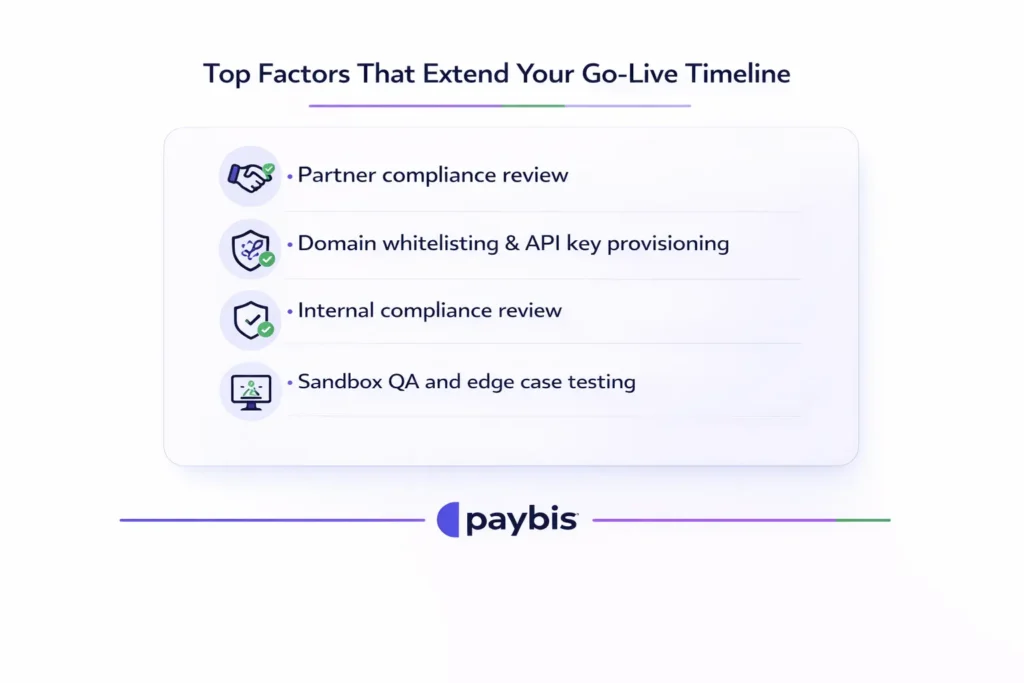
Even the fastest integration path carries non-code delays. Here are the five most common blockers and how to mitigate each:
- Partner compliance review: Payment platforms typically conduct KYC due diligence on partners before production access. Mitigation: Prepare incorporation documents, beneficial ownership details, and activity descriptions before submitting the integration request.
- Domain whitelisting: Our widget only opens from registered domains for security. Mitigation: submit domain registration requests on day one of onboarding, in parallel with technical work.
- API key provisioning: Ramp requires a partnership form submission before issuing an API key. Mitigation: Apply the same day you decide to integrate, not after code is written.
- Internal compliance review: Platforms in regulated jurisdictions need legal sign-off before shipping payment functionality. Mitigation: loop in legal during vendor evaluation, not at the end of the integration sprint.
- Sandbox QA and edge case testing: Thorough pre-production testing of payment failure states, KYC rejection handling, and currency conversion edge cases prevents production incidents. Mitigation: plan for several days of dedicated QA regardless of the integration method.
Our 24/7 support team is available throughout all of these phases, with average response times under one minute. That availability directly reduces time blocked on integration questions that would otherwise queue in an email system over hours.
Summary
- Custom builds cost 12 to 24+ months before a single user transacts, across licensing, engineering, PSP integrations, and KYC setup.
- URL redirect takes minutes with only HMAC signing required on the backend. Our Standalone integration is the fastest evaluated path to production.
- Hosted widgets take hours, keep users on-site, and suit platforms where session continuity drives conversion.
- Native SDKs take days to weeks and deliver maximum UI control. Use them when conversion data justifies the engineering cost.
- Go-live always exceeds integration time by 1 to 4 weeks due to compliance reviews, domain whitelisting, and sandbox QA.
- We cover 180+ countries, 20+ payment methods, and 90+ cryptocurrencies from day one, with no additional PSP negotiations required.
- ~15-second average support response time directly reduces blocked time during integration and post-launch monitoring.
Review our developer documentation to test the sandbox and calculate exact engineering hours for your specific path. To quantify saved engineering weeks for your team’s use case, contact our B2B team directly. Get started on your first on-ramp transaction with Paybis right here.
Key Terminology
URL Redirect: An integration method where the user is sent to a hosted external page to complete a transaction. Requires minimal backend work (HMAC signing) and represents the fastest technical implementation of any on-ramp path.
Hosted Widget: A UI component loading within the partner application’s interface, keeping the user on-site while the payment provider handles transaction logic. Requires more frontend work than a URL redirect but improves session continuity.
Native SDK (Software Development Kit): A platform-specific library (web, iOS, or Android) enabling deep integration of on-ramp functionality into the application’s native UI. Offers maximum UI control at the cost of higher engineering effort and longer timelines.
Cascade Routing: An automated payment retry strategy where a declined transaction is rerouted through an alternative payment processor or acquiring bank without user intervention, increasing card approval rates by reducing single-acquirer failure points.
HMAC Signing: A cryptographic method for verifying the authenticity of a URL or API request. Required by Paybis for all widget URL signatures to prevent unauthorized use of the partner integration.
FAQ
How long does it take to integrate a fiat on-ramp using a URL redirect?
URL redirect integration can be implemented quickly with HMAC signing on the backend and a frontend button. Full go-live, including compliance review and domain whitelisting, may extend 1 to 3 weeks depending on documentation readiness.
What is the difference between integration time and go-live timeline?
Integration time is the engineering hours to write and test the code. Go-live timeline adds compliance due diligence, partner onboarding, domain registration, and production approval, which can extend 1 to 4 weeks beyond the code-complete date.
How many countries does Paybis cover compared to Ramp Network?
We cover 180+ countries with 20+ payment methods and 90+ cryptocurrencies. Ramp covers 150+ countries with primary fiat support in USD, EUR, and GBP.
Does integrating the Paybis URL redirect require backend changes?
Minimal backend work is required: you need to implement HMAC signing to generate a verified URL. No Paybis API calls are required during the transaction flow itself, making it far lighter than a widget or SDK integration.
Disclaimer: Don’t invest unless you’re prepared to lose all the money you invest. This is a high‑risk investment and you should not expect to be protected if something goes wrong. Take 2 mins to learn more at: https://go.payb.is/FCA-Info