
Crypto Payout Solutions for Affiliate Networks: Automating Commission Disbursement at Scale
Key Takeaways:Crypto payout APIs replace SWIFT batch files with automated per-affiliate disbursements, enabling faster cross-border settlement. A fiat-funded vIBAN model lets you pre-fund in USD or EUR and disburse in multiple cryptocurrency options including Bitcoin and stablecoins (USDT, USDC) across various networks. Built-in KYC/AML screening and address verification at the infrastructure level help manage compliance requirements without adding headcount.
Affiliate marketing is projected to reach $27.78 billion by 2027, but most networks still run commission disbursements through manual batch files and SWIFT rails. Cross-border payments often carry hidden FX markups, and wire settlement can take multiple business days. For affiliates generating commissions daily, that combination is a churn trigger, not a compensation model.
This guide covers how to automate affiliate commission payouts at scale using a crypto payout API, how to reduce treasury risk through a fiat-funded virtual IBAN (vIBAN) model, and how to offload compliance across active jurisdictions without adding headcount.
Eliminating Payout Delays with Crypto
SWIFT payments take 1-5 business days in most cases, and cross-border wires can experience significant delays before the affiliate sees funds. For affiliates generating commissions daily, waiting until mid-month for a slow-clearing wire shows up directly in partner satisfaction scores.
Crypto settlement runs on a different timeline. Stablecoins on Polygon and Tron settle in approximately 2-3 seconds per block, with confirmations completing in minutes rather than days, making near-session payouts achievable without custom payment infrastructure.
Automating Rapid Commission Payouts
Manual batch processing creates compounding problems: settlement lag, reconciliation overhead, and error resolution cycles that scale linearly with affiliate count. Replacing batch files with API calls removes every manual step between a commission being earned and a payout being executed.
The Paybis Send integration guide covers discrete endpoints for address validation, real-time FX quoting, payout execution, and webhook-based status confirmation. Each payout request is processed in minutes. The full cycle from trigger to affiliate wallet receipt runs near-instantly, depending on the blockchain network selected.
You can see how Paybis CEO Innokenty Isers frames the broader B2B opportunity in this 2026 iGaming crypto payments interview, where he discusses why automated crypto infrastructure is increasingly the default for digital platform payouts.
Cut FX & Intermediary Fees with Crypto
Outgoing international wire fees range from $25-75 at the sending bank alone. Many receiving banks also charge fees, and foreign exchange markups can significantly increase the cost of cross-border payments. The combined impact of these fees means affiliates often receive notably less than the nominal payout amount.
Contrast that with a USDC payout routed via Polygon: network fees cost approximately $0.02 per transaction, making them more than 90% cheaper than Ethereum mainnet transfers at standard traffic levels. Even with platform fees included, a $1,000 payout typically delivers materially more to the affiliate than the wire equivalent.
Optimizing Multi-Currency FX & Payouts
A global affiliate program covers dozens of countries, each with different banking infrastructure and crypto preferences. An affiliate in Southeast Asia may prefer USDT on Tron. One in Europe may want BTC. Managing separate payout rails per region scales poorly. The Paybis Send API covers BTC, ETH, SOL, LTC, TON, DOGE, USDT (ERC20, TRC20, Polygon), and USDC (ERC20, Polygon, Base), removing the need to manage separate rails per region. Paybis Send accepts fiat deposits in USD and EUR with no additional currency conversion charge at the deposit stage, so your treasury stays in fiat while affiliates receive in their preferred crypto.
How Crypto Payout APIs Automate Commission Disbursement
API integration for mass crypto payouts requires three distinct workflows: balance management, payout execution, and status reconciliation. Most payments engineering teams already work with REST APIs and webhook-based event handling, so the technical lift is closer to a standard PSP integration than a custom blockchain build.
The Paybis Send product overview covers each stage with code-level detail. Sandbox access is available before production deployment, letting your team validate the full payout cycle against real test cases before committing to a go-live timeline internally. Konstantin Vasilenko, Paybis co-founder, discusses the infrastructure philosophy in this HackSeasons interview on making complex crypto operations operationally simple for platform partners.
API Design for Automated Crypto Payouts
A production-ready crypto payout integration requires four endpoint categories to function reliably at scale:
- Address screening: We validate the recipient’s wallet address format and run AML compliance checks before any funds move.
- Balance retrieval: We check available and held balances so your system prevents over-commitment before a payout batch executes.
- Quote locking: We obtain a real-time FX quote for the fiat-to-crypto conversion and lock it for a defined window, protecting the affiliate’s net received amount.
- Payout execution: We submit the payout request with the locked quote ID, triggering the conversion and transfer in a single call.
Tipalti’s AP automation API provides extensive fiat disbursement capabilities globally, with limited native crypto support as a secondary feature. Dots supports local bank, PayPal, RTP, and other fiat rails across many countries, with crypto available via third-party integrations rather than dedicated native rails. Trackdesk and Tapfiliate focus on affiliate tracking and attribution, with Trackdesk offering crypto payouts (BTC, ETH) via connected payment providers rather than native execution infrastructure.
Real-Time Payouts for Faster Commissions
The Paybis Send vIBAN model removes the treasury management complexity that blocks most platforms from deploying real-time crypto payouts. The flow works as follows:
- You deposit fiat (USD or EUR) into a dedicated IBAN issued under your company name.
- Your balance is held in fiat, ready for payout execution.
- When a payout API call fires, Paybis converts the required fiat amount to the affiliate’s specified cryptocurrency at the locked quote rate and transfers it to their wallet address.
Your company holds a fiat balance (USD or EUR) with no exposure to BTC or ETH price movements between funding and disbursement. Conversion to crypto happens only at the moment of each individual payout.
“Paybis offers transactions in a quick and easy format with thorough security measures. I’ve been using their app for quite some time and have had no issues.” – Amanda Stringfellow on Trustpilot
Connect Crypto Payouts to Tracking
Affiliate tracking platforms generate commission events via webhooks when a conversion is confirmed. Connecting that trigger to a Paybis Send payout call creates a fully automated disbursement pipeline: conversion confirmed, commission calculated, wallet address validated, payout executed.
The implementation requires two webhook listeners: one from your tracking platform to receive commission events, and one from the Paybis Send Transaction Data Webhook to confirm payout status and sync your internal ledger. Both integrate with standard event-handling architecture. You can also review the Paybis affiliate program guide and how affiliate payouts are received for context on the affiliate-side experience.
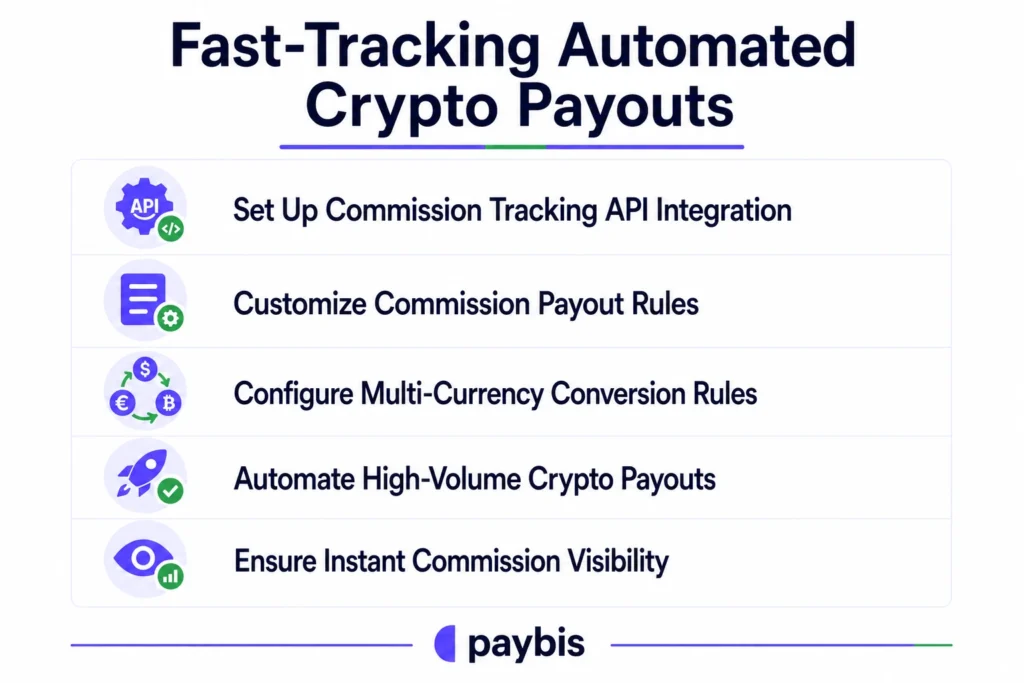
Fast-Tracking Automated Crypto Payouts
The following sequence covers the implementation path from decision to first live payout. Integration timelines vary depending on your team’s bandwidth, documentation readiness, and compliance requirements.
1. Set Up Commission Tracking API Integration
Map your existing affiliate tracking events to the payout trigger logic. Identify which event types (confirmed conversion, threshold crossed, period end) should initiate a payout call. Configure the tracking platform’s outbound webhook to POST commission data to your payout middleware.
2. Customize Commission Payout Rules
Define payout rules per affiliate tier: minimum payout thresholds (e.g., $50 before disbursement), payout frequency (daily, weekly, on-demand), and preferred cryptocurrency per affiliate. Store affiliate wallet addresses with associated AML screening status to streamline recurring payouts to validated addresses.
3. Configure Multi-Currency Conversion Rules
Set default cryptocurrency mappings per affiliate geography. Affiliates in regions with high USDT-on-Tron adoption get routed to that network by default. Affiliates who have opted into BTC receive on-chain transfers. The Paybis Send API accepts target cryptocurrency as a parameter in each payout call, so per-affiliate preferences are enforced at the API layer.
4. Automate High-Volume Crypto Payouts
For batch disbursement cycles (weekly commission runs, monthly performance bonuses), the Paybis Send partner portal supports both API-driven and portal-initiated mass payouts. API-driven batch calls support fully automated pipelines where no human review step is required between trigger and execution.
“Paybis is one of the leading Crypto networks you can for sure trust your transactions will always be swift and safe.” – Lostboy on Trustpilot
5. Ensure Instant Commission Visibility
The Paybis Send partner dashboard provides real-time balance tracking across fiat and crypto, transaction-level status visibility, and AML rejection reason codes. Your reconciliation team sees the same data without querying the blockchain directly. For corporate-level withdrawal workflows, the corporate crypto withdrawal guide covers the full process.
Rapid Setup for Multi-Currency Payments
Manage Multi-Currency Affiliate Options
Paybis Send currently supports the following cryptocurrency assets for payouts: BTC, ETH, SOL, LTC, TON, DOGE, USDT (ERC20, TRC20, Polygon), and USDC (ERC20, Polygon, Base). For affiliates prioritizing stable value, USDT-TRC20 and USDC-Polygon offer sub-cent network fees with near-instant confirmation. For affiliates who prefer native chain exposure, BTC remains the most commonly requested asset.
Network selection affects cost materially. Polygon stands out as the most cost-effective option for stablecoin transfers among the supported networks, with fees typically below a cent. Ethereum mainnet involves higher network fees, making Polygon-based stablecoins more suitable for frequent payouts unless the affiliate specifically requests Ethereum.
“I appreciate Paybis for its ability to facilitate instant cryptocurrency purchases… I value the feature that allows me to buy crypto with my card and have it sent directly to my wallet, offering a streamlined and direct process.” – Denis I. on G2
FX Rate Transparency and Spread Disclosure
Hidden FX spreads are a documented source of post-contract reconciliation problems in payout infrastructure. A platform advertising a “1% fee” can still deliver materially less crypto if the spread applied at conversion is 3-4% on top.
The correct metric to demand at procurement is net received: the exact crypto amount the affiliate receives for a specific fiat input, inclusive of all fees and spreads. We show net received at the quote stage before each payout executes, giving your reconciliation team a pre-execution confirmation of the affiliate’s actual credit. No spread is disclosed at the last step.
“I especially appreciate the transparent fee structure – no hidden costs or surprises.” – Vladimir Z. on G2
Predictable Payouts: Stablecoins or Native?
The choice between stablecoins and native assets for affiliate payouts comes down to who carries the volatility risk and at what point.
| Factor | Stablecoins (USDC/USDT) | Native Assets (BTC/ETH) |
|---|---|---|
| Value predictability | 1:1 USD peg | Volatile at receipt |
| Affiliate accounting | FMV accepted as $1/unit | FMV required at receipt timestamp |
| Network fees (Polygon/Tron) | Under $0.01 per transaction | Higher on ETH mainnet |
| Affiliate preference | Widely used for recurring income | Preferred for accumulation strategies |
Stablecoins are well-suited for recurring affiliate commissions due to their price stability and efficient settlement characteristics, making them the operationally lower-risk default. Native assets suit performance bonuses where the affiliate has explicitly opted into price exposure.
Ensuring Audit-Ready Crypto Transaction Data
Audit readiness for mass crypto payouts requires three data layers: balance-level ledger accuracy, transaction-level payout verification, and event-based reconciliation hooks. Gaps in any layer create compliance exposure during a tax audit or regulatory review.
Affiliate Commission Balance Tracking
Our internal ledger is credited by incoming fiat deposits and debited for each outgoing payout, creating a continuous audit trail with no manual journal entry required. Your finance team can export transaction-level data showing the fiat amount funded, the conversion rate applied, the crypto amount disbursed, and the on-chain transfer timestamp for every payout in a given period.
Verify Affiliate Payout Accuracy
Payout accuracy verification requires matching three data points: the commission amount your tracking platform recorded, the fiat amount debited from your vIBAN balance, and the crypto amount confirmed on-chain to the affiliate’s wallet. Webhook notifications can provide on-chain confirmation events to enable automated three-way matching against your internal ledger without manual blockchain queries.
Webhook Notifications for Payout Events
Configure your webhook listener to handle four event types:
- Payout initiated: Confirms the request was accepted and a quote was locked.
- Payout processing: Confirms the fiat-to-crypto conversion executed.
- Payout completed: Delivers the on-chain transaction hash confirming crypto receipt at the affiliate’s wallet.
- Payout failed: Delivers an AML rejection reason or technical failure code for resolution and resubmission.
Improve Net Received: Reduce Payout Costs
Authorization rate on the inbound side and net received on the outbound side are the two metrics that determine actual payout economics. Most vendor conversations lead with headline fee percentages, which is an incomplete comparison when spreads, intermediary fees, and network costs are bundled differently across providers.
True Cost: Crypto vs. Wire Payouts
The table below compares the fully loaded cost of a $1,000 cross-border commission payout via SWIFT wire versus USDC on Polygon.
| Cost Component | SWIFT Wire | USDC (Polygon) |
|---|---|---|
| Sending bank fee | $25–75 | $0 |
| Receiving bank fee | Up to $25 | $0 |
| FX spread | $20–50 (2–5%) | $0 (locked quote) |
| Intermediary bank fees | $10–20 per hop | $0 |
| Platform / network fee | N/A | ~1% platform + <$0.01 network |
| Affiliate receives | $830–920 | Materially higher |
SWIFT transfers carry processing delays of 1-5 business days, meaning an affiliate waiting on a $1,000 commission may receive significantly less, days after the payment date. That cost differential compounds across hundreds of affiliates and dozens of payment cycles per year.
Reconcile Mass Crypto Payouts Fast
The Paybis Send partner dashboard displays real-time monitoring of payouts and balances, with export capabilities for reconciliation reports. When every payout carries a locked conversion rate, an on-chain transaction hash, and a webhook-confirmed status timestamp, monthly close for a large affiliate network becomes a data export rather than a manual reconciliation exercise.
Automated KYC for Rapid Payouts
Requiring individual affiliate identity verification before every payout cycle introduces friction that slows onboarding and increases churn. Skipping it creates AML exposure. We handle KYC/KYB verification and AML monitoring as part of the payout infrastructure.
Wallet address screening runs automatically via our Crypto Address Screening API before each payout executes. Our KYC verification typically completes within 15 minutes (photo ID and selfie) for affiliates requiring identity verification, minimizing onboarding delay for high-value payouts.
Managing Cross-Border Crypto Payout Compliance
Building a multi-jurisdiction compliance infrastructure independently requires legal resources in each market, ongoing staff training as regulations evolve, and the operational cost of maintaining a license register across multiple regulators. Using a provider with existing registrations transfers the majority of that burden.
VASP Registration Requirements by Jurisdiction
Regulatory requirements for crypto payout providers vary materially by region:
- United States: MSB registration under the Bank Secrecy Act is mandatory for virtual currency exchangers. Operating as an unregistered MSB carries criminal penalties. We hold FinCEN registration under US entity 31000272911973 and PL entity 31000277275964.
- European Union: MiCA introduced a unified CASP framework across all 27 member states, replacing country-by-country VASP registrations. We hold VASP registration RDWW-805 with the Revenue Chamber in Katowice (Poland).
- Canada: FINTRAC oversees MSB obligations for crypto businesses serving Canadian users. We hold FINTRAC registration PL entity C100000816 and CA entity C100000646.
Integrating with us gives your platform immediate coverage across these jurisdictions without applying for registrations in each market independently.
Affiliate KYC Tiers for Crypto Payouts
A structured verification approach balances compliance coverage with operational friction:
- Address screening: Applies to affiliates below annual payout thresholds where wallet-level AML checks suffice. Our Crypto Address Screening API validates address format.
- Identity verification: Applies when cumulative payouts to a single affiliate cross jurisdiction-specific thresholds. Our KYC process typically completes within 15 minutes.
- Enhanced due diligence: Applies to high-value affiliates in elevated-risk jurisdictions. We handle the enhanced AML monitoring at the infrastructure level.
Managing Crypto Payout 1099 Obligations
When you pay a contractor $600 or more in cryptocurrency during a tax year, Form 1099-NEC is required, reporting the fair market value (FMV) of the crypto at the time of each payment. The IRS treats crypto as property: the USD FMV at the payment timestamp is the reportable figure, not the crypto quantity.
For USDC payouts, while the stablecoin is designed to maintain a 1:1 peg with the dollar, the IRS treats it as property, meaning fair market value could vary from $1.00 and should be properly recorded. For native asset payouts (BTC, ETH), you need the USD price at each transfer timestamp. The Paybis Send transaction log provides this data with each confirmed payout event, and the webhook timestamp and on-chain confirmation hash give your tax team what they need without manual price lookups.
Troubleshooting Crypto Payout Rollouts
Crypto Payout Go-Live Timeline
Integration complexity scales with the chosen deployment model:
- Portal-based (no API): Pre-fund your vIBAN, enter wallet addresses and amounts via the dashboard, and execute payouts manually. Standard setup completes within a few days.
- API integration (full automation): Connect your commission tracking webhooks to the Paybis Send endpoints. Full integration including compliance review and documentation verification varies based on your specific requirements. Our 24/7 support is available throughout via live chat, not ticketing queues. You can also watch this fast Paybis purchase walkthrough to understand the end-user experience your affiliates will encounter when interacting with the platform.
Affiliate Crypto Payout Limits & Compliance
Paybis Send supports both micro-commission disbursements and high-value performance bonuses within the same infrastructure. Per-affiliate annual thresholds for KYC escalation are defined by jurisdiction, and our compliance engine handles the monitoring and escalation logic automatically.
Converting Crypto Payouts to Fiat
Some affiliates want the settlement speed of crypto but prefer to hold fiat. The practical workflow for those affiliates is to receive USDC or USDT to a self-custodied wallet, then sell to a bank account via any exchange supporting the relevant stablecoin. For affiliates who want an integrated fiat off-ramp, our on/off-ramp infrastructure supports sell-side flows, with SEPA sells winning 95% of competitive net-received comparisons.
Troubleshoot Failed Crypto Payouts
Failed payouts generate one of three root causes:
- Invalid wallet address: Our Crypto Address Screening API catches this before the payout executes, returning a validation error with the specific failure reason so the affiliate can submit a corrected address without restarting the full workflow.
- AML rejection: The address is flagged in sanctions screening. We return detailed rejection reason codes so your team communicates accurately with the affiliate and determines next steps.
- Insufficient balance: The vIBAN balance is insufficient to cover the payout at the locked quote rate. Calling the balance retrieval endpoint before each payout batch prevents this failure mode entirely.
Platform Comparison: Affiliate Payout Solutions
| Platform | Crypto Payout Capabilities | API Features | Settlement Speed | Fee Structure | Compliance Support |
|---|---|---|---|---|---|
| Paybis Send | BTC, ETH, SOL, LTC, TON, DOGE, USDT (ERC20, TRC20, Polygon), USDC (ERC20, Polygon, Base) | Address screening, quote lock, payout execution, webhooks, balance API | Near-instant (network-dependent) | Custom tier-based, fiat-funded vIBAN | FinCEN, FINTRAC, VASP Poland. KYC/AML included |
| Tipalti | Limited crypto, primarily fiat mass payouts | Extensive AP automation API, 196 countries | 1–2 days (wire/ACH) | Custom enterprise pricing, FX fees apply | Tax compliance (1099/VAT), AML screening |
| Dots | Crypto and fiat payment rails including bank, PayPal, RTP | REST API, mass payout batching, webhook events | Variable by payment method | Per-payout fees, custom enterprise rates | KYC, OFAC screening, 190+ countries |
| Tapfiliate | Payout integrations available | Affiliate tracking API, webhook triggers | Depends on connected payout platform | Monthly SaaS fee + payout platform fees | Tracking compliance, not payout compliance |
| Trackdesk | Crypto payouts (BTC, ETH) via Confirm integration | Commission tracking API, conversion webhooks | Depends on connected payout platform | Monthly SaaS fee from $67/month | GDPR compliance |
| BitPay Send | BTC, ETH, stablecoins | Batch payout API, crypto address validation | 2+ business days | Transaction fees apply | MSB registered |
| PayQuicker | Limited crypto, primarily multi-currency fiat | Payee portal, mass payout API | Variable by payment method | Custom pricing, FX markup applies | KYC/AML, multi-jurisdiction |
For networks where crypto payout speed, compliance inheritance, and a fiat-funded balance model are primary criteria, Paybis Send removes the most operational risk at the infrastructure level. Tipalti suits teams whose primary need is enterprise AP automation with crypto as a secondary capability. Trackdesk and Tapfiliate are strong tracking tools that require a separate payout infrastructure layer to execute crypto disbursements.
Start Automating Affiliate Payouts with Paybis Send
The most operationally efficient path to global affiliate crypto payouts is a fiat-funded model: you pre-fund a virtual IBAN in USD or EUR, and we execute mass payouts in BTC, ETH, SOL, LTC, TON, DOGE, USDT, and USDC across multiple networks to affiliates in 180+ countries via API. You hold a fiat balance with no crypto volatility exposure; conversion happens at the moment of each payout at a locked quote rate. We handle compliance, AML screening, and address validation at the infrastructure level. Your affiliates receive funds near-instantly.
Before contacting the Paybis sales team, gather the following to accelerate the scoping conversation:
- Monthly payout volume (total USD equivalent across all affiliates)
- Top 10 target regions by affiliate count and commission volume
- Preferred payout frequency (daily, weekly, monthly, on-demand)
- Cryptocurrency preferences of your affiliate base (stablecoins, BTC, mixed)
- Existing tracking platform and whether you need webhook-based automation or portal-based batch execution
Contact the Paybis sales team with this data ready and expect a custom pricing proposal with net-received benchmarks at your target transaction sizes.
Key Terminology
- vIBAN (Virtual IBAN): A dedicated IBAN account issued under your company name that accepts fiat deposits in USD or EUR. Your balance is held in fiat and converted to the affiliate’s chosen cryptocurrency at the time of each payout execution.
- Net Received: The exact amount the affiliate receives after all fees, spreads, and network charges have been deducted from the original payout amount. Net received is the only all-in metric that accurately compares payout infrastructure costs across providers.
- VASP (Virtual Asset Service Provider): A regulatory classification for businesses that exchange, transfer, or hold virtual assets on behalf of clients. VASP registration is required by FinCEN (US), FINTRAC (Canada), and equivalent bodies in the EU under MiCA.
- AML Screening: Transaction monitoring and wallet address checks run against sanctions lists and high-risk address databases before a payout executes, ensuring payouts do not reach restricted or flagged recipients.
FAQ
What is the settlement time for crypto affiliate payouts via Paybis Send?
Payouts process near-instantly once executed, with settlement time depending on the blockchain network selected. Tron and Polygon stablecoin transfers confirm in approximately 2-3 seconds per block, while Bitcoin requires additional confirmations and takes longer.
Does using Paybis Send mean my company holds volatile crypto on its balance sheet?
No. Your pre-funded balance is held in fiat (USD or EUR). Conversion from fiat to the affiliate’s chosen cryptocurrency happens only at the moment of each individual payout, at a locked quote rate. Your balance sheet reflects fiat holdings with no exposure to crypto price movements between funding and disbursement.
What are the 1099 reporting obligations for crypto affiliate payouts in the US?
Form 1099-NEC is required for any affiliate receiving $600 or more in cryptocurrency during a tax year, reporting the USD fair market value at the time of each payment. For USDC payouts, the IRS accepts FMV at $1 per unit, which simplifies documentation while formal FMV recording remains required. For BTC and ETH, you need the USD price at each transfer timestamp, which the Paybis Send transaction log provides.
What happens if an affiliate's wallet address fails AML screening?
We return a detailed AML rejection reason code so your operations team receives the specific failure context rather than a generic error. The affiliate can be notified with accurate information, and an alternative address can be submitted without restarting the full payout workflow.
Disclaimer: Don’t invest unless you’re prepared to lose all the money you invest. This is a high‑risk investment and you should not expect to be protected if something goes wrong. Take 2 mins to learn more at: https://go.payb.is/FCA-Info