DeFi Tokens Worth Knowing in 2026: Utility, Momentum and Use Cases
- DeFi’s total value locked has crossed $150 billion in 2026. The sector has moved to a financial infrastructure that real capital depends on.
- Chainlink (LINK) is the data layer powering hundreds of DeFi protocols. Without it, most on-chain lending, trading, and settlement cannot price assets reliably.
- Aave (AAVE) holds roughly $33.9 billion in TVL. It is the largest decentralized lending protocol in existence, and businesses can now borrow against tokenized treasuries and off-chain instruments.
- Uniswap (UNI) activated its fee switch in December 2025, routing 17% of swap fees toward buying back and burning UNI. Protocol revenue now directly supports the token’s value for the first time.
- Lido (LDO) handles 31% of all staked Ethereum. Its stETH token earns staking rewards and can still be used as collateral across DeFi. That combination makes it one of the most composable assets in the ecosystem.
- Hyperliquid (HYPE) leads by market cap at $11.14 billion. Its on-chain perpetuals exchange is driving significant institutional trading volume.
Five years ago, DeFi was a playground for early adopters running experiments with their own money. The protocols were rough, the risks were real, and the capital involved was a rounding error compared to traditional finance. That picture has changed substantially. DeFi’s total value locked has crossed $150 billion. Institutions are borrowing against tokenized treasuries in Aave. Chainlink’s oracle network is pricing real-world assets across regulated lending protocols. Uniswap handles more trading volume than many centralized exchanges on any given week.
For businesses operating in crypto, understanding which DeFi tokens represent real infrastructure has moved from optional to genuinely useful. These are the protocols your clients are using, the rails your integrations depend on, and the systems your partners are building on top of. This guide covers six tokens that matter in 2026, what each one actually does, and why the B2B ecosystem around them has grown.
What Is a DeFi Token and Why Does It Matter for Businesses?
A DeFi token is the native asset of a decentralized finance protocol. Most serve two functions simultaneously: they govern the protocol through on-chain voting rights, and they capture some portion of the value the protocol generates. As DeFi protocols mature, the connection between those two functions has tightened. The most popular tokens in 2026 are tied to real protocol economics.
That matters for businesses because DeFi protocols have become core infrastructure. They sit underneath significant capital flows. A company integrating crypto payments, managing a treasury with on-chain yield, or building financial products on top of Ethereum is almost certainly interacting with one or more of these protocols, even if indirectly.
Understanding which tokens represent durable infrastructure versus speculative narratives also helps businesses evaluate counterparty risk in their crypto operations. A protocol with deep liquidity, active governance, and growing institutional use is a different kind of counterparty from one held together by token incentives and marketing.
With that context, here are the six tokens worth understanding in 2026.
Chainlink (LINK): The Infrastructure Nobody Sees but Everyone Uses
If Aave is the lending bank of DeFi and Uniswap is the exchange, Chainlink is the electricity grid. It powers everything but rarely appears in the headline.
Chainlink is an oracle network. Its job is to bring real-world data onto the blockchain in a way that is cryptographically verifiable and resistant to manipulation. When Aave needs to know the current price of ETH to calculate a borrower’s collateral ratio, it uses a Chainlink price feed. When a tokenized treasury protocol needs to price a US T-bill on-chain, it uses Chainlink. When a cross-chain bridge needs to verify that a transaction occurred on another network, it uses Chainlink’s Cross-Chain Interoperability Protocol.
In 2026, Chainlink carries a market cap of $6.86 billion and has expanded its addressable market significantly. CCIP, its cross-chain messaging protocol, now supports non-EVM chains including Solana, opening it up to the fastest-growing ecosystem in DeFi. The tokenized fund market crossed $17 billion in early 2026, and Chainlink’s infrastructure is pricing those assets across multiple lending platforms.
What makes Chainlink particularly relevant for institutional and B2B use is its regulatory posture. The project participated actively in US crypto policy discussions in early 2026 and helped form a RealFi alliance focused on standardizing cross-chain data for compliant financial applications. For businesses building regulated products on DeFi rails, that positioning matters.
The long-term logic is straightforward. As more financial activity moves on-chain, the demand for reliable, verifiable data grows with it. Chainlink is the dominant provider of that infrastructure today.
Aave (AAVE): Where Institutional DeFi Lending Lives
Aave is the largest decentralized lending protocol in existence, and by 2026, it has evolved into something that looks more like infrastructure for institutional capital.
The numbers tell the story. Aave holds approximately $33.9 billion in total value locked. Nearly $53.47 billion of liquidity was supplied to the protocol as of mid-2025. Aave has moved well beyond its origins as a place to borrow ETH against ETH collateral. Users can now borrow against tokenized treasuries and off-chain financial instruments, and traditional and crypto capital interact directly through the protocol.
The “Aave Will Win” revenue initiative, announced in 2026, directly ties protocol revenue to the AAVE token through a buyback mechanism. For businesses evaluating protocol sustainability, that shift from pure governance token to revenue-sharing instrument is significant.
The most defining event of 2026 for Aave was not something that happened to Aave directly. In April, the KelpDAO bridge exploit allowed an attacker to mint 116,500 unbacked synthetic tokens and deposit them as collateral to borrow approximately $190 million in real ETH from Aave. Aave’s own contracts were not the vulnerability. The risk was composability: DeFi protocols build on each other, and a failure in one can cascade into another.
What followed was arguably more important than the attack itself. Aave led DeFi United, assembling over $300 million in pledged ETH from Consensys, Lido, EtherFi, Mantle, and Aave’s own DAO treasury to cover the exposure. That coordinated response demonstrated that the largest DeFi protocols can operate with a level of institutional discipline that was not previously visible.
For businesses exploring on-chain capital deployment or yield strategies, Aave’s depth, cross-chain availability, and institutional engagement make it the most relevant DeFi lending protocol to understand.
Uniswap (UNI): The Protocol That Turned Revenue Into a Token Story
Uniswap has been the dominant decentralized exchange for years. What changed in December 2025 was that the protocol finally made its token reflect that dominance.
Before the fee switch activation, 100% of all swap fees generated by Uniswap went to liquidity providers. The protocol was generating enormous revenue, but UNI holders captured none of it. Governance rights without economic participation made UNI more of a voting token than a value-accruing asset. The fee switch changed that. From December 2025, 17% of swap fees are automatically used to buy back and burn UNI tokens across Ethereum and several other chains. For the first time, holding UNI creates a direct economic connection to the platform’s usage.
The V4 upgrade has also changed what Uniswap is at its core. The new hook architecture lets developers build custom logic directly into liquidity pools. The result is a programmable liquidity layer that other protocols and businesses can build on top of, which is what separates it from a standard trading venue.
With a market cap of $2.14 billion and a TVL above $5 billion, Uniswap remains the most-used DEX in crypto. Its weekly trading volume reflects that. For businesses that depend on deep on-chain liquidity for their operations or clients, Uniswap’s continued dominance matters directly.
Lido (LDO): Making Staked Ethereum Work Harder
Ethereum’s proof-of-stake mechanism requires validators to lock up ETH. Lido exists to solve the obvious problem with that: locked ETH cannot be used elsewhere.
The mechanism is straightforward. Users deposit ETH into Lido and receive stETH in return. That stETH earns staking rewards in real time. And crucially, stETH can be used as collateral in Aave, traded on Uniswap, and deployed across DeFi just like regular ETH. The staked position is liquid. That is what the industry calls liquid staking, and Lido built the dominant version of it.
By early 2026, Lido handled 31% of all staked Ethereum. That figure reflects genuine product-market fit: institutional holders who want ETH staking yield without sacrificing liquidity have made Lido the standard solution. The protocol was part of the DeFi United coalition that responded to the KelpDAO exploit, underscoring its position as a core piece of the ecosystem’s institutional layer.
For businesses managing ETH positions in treasury or on behalf of clients, understanding Lido’s role helps clarify how yield on ETH is generated and why stETH appears so frequently as collateral across the DeFi landscape.
Hyperliquid (HYPE): On-Chain Trading Infrastructure at Scale
Hyperliquid is the newest entrant on this list and the one that has moved fastest. With a market cap of $11.14 billion, it is the largest DeFi token by market cap in early 2026, a position that would have seemed implausible twelve months earlier.
The protocol built a fully on-chain perpetuals exchange. Every order, every fill, every liquidation happens on-chain with full transparency. That stands in contrast to most trading infrastructure, where execution happens off-chain and settlement is the only on-chain element. The trade-off is technical complexity, but the benefit is verifiability that institutional counterparties increasingly demand.
Hyperliquid’s growth reflects a broader pattern in DeFi in 2026: protocols that deliver institutional-grade performance on transparent infrastructure are attracting capital and attention that was previously reserved for centralized venues. For businesses operating trading desks, providing derivatives access to clients, or evaluating decentralized clearing infrastructure, Hyperliquid is the most relevant new protocol to understand.
Sky/Maker (SKY): The Stablecoin Foundation
MakerDAO rebranded to Sky in 2024, but the underlying system remains one of the most important pieces of DeFi infrastructure. The protocol issues USDC-backed and ETH-backed stablecoins and manages a treasury that bridges DeFi and traditional finance more directly than almost any other protocol.
The governance token SKY trades at approximately $0.077 with a market cap of $1.78 billion. The protocol’s significance to businesses lies less in the token itself and more in the stablecoin infrastructure it maintains. A meaningful portion of DeFi liquidity runs through Sky’s stablecoin products, and the protocol has been actively expanding its treasury into real-world assets including US Treasuries.
For businesses thinking about stablecoin infrastructure, lending against crypto assets, or building products that touch decentralized stablecoins, Sky/Maker remains foundational to understand even as newer protocols attract more immediate attention.
What Does DeFi Mean for Crypto Businesses?
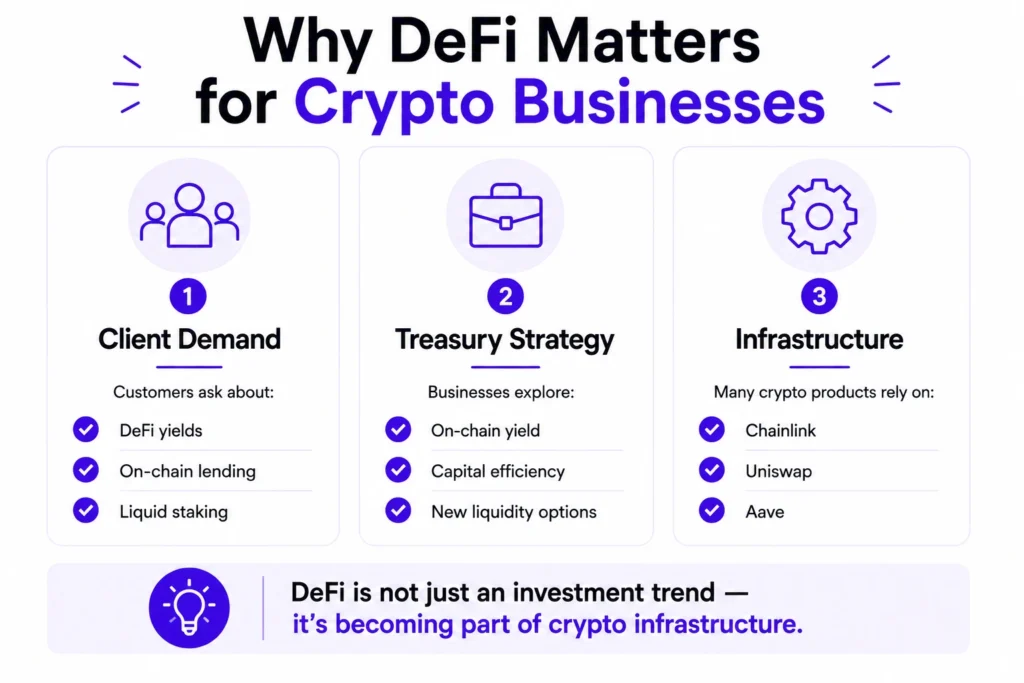
The practical relevance of DeFi for businesses operating in crypto has grown significantly in 2026, and it shows up in several specific ways.
First, client demand. Businesses serving retail and institutional crypto users are increasingly asked about DeFi yields, on-chain lending products, and liquid staking options. Understanding the protocols driving those products is part of providing meaningful service.
Second, treasury strategy. Businesses holding crypto on their balance sheets have access to on-chain yield through protocols like Aave and Lido that was not available through traditional financial channels. That does not mean the risk profile is comparable to a money market fund, but it does mean the option exists and clients are asking about it.
Third, infrastructure dependencies. Businesses integrating crypto payment rails, offering swaps, or building on Ethereum are almost certainly touching protocols like Chainlink and Uniswap under the hood. Understanding those dependencies helps with risk management and client communication.
For businesses that want to offer their clients access to crypto without managing the DeFi complexity directly, Paybis provides the licensed infrastructure to do that. The Paybis Corporate On/Off Ramp handles institutional-scale crypto conversion with compliance included: KYB, AML monitoring, and settlement across 25 fiat currencies and 140+ countries. For businesses running payment or payout operations, Paybis Send handles global crypto payouts under the same licensed framework.
The Paybis on/off-ramp for businesses offers a white-label integration that allows businesses to embed crypto buy, sell, and swap functionality for their end users without building or maintaining the compliance infrastructure themselves. The on/off-ramp guide covers how integration works in practice.
For regulatory context on how MiCA affects the DeFi landscape and what it means for licensed platforms, the Paybis MiCA content hub covers developments as they happen.
Bottom Line
DeFi in 2026 is a whole infrastructure, beyond speculation. Chainlink powers the data layer that makes everything else work. Aave provides the lending depth that institutional capital is beginning to access. Uniswap’s fee switch has finally tied its token to the scale of its usage. Lido makes staked ETH liquid and deployable. Hyperliquid has built on-chain trading infrastructure that competes with centralized venues on transparency. Sky maintains the stablecoin foundation that much of DeFi runs on. Businesses that understand these protocols understand the rails that on-chain finance is being built on in 2026.
FAQ
What is the difference between a DeFi token and a regular cryptocurrency?
Most cryptocurrencies like Bitcoin or Ethereum serve as currency, store of value, or gas for their respective networks. DeFi tokens are governance and utility instruments for specific decentralized protocols. Holding AAVE gives you voting rights over Aave’s parameters and, since the fee switch era, economic exposure to the protocol’s revenue. Holding LINK gives you access to Chainlink’s oracle services. The function is more specific and the value is more directly tied to the protocol’s usage and economic health. That specificity makes them more informative as indicators of how individual DeFi sectors are developing.
How does composability affect business risk in DeFi?
Composability means DeFi protocols interact with each other directly. Aave accepts stETH from Lido as collateral. Uniswap pools are priced using Chainlink feeds. That interconnection creates efficiency and depth. It also means that a failure in one protocol can cascade into others, as the KelpDAO incident demonstrated in April 2026. For businesses evaluating DeFi exposure, the relevant risk extends beyond whether a single protocol is secure to whether the protocols it depends on are equally robust. Understanding the composability graph of any DeFi position is part of proper risk assessment.
Is institutional use of DeFi growing?
Yes. In 2026, institutional participation in DeFi has expanded beyond early adopters. Aave is now used to borrow against tokenized treasuries and off-chain instruments. Chainlink’s oracle infrastructure prices tokenized stocks and T-bills across multiple lending protocols. The tokenized fund market crossed $17 billion in early 2026. These are not speculative positions. They are institutional capital deployment through on-chain infrastructure. The growth is partly enabled by regulatory clarity improvements, particularly in the EU under MiCA, and partly by the protocols themselves building the compliance interfaces that institutions require.
What is the KelpDAO incident and why does it matter?
On April 18, 2026, an attacker exploited how KelpDAO verified cross-chain messages through LayerZero, minting 116,500 unbacked synthetic ETH tokens. Those tokens were deposited into Aave as collateral to borrow approximately $190 million in real ETH. Aave’s own contracts were not compromised. The vulnerability was in KelpDAO’s bridge, and Aave was affected because it accepted KelpDAO’s synthetic tokens as collateral. The incident illustrated DeFi’s principal systemic risk: composability. The protocols that are strongest in isolation can still be affected by failures in the protocols they interact with. The coordinated DeFi United response, which assembled $300 million in pledged coverage, was a significant demonstration of the ecosystem’s institutional maturity.
Disclaimer: Don’t invest unless you’re prepared to lose all the money you invest. This is a high‑risk investment and you should not expect to be protected if something goes wrong. Take 2 mins to learn more at: https://go.payb.is/FCA-Info