
Mass Crypto Payout Automation: The Definitive Guide for Payments Infrastructure Teams in 2026
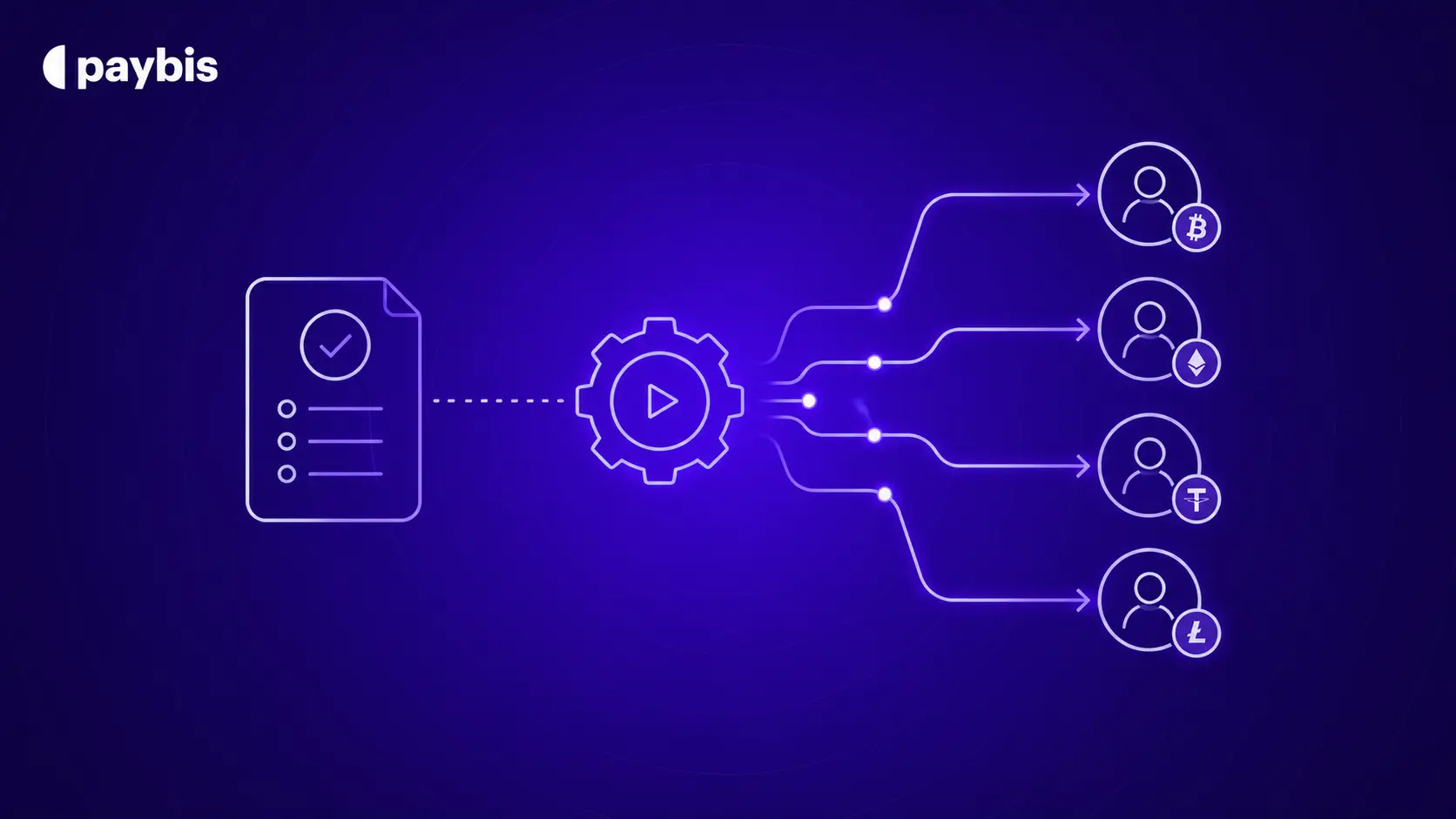
- Manual bottlenecks: Manual wallet management introduces human error and scaling limits that block global payout operations. A single copy-paste error can misdirect funds with no automated recovery path.
- Stablecoin standard: Using stablecoins (USDC, EURC) on low-fee networks reduces settlement times from days to minutes while eliminating asset volatility during transit.
- Compliance offload: Third-party gateways like Paybis Send allow platforms to pre-fund virtual IBANs in fiat and execute mass payouts across 90+ cryptocurrencies via API or portal, inheriting multi-jurisdictional compliance instantly.
If your payments team is still executing crypto payouts wallet-by-wallet, every disbursement cycle carries compounding operational risk: address errors are unrecoverable on-chain, audit trails require manual reconstruction, and throughput ceilings become growth constraints as payout volumes scale. Traditional cross-border bank transfers take 2 to 7 business days and carry FX markups of 2% to 5%. Mass crypto payouts settle in minutes, but only if the infrastructure behind them is built for scale.
This guide provides payments infrastructure teams with a quantitative framework for evaluating mass crypto payout automation: covering time-per-payout benchmarks, error rates, gas optimization, reconciliation overhead, and the operational ROI of API-first orchestration.
Crypto assets can increase or decrease in value. Paybis is a payment gateway, not an investment service. This content is for informational purposes only and does not constitute financial advice.
What Defines Mass Crypto Payout Automation
The shift from manual to automated payouts is not incremental. It changes how treasury risk, compliance liability, and operational headcount are allocated across the entire payments stack.
Why Manual Wallet Oversight Fails at Scale
Manual wallet management carries structural risks that compound as disbursement volume grows. The most visible is an address error: a treasury operator copying a wallet address manually can transpose a single character and send funds to an unrecoverable destination.
Concentrating key access in one or two individuals creates a treasury continuity risk with no automated fallback. Manual wallet transfers also produce no standardized ledger entry, forcing finance teams to reconstruct transaction histories from blockchain explorers after the fact, which delays reconciliation and creates audit exposure.
Beyond error risk, manual workflows impose a throughput ceiling. As disbursement volumes grow into hundreds of monthly payouts across affiliates, contractors, or merchants, this ceiling becomes a growth constraint. Paybis Send (Paybis’s product for business payouts) removes this ceiling by replacing manual execution with pre-funded, API-triggered disbursements.
Automating Crypto Payout Workflows
Three integration paths exist for automating crypto disbursements, each suited to different volume tiers and technical resources.
Table 1: Payout Automation Path Decision Matrix
| Payout Path | Technical Effort | Scalability | Ideal Use Case |
|---|---|---|---|
| API-Led Programmatic | High (full SDK integration launches in hours, with additional time required for webhook handling and sandbox validation) | Unlimited (real-time execution) | High-volume automated platforms, global payroll, affiliate networks |
| CSV Upload Portal | Low (dashboard access only, no backend engineering required) | Batch processing (confirm per-batch limits with the Paybis B2B team before go-live) | Low-frequency batch disbursements for freelancers, agencies, and merchants |
| Manual Bulk Tools | None (zero engineering) | Confirm volume ceiling with the Paybis B2B team before go-live | Early-stage startups, ad-hoc treasury rebalancing |
When to Transition to Automated Flows
Two thresholds signal that manual workflows are no longer viable. First, when monthly payout count grows to the point where manual execution and reconciliation consumes more than two hours of operator time per week (use your own time-tracking data to establish this threshold). Second, when monthly disbursement volume crosses the point where a single misrouted payout represents a material financial loss and the absence of automated audit trails creates real compliance exposure. Platforms that pass either threshold and remain on manual workflows accept operational risk that scales with every additional payout.
Scaling Payouts: In-House vs. Automated Models
The build-vs-buy decision for payout infrastructure is not primarily an engineering question. It is a compliance and time-to-market question.
Building a compliant, multi-jurisdiction payout stack in-house requires registering with FinCEN (Financial Crimes Enforcement Network) and FINTRAC (Financial Transactions and Reports Analysis Centre of Canada). That process is a multi-year undertaking. U.S. multi-state launches including BitLicense (New York’s cryptocurrency business license) and DFAL (California’s Digital Financial Assets Law) licensing alone typically run 12 to 24 months.
It also requires VASP (Virtual Asset Service Provider) authorization in relevant EU jurisdictions and FCA (Financial Conduct Authority) registration for UK operations. Adding FCA, VASP, and CASP authorization across multiple international jurisdictions extends the timeline further.
Registration timelines vary significantly by jurisdiction. FCA registration typically takes six to twelve months. EU CASP (Crypto-Asset Service Provider) or VASP authorization takes four to nine months depending on the national competent authority. FINTRAC processes full registration in three to six weeks. Beyond regulatory approval, platforms must build legal entity structures, integrate KYC and AML screening systems, and develop multi-network custody and gas optimization logic.
Benchmarking Crypto Disbursement Speed
The settlement time gap between traditional rails and automated crypto infrastructure is measurable.
Table 2: Settlement Speed Comparison
| Payment Rail | Average Settlement Time | Operational Window | FX / Transfer Fees |
|---|---|---|---|
| Traditional SWIFT | 2 to 7 business days | SWIFT network operates 24/7. Bank processing during banking hours only (weekends and public holidays add 2+ days to effective transfer time) | 2% to 5% (including FX markup) |
| SEPA / SEPA Instant | Under 10 seconds (SEPA Instant, mandatory for eurozone banks since 9 October 2025); 1 to 2 business days (traditional SEPA, applies outside eurozone mandate) | 24/7/365 (SEPA Instant); Banking hours only (traditional SEPA) | €1.00 to €10.00 flat |
| Crypto Automation | Under 15 minutes | 24/7/365 | Under 1% (network dependent) |
A cross-border payment speed analysis covering 5,621 SWIFT transactions found an average processing time of 27 hours, with transfers involving currency conversion averaging 4.6 days. Sending fees typically run $25 to $50, with correspondent bank charges adding $10 to $30 per intermediary, plus a 1% to 3% FX markup.
Note: Since 9 October 2025, SEPA Instant payments have been mandatory for eurozone banks under Regulation (EU) 2024/886, crediting recipients within 10 seconds at fees no higher than standard SEPA transfers. For EUR-denominated payouts within the eurozone, SEPA Instant is a viable alternative to crypto rails for recipients with bank accounts.
Comparing Gas Efficiency by Protocol
Asset selection determines a material portion of payout cost. Stablecoins (USDC, EURC) are the standard for B2B disbursements because they eliminate the price volatility risk that affects BTC or ETH payouts during transit. A recipient expecting $500 in ETH may receive $487 if the price moves between execution and settlement. USDC delivers exactly what was sent.
Network selection compounds this. Gas fee data shows Solana and Polygon execute transactions for under $0.01. Tron costs $0.10 to $0.30 per transfer but has strong stablecoin liquidity for USDC. Ethereum mainnet costs are substantially higher, though post-Dencun upgrade pricing has fallen significantly, with standard transfers now running under $1 at normal congestion levels. For routine disbursements, Layer 2 networks deliver the same settlement security at a fraction of the mainnet cost.
Off-peak hours, such as early EU morning before US trading opens, can capture gas prices up to 30-40% lower than peak rates. Automated scheduling executes this without manual monitoring. On Ethereum-compatible networks, the ERC-20 permit function (EIP-2612) lets the approval step happen off-chain via a signed message instead of a separate on-chain approve transaction. The transfer itself still executes on-chain, but the gas cost of the standalone approval is eliminated. Native EIP-2612 support varies by token: USDC implements it on most chains.
Automating Payout Reconciliation Workflows
Every on-chain transaction produces a cryptographic transaction hash that serves as an immutable ledger entry. API webhooks can push confirmation events into accounting systems or ERPs (Enterprise Resource Planning systems), reducing the manual reconciliation step that consumes hours weekly on high-volume manual workflows. Webhook events from payout confirmations can be routed to analytics and reporting tools. Integrating webhook data into existing dashboards requires endpoint configuration. Depending on the tool, custom reconciliation logic may also be needed to parse and structure the incoming event data. The audit trail is created automatically at execution, which satisfies AML documentation requirements without additional operational overhead.
Reducing Gas Costs for Payout Disbursements
The cost differential between Ethereum mainnet and alternative networks is structural, not marginal. Current gas fee data shows Polygon executing transfers for under $0.01, while Tron and Base run $0.10 to $0.30. Ethereum mainnet remains materially higher for equivalent transfers, making chain selection a core variable in payout cost modeling.
Programmatic batching groups multiple payout instructions into a single on-chain transaction, distributing the base network fee across all recipients in the batch. For platforms running large monthly settlement batches on Polygon or Base, per-recipient gas costs drop to fractions of a cent. Paybis Send supports payouts across major networks including those used for stablecoin disbursement, allowing chain selection to be programmed into the routing logic rather than managed manually per batch.
Ensuring Compliance in Scalable Crypto Payouts
Compliance infrastructure for scalable crypto payouts rests on three pillars:
- Immutable on-chain audit trails that satisfy regulatory documentation requirements
- Automated global compliance reporting aligned with MiCA and GENIUS Act frameworks
- Real-time AML screening that flags wallet exposure before disbursement executes
Ensuring Immutable Payout Records
Every on-chain transaction writes a cryptographically signed record to the blockchain that cannot be altered after confirmation. Regulators auditing a payout platform can verify the exact amount, timestamp, sender address, and recipient address for every transaction. This verification requires no reliance on the platform’s own record-keeping. Paybis partner dashboards provide real-time monitoring of executed payouts, supporting reconciliation and audit workflows.
Automating Global Compliance Reporting
Two regulatory frameworks now define baseline requirements for platforms executing crypto payouts at scale.
The GENIUS Act, enacted July 2025, establishes a federal framework for payment stablecoins. Digital asset service providers have until July 18, 2028 to restrict activities to GENIUS Act-approved stablecoins. The Act mandates AML programs, customer due diligence, transaction monitoring, and OFAC screening as baseline requirements.
For EU operations, MiCA authorization is required EU-wide as of July 1, 2026, when the transitional period for existing national arrangements closes. A MiCA CASP authorization provides passporting rights across all 27 EU member states from a single authorization. Paybis holds both a MiCA CASP authorization and a PSD2 (Payment Services Directive 2) Payment Institution license, secured in May 2026, enabling regulated stablecoin payouts across the entire EU. Platforms using Paybis Send for EU disbursements inherit this dual-license coverage without building it independently.
Managing AML Risks in Automated Flows
Crypto AML compliance for automated payouts requires wallet screening before each disbursement executes. Screening covers three categories:
- OFAC (Office of Foreign Assets Control) sanctions lists
- PEP (Politically Exposed Person) databases
- Blockchain analytics outputs that flag indirect exposure to sanctioned entities across multiple transaction hops
A wallet may carry exposure from several hops back in the transaction graph that name-based screening alone misses. When using Paybis Send, wallet screening and sanctions list matching transfer to Paybis. Platforms retain the obligation to verify that their payout instructions comply with their own AML policies before submission.
Due Diligence Checklist for Payout Providers
The following framework pressure-tests vendor claims across six operational dimensions: integration speed, asset coverage, pricing transparency, infrastructure resilience, custody security, and SLA benchmarks. Request specific evidence, validate it independently in sandbox, and document gaps before presenting a vendor recommendation internally.
Reducing Payout Implementation Latency
Integration timeline belongs in the first vendor conversation. The no-backend widget option requires minimal backend engineering for authentication, not zero. Full SDK integration deploys in hours. Before accepting any integration speed claim, request time-to-first-transaction logs from the vendor’s last three integrations at similar transaction volumes. Test in sandbox yourself and document the result before communicating a timeline to engineering leadership.
Supported Assets for Mass Payouts
Asset breadth determines whether a payout provider can serve your full recipient base. Paybis Send supports payouts across 90+ cryptocurrencies via API or portal. Confirm coverage for your specific top-10 recipient assets with the Paybis B2B team before treating breadth as a selling point.
Calculating True Payout Margin Impact
Advertised fee percentages are an unreliable comparator. Providers bundle costs differently: some charge explicit service fees, others embed margin in the spread, and many combine both. Before accepting any vendor’s pricing claims, calculate net received yourself at $100, $1,000, and $5,000 transaction sizes across your top three payment methods. Request the actual spread and network fee data, not just the headline service fee.
Table 3: Net Received Cost Transparency Matrix (Paybis B2B Base Rate)
| Payout Size | Paybis Service Fee | Est. Network Fee (Tron/Base) | Net Received by Recipient |
|---|---|---|---|
| $100 | $0.49 (0.49% base) | ~$0.10–$0.30 | ~$99.21–$99.41 |
| $1,000 | $4.90 (0.49% base) | ~$0.10–$0.30 | ~$994.80–$995.00 |
| $5,000 | $24.50 (0.49% base) | ~$0.10–$0.30 | ~$4,975.20–$4,975.40 |
Note: Network fees above reflect Tron and Base as example low-cost networks supported by Paybis Send. Traditional SWIFT transfers carry $25 to $50 flat sending fees paid by the sender (not deducted from the recipient amount) plus a 1% to 3% FX markup applied to the transfer amount. Applying FX markup only, net received is approximately $97 to $99 at $100, $970 to $990 at $1,000, and $4,850 to $4,950 at $5,000. Paybis shows net received at the quote stage, before the user confirms a transaction.
Auditing Single Points of Failure
Payment stack resilience requires redundancy at the payout layer. Before committing to a single provider, audit these dependencies: Does the vendor support multi-acquirer fallback for failed transactions? What is the documented escalation path if API endpoints experience degraded performance? Can the platform route payouts across multiple providers programmatically? Paybis Send’s Smart Cascade Routing provides multi-acquirer retry logic and delivers an 11%+ increase in successful transactions for partners. Platforms processing mission-critical disbursements should document a manual fallback procedure for total vendor outages in their runbook. A quarterly audit of single points of failure in the payout stack is standard practice for any platform managing significant disbursement volume.
Evaluating Crypto Cold Storage Risk
MPC (Multi-Party Computation) custody divides the private key into multiple shares distributed across different parties. No single party holds a complete key at any point. This architecture delivers cold storage security with hot wallet accessibility, because no single point of compromise can drain the custody balance. Paybis Crypto Custody uses MPC-based custody for company-owned and customer-issued wallets. Confirm the exact supported assets and networks with the Paybis B2B team before treating specific coverage as a selling point.
SLA Benchmarks for Payout Operations
Vendor reliability claims require verification against specific certifications and documented incident history. Relevant benchmarks for a payout infrastructure provider include PCI DSS Level 1 compliance and a 90%+ transaction success rate. ISO 27001:2022 certification indicates formalized information security management. When auditing vendor claims, request the last three incident post-mortems alongside the uptime figure. A credible post-mortem includes root cause analysis, affected transaction volume, mean time to recovery, and the process change implemented to prevent recurrence. An uptime number without incident history confirms only that the number was calculated.
Implementation Roadmap for Payout Automation
Deploying automated payout infrastructure follows a four-phase sequence:
- Sandbox validation to test payout logic and batch execution behavior
- Production deployment with multi-sig treasury controls
- Baseline metric documentation before go-live
- ROI benchmarking at 30, 60, and 90 days post-integration
Phases 1 and 2: Sandbox Validation
Sandbox testing uses testnet assets to validate payout logic before real funds move. Key metrics to verify: address validation rules per network, batch execution behavior at 2x to 5x expected peak volume, rejection handling for invalid addresses, and webhook delivery timing for confirmation events. For platforms with predictable payout spikes, such as end-of-month affiliate settlements, simulate the spike scenario and verify that execution completes within the required settlement window. Document throughput results as part of the integration sign-off, not as an afterthought. Time spent in sandbox directly determines how confidently a payments lead can present a go-live timeline to the CFO.
Phases 3 and 4: Production Deployment and ROI Benchmarking
The sandbox-to-production transition requires two additional controls. First, multi-sig treasury authorization for the pre-funded vIBAN balance, requiring multiple signatories to approve top-ups above a defined threshold. Second, a network-level routing rule directing stablecoin payouts to the lowest-cost supported network by default.
Before go-live, document baseline metrics: monthly manual reconciliation hours, payout error rate, average time-to-settlement per rail, and gas cost per payout by network. Measure the same metrics at 30, 60, and 90 days post-integration. Track these in a single dashboard with month-over-month deltas visible to finance and product leadership.
Example ROI calculation for 200 monthly payouts at $1,000 average payout size:
- Manual execution cost: 200 payouts × 15 min × $50/hr operator (illustrative rate: substitute your actual fully-loaded operator cost) = $2,500/month
- Automation cost: 200 × $1,000 × 0.49% service fee = $980/month + integration amortized over 24 months
- Net monthly savings: material from month 1, ROI positive within 3 to 4 months
The delta between pre- and post-automation on each metric is the operational ROI figure that belongs in the board update.
Evaluating Mass Crypto Payout Automation Vendors
This section addresses three evaluation dimensions for selecting a mass payout provider. The first is volume thresholds that signal when automation delivers measurable ROI. The second is the build-vs-buy decision for platforms weighing in-house development against third-party APIs. The third covers jurisdictional AML obligations and whether a vendor’s licensing coverage matches your distribution footprint.
Scaling Thresholds for Automated Payouts
In-house builds offer customization advantages when payout logic is deeply differentiated, such as complex split calculations or multi-asset settlement waterfalls. For standard mass disbursements, the compliance overhead and time-to-market cost of building in-house erases the customization advantage. The multi-year regulatory build queue blocks market expansion for jurisdictions that a third-party provider covers from day one.
Paybis Send targets platforms processing significant monthly disbursement volumes or high monthly payout counts. Below those thresholds, the CSV upload portal covers most use cases without API integration. Above them, the API-led programmatic path delivers the automation, audit trail, and exception handling infrastructure that manual tools cannot.
Integrating Automated Payouts: Lead Time
Paybis Send compresses integration lead time through pre-built API documentation and a no-backend widget option. Partners pre-fund a virtual IBAN in USD, EUR, or GBP via bank transfer, then execute mass crypto payouts via API or portal dashboard. No crypto needs to be held on the balance sheet. The fiat-to-crypto conversion happens at execution, eliminating treasury volatility exposure entirely.
Managing Jurisdictional AML Obligations
Table 4: Jurisdictional Coverage Matrix
| Region | Regulator | License Type | Registration Number |
|---|---|---|---|
| United States | FinCEN | Money Services Business (MSB) | 31000272911973 |
| Canada | FINTRAC | Money Services Business (MSB) | C100000646 |
| Poland (EU) | Revenue Chamber | VASP | RDWW-805 |
| European Union | Bank of Latvia | MiCA CASP & PSD2 Payment Institution | Secured May 2026 (covers all 27 EU states) |
Paybis operates in 180+ countries but excludes New York and Louisiana in the US due to local licensing restrictions. Platforms with concentrated user bases in those states should factor this into their evaluation before integration.
Quantifying Crypto Payout ROI
Before presenting any vendor recommendation to your CEO or CFO, validate integration speed and net received calculations in sandbox. Access the Paybis Send sandbox, execute a test payout across your target networks, and document time-to-first-transaction. For a custom net received cost model at your specific transaction volumes and jurisdiction mix, contact the Paybis payments infrastructure team with your monthly disbursement data.
Paybis Send’s B2B base rate starts at 0.49% per transaction. Contact the Paybis B2B team to receive a custom cost model based on your monthly disbursement volume, asset mix, and jurisdiction footprint.
Key Terminology
- Mass Payouts: The simultaneous distribution of funds to multiple global recipients using automated payment rails. Learn more about mass payouts.
- Automated Payouts: Programmatic disbursements triggered by API calls without manual human intervention or wallet oversight.
- Stablecoin Payout: Disbursements executed using fiat-pegged cryptocurrencies (such as USDC) to eliminate price volatility during transit. Learn more about stablecoins.
- Batch Payment Processing: Grouping multiple transaction requests into a single execution block to reduce network fees, distributing the base gas cost across all recipients in the batch.
- Automated Off-Ramps: Systems that automatically convert digital assets into local fiat currencies for direct bank deposit, eliminating manual conversion steps.
- Crypto Banking: Financial services bridging traditional fiat accounts with digital asset custody and transaction rails, allowing corporate accounts to hold, send, and receive both fiat and crypto balances.
FAQ
What Is the Minimum Transaction Volume Required for Paybis Send?
Paybis Send is optimized for platforms processing significant monthly disbursement volumes where manual workflows create material reconciliation overhead. Custom tier-based pricing is quoted based on monthly volume, asset mix, and geographic distribution.
Which Jurisdictions Are Excluded From Paybis Payout Operations?
Paybis operates in 180+ countries but excludes the US states of New York and Louisiana due to local licensing restrictions. Platforms with concentrated user bases in those states should factor this into their evaluation before integration.
What Are the API Latency Benchmarks for Automated Payouts?
On-chain settlement time depends on the selected blockchain network, ranging from under 5 seconds on Tron to under 15 minutes on Ethereum mainnet for standard priority transactions.
Disclaimer: Don’t invest unless you’re prepared to lose all the money you invest. This is a high‑risk investment and you should not expect to be protected if something goes wrong. Take 2 mins to learn more at: https://go.payb.is/FCA-Info