Bulk Crypto Payment Processing: Handling Cryptocurrencies and Multi-Chain Routing (2026)
Key Takeaways:Bulk crypto payouts require dynamic multi-chain routing to optimize gas costs and settlement speed simultaneously. With Paybis Send, businesses pre-fund a virtual IBAN in USD, EUR, or GBP and execute mass crypto payouts across BTC, ETH, SOL, LTC, TON, DOGE, USDT, and USDC via API in near-real time. We handle network selection, gas estimation, fallback routing, and AML compliance automatically across 180+ countries. You never hold crypto on your balance sheet, as fiat-to-crypto conversion is handled automatically during the payout process.
Most payment platforms obsess over checkout conversion while leaving capital locked in slow, expensive cross-chain payouts. Gas fee spikes, mismatched address formats, and reconciliation backlogs across dozens of jurisdictions create compounding operational drag. This guide breaks down how intelligent multi-chain routing optimizes gas fees, eliminates settlement lag, and ensures reliable delivery at scale without requiring you to hold crypto on your balance sheet.
What You Actually Pay: Net Received Across Networks
When you route a $1,000 USDT payout, the network you choose determines how much your payee receives. Here’s how the numbers compare across Ethereum, Polygon, Tron, and Solana at current gas prices:
| Payout Amount | Network | Avg. Gas Fee | Net Received | Gas as % |
|---|---|---|---|---|
| $1,000 USDT | Ethereum (ERC-20) | ~$0.014 | ~$999.99 | ~0.0014% |
| $1,000 USDT | Polygon | ~$0.007 | ~$999.99 | ~0.001% |
| $1,000 USDT | Tron (TRC-20) | ~$1.00 | ~$999.00 | ~0.10% |
| $1,000 SOL | Solana | ~$0.00025 | ~$999.99975 | ~0.000025% |
Our routing engine automatically selects the lowest-cost network for each payout based on real-time gas prices. For USDT transfers, this typically means routing through Polygon instead of Ethereum when gas fees are elevated, reducing network costs materially per transaction. At scale, these optimizations compound into meaningful margin improvements with no operator intervention.
Why Supporting Multiple Cryptocurrencies Creates Operational Complexity
When you support broad asset coverage, you drive user adoption and global reach. Your payroll platform serving contractors in Southeast Asia needs USDT on Tron. Your affiliate network paying publishers in Europe needs USDC on Polygon. Your gaming platform rewarding global players needs BTC and SOL. The moment you limit payouts to two or three assets, you lose users who transact on different chains.
But the operational cost of supporting each additional network compounds quickly.
Network Fragmentation Across Chains
Each blockchain runs on different consensus rules, uses different address formats, and requires separate node infrastructure. If you send crypto to the wrong network, recovery is rarely fast. Managing multiple networks independently creates substantial operational overhead, with each network introducing its own failure modes and maintenance requirements. Building that natively requires dedicated engineering capacity that most product teams can’t justify pulling from their core roadmap.
Settlement Lag Variability by Blockchain
Confirmation times vary by orders of magnitude depending on which network you choose. Bitcoin requires 3 to 6 confirmations before most platforms consider a transaction final, taking 30 to 60 minutes under normal conditions and longer during congestion. Ethereum’s proof-of-stake significantly improved finality times, with exchange-grade settlement typically taking 3 to 7 minutes. Solana delivers confirmations in 30 seconds to 2 minutes. When your payout batch spans all three networks, reconciliation timelines become unpredictable without automated status tracking.
Managing Volatile Crypto Gas Fees
Gas fees (the cost to process a transaction on the network) fluctuate dramatically and without warning. Ethereum gas averaged ~$0.014 in early 2026. Bitcoin fees have dropped significantly following a sustained period of low on-chain activity. Solana maintains average fees near $0.00025 for standard transactions. Polygon typically ranges between $0.005 and $0.01 for basic transfers. If you route blindly without real-time fee estimation, you can face sharp cost increases on individual transactions during network congestion.
How Paybis Processes Multi-Chain Payouts
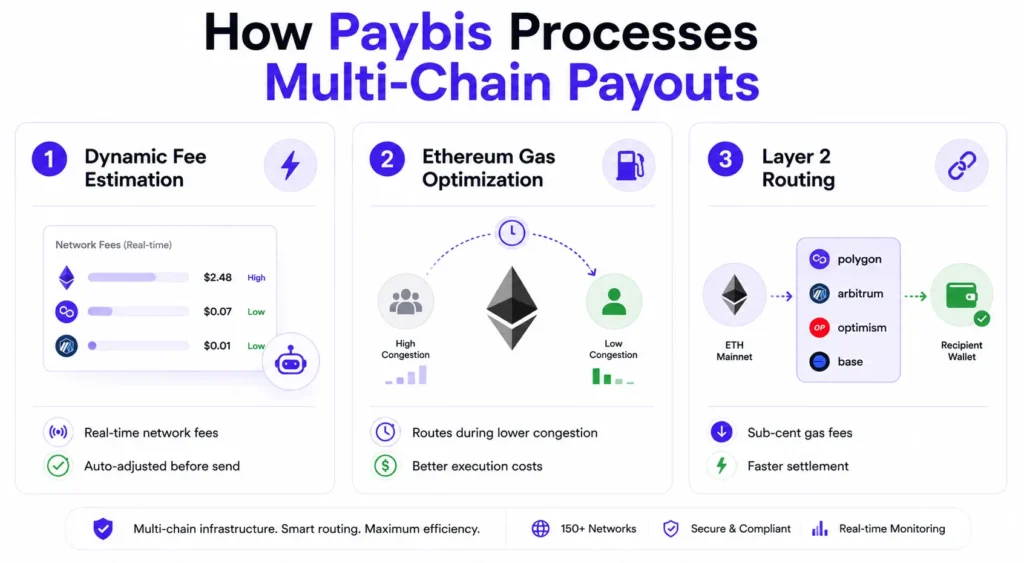
Paybis Send is designed so you never need to specify which network to use. Our routing engine determines the optimal path automatically. You call the API with the payout amount and destination wallet. We handle the rest.
Optimizing Chain Selection for Payouts
Our routing logic starts with your payee’s target asset. For a USDT request, we check which networks support USDT natively (Ethereum ERC-20, Tron TRC-20, Polygon), then query real-time gas fees across each network. The available routes are ranked by net received — the actual crypto amount your payee receives after fees, not by headline fee percentage. The route delivering the highest net received at your required speed wins. Address format validation prevents misdirected payouts before execution.
Dynamic Fee Routing for Best Net Received
Static fee tables can become outdated during network congestion events. Paybis checks current gas prices dynamically during the payout process, allowing your batch to route to a lower-cost alternative network when gas spikes occur, rather than locking in elevated fees.
Fallback Routing When Networks Congest
Fallback routing provides an alternative path when the primary route can’t complete the transaction. If the primary route fails, Paybis sends the request to an alternative route without operator intervention, reducing a common drop-off point in bulk payout flows.
Optimizing Cross-Chain Batching Costs
Batching groups multiple payouts to reduce per-recipient costs on networks that support it. On Ethereum, batching can consolidate multiple transfers into a single transaction. Bitcoin supports batching through “send to many” functionality, packaging multiple send requests into a single transaction with multiple output addresses. On Solana, batching can improve throughput and reduce API calls at scale.
How Paybis Protects Your Payout Margins Automatically
Fee management isn’t passive. If you treat gas fees as fixed costs, your margins erode every time a network spikes.
Dynamic Fee Estimation by Network
Real-time gas estimates are pulled via each network’s fee API immediately before initiating your payout. For Ethereum, our routing engine queries current network fee data via the Etherscan gas tracker to inform routing decisions for ERC-20 assets — whether that means using Ethereum mainnet during low-fee periods or leveraging Polygon when gas costs spike.
Ethereum Gas Optimization: Off-Peak Sends
Gas fees can vary throughout the day based on network activity. For non-urgent bulk payouts, monitoring gas prices and timing execution strategically may help reduce average costs over time. Our platform gives you full flexibility to control when transactions execute.
Layer 2 Routing for Sub-Cent Gas Fees
Layer 2 networks use rollup technology to reduce Ethereum-equivalent gas costs significantly while maintaining Ethereum-compatible security. Polygon achieves similar cost reductions. For platforms whose payees hold USDC or USDT without a chain preference, routing through Polygon by default delivers materially more crypto per payout at the same fiat value.
Which Blockchains Offer the Fastest Payouts?
The following table summarizes current speed and cost benchmarks for bulk B2B disbursements across major networks.
| Blockchain | Avg. Confirmation Time | Avg. Network Fee | Best For |
|---|---|---|---|
| Bitcoin | 30–60 min | Variable (~under $1 in 2026) | High-value, low-urgency treasury payouts |
| Ethereum | 2–6 min | ~$0.014 | Institutional USDC/USDT, ERC-20 tokens |
| Solana | 30 sec – 2 min | ~$0.00025 | High-volume, low-value micropayments |
| Polygon | 2–4 min | ~$0.007 | Cost-efficient USDC/USDT at scale |
Bitcoin: 30-60 Minute Confirmation Latency
Bitcoin’s confirmation latency generally makes it less suited for real-time payouts but appropriate for high-value transfers where settlement finality matters more than speed. Most institutional custodians require 6 confirmations, totaling approximately 60 minutes given typical block production times. Bitcoin fees have reached multi-year lows in 2026, with average fees under $1. For OTC settlements, treasury rebalancing, or large contractor payments, the latency is acceptable.
Ethereum: 12-Second Block Confirmations
Ethereum’s proof-of-stake architecture produces a new block every 12 seconds. Settlement times vary by exchange but typically resolve within several minutes. Ethereum is commonly used for USDC and USDT transfers, and many counterparties hold ERC-20 addresses. The cost premium is the trade-off for liquidity depth.
Solana: Sub-Second Settlement Speed
Solana’s architecture supports thousands of transactions per second with confirmation times that routinely land under 30 seconds and fees averaging ~$0.00025. Low, stable fees make it the optimal chain for affiliate commissions, payroll disbursements, and gaming rewards where throughput and cost are the primary variables.
Polygon and L2s for Bulk Crypto Payouts
Polygon’s 128-confirmation requirement resolves in 2 to 4 minutes at current block speeds. For Ethereum-compatible assets, Polygon offers a fraction of Ethereum’s gas cost, though it operates with slightly lower security guarantees than Ethereum mainnet. For bulk USDC disbursements where Ethereum address compatibility is required but Ethereum mainnet fees are prohibitive, Polygon is the default routing choice in our engine.
Building Resilient Cross-Chain Payment Rails
Failed payouts create significant operational costs through manual intervention, customer support escalation, and ledger correction. Paybis Send’s routing engine handles these failures automatically through intelligent re-routing.
Automated Payout Retry Logic
Our routing system handles retry without operator intervention. If the primary route fails to authorize, we re-route the request automatically to an alternative network. This prevents the most common drop-off point in bulk payout flows.
Resolving Frozen Crypto Payments
A transaction stuck in the mempool (the waiting queue for unconfirmed transactions, defined in Key Terminology below) may indicate it is pending rather than failed. One potential cause is a fee set below the current network minimum, which can drop the transaction’s priority below the block inclusion threshold. In some cases, these situations may be addressed by replacing the transaction with a higher fee via the RBF (Replace-By-Fee) mechanism.
Ensuring Correct Multi-Chain Addresses
Address format validation before execution is the highest-leverage error prevention step in a bulk payout flow. Different tokens use different address formats, and using the wrong format can result in unrecoverable errors. Our address validation layer is designed to catch format errors before they become irreversible.
Multi-Chain Payout Reconciliation
You need a unified transaction ledger that maps each on-chain transaction hash to an internal payout record, regardless of which network executed it. The Paybis Send partner dashboard gives you real-time monitoring of payouts and balances across all executed transactions in a single view. To see how Paybis withdraws and sends currency, check out this video.
Network Selection Decision Tree for Bulk Payouts
Choose the right network for each payout by considering asset type, transaction value, urgency, and recipient wallet compatibility. Paybis’ API can automate this routing for you.
- High-value, ERC-20 required (above $10,000): Route through Ethereum mainnet. For very high-value transactions, gas fees become negligible as a percentage of transaction value, making the Layer 2 cost argument less relevant.
- Ethereum-compatible, cost-sensitive: Route through Polygon. Fee of ~$0.007 versus Ethereum’s ~$0.014 per transaction. For high-volume operations with thousands of monthly payouts, the savings compound significantly.
- High-volume, low-value, SOL wallets: Route through Solana. Low fees and 30-second confirmations make it a highly cost-efficient bulk routing option for platforms whose users hold SOL-compatible wallets.
- High-value, BTC required, low urgency: Route through Bitcoin mainnet. Deep liquidity, universal exchange acceptance, and sub-$1 fees as of 2026 make it the settlement rail of choice when finality matters more than speed.
Solving Common Bulk Crypto Payout Issues
Operational issues in bulk payouts fall into three categories: wrong network, elevated costs during gas spikes, and reconciliation lag. Each has a systematic fix.
Diagnosing Missing Payouts: Check the Right Block Explorer
When a payee reports funds haven’t arrived, the first diagnostic step is confirming the transaction hash against the correct block explorer for the intended network. Network mismatches can prevent recipients from accessing funds in their expected wallet. Paybis’ 24/7 support team (average response time 1-2 minutes) handles edge cases requiring manual resolution.
Optimizing Batch Costs During Gas Spikes
When Ethereum gas spikes, the options are: wait for conditions to normalize, route eligible assets through Polygon or a Layer 2, or execute at a slow-tier gas price and accept extended confirmation times. Our Paybis Send quote mechanism locks the crypto-to-fiat rate at quote time, and your pre-funded ledger is debited when the payout request is processed, protecting the payout amount from exchange rate volatility between quote and execution.
Can You Switch Chains After a Payout Is Initiated?
No. Once a transaction is broadcast to a blockchain network, the destination address and network are fixed. Some blockchain protocols support Replace-By-Fee mechanisms that allow increasing the fee to speed confirmation, but the network and destination remain unchanged.
How Long Does Reconciliation Take Across Multiple Assets?
Automated reconciliation reduces the operational burden of tracking confirmed transactions across multiple networks. Our platform provides reconciliation tools through the partner dashboard, with transaction-level records accessible per payout hash, though the specific workflow depends on your integration setup and reporting needs.
Next Steps
Paybis Send is available to PSPs, payroll providers, affiliate networks, and e-commerce platforms operating in 180+ countries. Pre-fund a virtual IBAN in USD, EUR, or GBP and execute bulk payouts in BTC, ETH, SOL, LTC, TON, DOGE, USDT (ERC20, TRC20, Polygon), and USDC (ERC20, Polygon, Base) via API in near-real time, with no crypto custody required.
Evaluate it two ways:
- Test the API in sandbox. Measure actual response times, routing logic, and fee estimation against your current payout volumes. Typical path from API key to successful test payout: hours, not days.
- Book a technical demo. We’ll walk through your specific payout volume (transactions per month, average value, target cryptocurrencies, geographic distribution) and show you net received comparisons versus your current setup. Request access via the Paybis Send product page.
Key Terminology
- Multi-chain routing: The automated process of selecting the optimal blockchain network for a crypto payout based on real-time gas fees, network congestion, and required settlement speed. The routing engine evaluates all valid networks for a given asset and selects the path that maximizes net received for the payee.
- vIBAN (Virtual IBAN): A virtual bank account number issued in your company’s name that accepts standard bank transfers via SWIFT, SEPA, or FPS. In Paybis Send, the vIBAN holds a pre-funded fiat balance converted to crypto at payout execution. You never hold crypto on your balance sheet, eliminating custody risk and volatility exposure. Supported deposit currencies are USD, EUR, and GBP.
- Gas fee: The cost charged by a blockchain network to process a transaction. Gas fees vary based on network conditions and the specific blockchain being used. Ethereum gas is the most volatile, while Solana fees remain consistently near $0.00025 per transaction.
- Mempool: The waiting queue for unconfirmed blockchain transactions. Transactions with insufficient fees may experience delays or fail to confirm. The RBF (Replace-By-Fee) mechanism can help resolve stuck transactions by rebroadcasting with a higher fee.
- Net received: The exact crypto amount delivered to a recipient after all fees, conversion costs, and FX spreads are deducted from the fiat input. This is the only reliable metric for comparing total payout cost across providers, as many vendors obscure network costs or FX markups until after settlement.
FAQ
What Cryptocurrencies Does Paybis Send Support for Bulk Payouts?
Paybis Send currently supports BTC, ETH, SOL, LTC, TON, DOGE, USDT (ERC20, TRC20, Polygon), and USDC (ERC20, Polygon, Base); 12 asset/network combinations in total.
How Long Does It Take to Get a vIBAN After Signing Up for Paybis Send?
You receive a dedicated virtual IBAN in your company’s name upon completing onboarding and KYB verification. The vIBAN accepts fiat deposits in USD, EUR, and GBP.
How Does Paybis Handle Failed Payout Transactions?
Our routing system automatically re-routes the request to an alternative path if the primary network fails to authorize. For transactions stuck in the mempool due to insufficient fees, the system applies retry logic without manual escalation, and our 24/7 support team handles edge cases with an average response time of 1-2 minutes.
What Fiat Currencies Can Be Used to Pre-Fund Paybis Send?
Your virtual IBAN accepts deposits in USD, EUR, and GBP via standard bank transfer. The fiat-to-crypto conversion happens at payout execution using a locked rate.
Disclaimer: Don’t invest unless you’re prepared to lose all the money you invest. This is a high‑risk investment and you should not expect to be protected if something goes wrong. Take 2 mins to learn more at: https://go.payb.is/FCA-Info