The Complete Guide to Mass Crypto Payouts Without Holding Cryptocurrency
Key Takeaways:Paybis Send is built so platforms can execute bulk cryptocurrency disbursements without ever holding digital assets on their balance sheet. You pre-fund a dedicated virtual IBAN (vIBAN) in USD, EUR, or GBP, trigger the payout via its REST API, and Paybis handles the fiat-to-crypto conversion, routing, and multi-jurisdiction compliance. Building that infrastructure independently requires navigating complex regulatory requirements across multiple jurisdictions and significant engineering resources. Integrating Paybis Send can be completed quickly, its hosted widget can launch within hours, and full API integration typically follows a streamlined implementation process. Finally, Paybis Send shows net received upfront before any transaction confirms.
Most platforms abandon mass crypto payouts for one of two reasons: holding volatile digital assets on the balance sheet creates treasury risk that finance teams refuse to accept, or the regulatory overhead of operating as a VASP across multiple jurisdictions consumes engineering and legal capacity needed elsewhere. Paybis Send eliminates both obstacles by running a fiat-in, crypto-out model. You pre-fund in stable currency. Paybis handles conversion, compliance, and on-chain settlement.
This guide covers the full architecture, compliance offload specifics, integration pathways, and pricing structure for PSPs, payroll providers, affiliate networks, and e-commerce platforms evaluating Paybis Send as their bulk crypto disbursement layer.
Paybis Send: How Payouts Are Processed
Paybis Send is an API-based bulk cryptocurrency disbursement product for businesses. You pay end recipients in crypto without acquiring, holding, or managing digital assets directly. You maintain a fiat balance, Paybis executes crypto delivery, and that separation is the core architectural advantage.
Fiat Account Setup for Paybis Send
Every integration begins with a dedicated virtual IBAN. This vIBAN accepts incoming fiat deposits in USD, EUR, and GBP and supports SEPA Instant, UK Faster Payments (FPS), and SWIFT as funding rails. SWIFT follows standard interbank settlement timelines, typically one to five business days depending on correspondent bank routing.
Once live, the vIBAN operates as your pre-funded operating balance for all outbound crypto payouts. When the balance runs low, you top up by transferring fiat to the designated account and the balance updates after settlement, typically within minutes but may require up to three business days depending on the payment rail.
The Paybis Send Payout Process
The payout flow runs in four steps:
- Get a quote: Call the Quote API to receive a real-time conversion rate for the selected fiat-to-crypto pair, inclusive of all fees and the estimated network fee.
- Initiate the payout: Call the Execute API with the recipient wallet address, the crypto asset, and the fiat-denominated amount. We calculate the exact crypto amount to deliver based on the live rate.
- Conversion and routing: Paybis converts your fiat balance to the requested cryptocurrency using our liquidity layer, with conversions executed at the prevailing market rate.
- On-chain settlement: The crypto payout reaches the recipient wallet. Paybis then pushes real-time transaction status updates via webhooks throughout the process, and the Partner Portal Transactions tab reflects the payout state at each stage.
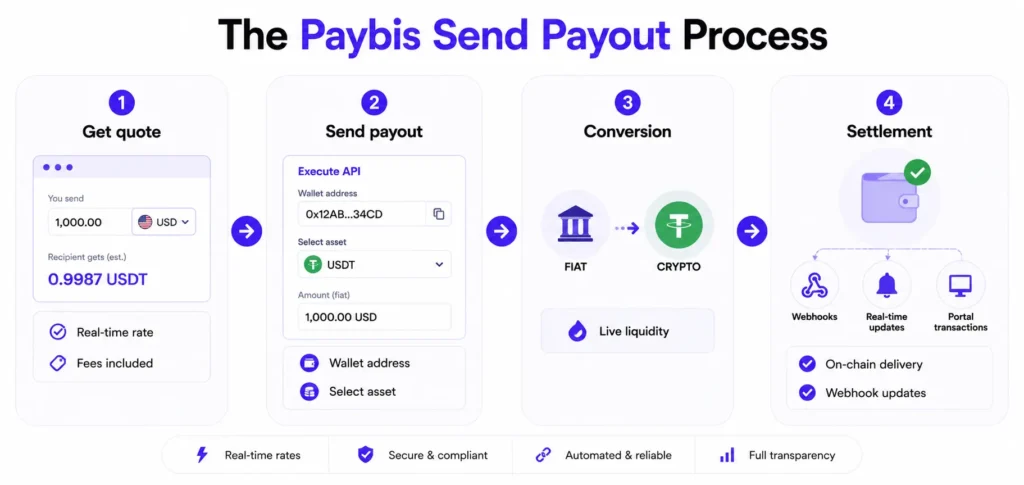
Payouts process in near-real time from API call to on-chain broadcast, with final confirmation times varying by blockchain network.
For a practical walkthrough of how send and withdraw operations work on the platform, see the send and withdraw video guide.
Supported Crypto Assets for Payouts
Paybis Send supports the following cryptocurrency assets for payout:
| Currency | Asset ID | Network |
|---|---|---|
| Bitcoin | BTC | Bitcoin |
| Litecoin | LTC | Litecoin |
| Solana | SOL | Solana |
| Ethereum | ETH | Ethereum |
| Toncoin | TON | TON |
| Dogecoin | DOGE | Dogecoin |
| Tether | USDT | ERC20 |
| Tether | USDT-TRC20 | TRC20 |
| Tether | USDT-Polygon | Polygon |
| USD Coin | USDC | ERC20 |
| USD Coin | USDC-Polygon | Polygon |
| USD Coin | USDC-Base | Base |
This asset selection covers the highest-volume payout use cases: BTC, ETH, SOL, LTC, TON, and DOGE for recipients who want native asset exposure, and USDT/USDC across multiple networks for stablecoin disbursements where settlement cost and speed vary by chain. USDT-TRC20, USDT-Polygon, and USDC-Polygon provide low-cost, near-instant stablecoin options. USDC-Base adds an additional Ethereum Layer 2 option for cost-efficient stablecoin transfers.
Paybis Send: Streamlining Crypto Payouts
Eliminating Crypto Treasury Risk
Holding crypto on a corporate balance sheet creates continuous FX exposure. Paybis Send removes this entirely: all accounting is fiat-denominated. You hold the USD, EUR, or GBP balance and Paybis executes the crypto transfer at execution time, so your finance team reports fiat outflows against stable balances rather than volatile digital asset positions that require daily revaluation.
Removing Multi-Jurisdiction VASP Licensing Burden
Paybis holds the following active registrations, which your integration inherits immediately:
| Jurisdiction | License Type | Registration Reference |
|---|---|---|
| United States | FinCEN MSB | Registered |
| Canada | FINTRAC MSB | Registered |
| Poland / EU | VASP | RDWW-805 |
| United Kingdom | FCA | Registered |
You can verify these registrations directly in the FinCEN MSB registry and the FINTRAC registration database. Partners do not file separately in these jurisdictions to operate through Paybis Send infrastructure. The compliance burden that would otherwise block market entry for 12 months or more is absorbed at the point of integration.
Reducing KYC/AML Operational Costs
Paybis handles KYC, AML monitoring, and fraud prevention for transactions processed through the platform. This offloads the operational cost of maintaining a compliance team for ongoing transaction screening, STR filing, and AML reporting.
For end recipients, Paybis also runs sanctions screening, watchlist checks, and transaction pattern analysis. A tiered verification approach is applied based on transaction amounts and risk profiles, which reduces KYC drop-off on smaller disbursements while maintaining regulatory compliance for higher-value payouts.
Fiat-Denominated Reporting for Reconciliation
The Paybis Send Partner Portal provides real-time monitoring of payout status, fiat balance, and transaction history. All records are maintained in fiat-denominated terms, which simplifies reconciliation for finance teams that need to report outbound payments without translating crypto values back to functional currency.
Optimal Use Cases for Paybis Send Mass Payout API
PSPs: Crypto Payouts via Paybis Send
PSPs with merchants who need crypto settlement can add crypto payout capability without changing existing fiat settlement flows. You continue to collect fiat, pre-fund a vIBAN balance, and trigger crypto payouts to merchants via API. This is particularly relevant for high-risk merchants in iGaming, forex, or adult verticals who face banking friction on fiat settlement rails and need fast availability of funds.
Your accounting, compliance reporting, and treasury management all stay fiat-denominated, and your merchants get near-instant crypto settlement without you ever touching digital assets directly.
Solving Payroll Crypto Payout Challenges
For companies paying remote contractors, the challenge is rarely the desire to offer crypto payroll. It is the operational overhead of acquiring, custodying, and disbursing multiple cryptocurrencies to recipients across dozens of countries. Paybis Send reduces this to a single fiat deposit into a vIBAN, followed by API calls specifying recipient wallet, asset, and USD-equivalent amount.
The payroll provider funds in USD, EUR, or GBP, and contractors receive BTC, USDT, USDC, or any other supported asset on their preferred network, near-instantly. For a broader look at how crypto payouts work for business payroll, see our how Paybis works walkthrough.
Enabling Crypto Payouts for Affiliate Networks
Affiliate networks that restrict payouts to fiat wire transfers are already missing a segment of publishers who prefer or require crypto. International wire transfers carry fixed bank charges and FX margin that consume a material portion of smaller commission payments, and processing delays of several business days create cash flow friction for publishers dependent on fast settlement.
Crypto payouts via Paybis Send eliminate the correspondent banking chain. A commission earned in USD converts to USDT and settles to the publisher’s wallet in minutes. For affiliate networks running high-frequency, lower-average-value disbursements, this is the highest-ROI use case in the product.
E-Commerce: Secure Crypto Payouts
Marketplace platforms with vendor networks in underbanked regions routinely encounter vendors who cannot receive fiat wires due to unstable banking relationships. We let marketplaces disburse in USDT, USDC, or other supported assets to any wallet address in 180+ countries, serving vendors who struggle with fiat payments or banking setup. The same mechanism supports crypto refunds for marketplaces that have accepted crypto payments and need to return funds in-kind.
Managing Multi-Jurisdiction Crypto Payout Compliance
VASP and MSB Licensing by Country
Operating a crypto payout service in the US, Canada, UK, and EU without appropriate registrations exposes a platform to enforcement action, banking partner account freezes, and forced offboarding. Our active registration portfolio, verifiable directly in the FinCEN MSB registry and the FINTRAC registration database, covers the primary institutional markets. Partners operating through Paybis Send inherit this coverage across 180+ countries without independent filings for covered jurisdictions.
Before finalizing your integration strategy, compare licensing coverage and compliance overhead between managed on-ramp providers and custom builds.
No-Code KYC/AML Compliance
Our compliance engine handles AML monitoring, transaction screening, and reporting obligations for all transactions processed through the platform. This includes sanctions screening, transaction pattern monitoring, and threshold-based review triggers. The Crypto Address Screening API lets you validate recipient wallet addresses for compliance before initiating any payout, preventing payouts to flagged or invalid addresses before they reach the blockchain.
Mitigating Payout Fraud and Sanction Risk
We maintain PCI DSS Level 1 certification and have operated without a security breach since 2014. Business wallets use Multi-Party Computation (MPC) technology, which fragments private keys across multiple secure locations to eliminate single points of failure. Transaction monitoring is continuous, and flagged transactions are reviewed before execution.
Compliance Scope Limits by Region
We operate in 48 US states. New York and Louisiana are currently excluded. For platforms with concentrated user bases in either state, this requires independent licensing or an alternative solution for that user segment. All other US markets and the full EU, UK, and Canadian footprints are covered under existing registrations.
A jurisdictional coverage matrix mapped to your specific user distribution is available directly from our sales team before you commit to integration.
Paybis Send API and Technical Requirements
Streamlined Bulk Payouts via API Integration
Our REST API exposes three primary endpoints for bulk payout operations:
- Quote API (POST /v1/quote): Returns a real-time conversion rate for a specified fiat-to-crypto pair, inclusive of all fees and the estimated network fee at the time of quoting.
- Execute API (POST /v1/execute): Submits the payout request with wallet address, asset, and fiat-denominated amount. We calculate the exact crypto amount at execution time.
- Transaction Data Webhooks: Push real-time payout status updates to your callback URL, eliminating the need for polling.
All API requests require request signing as detailed in our developer documentation. You can begin testing in the sandbox environment immediately after receiving credentials.
UI-Driven Mass Payouts Setup
Not every operations team wants to route all payouts through an API. Paybis Send also supports manual payout initiation through the Partner Portal, enabling finance and operations teams to execute disbursements without engineering involvement. The portal provides a complete view of account balance, active payouts, and full transaction history.
For a visual walkthrough of how crypto withdrawal and send operations work, see how to send and withdraw crypto on Paybis and the crypto withdrawal limits explainer.
Integration Timeline by Implementation Path
Integration path and time-to-production vary by implementation depth:
- URL redirect: Live in under 30 minutes. Requires minimal backend work for HMAC signing, then redirects users to a hosted Paybis flow. No full backend rebuild required.
- Widget embed or full API with webhooks: Hours to launch from a clean start with a senior engineer familiar with REST API integration.
- Full API with shared KYC and SSO: Days to weeks, depending on existing authentication infrastructure.
- Total onboarding including compliance screening: Up to one week end-to-end, covering technical setup, partner screening, and account activation.
This compares directly against the alternative. Building multi-jurisdiction crypto payout infrastructure from scratch requires independent VASP and MSB filings, engineering time across payment processor integrations, and ongoing compliance operations, all before a first production transaction processes.
Developer Sandbox and API Reference
A sandbox environment with a dedicated API key and URL is available immediately upon partner onboarding. The sandbox allows full end-to-end validation of the payout flow without risking live funds. You can test Quote API responses, Execute API calls with test wallet addresses, and webhook delivery to your callback URL. Time-to-first-transaction in the sandbox is the most direct proof point for integration speed claims. We recommend running a full payout test before communicating any internal timeline.
All-In Cost: Pricing and Net Received
Setting Your Crypto Payout Markup
B2B partner rates start at 0.49% per transaction. After integration, you set your own end-user fees above that base rate, retaining the margin difference on every payout your platform executes. A partner charging 2% on each payout keeps 1.51% above our base rate. Pricing is custom-quoted based on expected monthly volume, asset mix, and geographic distribution.
Net Received Across Payout Tiers
Net received is the exact crypto delivered to a recipient after all fees, FX spreads, and conversion costs are applied to the fiat input. It is the only all-in metric that gives a payments product team an accurate picture of what the end recipient actually gets, because platforms bundle costs differently. A lower stated fee percentage can still deliver less crypto if the spread is wider.
We show net received at the quote stage, before any transaction confirms. The table below reflects competitive positioning using publicly available data:
| Platform | B2B Volume Share | vIBAN Funding | Net Received Shown Upfront | Mass Payout Architecture | Integration Time |
|---|---|---|---|---|---|
| Paybis Send | 82% | USD, EUR, GBP | Yes, at quote stage | Dedicated API product | Hours to days |
| Provider B | Not disclosed | SEPA, ACH, Open Banking, Faster Payments | Not confirmed | Not disclosed | ~10 minutes |
| Provider C | Not disclosed | AUD, CAD, EUR, GBP, USD, 60+ others | Yes, via “See Calculation” breakdown | Not disclosed | Not disclosed |
“Paybis offers transactions in a quick and easy format with thorough security measures. I’ve been using their app for quite some time and have had no issues.” – AMANDA STRINGFELLOW on Trustpilot
Settlement Timelines by Currency
Funding your vIBAN via SEPA Instant or UK Faster Payments settles in near-real time. SWIFT deposits follow standard interbank timelines of one to three business days depending on correspondent bank routing. Once your balance is live, crypto payout initiation processes in a few minutes, with final on-chain confirmation times by network:
- Bitcoin: 10 to 30 minutes
- USDT on Tron: Under 2 minutes
- USDT/USDC on Ethereum: 1 to 5 minutes depending on gas
- USDT/USDC on Polygon: Under 2 minutes
- SOL: Under 1 minute
- USDC on Base: Under 2 minutes
Critical Due Diligence for Crypto Payouts
Payout Uptime SLAs and Metrics
We maintain approximately 99.4% platform uptime. We have processed $1.86B in trading volume in 2025, as reported in our Paybis vs. Ramp Network analysis.
“Excellent platform. No complicated pathways to implementation of asset movement. Extremely reliable, quick & straight forward format. Been one of my main ‘Go To’s’ for many years now. Support actually responds & is extremely courteous.” – Kevin Ashley on Trustpilot
Crypto Payout Data Accuracy and Audit
Every transaction processed through Paybis Send generates an immutable record of the fiat amount deposited, the conversion rate applied, the crypto amount delivered, the recipient wallet address, and the on-chain transaction hash. These records are accessible in the Partner Portal Transactions tab and via webhook callbacks in real time.
The fiat-denominated transaction log eliminates the need to reconstruct historical crypto-to-fiat valuations during financial audits. The base currency throughout is the funding currency, so reconciliation works like any other fiat payment rail.
“Paybis always fast and efficient. Only my bank keeps me back. But once my Bank approves, Paybis transaction are very efficient.” – Anastacia Smith-McKay on Trustpilot
Vendor Support and Escalation Process
Paybis provides 24/7 live support in 9+ languages with an average response time of 1-2 minutes. For enterprise partners, a dedicated account management layer provides escalation paths outside the standard live chat queue.
Paybis has operated since 2014 with a substantial track record on review platforms like Trustpilot. A decade of continuous operation provides an operational reliability signal for platforms evaluating infrastructure dependency risk.
Mitigating Single-Vendor Outage Risk
Paybis Send runs on deep crypto liquidity pools designed for high-volume fiat/crypto and crypto/fiat trades at minimal slippage. On-demand liquidity for mass payouts is designed to prevent execution failures during periods of market volatility or elevated transaction volume.
You don’t need to replace your current payment infrastructure. Our architecture adds crypto payout capability to your existing stack as a parallel disbursement layer. If a service disruption occurs, our 24/7 support team provides real-time incident updates via the Partner Portal and direct communication channels. We recommend maintaining a secondary fiat payout rail (ACH, SEPA, or wire) that can be triggered as a fallback, so your payout SLAs to end recipients stay intact regardless of any single-provider event.
Paybis Send: Practicalities for Payouts
Do I Need to Hold Cryptocurrency to Use Paybis Send?
No. You deposit USD, EUR, or GBP into a dedicated vIBAN. We convert the funded balance to the requested cryptocurrency at execution time and deliver it to the recipient wallet. Your balance sheet never holds a digital asset, eliminating the treasury risk and accounting complexity that blocks most platforms from launching crypto payouts.
Which Jurisdictions Are Covered by Paybis Licensing?
We cover 180+ countries under existing FinCEN (US, 48 states), FINTRAC (Canada), FCA (UK), and VASP Poland (RDWW-805) registrations. New York and Louisiana are excluded from US coverage. Partners with concentrated user bases in either state need to assess independent licensing for that segment.
How Fast Can You Integrate Paybis Send?
A URL redirect integration goes live in under 30 minutes with minimal backend work. A full API integration with webhook handling and sandbox validation typically launches within hours to days. Full API with shared KYC and SSO runs to days or weeks depending on your existing authentication stack. Total onboarding including partner screening and account activation takes up to one week. A dedicated sandbox environment is available from day one so time-to-first-transaction can be validated before you communicate any internal launch timeline.
What Are the Transaction Limits for Paybis Send?
Corporate Ramps use SWIFT, SEPA, and FPS for high-limit institutional conversion. For end recipients, the no-KYC threshold is $1,000 per year for low-risk users and $500 per year for high-risk users. Recipients above those thresholds complete standard verification.
Can Paybis Send Run Alongside Existing Fiat Rails?
Yes. Paybis Send functions as a dedicated crypto disbursement layer that integrates alongside existing fiat rails without replacing them. Partners who already operate ACH, SEPA, or SWIFT payout infrastructure add Paybis Send as a parallel crypto channel, triggered only when a recipient nominates a crypto wallet as their payout destination. For a full picture of how to structure multi-rail payout architecture alongside our treasury products, review the Paybis Corporate Service overview in our support documentation.
Mass crypto payouts without holding cryptocurrency is production-ready infrastructure available today. We processed $1.86B in trading volume in 2025. If your platform needs crypto payout capability without the treasury risk, compliance overhead, or multi-month build timeline, Paybis Send is the most direct path from decision to first live transaction.
Test net received pricing in your top three markets in our sandbox. See the exact crypto delivered for $1,000, $5,000, and $50,000 payouts before any contract discussion. For volume-based pricing, sandbox access, and a jurisdictional coverage matrix mapped to your user distribution, contact our sales team with your expected monthly GPV, top five payout markets, and preferred asset mix.
Key Terminology
- vIBAN (Virtual IBAN): A dedicated, named IBAN account number issued to a partner for receiving fiat deposits via SEPA, FPS, or SWIFT. In Paybis Send, the vIBAN is the pre-funded balance source for all outbound crypto payouts. Supported deposit currencies are USD, EUR, and GBP.
- Net Received: The exact amount of cryptocurrency delivered to a recipient after all fees, conversion costs, and FX spreads are deducted from the fiat input. This is the only reliable metric for comparing total payout cost across providers, because many vendors hide network costs or FX markups until after settlement. We show net received at the quote stage so you know the exact margin impact of every payout before any transaction confirms.
- VASP (Virtual Asset Service Provider): A regulated business category for entities providing crypto exchange, transfer, or custody services. Operating as a VASP without registration in a given jurisdiction exposes a platform to regulatory enforcement. We hold VASP registration RDWW-805 in Poland, along with FinCEN (US), FINTRAC (Canada), and FCA (UK) registrations.
- MPC (Multi-Party Computation): A cryptographic method that distributes private key material across multiple independent locations, ensuring no single point of failure in wallet custody. Paybis uses MPC to secure business wallets within the Paybis Send infrastructure.
FAQ
What Cryptocurrencies Does Paybis Send Support for Payouts?
Paybis Send currently supports BTC, ETH, SOL, LTC, TON, DOGE, USDT (ERC20, TRC20, Polygon), and USDC (ERC20, Polygon, Base) — 12 asset/network combinations in total. Stablecoin payouts are available across multiple blockchain networks with varying confirmation times and network fees.
How Does Paybis Send Handle Network Fees for Different Blockchains?
Network fees are set by the respective blockchain miners or validators, not by us. The Quote API returns the net received amount inclusive of the conversion fee and the estimated network fee at the time of quoting, so you see the all-in delivery amount before executing the payout.
Can Partners Set Their Own Crypto Payout Fees?
Yes. Our B2B partner rates start at a 0.49% base rate. You set the end-user fee above that base rate for each asset and payment method, retaining the margin difference on every payout. Custom rates are negotiated based on expected monthly volume, asset mix, and geographic distribution.
What Happens If a Payout Fails After the Fiat Balance Is Debited?
We provide real-time transaction status via webhooks and the Partner Portal. If a payout fails after initiation, our 24/7 support team handles escalations with an average response time of 1-2 minutes.
Disclaimer: Don’t invest unless you’re prepared to lose all the money you invest. This is a high‑risk investment and you should not expect to be protected if something goes wrong. Take 2 mins to learn more at: https://go.payb.is/FCA-Info