Paybis vs. Ramp Network: Which On-Ramp Is Right for Your Business?
Key Takeaways:Choosing between Paybis and Ramp Network comes down to your user geography and how fast you need to go live. We operate in 180+ countries with 20+ payment methods and a wide selection of supported cryptocurrencies, making us the stronger option for globally distributed user bases, LATAM, Africa, and US traffic outside New York and Louisiana. Ramp Network reportedly holds MiCA CASP authorization from the Central Bank of Ireland, giving it a regulatory edge for strict EU-only deployments. If your users are 80%+ EU-based and open banking rails are a priority, Ramp is purpose-built for that context.
Most product teams treat the fiat on-ramp as a solved problem and then spend three quarters debugging card failure rates and KYC drop-off in their analytics dashboards. The infrastructure choice made at integration directly dictates whether your payment layer is a growth lever or a conversion bottleneck. We break down our platform against Ramp Network across eight evaluation criteria so engineering and product leadership can justify the decision with hard data rather than vendor pitch decks.
Key Differences at a Glance
| Criteria | Paybis | Ramp Network |
|---|---|---|
| Country coverage | 180+ countries | 150+ countries |
| Cryptocurrencies | 100+ | 100+ |
| Payment methods | 20+ (PIX, M-PESA, SPEI, Apple Pay, Visa, Mastercard, Google Pay, SEPA) | Cards, Apple Pay, Google Pay, SEPA, open banking |
| KYC threshold | Reportedly no KYC up to $1,000/year (most regions) | Basic KYC required from first transaction |
| Regulatory licenses | FinCEN (US), FINTRAC (Canada), VASP Poland, FCA (UK) | FCA (UK), MiCA CASP (Ireland/EU), FinCEN (US), state MTLs |
| Security certifications | PCI DSS Level 1 | SOC 2 Type II |
| Support | 24/7 human live chat, avg. 15-second response | Email, help center, and live support |
| Integration options | URL redirect, hosted widget, Web SDK, iOS SDK, Android SDK | Web SDK, API, embeddable widget |
Geographic Coverage and Regulatory Compliance
Paybis: Global Reach Across 180+ Countries
We serve users across 180+ countries with registrations covering the most critical regulatory jurisdictions for a globally distributed user base. Our compliance registrations include FinCEN (US entity 31000272911973), FINTRAC (Canada), and Revenue Chamber in Katowice (VASP in Poland, registration RDWW-805). Our PCI DSS Level 1 certification covers all card transaction flows.
Two notable US exclusions apply: New York State and Louisiana residents cannot be served, and Canadian users cannot purchase stablecoins such as USDT or USDC due to local regulations. These are real constraints for US-heavy B2C user bases and should be mapped against your user geography before integration.
For product teams running crypto wallets or DeFi apps with significant LATAM, African, or Asian user bases, our support for regional payment rails, including PIX (Brazil), SPEI (Mexico), and M-PESA (Kenya) directly reduces the drop-off that comes from unsupported local payment methods. The Paybis Corporate Service is built specifically for these global B2B deployment scenarios.
Ramp Network: EU-Centric Optimization
Ramp Network’s coverage spans 150+ countries, with its most significant regulatory differentiator being MiCA CASP authorization from the Central Bank of Ireland. This authorization allows Ramp Network to passport regulated crypto-asset services across all 27 EU member states, a structural advantage for platforms deploying primarily to EU users and seeking to minimize their own regulatory overhead under MiCA.
Ramp also holds FCA registration in the UK (firm reference number: 928783) and FinCEN registration in the US (MSB 31000287566749), along with active state Money Transmitter Licenses in Alabama, Maryland, Alaska, Arkansas, New Mexico, Ohio, and Oregon. The EU MiCA passporting advantage is real but specifically valuable for EU-centric deployments. For any platform with significant non-EU traffic, that advantage dissipates quickly.
Integration Flexibility and Time to Production
API and SDK Capabilities
Every week of delayed payment infrastructure is a week competitors compound user growth on your addressable market. Integration speed is a first-order evaluation criterion.
We provide full API and SDK documentation through our developer portal, reportedly including a REST API structured around HTTP and JSON, a Web SDK for JavaScript-based web applications, a native iOS SDK, and a native Android SDK. Our native mobile SDKs reportedly offer advantages for teams building non-custodial wallets or DeFi apps that need a payment layer without routing users to a mobile browser.
Ramp Network provides developer documentation through its own portal, including a JavaScript SDK and embeddable widget with React component support. Teams can contact Ramp’s integration team directly for technical questions not covered in public documentation.
Hosted Widgets and URL Redirects
A straightforward path to production is the standalone URL redirect integration. Build a signed URL with the required parameters, point users to it, and the widget handles payment, verification, and delivery without requiring backend API calls. Typically, this means no server-side changes and no new deployment.
For teams that want deeper control over the user flow, our hosted widget embeds directly into the application via the Web SDK, with JavaScript event hooks for customizing behavior and appearance. Our business payouts product extends this for outbound payment use cases.
Our standalone URL redirect integration requires no backend changes. Teams can have a working prototype deployed quickly.
Conversion Rates and KYC Friction
The Impact of Streamlined Flows on First-Time Buyers
KYC friction is consistently one of the top-three conversion killers in crypto onboarding funnels. A verification step that takes more than three minutes will end the session for a significant share of first-time buyers, and those users rarely return.
We complete identity verification in approximately 2.5 minutes via photo ID and selfie using Sumsub’s 3D liveness scanning, with 80% of users approved on the Sumsub case study. Our platform accepts over 6,500 document types globally, including national IDs and voter cards that US-centric platforms routinely reject. In select regions, users may be able to complete smaller transactions without full KYC verification, which can reduce friction for low-volume first-time buyers and improve top-of-funnel conversion.
“you can purchase ultra-fast crypto here for all your needs the customer service response was lightning fast and accurate… the withdrawals to wallets outside the platform were refreshing to see that they would move at warp-speed and they didn’t require many levels of KYC verification.” – Robert M. on Trustpilot
Ramp Network’s documentation describes the purchase process as taking no more than 10 minutes, with basic KYC required from the first transaction. There is no documented no-KYC threshold equivalent to our $1,000/year limit.
Identity Verification Speed and Drop-Off Rates
Card failure rates are a major conversion leak in payment funnels. A single declined card transaction often ends the purchase session for first-time crypto buyers, with no recovery path if the infrastructure lacks fallback routing.
We implement a cascade fallback mechanism: if a card transaction fails, our platform automatically switches to an alternative payment method in less than 5 seconds, preventing a hard stop in the user session. This multi-acquirer approach targets the two highest-friction points in the onboarding funnel simultaneously, verification speed and payment success rate.
“site has a top notch live support with real people that solves any problems in minutes have dealt with them alot and always got it resolved promptly unlike skrill who are still ignoring my support calls even tho paybis has a higher crypto fee then skrill the live support with real people makes it worth it keep delivering this perfect service” – LagToScam on Trustpilot
Payment Methods and PSP Integrations
We support 20+ payment methods with coverage built for non-EU markets where card penetration is lower and local rails dominate transaction volume. The full list includes Visa, Mastercard, Google Pay, Apple Pay, PayPal, Skrill, Neteller, Revolut Pay, AstroPay, PIX (Brazil), SPEI (Mexico), M-PESA (Kenya), and Faster Payments (UK). For US users, over 3,000 US banks are available for ACH bank transfers.
Ramp Network’s payment method focus centers on open banking rails for EU users (SEPA transfers), Visa, Mastercard, Apple Pay, and Google Pay. Open banking is a strong differentiator for EU deployments because it reportedly connects directly to the user’s bank account, potentially reducing card processing fees. For platforms serving LATAM, African, or Southeast Asian user bases, the absence of local rails like PIX and M-PESA may create coverage gaps.
Pricing Models and Net Margin Impact
Our fee structure is fully disclosed before the user confirms any transaction. The breakdown for a card purchase above $50 includes three components:
- Service Fee: Starts from 1.49% (the first card transaction carries a 0% service fee)
- Processing Fee: 4.5-8.5% depending on currency
- Network Fee: Varies by blockchain demand and is set by miners, not by us
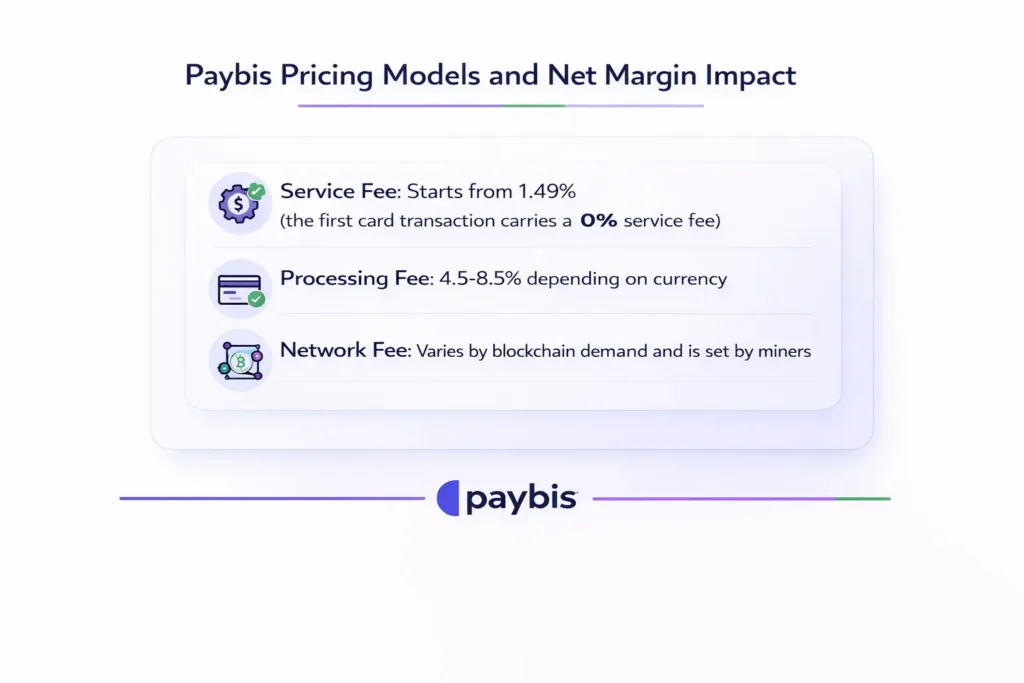
For a $1,000 card purchase, the approximate cost is: Service Fee ~$14.90 (1.49%) plus Processing Fee $45.00-$85.00 (4.5-8.5% depending on currency) plus Network Fee (variable). The total is shown before confirmation with no hidden components.
For B2B partners, our Corporate Services team offers volume-based pricing tiers and partnership structures. Contact our Corporate Services team directly for details on B2B partnership options.
Security, Reliability, and Uptime SLAs
We have operated since 2014 with no security breaches affecting customer funds. Our platform holds PCI DSS Level 1 certification, the highest standard for payment card security. With $2.6B in annual transaction volume (2024) and 5M+ retail users, our operational track record provides a meaningful proof point for infrastructure reliability. Our 24/7 support availability with an average ~15 second response time across 9+ languages adds an additional reliability layer for partner teams.
Ramp Network holds SOC 2 Type II certification and is FCA-registered as a cryptoasset business. Ramp has been building its on-ramp and off-ramp products since 2018 and reports 8 million customers worldwide.
Neither provider publicly discloses a specific uptime SLA percentage in their documentation. This is standard across the fiat on-ramp category and should be addressed directly in partner contract negotiations if your platform requires SLA-backed reliability guarantees.
Which On-Ramp Is Better for Self-Custodial Wallets?
Both platforms support non-custodial delivery, sending purchased crypto directly to the wallet address provided by the user. This is the baseline requirement for any Web3 app, DEX, or non-custodial wallet integration.
We extend this with an optional custodial wallet for users who prefer managed storage, while maintaining the non-custodial path as the default for external wallet delivery. Our platform sends crypto directly to any external wallet address during purchase. For DeFi protocols and DEX interfaces where users need funds on-chain immediately to execute swaps or provide liquidity, this architecture matters.
Ramp Network takes an entirely non-custodial approach, delivering crypto directly to user wallets and dApp interfaces without holding assets at any point. This is well-suited for dApp integrations where the application manages wallet state. For platforms with a self-custody-first user base, both providers satisfy the core requirement, and the decision factor shifts back to geographic coverage and payment method breadth.
The Verdict: Choosing Based on Your User Geography
The comparison reduces to one variable: where your users are.
If your user base is globally distributed, heavily weighted toward LATAM, Africa, or the US outside New York and Louisiana, we provide materially better coverage and deeper local payment rail support. Our cascade fallback mechanism and verification process help address key friction points in first-time buyer conversion. Get started on your first on-ramp transaction with Paybis!
Geographic breadth and local rail coverage are becoming the competitive moat in on-ramp infrastructure, not regulatory registration counts alone – a shift that’s directly relevant for product teams planning 12-18 month roadmaps.
Key Terminology
Cascade routing: A payment infrastructure mechanism that automatically reroutes a failed card transaction to an alternative payment processor within seconds, preventing hard stops in the user payment session and improving overall card approval rates.
Fiat on-ramp: The infrastructure that converts traditional currency (USD, EUR, GBP) into cryptocurrency. It includes payment processing, identity verification, and delivery to a wallet address.
MiCA CASP authorization: A Crypto-Asset Service Provider license issued under the EU’s Markets in Crypto-Assets Regulation. An authorization from one EU member state’s regulator allows the holder to passport regulated crypto services across all 27 EU member states.
PSP (Payment Service Provider): A third-party company that handles payment processing between buyers and sellers. On-ramp platforms integrate with multiple PSPs to support different payment methods, geographies, and currencies.
FAQ
How long does Paybis identity verification take?
We complete verification in approximately 2.5 minutes using photo ID and selfie via 3D liveness scanning, with 80% first-check approval.
How many countries does Paybis support compared to Ramp Network?
We operate in 180+ countries with 20+ payment methods. Ramp Network covers 150+ countries with a stronger concentration in EU markets through its MiCA CASP authorization.
What is the minimum service fee for a Paybis card transaction?
Our service fee starts from 1.49%, with the first card transaction carrying a 0% service fee. Processing fees run 4.5-8.5% depending on currency for card transactions above $50.
Does Paybis deliver crypto directly to external wallets?
Yes. We send crypto directly to any external wallet address during purchase. Both custodial and non-custodial delivery paths are supported, with non-custodial delivery as the default.
Disclaimer: Don’t invest unless you’re prepared to lose all the money you invest. This is a high‑risk investment and you should not expect to be protected if something goes wrong. Take 2 mins to learn more at: https://go.payb.is/FCA-Info