
Multi-Signature Wallets for Corporate Treasury: Governance, Setup, and When MPC Fits Better
- A multi-signature wallet needs more than one approval to send funds, so no single person can move corporate crypto alone.
- It is written as M-of-N: N total keys, M needed to approve. 2-of-3 and 3-of-5 tolerate a lost key while still needing agreement.
- Good setup means a sensible threshold, keys spread across trusted people, keys stored apart, and recovery planned before funding.
- Governance decides who the keyholders are and how they behave: separate duties, a written approval policy, and an approval record.
- Review keyholders regularly and keep a break-glass plan, so a crisis is not an improvised decision.
- Running multisig in-house puts key storage, recovery, and keyholder changes on your team for good.
- It often shows on-chain with higher fees, and how well it works varies by blockchain.
- MPC custody reaches the same no-single-mover guarantee while a provider carries the key operations.
- MPC signs off-chain, so a transaction looks like a normal payment and the same method works across chains.
- Paybis secures a company’s own crypto with MPC custody inside one account alongside fiat.
A corporate treasury holding crypto needs more than a wallet. It needs a rule that no single person can move the money alone. A multi-signature wallet is the classic way to do that: it requires several approvals before a transaction goes through. This guide covers how to set one up, how to govern it, and where a newer approach, MPC custody, fits a treasury better.
What is a multi-signature wallet?
A multi-signature wallet, or multisig, is a crypto wallet that needs more than one approval to send funds. Instead of a single key controlling the money, several keys exist, and a set number of them have to sign off on a transaction before it runs.
This is written as M-of-N. N is the total number of keys, and M is how many are needed to approve. A 2-of-3 wallet has three keyholders and needs any two to agree. That removes the single point of failure of one key, and it forces more than one person into every movement of money.
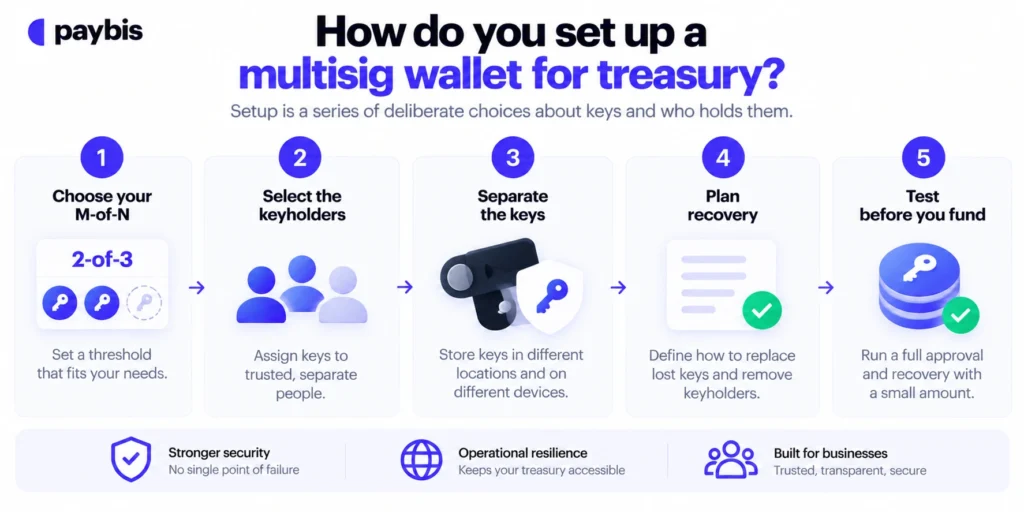
How do you set up a multisig wallet for treasury?
Setup is a series of deliberate choices about keys and who holds them. Get these right and the wallet protects the treasury. Get them wrong and it either exposes funds or locks them up.
- Choose your M-of-N. Pick a threshold that survives a lost key without stalling operations. 2-of-3 and 3-of-5 are common, since they tolerate one lost key while still needing agreement.
- Select the keyholders. Spread keys across trusted, separate people, so no one person or team controls enough to move funds alone.
- Separate the keys physically. Store keys in different places and on different devices, so one break-in or one failure cannot reach several keys at once.
- Plan recovery before you fund it. Decide in advance how a lost key is replaced and how a keyholder who leaves is removed, and write it down.
- Test with a small amount first. Run a full approval and a recovery on a small balance before the treasury goes in.
What are multisig governance best practices?
Governance is the set of rules around the wallet, and it matters as much as the setup. The wallet enforces that M keys sign. Your governance decides who those keyholders are and how they behave.
- Separate duties. The person who requests a payment should not be able to approve it alone. Spread request and approval across different roles.
- Write the approval policy down. Define who can request, who approves, and any limits by amount, so approvals are consistent rather than ad hoc.
- Keep an approval record. Log who approved what and when, so the treasury can be reviewed and audited later.
- Review keyholders regularly. Remove people who change roles or leave, and confirm each keyholder still controls their key.
- Have a break-glass plan. Decide in advance what happens in an emergency, so a crisis does not become an improvised decision.
What are the limits of running multisig yourself?
Multisig is solid, but running it in-house puts real weight on your team, and it carries some technical friction. Worth knowing before you commit.
- You own all the operations. Key storage, recovery, keyholder changes, and emergencies are all your team’s job, forever.
- It shows on-chain. Many multisig setups are visible as multisig on the blockchain and can carry higher transaction fees than a normal payment.
- Chain support varies. How multisig works, and whether it works well, differs by blockchain, so a multi-chain treasury juggles different setups.
- A lost quorum is serious. Lose more keys than your threshold allows, and the funds can be stuck for good. The governance has to prevent that.
When does MPC custody fit a treasury better?
When you want the same “no single person can move funds” guarantee without running the key operations yourself. MPC custody is a newer approach that splits one key into shares held by different parties, so it reaches the same goal by a different route.
The practical differences favour a managed treasury. MPC does its signing off the chain, so a transaction looks and costs like a normal payment, and the same method works across many chains rather than depending on each one. With a managed MPC provider, the heavy operational load, key storage, recovery, and keeping up with each chain, sits with the provider rather than your team.
| Multisig, run in-house | Managed MPC custody | |
|---|---|---|
| No single mover | Yes, needs M of N keys | Yes, key split across shares |
| Who runs key operations | Your team | The provider |
| On-chain footprint | Often visible, higher fees | Looks like a normal payment |
| Across many chains | Varies by chain | Same method across chains |
| Recovery burden | Yours to plan and run | Handled by the provider |
| Fiat alongside crypto | Separate systems | Can sit in one account |
How Paybis fits
Paybis secures a company’s own crypto with MPC custody, so the key is split across parties and no single person can move funds alone, without your team running the key operations. It sits inside one account alongside your fiat.
- Managed MPC custody. The split-key protection of multisig without the in-house key operations, described on the Paybis business account.
- One account for cash and crypto. Custody sits inside the Paybis Global Account, so crypto and fiat are held and seen in one place.
- Clear on where funds sit. How custody and holdings work is worth confirming with any provider, including where your money sits on a regulated platform.
- For your own money. The account is built for a company’s own corporate crypto, not balances held for customers.
Multisig remains a sound choice for a team that wants to hold its own keys and run its own governance. For a treasury that also wants fiat and crypto in one managed account, MPC custody is the closer fit.
Bottom line
A multisig wallet keeps any single person from moving corporate crypto alone, and it works when the setup and the governance are done with care: a sensible M-of-N, keys spread and stored apart, duties separated, and recovery planned before funding. The cost is that your team owns the key operations for good, across every chain. MPC custody reaches the same no-single-mover guarantee while a provider carries that load, and it can sit in one account with your fiat. Choose multisig to hold your own keys, and managed MPC when you would rather not.
FAQ
What is a multi-signature wallet?
A crypto wallet that needs more than one approval to send funds. Several keys exist, and a set number, written as M-of-N, must sign before a transaction runs. A 2-of-3 wallet has three keyholders and needs any two to approve.
How do you set up a multisig wallet for corporate treasury?
Choose an M-of-N threshold that survives a lost key without stalling, spread the keys across trusted separate people, store them in different places and on different devices, plan recovery before funding, and test a full approval and recovery on a small balance first.
What are the best governance practices for multisig?
Separate the person who requests a payment from those who approve it, write down who can request and approve and any limits, keep a record of who approved what, review keyholders regularly, and hold a break-glass plan for emergencies.
What are the downsides of running multisig yourself?
Your team owns key storage, recovery, and keyholder changes for good. Many setups show on-chain and carry higher fees, support varies by blockchain, and losing more keys than your threshold allows can lock the funds permanently.
When is MPC custody a better fit than multisig?
When you want the same guarantee that no single person can move funds, without running the key operations yourself. MPC splits one key into shares, signs off-chain so a transaction looks normal, works the same across chains, and with a managed provider the operational load sits with the provider.
Disclaimer: Don’t invest unless you’re prepared to lose all the money you invest. This is a high‑risk investment and you should not expect to be protected if something goes wrong. Take 2 mins to learn more at: https://go.payb.is/FCA-Info