
Payout Reconciliation: Why Manual Reconciliation Breaks at Scale and How to Automate It
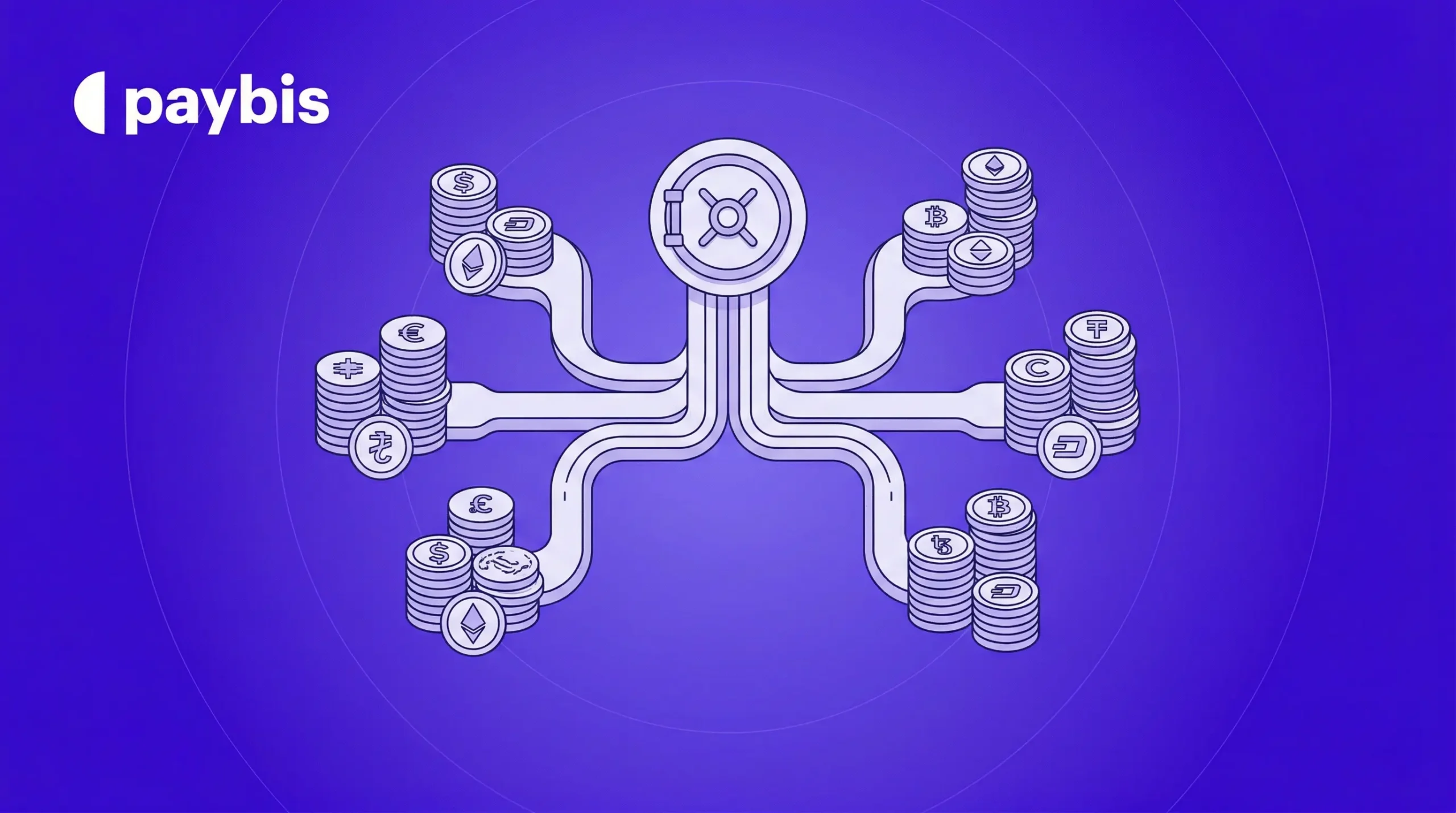
- Payout reconciliation automation automatically matches payouts with bank statements, settlement reports, and accounting records.
- Manual reconciliation becomes difficult to manage as payout volumes scale, with settlement lag, currency conversions, and inconsistent PSP data creating compounding errors.
- Automated systems track failed payouts, reversals, and final received amounts in real time through APIs.
- Automation helps reduce errors caused by settlement delays, currency conversions, and inconsistent payment provider data.
- Paybis Send provides reconciliation APIs that support operations in 180+ countries and 90+ cryptocurrencies.
Crypto assets can increase or decrease in value. Paybis is a payment gateway, not an investment service. This content is for informational purposes only and does not constitute financial advice.
When your platform reaches high payout volumes, your finance team stops analyzing margin and starts hunting for missing pennies in PSP settlement reports. Reconciliation errors obscure the true take-rate improvement you shipped last quarter, and the boardroom asks why the numbers don’t match. The fix isn’t another finance hire. It’s upgrading your payout API to eliminate the reconciliation backlog before it erodes your next funding case.
Why Manual Payout Reconciliation Fails at Scale
Settlement Lag Creates Reconciliation Gaps
A payment captured today lands in a PSP settlement file tomorrow and hits the bank ledger the day after. At scale, that lag means a growing number of valid items sit open in your ERP simply because the matching record hasn’t arrived yet. Each open item forces a human decision: timing difference, failed payment, or genuine discrepancy? At scale, those decisions accumulate faster than any team can clear them, and the reconciliation software market has grown precisely because finance teams have hit this wall.
Multi-PSP Format Inconsistencies Compound the Problem
One PSP delivers data via API. Another provides a daily CSV over SFTP. A third sends an Excel file requiring manual download. Each format uses different field names, date conventions, and fee structures. Multi-currency FX variance adds a second layer of complexity. The rate applied at the time of payout often differs from the rate the receiving institution ultimately settles at, and that gap makes it impossible to close the ERP ledger manually within a standard reporting cycle.
Reconciliation Engine: How It Powers Fast, Precise Matching
An automated reconciliation engine ingests data from three sources simultaneously: the internal order record, the PSP transaction report, and the bank statement. Deterministic ID matching handles clean cases where a single transaction appears in both the PSP data and the bank statement with an exact amount match. Probabilistic matching handles edge cases, including partial settlements, split transactions, delayed settlements, and fees that PSPs net out differently by payment method. Both layers are required in any production multi-PSP environment.
Partial settlements occur when a payout batch includes activity from multiple days, refunds, and rolling reserves. Configurable matching rules, including small-amount tolerances and fee treatment logic, determine whether a discrepancy is a legitimate deduction or an error requiring exception review.
Ensuring Accurate Payout Error Resolution
Identifying Failed vs. Pending Payouts
The distinction between a failed payout and a pending one is critical for reconciliation accuracy. Standard webhook status fields differentiate between payout.succeeded, payout.failed, and payout.reversed. A failed payout means the receiving institution rejected the transaction and funds return to the source account. A pending payout means the transaction is still in transit.
Automated engines apply time-stamped FX conversion records to each transaction so the reconciliation report reflects the actual net received amount rather than an estimated conversion.
Automating Chargeback and Reversal Reviews
In payout infrastructure, a reversal that occurs after a payout.succeeded event differs from a pre-settlement cancellation. In the post-settlement case, funds were confirmed delivered before being clawed back by the receiving institution, which is what makes the reconciliation treatment distinct.
Automated engines use a persistent transaction identifier that travels with every lifecycle event tied to a payout, from authorization through to any subsequent reversal. The engine then links each reversal to the originating record and flags the affected settlement period for ledger adjustment. The Paybis partner dashboard reflects the updated balance in real time, which is particularly critical for affiliate network disbursements where commission adjustments affect downstream payable calculations.
Standardizing Diverse Payout Data
Paybis operates with 150+ PSP integrations on demand, with pre-built normalization logic for each provider. Dates, currencies, and descriptions are transformed into a canonical internal format, with additional enrichment including transaction type classification, counterparty lookup, and internal entity tagging applied before the matching pass runs.
Payout Reconciliation Automation Checklist
Use this checklist when evaluating payout reconciliation software before committing to a vendor or starting an in-house build:
Data ingestion:
- Ingests data from all active PSPs without manual uploads
- Supports API connectors and SFTP for automated data pulls
- Normalizes date formats, currencies, and fee structures at ingestion
Matching logic:
- Runs both deterministic and probabilistic matching
- Supports configurable tolerance rules for small-amount discrepancies
- Handles partial settlements, split transactions, and delayed settlements
Failed and reversed payouts:
- Differentiates
failed,pending, andreversedstates via webhook - Links reversal events to originating payout records using a persistent transaction ID
- Flags reversal events for ledger review and adjustment
Fee transparency:
- Calculates FX conversion with time-stamped rates
- Separates service fees, processing fees, and network fees in settlement reports
ERP integration:
- Exports audit-ready data in standard formats (CSV, API, or direct connector)
- Syncs with NetSuite, SAP, QuickBooks, or Xero
- Maintains bi-directional sync to eliminate manual GL adjustments
Vendor reliability:
- Platform uptime track record with documented SLA
- 24/7 support availability with documented response times
Pre-Built APIs Automate Payout Matching
Paybis Send operates on a pre-funded model: you deposit fiat (USD, EUR, or GBP) via virtual IBAN and execute mass crypto payouts in 90+ cryptocurrencies via API or portal. Webhooks deliver real-time status updates throughout the payout lifecycle, providing the visibility needed to trigger downstream reconciliation actions without manual polling.
The Paybis partner dashboard provides real-time payout monitoring and balance tracking, with audit-ready export for ERP sync, so product teams see the state of every transaction without building custom reporting infrastructure.
Automating Payouts: In-House vs. Vendor
The build-vs-buy decision comes down to fully loaded cost, and that cost extends well beyond the initial engineering sprint. Institutions that build today almost always end up buying later, but only after paying the full cost of building first. A build-vs-buy framework analysis shows that the 24-month comparison consistently favors third-party APIs once you include PSP maintenance, the new routing logic, payment rails, and compliance layer that each new market requires, and the opportunity cost.
| Factor | In-house build | Paybis API |
|---|---|---|
| Time to production | 12–24 months | Faster than in-house; timeline varies by integration scope |
| Initial engineering cost | $264,000–$316,000+ per year for 2 senior engineers at average US market base salaries, before benefits and overhead; full build costs vary by scope | No setup fees; tier-based pricing applies |
| Annual maintenance | Substantial ongoing engineering time | Included |
| PSP format changes | Engineering ticket per change | Managed by Paybis via pre-built PSP normalization logic; no engineering ticket required on the client side |
| Regulatory coverage | Build per jurisdiction | MiCA CASP, PSD2 PI, FinCEN, FINTRAC, VASP Poland |
| Crypto support | Multi-asset support requires significant engineering complexity; implementation scope varies by asset type and network | 90+ cryptocurrencies |
| Countries | Build per region | 180+ |
| 24/7 support | Internal resources required | Included, avg. response 1–2 min |
For crypto-specific payout security, including custody models and wallet management, the Paybis payout security guide covers MPC custody architecture and multi-jurisdictional compliance in detail.
Ready to test automated payout matching? Request a sandbox API key to run a proof of concept against your integration. For pricing details, contact the Paybis sales team directly.
Key Terminology
- Payout reconciliation automation: The process of matching outgoing payments to corresponding financial records (bank statements, PSP settlement reports, ERP entries) using rules-based and probabilistic matching logic without human intervention. Automated systems handle edge cases including partial settlements, FX variance, and asynchronous reversal events.
- Automated payout matching: A matching engine that cross-references payout records across three data layers (internal order, PSP transaction, bank statement) using deterministic ID matching for clean cases and probabilistic matching for partial settlements, split transactions, and netting discrepancies.
- Failed payout reconciliation: The process of identifying payouts that reached a terminal
failedstate (as opposed topendingorreversed), returning funds to the source account, and updating the ledger without creating a phantom open item in the reconciliation report. - Payout reversal tracking: The automated linking of a
payout.reversedwebhook event back to the originating payout record using a persistent transaction identifier, followed by automatic recalculation of net payout totals for the affected settlement period and ERP journal entry update.
FAQ
What Transaction Volume Requires Automated Reconciliation?
Manual reconciliation typically becomes challenging at higher transaction volumes, where settlement lag, multi-currency FX variance, and multi-PSP format inconsistencies exceed what a finance team can manually process within the reporting cycle. Adding transaction growth without automation compounds the problem directly, as each new PSP, currency, and payment method multiplies the number of open items requiring human review.
How Do Reconciliation APIs Handle Multi-Currency Payouts?
Automated engines apply time-stamped FX conversion records to each transaction so the reconciliation report reflects the actual net received amount rather than an estimated conversion. Paybis supports 70+ fiat currencies, which eliminates spread-driven surprises in the post-settlement ledger.
How Does Automated Reconciliation Handle Failed Payouts?
Webhook status events (payout.failed, payout.succeeded, payout.reversed) feed the reconciliation engine in real time, with each status triggering a corresponding ledger update without requiring a manual adjustment. The engine differentiates between failed, pending, and reversed states so finance teams do not misclassify timing differences as genuine discrepancies.
How Long Does It Take to Connect a Reconciliation API to Production?
Integration deployment times vary by implementation scope and complexity. Straightforward use cases, such as webhook status monitoring or a single-endpoint API connection, can connect within hours. Full SDK integrations typically complete within a week, depending on implementation complexity. Both are significantly faster than a 12–24 month in-house build. Corporate account setup and verification follows a documented step-by-step process.
Disclaimer: Don’t invest unless you’re prepared to lose all the money you invest. This is a high‑risk investment and you should not expect to be protected if something goes wrong. Take 2 mins to learn more at: https://go.payb.is/FCA-Info