
Crypto Payout Security: Custody Models, Wallet Management, and Fund Protection

Key Takeaways:When you secure mass crypto payouts, you face far more than choosing a wallet provider. If you execute bulk crypto disbursements, you face three compounding risks: private key liability, multi-jurisdictional compliance gaps, and single-provider infrastructure failure. The safest architecture removes crypto holding from your balance sheet entirely. Paybis Send enables this by pre-funding payouts in fiat via a virtual IBAN and using MPC-based custody architecture, eliminating balance sheet exposure, inheriting global licensing, and launching in hours rather than the months or years an in-house build demands.
Managing mass crypto payouts introduces compounding risks: private key vulnerabilities, multi-jurisdictional regulatory gaps, and the operational overhead of wallet management at scale. This guide breaks down the custody models, wallet architectures, and compliance certifications you need to safeguard funds, and explains why leading platforms delegate this infrastructure to regulated partners like Paybis.
How Custody Models Protect Crypto Payouts
The custody model you choose for mass payouts determines your regulatory exposure, engineering overhead, and resilience to failure. Before you commit to either building or outsourcing, you need to understand the trade-offs.
Direct vs. Delegated Crypto Payout Custody
Direct custody places significant security responsibility on you. If private keys are lost or stolen through hardware failure, human error, or theft, there is no recovery mechanism. When you manage your own keys, you must build and maintain encrypted key storage, access control systems, and security audit programs from scratch. An asset manager that self-custodies on behalf of clients faces devastating liability if a hack or mistake leads to fund loss, with no external well-capitalized custodian to compensate.
Delegated custody shifts this liability to a system designed explicitly for audits, asset segregation, and regulatory scrutiny. Working with a qualified custodian gives you access to institutional-grade controls including regular audits, multi-signature key management, and comprehensive insurance coverage. These layers of oversight reduce the single-point failures that would otherwise end a payout operation permanently.
| Dimension | Direct Custody (You Manage) | Delegated Custody (Partner Manages) |
|---|---|---|
| Liability for loss | Entirely on you | Transferred to a regulated partner |
| Engineering overhead | High: key storage, HSMs, access controls | Low: API integration only |
| Recovery path | None if keys are lost | Partner-managed MPC recovery protocols |
| Compliance burden | Full in-house KYC, AML, VASP licensing | Inherited from partner registrations |
Hot, Warm, and Cold Wallet Architecture
If you operate an institutional payout platform, you’ll use a three-tier wallet architecture to balance liquidity with security. Each tier plays a distinct role:
- Hot wallets store daily operational liquidity, enabling near-real-time payout execution. They connect directly to the internet, making them fast but the most exposed to external attack. Limit hot wallet balances to the minimum required for operational needs.
- Warm wallets sit between hot and cold tiers. Keys or key shares can be brought online quickly, but additional controls such as multi-signature approval or policy-based rules are required before a transaction executes.
- Cold wallets store private keys completely offline, as explained in this Paybis crypto safety guide. They provide the highest protection against hacking because they cannot be reached via network-based attacks. Use cold storage for long-term reserves and high-value treasuries.
One effective configuration keeps a small percentage of total funds in hot wallets for operational payouts, a larger reserve in warm wallets for same-day settlements, and the bulk of reserves in cold storage. A breach of the hot wallet layer should never expose your total fund balance.
Secure Multisig Payout Approvals
Multi-signature (multisig) wallet architecture requires you to configure multiple private key holders to co-sign a transaction before it executes. A 2-of-3 configuration requires any two of three designated parties to approve, preventing a single compromised account from authorizing a payout unilaterally. This eliminates two critical risks: internal fraud (no single employee can move funds without co-authorization) and external compromise (stealing one key produces no access to funds).
For mass payout operations, multisig adds approval workflow overhead, which is where threshold signatures and MPC offer a more scalable alternative.
Ensuring Secure Crypto Custody
MPC (Multi-Party Computation) represents the current institutional standard for payout custody. With MPC, private keys are distributed across multiple parties, meaning a complete key never exists in a single location. MPC algorithms generate private key shards distributively so that no complete private key exists anywhere in isolation.
Paybis uses MPC-based architecture in Paybis Crypto Custody to secure company-owned and customer-issued wallets. Paybis Crypto Custody supports 90+ cryptocurrencies across multiple networks including Ethereum, Tron, Polygon, and Base. The MPC model eliminates the single private key vulnerability that makes traditional wallet custody a liability for platforms executing payouts at scale. Watch the Paybis security overview for a walkthrough of how these controls operate in practice.
Wallet Strategies for Secure Crypto Payouts
Wallet security governs how quickly a payout can execute, how resilient your system is to failure, and what happens if the infrastructure is compromised.
Protecting Crypto Payout Keys
If you run your own key management, you must build secure key generation ceremonies, enforce hardware security module (HSM) requirements, and implement strict access policies governing who can touch key material. The failure mode is severe and irreversible: a single compromised employee account, phishing attack, or hardware failure can result in total and permanent fund loss. Crypto security failures at major centralized exchanges have resulted in losses exceeding hundreds of millions of dollars precisely because key management failed under operational pressure.
For platforms whose core product is payments, not security engineering, the overhead of key management justifies delegating custody entirely to a partner with institutional-grade infrastructure already in place.
Optimizing Payout Authorization Workflows
Secure payout authorization workflows must balance speed with control. The recommended architecture for mass crypto payouts separates authorization tiers by transaction size and risk profile:
- Sub-threshold payouts: Automatically authorized against pre-approved whitelist addresses with velocity limits enforced at the API level.
- Mid-range payouts: Triggered via API with two-factor authentication required from the initiating account.
- High-value payouts: Require multi-party co-authorization before broadcast, with mandatory time-lock delays for amounts above defined thresholds.
This tiered model keeps routine payouts running without bottlenecks while enforcing human review on transactions that carry meaningful loss potential.
Implementing Threshold Signatures
In a Threshold Signature Scheme (TSS) model, a private key is split into shares. A specified number of shares (the threshold, for example, 2-of-3) must combine to sign a transaction. The resulting signature is mathematically identical to a regular single-key signature but requires collaboration from multiple independent parties.
No single entity or device ever reconstructs the full key, even when authorizing a transaction. Paybis uses MPC to secure both company-owned and customer-issued wallets, providing this cryptographic protection without requiring you to build or manage the underlying key infrastructure.
Wallet Backup & Disaster Recovery
MPC-based custody solves the backup problem by distributing recovery capability across multiple independent parties and locations. No single backup can restore full access. Recovery requires collaboration from a defined set of key share holders, each operating from secure, audited environments. Even a catastrophic failure of one data center or key shard holder does not result in fund loss.
If you operate your own wallets, establish formal key rotation procedures, encrypted off-site backups, and documented recovery protocols reviewed at least annually. Annual testing of recovery procedures, not just documentation, is the baseline for any infrastructure under enterprise scrutiny.
Essential Crypto Fund Safeguarding Practices
Beyond custody architecture, you need operational controls that prevent fund loss from internal error, fraud, and operational mistakes.
Regulatory Client Fund Segregation
Mixing corporate and client funds is a compliance failure with catastrophic consequences. When commingling occurs, clients lose priority claim to their funds in bankruptcy proceedings, and regulators respond with fines and license revocation. The Markets in Crypto-Assets Regulation (MiCA) mandates that custodians must be authorized, comply with capital requirements, and meet audit obligations, including strict asset segregation requirements. The FSMA makes safeguarding qualifying cryptoassets a regulated activity in the UK, with proposed rules mandating that client cryptoassets be segregated from firm assets.
Paybis enforces strict fund segregation between corporate and client balances through the Paybis Global Account. You can maintain separate reporting across fiat and crypto balances, with no commingling between operational and client funds. This segregation is a non-negotiable requirement for any platform operating under FCA, MiCA, or equivalent oversight.
Managing Crypto Payout Risks with Insurance
Digital asset insurance provides a financial backstop for losses from external theft, internal collusion, and administrative errors. Institutional-grade insurance typically covers cold storage assets and criminal acts. Standard exclusions you must verify include:
- User error (sending funds to incorrect addresses)
- Phishing and social engineering attacks targeting platform employees
- Blockchain protocol failures or smart contract vulnerabilities
- Market losses unrelated to security incidents
When evaluating a policy, review the coverage limit relative to maximum funds under custody at any point in the payout cycle, the financial strength rating of the insurer, and whether the policy covers the specific attack vectors most relevant to mass payout operations.
Proactive Payout Anomaly Detection
Transaction monitoring flags suspicious activity before funds leave your platform. For mass payout operations, anomaly detection systems watch for patterns deviating from baseline behavior: unusual destination address clusters, sudden spikes in payout volume, geographic anomalies, and velocity triggers exceeding pre-approved thresholds.
Effective AML monitoring requires integration with blockchain analytics tools that score destination wallet addresses against known illicit clusters. FATF standards require VASPs to implement AML and CFT measures comparable to those applied to traditional financial institutions. When you outsource payout infrastructure to a regulated partner, you inherit the partner’s AML monitoring infrastructure, eliminating the need to build, certify, and maintain these systems independently.
Enforcing Secure Withdrawal Limits
Velocity limits and IP whitelisting provide the API-level controls that prevent automated exploitation of payout endpoints. For mass payout operations, the standard architecture enforces:
- Velocity limits: Maximum payout volume per time period with automatic holds when thresholds are breached.
- Address whitelisting: Only pre-approved destination wallets can receive payouts. New addresses require a separate approval workflow before activation.
- IP whitelisting: API payout requests accepted only from pre-registered IP ranges, with alerts triggered for unexpected sources.
- Time-locks: Large transactions broadcast with a mandatory delay, allowing fraud review before on-chain confirmation.
You can configure these controls at the API level in Paybis Send, which provides a partner dashboard with real-time monitoring of payouts and balances, letting your operations team identify and respond to anomalies before they become losses.
Crypto Payout Recovery Planning
The irreversibility of blockchain transactions means prevention is the only effective recovery strategy. Once a transaction is confirmed on-chain, it cannot be reversed, recalled, or amended regardless of the cause. The practical response is a prevention architecture built on mandatory address validation, whitelisting at the API layer, and multi-approval workflows for new destination addresses. When you operate with a regulated partner, the partner’s compliance infrastructure provides an additional pre-broadcast screening layer. Paybis operates with 24/7 support and a 1-2 minute average response time, letting your team escalate flagged transactions before they execute.
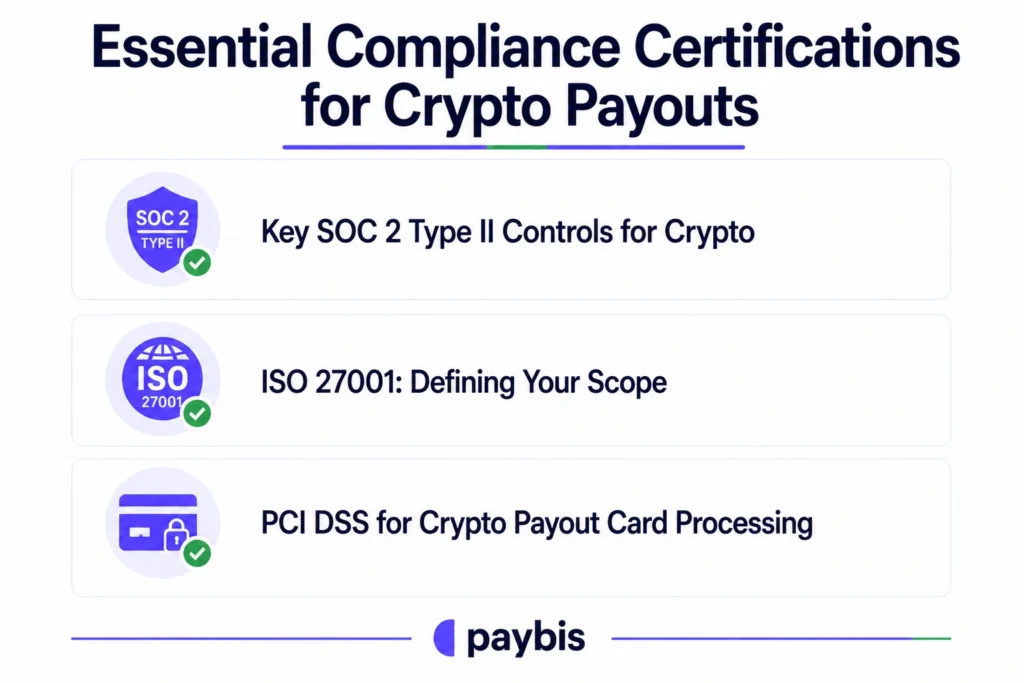
Essential Compliance Certifications for Crypto Payouts
Compliance certifications are verifiable proof that a vendor’s security claims are independently validated rather than self-reported. If a vendor lacks relevant certifications, treat this as a material risk signal during your due diligence.
Key SOC 2 Type II Controls for Crypto
SOC 2 Type II certification proves that a vendor’s security controls operated effectively over an extended audit period, typically 6-12 months. This is materially different from SOC 2 Type I, which evaluates whether controls exist at a single point in time.
For crypto payout infrastructure, the relevant controls cover access control and identity management, change management and system monitoring, incident response procedures, data encryption at rest and in transit, and availability and business continuity. A current SOC 2 Type II report issued within the last 12 months from a recognized AICPA-affiliated auditor is the baseline documentation requirement for enterprise payout infrastructure procurement.
ISO 27001: Defining Your Scope
ISO 27001 is the internationally recognized standard for information security management systems (ISMS). Certification requires a systematic approach to managing sensitive information, ensuring confidentiality, integrity, and availability. The process typically takes 6-12 months and requires audit by an accredited registrar.
When you evaluate a vendor’s ISO 27001 certification, verify that the scope explicitly covers the API infrastructure processing payout requests, the key management systems, the AML monitoring systems, and the environments hosting the payout engine. A certification that excludes critical payout infrastructure from its scope provides weaker assurance than a full-scope audit.
PCI DSS for Crypto Payout Card Processing
PCI DSS originated as a collaborative standard between major card networks to protect cardholder data. For fiat-funded crypto payout models where users fund accounts via card payments, the applicable PCI DSS compliance level depends on your annual card transaction volume: Level 1 applies to platforms processing over 6 million card transactions per year and requires an annual Report on Compliance from a Qualified Security Assessor. Paybis is PCI DSS Level 1 compliant, covering the card processing infrastructure used when partners pre-fund payout accounts through card rails.
How to Verify Certification Validity
Here is the due diligence protocol for confirming vendor certifications during procurement:
- Request the full audit report: Vendors should produce the formal Attestation of Compliance or SOC 2 audit report, not a marketing summary or badge image.
- Check the audit date: SOC 2 Type II reports are typically accepted for 12 months following the report date. While reports do not technically expire, customers expect updated reports annually to confirm controls remain effective. ISO 27001 certifications should show an annual surveillance audit date.
- Confirm the auditing firm: Verify the auditor’s credentials through the AICPA directory for SOC 2, or the ANSI National Accreditation Board registry for ISO 27001.
- Validate the scope: Confirm the audit scope covers the specific infrastructure components relevant to the payout function, not just corporate IT systems.
- Request the bridge letter: For SOC 2, a bridge letter issued by the vendor’s management confirms that no material changes to the control environment occurred between the audit period end date and today.
Assessing Crypto Platform Security Audits
Certifications establish a baseline. Ongoing audits validate that the baseline holds under a live, evolving threat environment.
Third-Party Audits for Fund Safety
Internal security audits do not satisfy enterprise due diligence requirements. The fundamental conflict of interest in self-assessment means internal teams cannot provide the independence required for enterprise trust. External SOC 2 audits and regular penetration testing are now standard practice for institutional-grade payout platforms. Third-party audits provide independence from the team being evaluated, standardized methodology enabling cross-vendor comparison, and formal attestation carrying legal accountability for the auditing firm.
Auditing DeFi Contracts for Payout Security
If you route payouts through decentralized protocols, commission a smart contract audit from a specialized firm to evaluate the contract code for logical errors, reentrancy vulnerabilities, access control weaknesses, and economic attack vectors. Platforms delegating payouts entirely to a regulated B2B partner eliminate most smart contract exposure from their risk surface.
Pen Test: What to Test, How Often?
Industry best practice for payout infrastructure requires annual or bi-annual penetration testing by an independent third-party cybersecurity firm. The test scope should cover external API endpoints, internal network segmentation, application-layer vulnerabilities, authentication controls, key management system access, and social engineering resistance of operations staff. Vendors should produce the executive summary from their most recent test, including finding severity distribution and remediation status.
Bug Bounty Incentives for Fund Safety
Bug bounty programs provide continuous security validation between formal audit cycles. When you evaluate payout partners, the existence of a public bug bounty program signals that the vendor is confident enough in its architecture to invite external scrutiny. The absence of such a program, combined with the absence of recent penetration test documentation, should prompt you to ask direct questions about the vendor’s approach to vulnerability discovery.
Secure Payouts: Centralized vs. Decentralized
The architecture decision between centralized licensed platforms and decentralized protocols has direct implications for compliance, recovery options, and time-to-market.
| Criterion | Centralized (Paybis Model) | Decentralized Protocols |
|---|---|---|
| Compliance | Inherited regulatory registrations (FinCEN, VASP, FINTRAC, FCA) | Protocol-level controls, user-managed due diligence |
| Speed | Near-real-time settlement, managed liquidity | Variable, dependent on protocol throughput |
| Recovery | Partner-managed MPC recovery protocols | Effectively impossible if keys are lost |
| Support | 24/7 with 1–2 minute average response | No customer service |
Minimizing Crypto Payout Failures
Payout failures in mass disbursement operations trace to two root causes: routing failures and liquidity gaps. Routing failures occur when a payout request cannot find a valid execution path because of network congestion, unsupported assets, or acquirer rejection. Liquidity gaps occur when you cannot source the required crypto asset at a competitive price within the required timeframes.
Paybis provides deep crypto liquidity for high-volume fiat-to-crypto and crypto-to-fiat trades, with on-demand liquidity for mass payouts and settlements designed to minimize slippage.
Building multi-jurisdictional compliance from scratch means obtaining separate regulatory authorizations in each operating market. If you target EU, UK, US, and Canadian users simultaneously, that means VASP registration under MiCA, FCA registration in the UK, FinCEN MSB registration in the US, and FINTRAC registration in Canada, each with different application timelines, capital requirements, and ongoing compliance obligations.
Paybis holds all four registrations: FinCEN (MSB in the US) with US entity 31000272911973, FINTRAC (MSB in Canada) with PL entity C100000816, VASP registration in Poland (RDWW-805) via the Revenue Chamber in Katowice, and FCA registration in the UK. When you integrate Paybis, you inherit this coverage immediately, compressing the compliance build queue from 12-24 months to your integration timeline.
Recovery Options When Keys Are Lost
The contrast between centralized MPC custody and decentralized self-custody is starkest at the point of key loss. In DeFi, if a private key or recovery phrase is lost, there is no customer service that can help recover funds, making recovery effectively impossible. In an MPC custody model, key material is distributed across multiple independent parties and locations. A fire at one data center, a departing employee, or a compromised device does not result in permanent fund loss because no single compromise exposes the complete key. When you execute mass payouts, this distinction is operationally critical: a self-custody model that loses key access loses the payout function entirely.
Budgeting for Secure Crypto Payouts
The build-vs-buy cost comparison is straightforward when fully loaded costs are accounted for. Building a compliant, multi-jurisdictional crypto payout engine from scratch requires substantial upfront investment, often reaching six figures for development alone. That covers only the initial build. Add ongoing compliance and legal costs, specialized security engineering salaries, annual audit fees, penetration testing, and insurance premiums.
Paybis’ B2B partner rates start at 0.49% per transaction. You set your own end-user fees above that base rate, keeping the margin difference on every transaction your users complete.
Key Criteria for Vetting Crypto Payout Partners
These are the criteria that determine whether a partner holds up under enterprise scrutiny.
Is Your Custody Model Documented?
If a vendor cannot produce a detailed written description of their custody model, including wallet tier distributions, key management procedures, and recovery protocols, their custody claims are unverifiable. The documentation package should include:
- Written description of the MPC or multisig architecture
- Cold/warm/hot wallet balance distribution policy
- Key rotation frequency and procedures
- Backup and recovery protocol documentation
- Named the responsible parties for custody operations
Verbal assurances during a sales call are insufficient. Request the documentation before advancing to contract discussions.
Security Audit & Compliance Reports
Request these specific documents during your due diligence:
- Current SOC 2 Type II report (full report, not an executive summary, dated within 12 months)
- ISO 27001 certificate with surveillance audit dates and accrediting body name
- PCI DSS attestation if fiat card processing is involved in the payout funding model
- Penetration test executive summary from a named third-party firm, including finding severity distribution and remediation status
- Regulatory registrations with specific registration numbers, regulator names, and effective dates
A vendor who delays producing these documents is signaling that they do not exist or are not current.
Vendor Incident Response Track Record
Request the vendor’s incident response procedures and their history of material incidents over the past 24 months, including root cause analyses and remediation steps. Paybis has operated since 2014 with zero security breaches and maintains approximately 99.4% platform uptime. Alongside 30,994+ Trustpilot reviews with a rating of 4.1 or “Great” (as of April 2026), this track record demonstrates our operational reliability.
“Paybis is one of the leading Crypto networks you can for sure trust your transactions will always be swift and safe.” – Lostboy on Trustpilot
“The best platform for making crypto transfers, even buying directly to your preferred crypto wallet.” – HICHAM EL HORMI on Trustpilot
Crypto Fund Loss Coverage Limits
Insurance coverage limits must be evaluated relative to the maximum funds under custody at any point in the payout cycle. A policy with a $10 million coverage limit provides inadequate protection for a platform processing $50 million in monthly payout volume. Key questions to ask:
- What is the total coverage limit per incident and aggregate annual limit?
- Does the policy cover hot wallet balances, cold storage, or both?
- What is the financial strength rating of the insurer?
- Are there exclusions for employee errors or social engineering attacks?
Evaluate Crypto Custody Licenses
MSB and VASP registration status must be verified directly with the issuing regulator, not taken on a vendor’s word. Check:
- FinCEN MSB Registrant Search for US MSB status
- FINTRAC Registry for Canadian MSB registration
- FCA Financial Services Register for UK authorization
- Relevant EU national VASP registry for European operations
Paybis maintains all four registrations. New York and Louisiana are excluded from current US coverage, which is a material consideration if you have concentrated user bases in those states.
Due Diligence for Crypto Custody Security
Secure Custody for Mass Crypto Payouts
The most defensible architecture for mass crypto payouts removes crypto holding from your balance sheet entirely. We provide this model through Paybis Send.
Here is how the workflow operates:
- Pre-fund in fiat: You deposit USD or EUR into a dedicated virtual IBAN (vIBAN) account. Your balance sheet never holds crypto.
- Trigger via API or portal: You initiate payout requests to pre-approved crypto wallet addresses, specifying amounts, destination assets, and recipient details through the API or the Paybis Send partner portal.
- Conversion and disbursement: We handle real-time fiat-to-crypto conversion and execute the payout in BTC, ETH, SOL, LTC, TON, DOGE, USDT (ERC20, TRC20, Polygon), or USDC (ERC20, Polygon, Base) in near-real-time to any destination wallet. The partner dashboard provides real-time monitoring of payout status and balances.
Your fiat balance converts to crypto only at the moment of disbursement, with Paybis managing the crypto holding, MPC custody, and wallet security for the conversion window. This fiat-funded payout model means your balance sheet exposure to crypto asset volatility is zero.
“I like how easy it is to buy crypto with my card and send it directly to my wallet. The interface is clear, transactions are fast, and support has been helpful whenever I had questions.” – Elizar S. on G2
Audit Frequency for Crypto Payouts
Your vendor monitoring does not end at contract signature. The standard for ongoing oversight of a B2B payout infrastructure partner includes:
- Annual review of current SOC 2 Type II report, ISO 27001 surveillance audit, and penetration test results
- Quarterly check on platform uptime statistics and incident log
- Real-time monitoring of your own authorization rate data and payout success rates through the partner dashboard
- Bi-annual review of regulatory registration status, particularly as MiCA requirements evolve in the EU
Build a jurisdictional compliance tracker that logs your partner’s registration status by market and flags renewal or update requirements. Crypto regulatory developments move quickly in 2026, and a partner’s registration status can change between your annual reviews.
Crypto Payouts: FDIC Coverage Status
Cryptocurrency assets do not qualify for FDIC insurance in the US or FSCS protection in the UK. Fiat currency deposited into a vIBAN account held at a regulated bank may receive pass-through FDIC coverage (up to $250,000 per depositor) for the fiat balance only. Once that fiat converts to crypto, government insurance protection disappears. This reinforces the security advantage of the Paybis Send model: pre-funding keeps your balance under potential pass-through protection until the moment of conversion, with the conversion window as short as possible before disbursement.
Post-Hack Fund Recovery and Safeguards
A vendor’s post-incident response record is the most honest assessment of their operational resilience. Marketing materials describe how the architecture is supposed to work. Incident history reveals how it actually held up under pressure.
The documented history of crypto exchange security failures demonstrates that even large, established platforms can be compromised when custody architecture has unaddressed single points of failure. North Korean hackers alone have been linked to approximately $6.75 billion in total thefts across crypto platforms, with $2.02 billion stolen in 2025 alone.
Paybis zero-breach record over more than a decade of operation is not a marketing claim but a verifiable operational fact. Combined with MPC-based custody that eliminates single-key vulnerabilities and 24/7 support with a 1-2 minute average response time, our architecture reflects a security posture built to hold under real-world attack pressure, not just pass an audit checklist.
Choose a payout infrastructure partner on the basis of what has not happened to them over time, not on the basis of what they say their architecture prevents. A decade without a breach is evidence. Everything else is a claim.
Ready to validate Paybis’ security architecture with your own transaction data? Try Paybis Send to test payout execution and security workflows directly, or contact the sales team to review the compliance coverage matrix and MPC custody architecture against your specific jurisdiction footprint.
Does FDIC insurance cover crypto assets held by a payout partner?
No. FDIC insurance applies only to fiat currency deposits at FDIC-insured banks. Crypto assets held by any custodian receive zero government deposit insurance protection. Fiat balances in a vIBAN account at a regulated bank may receive pass-through FDIC coverage (up to $250,000 per depositor) for the fiat portion only, which is why fiat-funded crypto payout models like Paybis Send reduce balance sheet risk relative to holding crypto directly.
Key Terminology
- MPC (Multi-Party Computation): A cryptographic method that distributes private key material across multiple independent parties and locations, ensuring no single party ever holds the complete key. Transactions require collaboration from a defined set of parties, eliminating single points of failure in custody architecture.
- VASP (Virtual Asset Service Provider): A regulatory classification under FATF standards covering any business offering crypto trading, custody, or payment services. VASPs are required to implement AML and CFT measures and obtain registration or authorization from the relevant national regulator.
- Threshold Signatures: A cryptographic scheme where a private key is split into shares, requiring a minimum number of shares (the threshold) to combine and produce a valid transaction signature. A 2-of-3 threshold requires any two of three designated parties to approve before a transaction executes.
- vIBAN (Virtual International Bank Account Number): A unique reference number linked to a master account that enables businesses to send, receive, and reconcile funds with a partner. In the Paybis Send model, each client receives a dedicated vIBAN for fiat pre-funding, enabling precise tracking and settlement of payout balances without requiring the business to hold crypto.
- SOC 2 Type II: An audit certification issued by AICPA-affiliated auditors confirming a vendor’s security controls operated effectively over an extended period (typically 6-12 months), as opposed to SOC 2 Type I which evaluates controls at a single point in time.
FAQ
What happens if a crypto payout is sent to the wrong address?
Blockchain transactions are irreversible once confirmed. There is no recall, reversal, or recovery mechanism regardless of the reason for the error. Prevention through mandatory address whitelisting, checksum validation on destination addresses, and multi-party approval workflows for new addresses is the only effective response.
How fast do fiat-funded crypto payouts settle via Paybis Send?
Payouts execute in near-real-time following API trigger, with the precise settlement time depending on the destination blockchain’s confirmation requirements. SEPA Instant and UK Faster Payments (FPS) fiat pre-funding settle in near-real-time, while SWIFT pre-funding follows standard interbank settlement timelines.
What certifications should a crypto payout infrastructure partner hold?
At minimum, request a current SOC 2 Type II report (dated within 12 months, with full auditor details), ISO 27001 certification with the accrediting body named, PCI DSS attestation at the level applicable to your transaction volume if fiat card processing is involved, and current regulatory registrations with specific registration numbers for each operating jurisdiction.
Does FDIC insurance cover crypto assets held by a payout partner?
No. FDIC insurance applies only to fiat currency deposits at FDIC-insured banks. Crypto assets held by any custodian receive zero government deposit insurance protection. Fiat balances in a vIBAN account at a regulated bank may receive pass-through FDIC coverage (up to $250,000 per depositor) for the fiat portion only, which is why fiat-funded crypto payout models like Paybis Send reduce balance sheet risk relative to holding crypto directly.
Disclaimer: Don’t invest unless you’re prepared to lose all the money you invest. This is a high‑risk investment and you should not expect to be protected if something goes wrong. Take 2 mins to learn more at: https://go.payb.is/FCA-Info