Best Auto-Conversion Platforms for Businesses in 2026
- Auto-conversion platforms convert fiat currency to crypto at the exact moment of payout, limiting the need for businesses to hold volatile assets.
- Mass Crypto Payouts pricing is from 0.49% per transaction, custom-quoted, with all fees shown in the quote before each payout.
- Paybis’s Mass Crypto Payouts lets businesses execute payouts in crypto from a pre-funded corporate balance, without holding crypto on the balance sheet.
Crypto assets can increase or decrease in value. Paybis is a payment gateway, not an investment service. This content is for informational purposes only and does not constitute financial advice.
Quick Answer: The best auto-conversion platforms for business contractor payments in 2026 are Mass Crypto Payouts, Coinbase Business, and BitPay. Paybis offers a portal-based setup with no engineering required. It operates globally and holds registrations in the US and Canada plus EU authorizations (full details below). Businesses fund a named corporate IBAN in USD, EUR, or GBP, then execute payouts in 100+ cryptocurrencies. Paybis quotes pricing through the business team, with all fees shown before each payout is confirmed. Coinbase Business focuses primarily on USDC. BitPay charges 1-2% plus $0.25 per transaction for merchant processing, with rates adjusted by monthly volume (November 2026).
A $5,000 international wire through a major US bank costs roughly $135-$200 all-in once fees and FX markup are included, per WorldFinancer’s 2026 bank-by-bank comparison. The same payment via mass crypto payouts is priced from 0.49% per transaction, custom-quoted, with all fees shown upfront in the quote before you confirm. This article evaluates the leading auto-conversion platforms for business contractor payments on licensing, supported currency pairs, fees, settlement speed, and setup effort. Auto-conversion applies to any business payment that converts fiat to crypto at the moment of payout. Contractor payments are the most common business use case and the focus of this roundup.
Why Does Your Business Need Automated Crypto Contractor Payments?
The subsections below cover how auto-conversion works and why businesses adopt it.
Auto-Conversion Automates Contractor Payments at the Moment of Payout
Auto-conversion platforms handle fiat-to-crypto conversion automatically during the payout process. Your business funds a corporate account with government-issued currency (fiat), and the platform converts it to the target cryptocurrency when you trigger a payment. You never hold crypto on your balance sheet. Settlement is near-to-instant (depends on the blockchain), rather than taking days.
Businesses Use Crypto for Contractor Payments to Avoid Stacked Fees
Traditional wire transfers layer multiple fees: an outgoing transfer fee, an exchange rate markup around 3-5%, and possible receiving bank fees on top. According to international banking analysis from LeavingTheStates, these stacked costs make even a single international payment expensive. The 3-5% exchange rate markup figure comes from the same LeavingTheStates analysis.
Paybis processes payouts in near-real time, and settlement is near-to-instant (depends on the blockchain). Contractors in any supported country receive crypto in their wallet, then cash out to local currency with the method they prefer.
Crypto Contractor Payments Replace Manual Transfer Workflows
Manual contractor payment runs consume hours per payment cycle. A typical manual run involves these steps:
- Exporting contractor data from spreadsheets
- Logging into multiple payment platforms
- Entering amounts by hand
- Waiting for confirmation emails
- Reconciling in accounting software
Automated crypto contractor payments turn this into a quick review-and-send workflow: add contractor details and amounts, confirm the total, click send. Mass Crypto Payouts sends the whole batch in one run, and settlement is near-to-instant (depends on the blockchain).
How Was Each Contractor Payout Solution Tested?
Auto-conversion platforms were evaluated on six criteria that matter for business contractor payments: regulatory compliance, supported currency pairs, total cost, settlement speed, setup effort, and batch payout and monitoring options.
Legal and AML Standards Were Checked Through Official Databases
Regulatory standing was verified through official databases. Paybis holds two categories of status, listed separately below.
Registrations:
- FinCEN MSB (US): 31000272911973 (Paybis USA LTD, Delaware), 31000224635628 (Paybis US state operations), and 31000277275964 (Paybis Poland).
- FINTRAC MSB (Canada): C100000646 (Paybis Canada) and C100000816 (Paybis Poland).
- VASP (Poland): RDWW-805.
Licenses/authorizations:
- MiCA CASP and Payment Institution (PI) licence: Latvia, secured May 2026. FinCEN, FINTRAC, and VASP are registrations only.
A FinCEN MSB registration is not a money-transmitter license and does not by itself authorize moving funds. MiCA CASP and PSD2 Payment Institution are the licenses/authorizations.
Supported Fiat and Crypto Pairs Determine Payout Flexibility
Analysis covered which fiat currencies businesses can use to fund payouts and which cryptocurrencies contractors can receive. Paybis supports bank-transfer funding through a named corporate IBAN, with payouts available in cryptocurrencies including USDC, BTC, and ETH.
Hidden Fees Add Up on Traditional Wire Transfers
A total cost comparison for a $5,000 payment shows traditional wire transfers stack transfer fees on top of FX spread, so the all-in cost is well above the upfront fee alone (see the fee comparison below). Crypto auto-conversion offers transparent, upfront pricing instead: all applicable fees are calculated and shown in the quote before each payout is confirmed.
Businesses Can Run Batch Payouts Through a Portal or API
Evaluation assessed whether businesses can send batch payouts and monitor them in real time. Paybis results for both criteria appear in the platform review below.
Settlement Speed Was Measured From Payout to Wallet
Settlement speed was measured from the moment a business initiates a payout to when the contractor receives crypto in their wallet. Paybis processes payouts in near-real time, while traditional wire transfers take 1-5 business days (per Western Union’s article.)
Existing Contractor Payment Workflows Connect Through a Web Portal or API
Testing confirmed whether each platform requires developer resources or works through a simple web portal. Paybis results appear in the setup comparison below.
What Are the Best Platforms for Automated Crypto Contractor Payments?
Three providers, plus one that has closed, are reviewed in turn below.
Paybis Automates Contractor Payments Through a Named Corporate IBAN
Mass Crypto Payouts lets businesses fund a named corporate IBAN in USD, EUR, or GBP, then execute batch payouts in crypto via API or web portal. No crypto balance is required. Paybis converts funds at the moment of payout, so crypto never appears on your balance sheet and volatility risk stays low. The platform supports payouts in 100+ cryptocurrencies, including BTC, ETH, and USDC, across multiple blockchains. Paybis operates in 180+ countries.
Paybis brings 12+ years of crypto expertise, 24/7 technical support, and personal account management to business payouts.
Coinbase Scales Contractor Payouts With USDC
Coinbase Business centers its payment flows on USDC, and its launch messaging ties the platform’s value proposition to stablecoin speed: instant settlement, minimal fees, and zero chargebacks (TechNode Global, Nov 14, 2025). It launched in Singapore in November 2025, its first international market.
BitPay Pricing and Program History for Enterprise Contractor Payments
BitPay charges 1-2% plus $0.25 per transaction for merchant processing, with rates adjusted by monthly volume, per BitPay’s published pricing tiers (November 2026). BitPay paused its prepaid Mastercard program in June 2023 after its banking partner exited the crypto business.
Wyre Shut Down in 2023
Wyre positioned itself for international payments but ceased operations in 2023 after restricting customer withdrawals, per The Paypers (June 2023). Businesses evaluating contractor payout providers should prioritize platforms with proven operational stability and transparent regulatory standing.
What Other Business Payments Can Auto-Conversion Cover?
Contractor payouts are the primary use case, but the same model supports other business payments. Businesses pay out from the same pre-funded balance in 100+ cryptocurrencies.
- Affiliate and commission payouts: Businesses can send commissions to many recipients in a single batch, with each recipient receiving the cryptocurrency they choose.
- Vendor and supplier payments: Businesses can pay international suppliers that accept crypto from the same funded balance, with fees shown in the quote before each payout is confirmed.
- Payout conversions: Business owners can convert fiat funded to the IBAN into crypto at the moment of payout, so no crypto stays on the balance sheet.
How Do the Top Crypto Contractor Payout Providers Compare?
| Feature | Paybis | Coinbase | BitPay |
|---|---|---|---|
| Registrations / Licenses | MiCA CASP and PSD2 Payment Institution licence (Latvia, May 2026), FinCEN (US), FINTRAC (Canada), VASP Poland | Not published | Not published |
| Supported Fiat | 54+ fiat currencies | Not published | USD |
| Supported Crypto | 100+ cryptocurrencies | Primarily USDC for payouts | Not published |
| Payment Methods | 35+ payment methods | Not published | Not published |
| Fees | Custom-quoted pricing | Not published | 1-2% + $0.25 per transaction, tiered by monthly volume |
| Settlement Speed | Near-real time | Instant (per Coinbase launch messaging) | Not published |
| API Setup Time | Under 48 hours via widget, SDK, or API. Some integrations require no engineering | Not published | Not published |
Businesses Can Compare Global Payment Fees Against Wire Costs
TransferFees measures two separate components of a bank wire, while WorldFinancer’s $135-$200 figure is an all-in total. Per TransferFees’ 2026 comparison, the upfront fee on an international wire at major US banks runs $30-$75, and the FX-rate gap alone adds $146-$202 on a $5,000 wire. The two sources use different methods and scope, so their figures are not directly additive. Mass Crypto Payouts pricing is from 0.49% per transaction, custom-quoted, so businesses can contact the Paybis business team for a quote and compare it against their current wire costs.
Available Currencies for Global Contractor Payments
Paybis supports three funding currencies (listed in the table above) with payouts in a wide range of cryptocurrencies, giving contractors the flexibility to receive payment in their preferred asset and cash out to local currency. Coinbase Business focuses primarily on USDC.
Contractors Receive Crypto With Near-to-Instant Settlement
Settlement to the contractor’s wallet is near-to-instant (depends on the blockchain) after the business initiates payment. Traditional wire transfers take several business days, and security reviews can add further delays.
Setup Requires Different Levels of Developer Effort
Mass Crypto Payouts works through a web portal with no engineering required, letting operations or finance teams complete setup without developer time. API integration is available for companies that want full automation but is optional.
How Do You Find Your Ideal Crypto Contractor Payout Solution?
Choosing a provider comes down to a few practical factors, outlined below.
Reliable Crypto Payouts Depend on Uptime and Regulatory Standing
Choose a provider with proven uptime and transparent regulatory standing. Avoid providers with documented operational failures, such as the Wyre closure covered above.
Distributed Teams Get Reliable Crypto Contractor Payments From One Balance
Businesses with distributed contractors need a platform that works across multiple countries. The business pays out from its own pre-funded balance, and Paybis routes each payout to the contractor’s wallet.
Large Contractor Payouts Maximize Savings Through Total Cost Comparison
If your business pays $50K+ per month in contractor payments, total cost matters more than headline fees. Using WorldFinancer’s per-bank all-in figures, ten $5,000 wires totaling $50K cost $1,350-$2,000 per month across Citibank, Chase, and Bank of America.
Businesses can contact the Paybis business team for a quote and compare it against these wire costs.
Multi-Currency Contractor Payout Runs Simplify Into One Platform
Managing contractors across 8-25 countries means dealing with multiple currencies, payment methods, and local banking systems. Paybis consolidates this into a single platform: fund one balance, and contractors receive crypto they can cash out to local currency in their own countries.
This removes the need to maintain separate payment relationships for each country or currency.
How Do You Set Up Crypto Contractor Payments in 4 Steps?
Setup moves from onboarding to a full payout run, one stage at a time.
Activate Your Payment Dashboard Through KYB Onboarding
Contact the Paybis business team to start KYB (Know Your Business) onboarding. Provide standard business documentation including incorporation papers, proof of address, and beneficial ownership information.
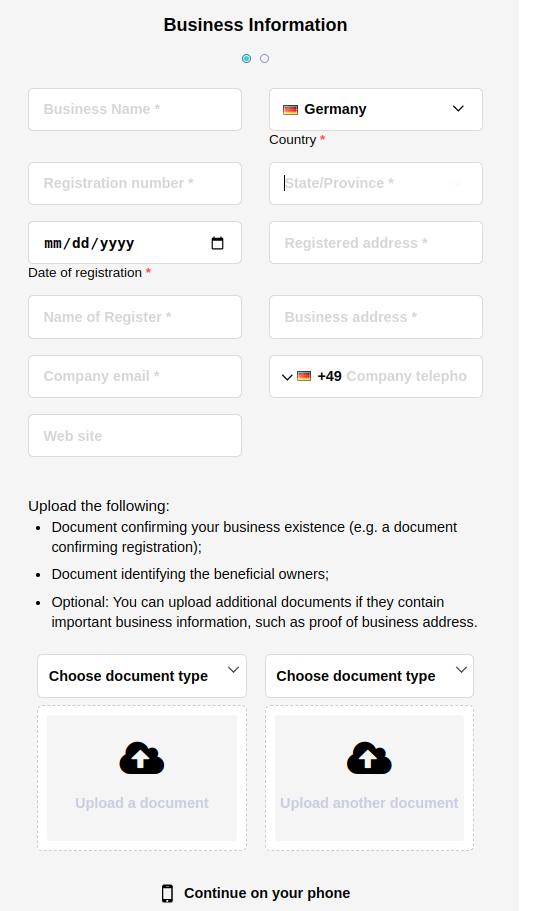
Once approved, Paybis issues a named corporate IBAN in your company name. Fund this account in USD, EUR, or GBP via standard bank transfer.
Manage Crypto Payout Preferences in the Portal
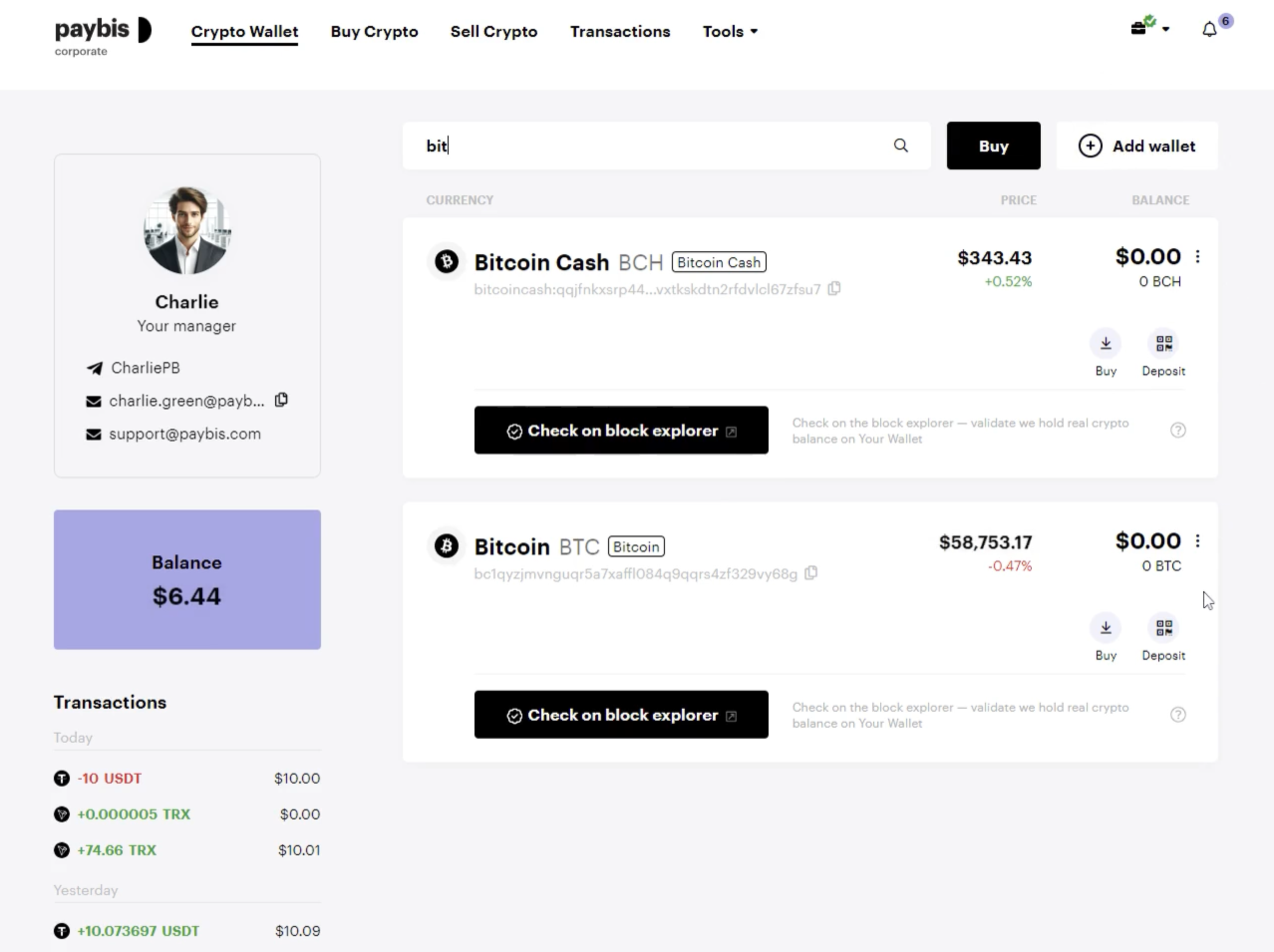
Add contractor wallet addresses, payment amounts, and preferred cryptocurrencies through the portal. Submit the payouts as a batch, or use the API for fully automated payout runs.
Verify Payment Flows With Small Batches
Run a test payment to 3-5 contractors before your first full payout run. Confirm they receive crypto in their wallets and can cash out to local currency.
Monitor payout status in real time through the Paybis dashboard. You see exactly when each contractor receives funds.
Manage Payouts for 10 to 200 Contractors in One Run
Scale from test batch to a full payout run by uploading your complete contractor list. Funds convert from fiat to crypto at the moment of payout. Track payouts and transaction history through the Paybis dashboard. Export reports for accounting and tax reporting.
How Do Crypto Contractor Payment Taxes and Regulations Work?
Legal, tax, and compliance questions are answered in the subsections below.
Auto-Conversion Is Permitted in Many Jurisdictions, but Rules Vary
Paying contractors in crypto is permitted in many jurisdictions, including the US, EU, and Canada, but rules vary by country and by contractor location. Businesses must comply with local tax reporting requirements and anti-money laundering regulations, and should confirm their position with a legal or tax professional.
Paybis remains the regulated entity for its crypto contractor payout services under the registrations and authorizations listed in the testing section above. Businesses keep their own regulatory and AML obligations.
Paybis is available in most US states, excluding New York and Louisiana. US businesses should confirm availability in their state with the Paybis business team before starting KYB onboarding.
Identity Verification and Compliance Requirements Businesses Must Meet
Paybis provides the compliance infrastructure businesses operate through, including identity verification and compliance checks on payouts. Businesses complete KYB verification once during onboarding, and Paybis monitors payout activity.
Ready to Start Paying Contractors in Crypto?
Paybis is a regulated crypto payment gateway with a dedicated business team for contractor payouts. The team offers 24/7 technical support and personal account management.
Contact the Paybis business team to start KYB onboarding for mass crypto payouts, then pre-fund in USD, EUR, or GBP and send payouts from your balance.
Key Terminology
- Auto-conversion: The process of converting fiat currency to cryptocurrency at the exact moment of payout, limiting the need to hold crypto on your balance sheet.
- Settlement speed: The time from when a business initiates a payment to when the contractor receives funds in their wallet.
- Fiat currency: Government-issued currency such as the US dollar. Businesses fund their Paybis corporate IBAN in fiat currency.
- Stablecoin: Cryptocurrency designed to maintain a stable value, typically pegged to $1 USD. USDC is a common stablecoin used for contractor payments.
- Wallet: A digital address where cryptocurrency is stored. Contractors provide their wallet address to receive crypto payouts.
FAQ
What Is the Typical Fee for Auto-Conversion Services?
Bank wire costs vary by bank, and the all-in wire figure is covered in the fee comparison above. Mass Crypto Payouts pricing is from 0.49% per transaction, custom-quoted through the business team, and all applicable fees are shown in the quote before each payout is confirmed.
How Long Does Auto-Conversion Settlement Take?
Settlement is near-to-instant (depends on the blockchain) after the business initiates payment. Contractors then cash out to local currency with the method they prefer.
Do I Need Technical Expertise to Set Up Auto-Conversion?
No. Paybis Mass Crypto Payouts runs through a web portal, and API integration is optional for businesses that want full automation.
How Are Contractor Payouts Routed Through Paybis?
Payouts run against the business’s own funds. The business pre-funds its balance once, then executes payouts, and Paybis converts the funds and sends crypto to each contractor’s wallet.
Disclaimer: Don’t invest unless you’re prepared to lose all the money you invest. This is a high‑risk investment and you should not expect to be protected if something goes wrong. Take 2 mins to learn more at: https://go.payb.is/FCA-Info