Crypto Chargebacks: What They Are and Who Carries the Risk
- Crypto does not remove chargebacks, it moves them. The crypto transfer is final, but the card payment used to buy it can be reversed.
- A chargeback is when a customer asks their bank to reverse a card payment, and the seller loses the funds plus a fee.
- Chargebacks are worse for crypto sellers because the asset is gone once sent, so a reversed payment is a straight loss.
- Friendly fraud, buying crypto then disputing the card charge, is a common target because the crypto cannot be clawed back.
- Dispute handling runs through set stages, and the merchant has to respond at each with evidence or lose by default.
- The question that decides your real exposure is who carries the chargeback liability, and it’s worth asking before you sign.
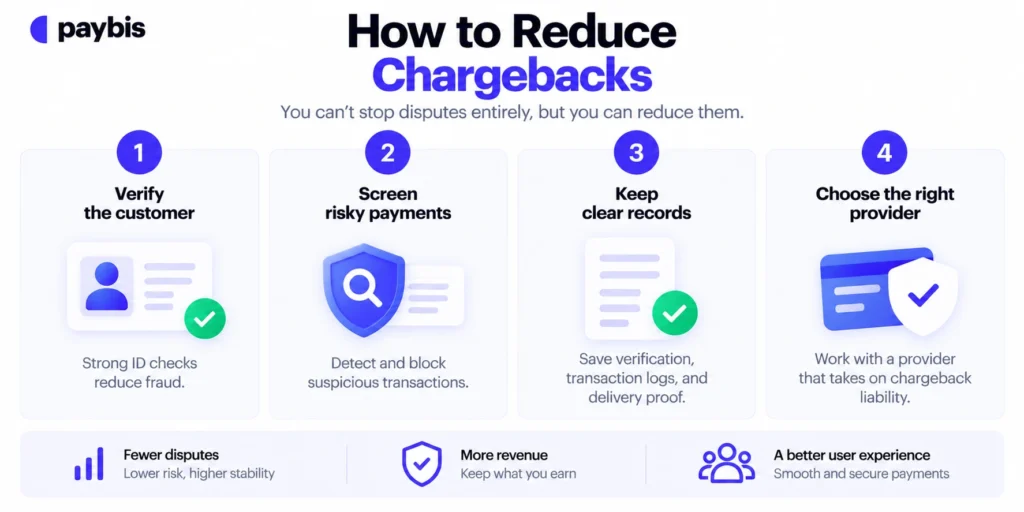
- Verifying customers, screening risky payments, and keeping clear records are what reduce and win disputes.
- The biggest single lever is choosing a provider that takes on chargeback liability.
- Paybis undertakes chargeback liability, so a reversed card payment behind a crypto purchase is not the partner’s loss.
- With the Paybis widget and SDKs, the card step and its fraud checks run on the Paybis side.
Merchants moving into crypto often hear that chargebacks disappear. That is half true, and the other half is where the money gets lost. A chargeback is when a customer asks their bank to reverse a card payment, and the merchant loses the funds plus a fee. On-chain crypto transfers cannot be reversed. The card payment a customer uses to buy that crypto can be, and that is where the risk actually sits.
Can a crypto payment be charged back?
The crypto transfer itself cannot, but the card payment behind it can. Once crypto moves on the blockchain, it is final and no one can claw it back. The problem is the step before: the customer paid with a card, and a card payment can be disputed for weeks after it clears.
So a platform selling crypto sits in a hard spot. It sends the crypto, which is gone for good, then the customer disputes the card charge and the bank pulls that money back. The platform is out both sides. This is the opposite of the usual merchant setup, where the goods can sometimes be recovered.
Why are chargebacks worse for crypto sellers?
Because the thing sold cannot be taken back, and fraudsters know it. The mismatch between irreversible crypto and reversible card payments is exactly what gets targeted.
- The asset is gone. Once the crypto is sent, a reversed card payment is a straight loss, with no product to recover.
- Friendly fraud is easy. A customer can buy crypto, receive it, then claim the card charge was not theirs. This is called friendly fraud, and crypto is a common target.
- Fees stack on the loss. Each chargeback carries a fee on top of the reversed amount, and too many can raise your processing costs or put your account at risk.
- Disputes take time to fight. Contesting a chargeback means gathering evidence and waiting on the card networks, which is slow and often unsuccessful.
How does dispute handling work?
A dispute runs through set stages, and the merchant has to respond at each one with evidence. Knowing the flow is how you avoid losing by default.
- The dispute is raised. The customer contacts their bank, which reverses the charge and notifies the payment side.
- Evidence is requested. The merchant is asked to show the payment was genuine, with records like verification, transaction logs, and delivery of the crypto.
- The networks decide. The card networks weigh the evidence and rule for the customer or the merchant.
- The cost lands somewhere. If the merchant loses, it carries the reversed amount and the fee. Who bears that depends on the contract with the provider.
Who carries the chargeback risk, you or your provider?
That is the question that decides your real exposure, and it lives in the contract. With most providers the liability sits with you, so a fraud spike lands on your books. With some, the provider takes it on.
| When a card payment is reversed | You carry the liability | The provider carries it |
|---|---|---|
| Who absorbs the loss | You, the reversed amount and the fee | The provider |
| Effect of a fraud spike | Lands on your books | Does not hit your books |
| Who fights the dispute | Your team gathers evidence | Handled on the provider side |
| Effect on your costs | Fees and account risk rise | Shielded from that pressure |
| What to check | Read the liability clause closely | Confirm it is written into the contract |
How to reduce chargebacks
You cannot stop disputes entirely, but you can cut how often they hit and how many you lose. A few controls do most of the work.
- Verify the customer. Solid identity checks at sign-up make friendly fraud harder and give you evidence later.
- Screen risky payments. Fraud checks that flag suspect transactions before the crypto goes out stop losses at the source.
- Keep clear records. Verification, transaction logs, and proof the crypto was delivered are what win a dispute.
- Choose where the liability sits. The biggest single lever is a provider that takes on chargeback liability, so a reversal is not your loss.
How Paybis handles chargebacks
Paybis undertakes chargeback liability. When a card payment behind a crypto purchase is reversed, that loss does not land on the partner. The card step runs on the Paybis side, along with the verification and fraud checks behind it.
- Chargeback liability on Paybis. A reversed card payment is not the partner’s loss to absorb.
- Checks run on the Paybis side. Identity verification and fraud screening sit with the payment, through the on-ramp.
- Card data stays with Paybis. With the widget and SDKs, the card step runs on Paybis, which affects where risk and compliance sit.
- Ask the right question. Whichever provider you weigh, confirm who carries chargeback liability in writing. The questions to ask a provider cover it.
Bottom line
Crypto does not remove chargebacks, it moves them. The crypto transfer is final, but the card payment behind it can be reversed for weeks, and when it is, the seller is out an asset it cannot recover. The controls that help are real: verify customers, screen risky payments, and keep the records that win disputes. The biggest lever is who carries the liability. Paybis undertakes chargeback liability, so a reversed card payment is not the partner’s loss.
FAQ
Can a crypto payment be charged back?
The crypto transfer itself cannot, because once it moves on the blockchain it is final. The card payment used to buy the crypto can be, and a card payment can be disputed for weeks after it clears, which is where the risk sits.
Why are chargebacks a bigger problem for crypto sellers?
Because the asset cannot be recovered. Once the crypto is sent, a reversed card payment is a straight loss with no product to take back, and fraudsters target that mismatch through friendly fraud, where a customer receives crypto then disputes the charge.
How does crypto dispute handling work?
The customer’s bank reverses the charge, the merchant is asked to show the payment was genuine with records like verification and delivery, the card networks decide, and if the merchant loses it carries the reversed amount and the fee. Who bears that depends on the provider contract.
Who is responsible for a crypto chargeback?
It depends on the contract. With most providers the liability sits with the merchant, so a fraud spike lands on its books. With some, the provider takes it on. Paybis undertakes chargeback liability, so a reversed card payment is not the partner’s loss.
How can a platform reduce crypto chargebacks?
Verify customers at sign-up, screen risky payments before the crypto goes out, keep clear records that win disputes, and choose a provider that carries chargeback liability so a reversal is not your loss.
Disclaimer: Don’t invest unless you’re prepared to lose all the money you invest. This is a high‑risk investment and you should not expect to be protected if something goes wrong. Take 2 mins to learn more at: https://go.payb.is/FCA-Info