How Crypto Payout APIs Work: Architecture, Settlement, and Real-Time Processing Explained

Key Takeaways:Crypto payout APIs let platforms disburse funds globally in near-real time without holding cryptocurrency on the balance sheet. The architecture accepts fiat pre-funding via a virtual IBAN (vIBAN), converts to the target crypto at a locked rate, routes to recipient wallets, and confirms settlement via webhooks. Smart liquidity routing prevents slippage on high-value payouts, while inherited multi-jurisdiction licensing removes the compliance build queue. Paybis Send handles conversion and routing automatically, with compliance built in, payout initiation processing in a few minutes, and near-to-instant on-chain finality depending on the blockchain.
Most platforms obsess over payout execution latency while ignoring the days their capital sits locked in pre-funding accounts or eroded by hidden conversion spreads. Cross-border payment rails are evolving: API-driven crypto disbursements now run alongside SWIFT for platforms that need speed and margin efficiency on mass payouts. But the underlying architecture determines whether that move actually saves time and money or just relocates the problem to a different layer of the stack.
We break down the mechanics of modern crypto payout APIs here, from fiat-to-crypto conversion to on-chain settlement. By the end, you’ll know how to evaluate integration complexity and minimize slippage while running mass disbursements without taking on custody risk.
Automating Mass Crypto Payouts via API
A crypto payout API moves each disbursement through a defined sequence of discrete, auditable operations. You need to understand this sequence before you can evaluate any vendor’s reliability claims, because reliability failures almost always trace back to a specific stage in the flow.
Crypto Payout API Architecture
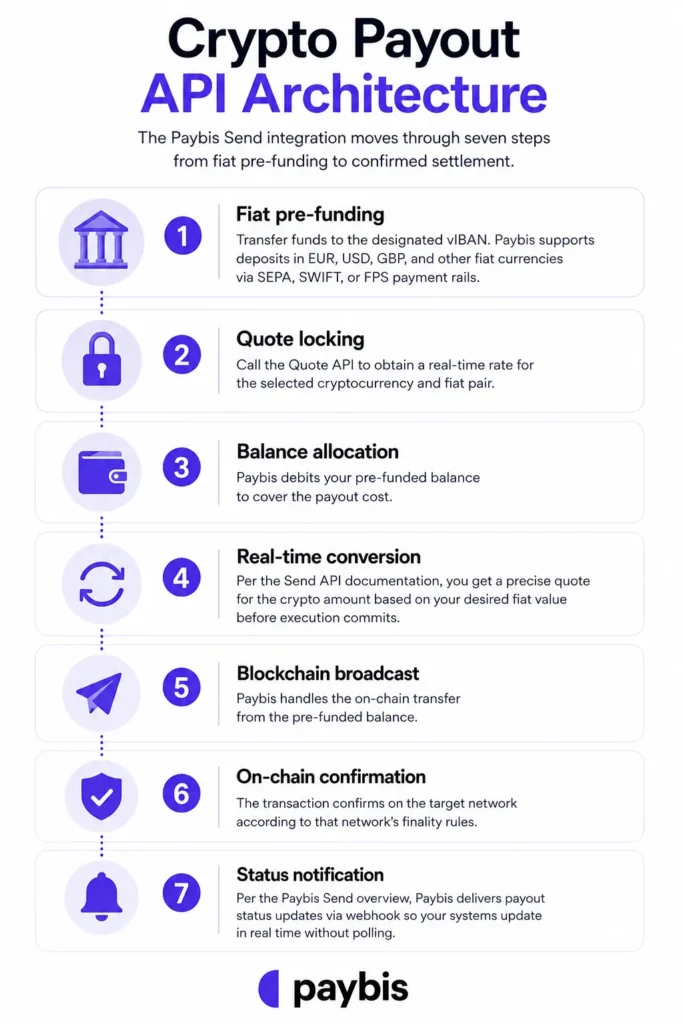
The Paybis Send integration moves through seven steps from fiat pre-funding to confirmed settlement:
- Fiat pre-funding: Transfer funds to the designated vIBAN. Paybis supports deposits in EUR, USD, GBP, and other fiat currencies via SEPA, SWIFT, or FPS payment rails.
- Quote locking: Call the Quote API to obtain a real-time rate for the selected cryptocurrency and fiat pair.
- Balance allocation: Paybis debits your pre-funded balance to cover the payout cost.
- Real-time conversion: Per the Send API documentation, you get a precise quote for the crypto amount based on your desired fiat value before execution commits.
- Blockchain broadcast: Paybis handles the on-chain transfer from the pre-funded balance.
- On-chain confirmation: The transaction confirms on the target network according to that network’s finality rules.
- Status notification: Per the Paybis Send overview, Paybis delivers payout status updates via webhook so your systems update in real time without polling.
API request payloads typically include details such as recipient information, asset type, amount, currency denomination, and a reference identifier for client-side reconciliation. The API responds with tracking identifiers and status information that updates as the transaction progresses through each confirmation stage via the webhook system.
Payouts vs. Payments: Distinct Mechanics
Accepting crypto (inbound) and sending it out (outbound disbursements) require architecturally distinct operations. Inbound payments require you to expose a deposit address, monitor for incoming transactions, and confirm finality before crediting a balance. Outbound payouts flip this: you hold a funded balance, sign a transaction from a hot wallet, broadcast to the network, and monitor confirmation. The error modes differ completely, and vendors who conflate inbound and outbound mechanics in their documentation warrant closer scrutiny.
Instant Fiat-to-Crypto Payout Processing
The conversion stage is where hidden costs accumulate. Platforms can advertise a low payout fee while embedding a wider spread in the exchange rate, which increases your effective cost. Net received, the exact crypto amount a recipient gets for a fixed fiat input after all fees and spread, is the only metric that removes this ambiguity.
Optimizing Real-Time Liquidity Routing
We source real-time liquidity from one or more providers to execute fiat-to-crypto conversions at the moment you initiate a payout. Platforms routing through a single liquidity provider face concentration risk: if that provider quotes wide spreads during a volatile period, every payout in that window absorbs the cost.
How Payout Spreads Are Determined
Spread is the difference between the market rate and the rate applied to your conversion. A provider’s total cost includes both stated fees and any embedded spread. You can only compare providers on net received at specific transaction sizes across your actual payment methods. Many platforms display the full breakdown before a transaction commits, which helps eliminate post-execution surprises. For high-frequency payout programs, spread differences can accumulate across large transaction volumes.
Preventing Slippage on High-Value Payouts
Quote locking prevents slippage by freezing the exchange rate for the execution window. If the quote expires before execution, we retrieve a fresh rate rather than settling at a stale price.
Automating Wallet Routing for Mass Payouts
Routing thousands of simultaneous payouts calls for automated address validation and network selection. Broadcast sequencing also has to run without manual intervention. Each step has failure modes the API layer must handle before a transaction touches the blockchain.
Securing Payout Wallets: Hot vs. Cold
Sending wallets in payout infrastructure typically operate as hot wallets that sign and broadcast transactions programmatically. Industry best practice limits hot wallet exposure by automating balance sweeps to cold storage above defined thresholds. When you use Paybis Send, we handle operational security elements of the payout flow. The “How Paybis Works” guide covers the end-to-end custody and execution model for those evaluating the full infrastructure scope.
Multi-Chain Payout Fallback Strategies
A resilient payout API maintains connections to multiple blockchain nodes per network. For multi-asset payout programs disbursing across different networks, isolating each asset’s settlement path helps prevent network-specific congestion from blocking other payouts.
Error Prevention in Crypto Payouts
Address validation delivers the most impact as a pre-broadcast control. Bitcoin addresses require checksum validation and a format check, since legacy addresses begin with 1 or 3 and native SegWit addresses begin with bc1. A valid Ethereum address is 42 characters long: the 0x prefix followed by 40 hexadecimal characters. Building address validation into the pre-broadcast stage helps prevent irreversible fund loss from formatting errors before transactions reach the network.
Fast, Secure Crypto Payout Settlement
In blockchain contexts, settlement generally refers to when a transaction becomes effectively irreversible. Releasing payout balances before adequate network confirmations may create risks, so you need to understand what confirmation thresholds each network requires before crediting any downstream balance.
On-Chain Confirmation Requirements by Network
Settlement times vary by orders of magnitude across networks. The table below reflects current blockchain data as of April 2026.
| Network | Avg. Block Time | Standard Finality | Notes |
|---|---|---|---|
| Bitcoin (BTC) | typically ~10 minutes | commonly ~60 min (6 confirmations) | Probabilistic finality: 6 blocks makes reversal economically impractical |
| Ethereum (ETH) | typically ~12 seconds | commonly ~13 min (64 confirmations) | Mathematical finality at 64 blocks; exchanges often accept 12-30 confirmations (3-7 min) |
| Solana (SOL) | Sub-second | ~13 seconds (typical) | Full finality achieved under normal conditions |
Cointelegraph’s finality explainer describes different finality models across blockchains. Some networks use probabilistic approaches where transaction permanence increases over time, while others use deterministic models designed to reach conclusive finality more quickly. For payroll platforms, these architectural differences may influence settlement policies and the trade-offs between speed and confirmation confidence.
Improving Cash Flow via Faster Settlement
The business impact of near-to-instant settlement versus 3-5 day SWIFT delays is structural rather than incremental. Blockchain-based stablecoin payouts on networks like Solana and Tron can potentially settle much faster than traditional systems, which converts a multi-day capital lock-up into a much shorter settlement window. For affiliate networks running performance-based payouts on daily cycles, this directly affects how attractive the program is to high-volume affiliates who prioritize same-day liquidity.
Calculating Net Received: Fee Impact
For a $1,000 fiat-funded payout via Paybis Send, net received comes down to three components:
- The service fee, with tiered pricing available for B2B partners
- The conversion spread, locked at quote time
- The network fee charged by the blockchain
On Ethereum, gas fees fluctuate and typically remain under $5, with congestion events occasionally pushing costs toward $7. Partners can set their own end-user markup and retain the margin, which makes the net received calculation clear before any transaction commits.
Real-Time Balance Updates without Holding Reserves
Product Feature Showcase 1: Paybis Send vIBAN Pre-Funding
The pre-funded vIBAN model moves treasury management from crypto to fiat denomination. You deposit USD, EUR, or GBP into your vIBAN, and the balance stays denominated in that fiat currency until a payout converts it. This reduces the operational burden of private key management and custody infrastructure.
Accounting treatment depends on jurisdiction and asset classification. Under MiCAR frameworks, certain stablecoins may qualify as cash equivalents under IFRS, which can remove fair value revaluations. Under US GAAP, digital assets in scope of Subtopic 350-60 are measured at fair value through net income, and the vIBAN structure does not change that requirement. The complexity of mark-to-market accounting comes from how your organization classifies and reports digital assets rather than from the payment rail itself.
Instant Liquidity for Crypto Payouts
A virtual IBAN enables you to receive payments into your Paybis Send account. You deposit fiat (USD, EUR, or GBP), and balances are held in those fiat currencies. When a payout executes, we access on-demand liquidity to convert that fiat balance to the target cryptocurrency at the locked quote rate, then broadcast to the recipient wallet and confirm. You never hold crypto at any point in this flow.
Minimizing Payout Reserve Holdings
Not holding crypto on your corporate balance sheet delivers two concrete benefits. First, it simplifies regulatory classification: you hold only fiat-denominated balances rather than cryptocurrency assets. Second, it reduces exposure to cryptocurrency price volatility on your balance sheet. The vIBAN model keeps your pre-funded balance in fiat and converts to the target cryptocurrency only when a payout executes.
Real-Time Payout Ledger Systems
Your internal ledger stays synchronized via webhook events. Every status transition triggers a webhook callback to your registered endpoint with updated payout information. This eliminates polling: instead of repeatedly querying the status endpoint, your system receives a push notification at each state change, which reflects the actual payout state in real time.
Implementing Mass Crypto Payout Solutions
Product Feature Showcase 2: Paybis Send API Integration and Go-Live Path
Integration complexity is the most commonly underestimated cost in vendor selection. The go-live timeline directly determines how many engineering sprints you allocate to payment infrastructure rather than product differentiation.
REST vs. Webhooks for Crypto Payouts
REST endpoints and webhooks serve distinct roles and aren’t interchangeable. REST endpoints handle operations where your system initiates a request and expects an immediate response. Webhooks handle asynchronous updates where the platform notifies your system when status changes, without requiring polling. The rule is simple: use REST when you need to trigger an action or check status on demand, and use webhooks for receiving updates and reconciliation. If you rely on REST polling for updates instead of webhooks, you’ll pay higher API latency costs and see stale data accumulate in your partner ledger.
Widget or API: Which Suits Your Needs?
Paybis Send supports flexible integration approaches to match varying operational needs. API integration enables programmatic control for scenarios requiring automated payout execution and custom reconciliation logic. Organizations may also consider alternative integration methods during evaluation phases or for different volume requirements.
Accelerate Your Go-Live Path
Paybis Send’s fastest integrations go live in under 24 hours. The compliance overhead that otherwise extends cross-border payment integrations by months is already handled. Paybis carries MiCA CASP authorisation from the Bank of Latvia (ref CASP 27-55/2026/6), which passports across all 27 EU member states, alongside a PSD2 Payment Institution licence from the Bank of Latvia (ref PI 27-55/2026/7). It also holds FinCEN (Financial Crimes Enforcement Network) registration (US entity 31000272911973), FINTRAC (Financial Transactions and Reports Analysis Centre of Canada) registration in Canada, and VASP (Virtual Asset Service Provider) registration in Poland (RDWW-805). Partners should verify which specific jurisdictional obligations transfer and which remain with them. The foundational licensing across the EU, the US (excluding New York and Louisiana), Canada, and Poland is already in place and available at integration.
Building Trust through Payout Stability
Single-provider dependency is the failure mode product leads most frequently underestimate until it causes a revenue outage. Cascade logic and node redundancy keep payouts flowing when a component fails, and real-time monitoring surfaces problems before they reach revenue.
Automated Retries for Payout Failures
Paybis Send includes retry logic to handle payout broadcast failures, managed within the infrastructure layer so you don’t implement or maintain it independently. If a broadcast doesn’t succeed on the first attempt, the system attempts resubmission to complete the transaction. The Paybis crypto withdrawal guide demonstrates how the platform handles payout execution and confirmation flows in practice.
API Network Fallback Strategies
The platform is designed to handle network disruptions and maintain payout reliability. Paybis Send’s infrastructure layer includes redundancy mechanisms that help ensure broadcasts execute even when individual network components experience temporary issues. At the liquidity layer, the platform routes conversions to available providers, which helps protect your payout batches from service interruptions.
Real-Time Outage Detection & Resolution
Product Feature Showcase 3: Paybis Send Partner Dashboard
The Paybis Send partner dashboard provides real-time monitoring of payout statuses and balance positions across all active disbursement programs. You see transaction-level detail for reconciliation and aggregate balance across fiat and crypto positions. The view also shows which payouts are progressing normally and which require attention. When a payout requires investigation, the dashboard gives your operations team the transaction detail needed to determine the root cause, whether an address error or a network or balance problem, without waiting for a support ticket cycle.
Paybis operates with 24/7 support and typical response times of 1 to 2 minutes. With 31,900+ Trustpilot reviews and a 4.1 out of 5 rating, plus a decade of operation since 2014, the reliability track record is publicly verifiable. Additional user perspectives are available across independent review platforms.
Ready to automate your mass payouts? Request Paybis Send API sandbox access to test payout routing and settlement speeds across your target markets, or book a technical demo with the Paybis integration team to walk through the compliance coverage matrix and API architecture for your specific use case.
Key Terminology
- vIBAN (Virtual IBAN): A virtual International Bank Account Number that receives payments identically to a standard IBAN but maps to a pooled master account rather than a single dedicated account. Multiple vIBANs route to the same underlying balance, which enables payment segregation and reconciliation without separate bank accounts per currency or use case.
- Net received: The exact crypto amount a payout recipient receives after all fees and conversion spread apply to a fixed fiat input. It captures both explicit fees and embedded spread in a single metric, making it the only reliable basis for comparing payout infrastructure providers at a given transaction size.
- Blockchain finality: The point at which a transaction is permanently and irreversibly recorded on the ledger. Probabilistic finality (Bitcoin) strengthens with each additional confirmation block, while deterministic finality (Solana) is absolute once the network’s finalization process completes.
- Webhook: An HTTP callback that the payout API sends to your registered endpoint when a transaction status changes. Webhooks replace polling-based status checks and deliver real-time state updates (initiated, confirmed, failed) without your system generating repeated API requests or accumulating stale ledger data.
FAQ
What Role Does an API Play in Crypto Liquidity?
A crypto payout API accesses real-time liquidity by connecting to conversion providers at payout initiation and executes conversions at current market rates. Without this real-time liquidity access, conversions may occur at less favorable rates.
How Do Crypto Payouts Work During Network Congestion?
During congestion, payout APIs may increase the attached network fee to improve miner or validator priority. Platforms with access to multiple settlement networks may reduce exposure by distributing disbursements across less-congested rails.
How Fast Is Real-Time Crypto Payout Settlement?
Settlement speed depends on the network and confirmation requirements. Networks like Solana and Tron typically offer faster finalization times, while Ethereum’s block time is approximately 12-15 seconds per block (though multiple confirmations are often required), and Bitcoin typically requires 6 confirmations for finality. On-chain settlement follows each network’s specific timeline and conditions.
Which Crypto Assets Does Paybis Send Support?
Paybis Send supports multiple crypto assets, with partners pre-funding a vIBAN in USD, EUR, or GBP and executing payouts without holding crypto reserves. The broader Paybis on/off-ramp infrastructure supports 90+ cryptocurrencies for retail integrations across 180+ countries.
Disclaimer: Don’t invest unless you’re prepared to lose all the money you invest. This is a high‑risk investment and you should not expect to be protected if something goes wrong. Take 2 mins to learn more at: https://go.payb.is/FCA-Info