Crypto IBANs for Business: How Mass Crypto Payouts and Dedicated IBANs Work
- A dedicated IBAN gives a crypto business a named account for fiat deposits and payouts without opening a traditional bank account.
- Paybis issues named IBANs to businesses and their partners, supporting SEPA, SEPA Instant, SWIFT, and Faster Payments.
- Incoming fiat can be configured to convert to crypto automatically, or held in fiat for outgoing B2B payments. Mass Crypto Payouts runs mass crypto payouts in 90+ cryptocurrencies from a pre-funded balance.
- Paybis operates under a PSD2 Payment Institution license and MiCA CASP authorization (May 2026), covering regulated payment and crypto services across all 27 EU states.
- Corporate and client balances are segregated, and compliance checks, identity verification, and transaction monitoring are handled by Paybis.
Crypto assets can increase or decrease in value. Paybis is a payment gateway, not an investment service. This content is for informational purposes only and does not constitute financial advice.
Quick Answer: A dedicated IBAN is a bank account number issued in a business’s own name, for accepting fiat deposits without a bank. Paybis issues named IBANs to corporate clients and their partners within three business days. Deposits arrive over SEPA, SEPA Instant, SWIFT, or Faster Payments. Incoming fiat can convert to crypto automatically or stay in fiat for outgoing B2B payments. With Mass Crypto Payouts, a business pre-funds in USD, EUR, or GBP and pays out in 90+ cryptocurrencies to 180+ countries. Paybis holds an EU MiCA CASP authorization and a PSD2 Payment Institution license.
For a business that runs on crypto rails, the fiat side is usually the hard part. Receiving bank payments from partners, holding balances in the company name, and paying out across borders all normally need a bank relationship. Dedicated IBANs solve exactly that.
This guide covers how they work, how they pair with Mass Crypto Payouts for bulk disbursements to wallets, which businesses they fit, and the licensing that makes a non-bank IBAN possible.
About Paybis
Paybis is a B2B cryptocurrency payment infrastructure company operating since 2014. Close to $6 billion processed and 7 million users (May 2026), with 82% of settled volume coming from business partners (H1 2025). In 2025 alone it onboarded 340 new business clients.
Since May 2026 Paybis holds both an EU MiCA CASP authorization (27-55/2026/6) and a PSD2 Payment Institution license (27-55/2026/7). Together these permit regulated crypto and payment services, including IBAN issuance and stablecoin payouts, across all 27 EU member states.
With Mass Crypto Payouts, On/Off Ramp, Plug&Play Wallets, and OTC & Business Wallets, Paybis offers businesses reliable and efficient tools for crypto adoption. Its focus is compliance, security, and efficiency: crypto payout infrastructure, dedicated IBANs, and fiat-to-crypto conversion.
Introducing Mass Crypto Payouts and Dedicated IBANs
According to NFT Evening’s research, in 2024 12,834 merchants worldwide accepted cryptocurrency payments, up 50% from 2023. Of these businesses, 88% reported higher revenue after accepting crypto payments. Yet crypto adoption remains a challenge to most due to a lack of facilitating technology.
Mass Crypto Payouts is an API-based solution that makes it easier for businesses to handle cryptocurrency payouts, and to generate additional revenue by charging a transaction fee on every payout request.
It is built to make crypto payouts to partners, employees, and service providers predictable and secure. Whether a business operates a freelance platform, payroll service, ad network, or another model, Mass Crypto Payouts offers an alternative to traditional fiat payments that removes complexity, reduces costs, and increases transaction speed.
Dedicated IBANs extend the product with the fiat side: named accounts that receive bank payments and feed the same payout engine.
Advantages Over Traditional Fiat Payouts
- Speed and efficiency: SEPA Instant and Faster Payments settle in near real time, and crypto payouts reach wallets in near real time. SWIFT follows standard interbank timelines.
- Lower costs: Direct payouts remove the intermediary bank charges that sit on a correspondent banking chain. Paybis B2B rates start at 0.49% per transaction.
- Cross-border accessibility: Send funds to any part of the world, including unbanked or underbanked regions, where traditional payment methods are unavailable.
- Regulatory compliance: Paybis runs compliance checks and transaction monitoring on every payout, which reduces the burden on the business.
- No banking infrastructure required: Paybis manages the wallets, security, and compliance layer, so the business does not build them.
Getting Started with Mass Crypto Payouts in 5 Steps
Mass Crypto Payouts is designed to make cryptocurrency payouts simple, secure, and scalable for businesses. The service removes the need for companies to manage their own crypto infrastructure. Here is how the process works:
- Step 1. Pre-funding a balance: Businesses deposit fiat in USD, EUR, or GBP into a named corporate IBAN held in their own company name. The balance can be configured to convert to stablecoins automatically, which removes exposure to crypto price moves before payout.
- Step 2. Making payments: Once funded, businesses initiate payments via API, specifying the recipient’s wallet and payout amount, while Paybis handles conversion and transfer automatically.
- Step 3. Managing compliance and security: Paybis handles regulatory reporting, monitors transactions, and blocks payouts to restricted or high-risk addresses.
- Step 4. Partner’s markup: Businesses can add a markup to transactions, earning a percentage on each payout while keeping pricing competitive for partners.
- Step 5. Fund withdrawals: Partners can withdraw profits on schedule or access fiat balances anytime, which allows flexible fund management for conversions back to fiat or reinvestment.
Named, Dedicated, and Virtual IBANs: What Is the Difference?
A virtual IBAN (vIBAN) is an account number that routes payments into an underlying master account rather than being a standalone bank account. A named or dedicated vIBAN carries the business’s own name, so partners see and pay the company directly, reconciliation is automatic, and attribution is clean.
Paybis issues dedicated, named IBANs to corporate clients. Where a platform needs it, Paybis also issues them to the platform’s own partner businesses or end customers. That is how a neobank or marketplace gives each participant a fiat deposit account under its own brand.
The licensing behind this matters: issuing payment accounts is regulated activity, and Paybis provides it under its PSD2 Payment Institution license rather than a banking charter. How a Payment Institution licence changes stablecoin payouts covers what that distinction means for platforms.
Dedicated IBANs for Mass Crypto Payouts
Paybis corporate clients settle B2B payments through named IBANs, which simplifies fiat-to-crypto conversion for businesses, particularly for enterprises operating in sectors like iGaming.
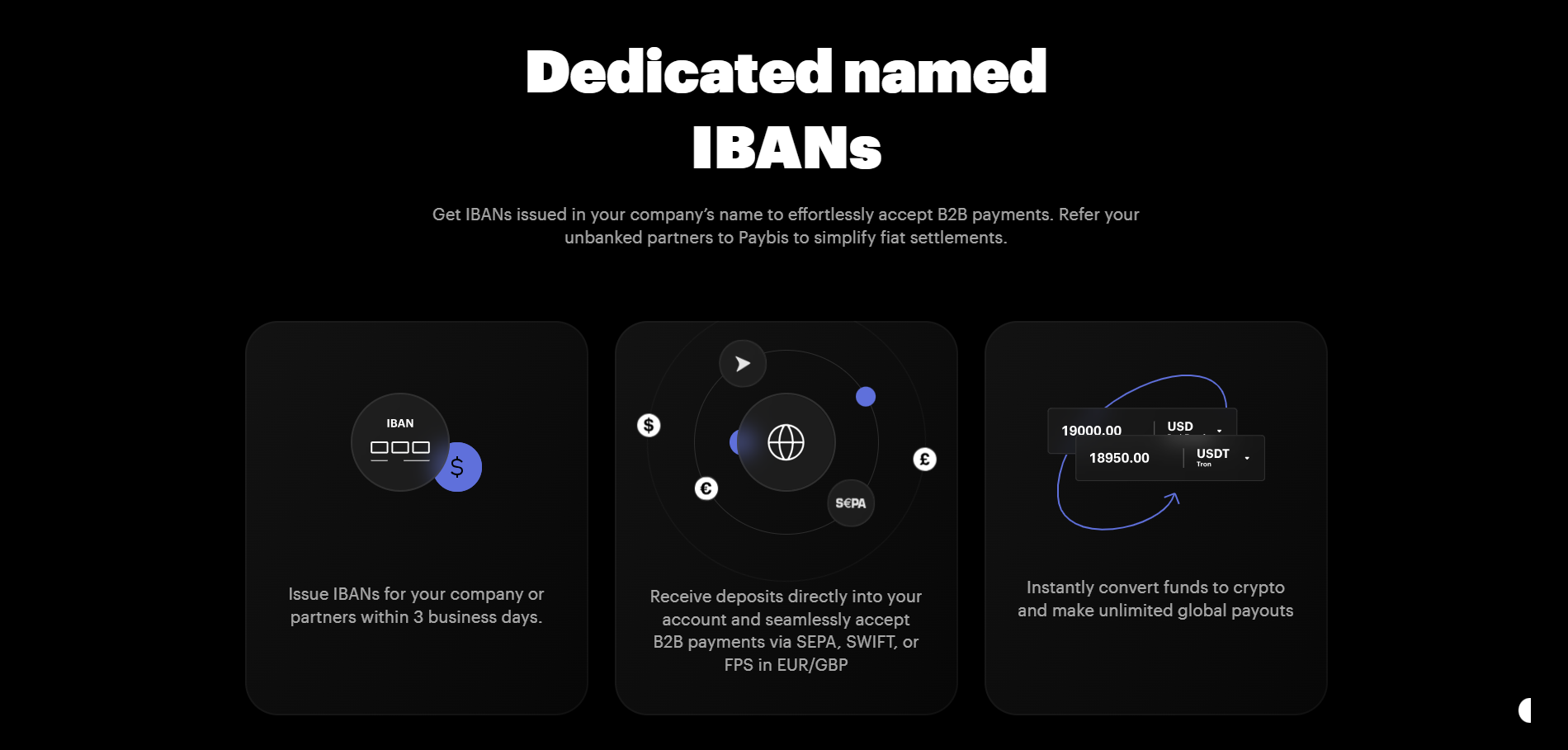
With a named IBAN, a business can accept fiat payments directly from B2B partners without opening a traditional bank account. Those balances convert into cryptocurrencies through a single integration.
Benefits of Named IBANs for Businesses and Partners
Dedicated IBANs give a business one place to handle both sides of a B2B payment. Fiat comes in and converts to crypto, or goes out as a fiat settlement. Key benefits include:
- Individual IBANs: Businesses can issue IBANs in their own company name or provide dedicated IBANs for B2B partners, which allows more structured payment flows.
- Automatic fiat deposits: Incoming payments are credited to the corresponding Paybis account, which reduces manual processing.
- Flexible payment opportunities: Businesses can receive fiat deposits and send outgoing B2B fiat payments to their own IBANs or third-party accounts.
- Direct fiat-to-crypto conversion: Convert fiat balances into cryptocurrency through manual transactions or API integration, with full control over fund management.
- Compliant B2B transactions: Compliance checks and identity verification to international standards, with a clear financial audit trail.
- Support for B2B businesses without bank accounts: Open a Paybis Business Account for partners so they can receive fiat payments directly, then convert received fiat into crypto.
- Fund segregation: Corporate and client balances are held separately, with clear reporting across fiat and crypto. Platforms holding money that belongs to their users get that structure without building it.
- Issuance speed: IBANs for a company or its partners within three business days.
- Widespread accessibility: Paybis pays out to 180+ countries for B2B transactions.
How Businesses Can Utilize Dedicated IBANs
Dedicated IBANs provide the flexibility to manage fiat and crypto transactions, which enables smooth fund reception and outgoing payments.
Receiving Fiat Deposits and Converting to Crypto
Businesses using Mass Crypto Payouts can open a dedicated IBAN account under their own name or a partner’s name to receive B2B fiat currencies. Once deposited, funds are credited to their Paybis account.
Dedicated IBANs let a business convert a fiat balance into crypto manually or by API. There is no wait on a traditional bank transfer to clear.
Outgoing B2B Fiat Payments
The other major use case is outgoing payments in fiat. With Mass Crypto Payouts and its added feature of dedicated IBANs, businesses can deposit funds in fiat directly. Funds deposited into a Paybis account remain available for fiat transfers instead of being converted automatically.
Mass Crypto Payouts lets a business sell crypto and receive EUR directly into its dedicated IBAN. Funds can then move on to external IBANs, so B2B fiat settlements run end to end.
Why Businesses Should Choose Mass Crypto Payouts and Dedicated IBANs
Mass Crypto Payouts and dedicated IBANs give businesses tools to adopt cryptocurrencies in their operations, and to send and receive fiat with partners and customers.
- Near-real-time transactions: Traditional cross-border bank transfers can take days to settle, which delays operations.
- Fewer intermediary fees: International payments through correspondent banking carry transaction fees, currency conversion costs, and intermediary charges at each hop. Paybis B2B rates start at 0.49% per transaction.
- No geographical barriers: Many industries face banking restrictions, and unbanked or underbanked regions lack financial infrastructure.
- Simplified legal and financial risk: Paybis holds the licences and runs the compliance layer, so the business does not build equivalent coverage itself.
How Do Dedicated IBANs Compare to Traditional Bank Accounts for B2B Settlements?
Traditional bank accounts work fine for domestic transfers. Once you cross borders, fees climb, processing times stretch, and some regions become effectively unreachable. A dedicated IBAN from Paybis solves the core problems that slow down B2B settlements without replacing an existing banking setup.
Here is where the key differences show up:
| Feature | Traditional Bank Account | Dedicated IBAN (Paybis) |
|---|---|---|
| Settlement speed | 1 to 5 business days | Near real time on SEPA Instant and FPS |
| Cross-border reach | Limited by correspondent banks | 180+ countries |
| Conversion flexibility | Fiat only | Fiat-to-crypto, crypto-to-fiat |
| Compliance management | Handled by the business | Handled by Paybis |
| Fee structure | Multiple intermediary fees | Transparent, quoted upfront |
A dedicated IBAN can be configured to convert incoming fiat to stablecoins automatically, or to hold the balance in fiat. From there the path splits depending on what the business needs. Payouts go out in crypto to partners or contractors. When funds need to move back to fiat, the ability to sell Bitcoin and convert to traditional currency makes the conversion straightforward.
For businesses managing multiple incoming currencies, the option to swap BTC to ETH or convert between supported digital assets allows optimisation for network fees and payout speed by transaction type.
Traditional accounts remain useful for domestic work. For global B2B settlements, a dedicated IBAN backed by crypto infrastructure delivers more flexibility and fewer bottlenecks.
Which Industries Get the Most Out of Mass Crypto Payouts and Dedicated IBANs?
Mass Crypto Payouts was built for volume. Any business handling high-frequency payouts to a distributed, international recipient base will find it worth exploring.
Freelance and Gig Platforms
Platforms paying thousands of contractors across dozens of countries every week hit a wall with traditional payroll rails. Crypto payouts reach workers in markets where bank transfers are slow, expensive, or flat-out unavailable. Settlement happens in near real time regardless of where the recipient is based.
iGaming and Betting Operators
Operators need to move winnings fast. Delays erode player trust. A dedicated IBAN means deposits arrive with clear attribution, and payouts go out in crypto without manual reconciliation. The compliance layer is handled by Paybis, which matters in a sector with strict regulatory requirements.
Ad Networks and Affiliate Programs
Global payment schedules to partners with variable earnings are expensive to manage through traditional banking. Crypto payout infrastructure cuts processing time and removes the layers of fees that eat into partner margins. Monthly pay cycles compress into near-daily settlement windows.
Crypto Exchanges and Fintech Companies
Businesses already operating in the digital asset space benefit the most from Paybis infrastructure. Companies that want crypto payment processing for treasury management or an on-ramp (the service that converts bank money into crypto) for their own users can use Paybis as the underlying infrastructure layer, without building compliance and custody infrastructure from scratch.
Before building this out, it helps to understand what on-ramps and off-ramps are and how they fit into a broader payment architecture. The guide on understanding on-ramps and off-ramps covers the mechanics in plain language.
Regardless of industry, the core requirement is consistent: a secure crypto wallet setup for handling incoming payments, which Paybis manages on the business’s behalf. If you’re still evaluating whether this infrastructure makes sense for your operations, the piece on why your business needs an on-ramp is a solid starting point.
Wrapping Up
Paybis builds the payout and settlement tooling businesses need as commerce moves on-chain. Crypto is increasingly a payment rail, not only an asset.
Businesses evaluating the fiat side of crypto operations can also compare the full account structure in the Paybis guide to choosing a business wallet.
Ready to set up named IBANs and run payouts from one balance? Review Mass Crypto Payouts and the Paybis sales team can walk through the fit for a specific payout flow.
Key Terminology
IBAN: the international bank account number format used for cross-border fiat payments.
Virtual IBAN (vIBAN): an IBAN that routes into a master account instead of being a standalone bank account.
Named / dedicated IBAN: a vIBAN issued in the business’s own name, giving clean attribution and reconciliation.
Fiat: Government-issued currency such as USD, EUR, or GBP, as opposed to crypto.
Stablecoin: Crypto designed to hold a fixed value, usually one US dollar.
SEPA Instant / Faster Payments: the EU and UK rails that settle transfers in near real time.
Fund segregation: holding corporate funds and client funds in separate balances.
Pre-funding: depositing fiat in advance so payouts execute instantly from balance.
FAQ
What Is a Dedicated IBAN and How Does It Work for Businesses?
A dedicated IBAN is a unique international bank account number assigned specifically to a business, used to receive fiat payments directly from clients, banks, or payment processors. Unlike shared accounts, where multiple businesses route through the same number, a dedicated IBAN is registered in the company’s name, which makes reconciliation faster and payment attribution cleaner.
When funds arrive, the account can be configured to convert them to stablecoins automatically, which removes exposure to crypto price moves during settlement. This setup means businesses can accept traditional wire transfers while using crypto payment rails on the backend. No custom banking infrastructure is required.
What Payment Methods Are Available With Mass Crypto Payouts?
Currently, Paybis dedicated IBANs support SWIFT, SEPA, SEPA Instant, and Faster Payments.
Can a Business Accept Crypto Payments?
Any business can integrate cryptocurrency payments into day-to-day operations. There are laws associated with cryptocurrency use for commerce and individual purposes, so review the laws and policies on crypto use in specific countries.
Can Mass Crypto Payouts Reach Recipients Across Multiple Countries at Once?
Yes. Mass Crypto Payouts is designed for bulk payout scenarios involving recipients in multiple countries. The API-based infrastructure lets businesses initiate bulk payments specifying each recipient’s wallet address and payout amount, and Paybis handles routing and transaction monitoring for each transaction individually.
Recipients across 180+ countries can receive funds in their preferred cryptocurrency and convert to local fiat independently. This removes the complexity of managing currency-specific accounts and correspondent banking relationships. For businesses running global payroll or affiliate programs, this compresses what typically takes days into near-real-time settlement.
What Is a Virtual IBAN (vIBAN)?
A virtual IBAN is an account number that receives payments and routes them into an underlying master account, rather than being a standalone bank account.
Businesses use virtual IBANs to give each entity, partner, or customer its own named account number for deposits, with automatic payment attribution. Paybis issues named vIBANs to corporate clients and their partners, backed by its PSD2 Payment Institution license.
Can a Business Get an IBAN Without a Bank Account?
Yes. Licensed non-bank providers can issue IBANs under EU payment regulation. Paybis does so under a PSD2 Payment Institution license, which authorizes payment accounts and transfers without a banking charter. The business gets a named IBAN for deposits, while Paybis handles the regulatory and compliance layer underneath. For more details, check out Paybis’s guide to how payment institution license changes stablecoins payouts.
Are Client Funds Segregated From Corporate Funds?
Yes. Paybis separates corporate balances from client balances, with reporting across both fiat and crypto. Platforms holding user money get the segregation structure required for regulated operations without building it themselves.
Disclaimer: Don’t invest unless you’re prepared to lose all the money you invest. This is a high‑risk investment and you should not expect to be protected if something goes wrong. Take 2 mins to learn more at: https://go.payb.is/FCA-Info