Crypto Wallets for Business: How to Choose the Right One

- The right business crypto wallet depends on the job: accepting payments, running payouts, holding treasury, or converting between crypto and fiat.
- Most businesses choose custodial or MPC-based wallets over self-custody. Key loss risk, compliance, and team access matter more at company scale.
- MPC (multi-party computation) custody splits the private key into shares, so no single person can lose it or move funds alone. Paybis Business Wallets use it for BTC, ETH, SOL, and USDC across four networks.
- Check six things before choosing: custody model, licensing, fiat rails, limits, integration effort, and support.
- The Paybis crypto OTC desk and Business Wallet handle $500 to $5,000,000 per transaction, rail-dependent, with built-in on/off ramps. Both run under EU MiCA CASP and PSD2 authorization.
Crypto assets can increase or decrease in value. Paybis is a payment gateway, not an investment service. This content is for informational purposes only and does not constitute financial advice.
Quick Answer: The right business crypto wallet depends on the job. Accepting customer payments needs a custodial wallet with automatic fiat settlement. Mass payouts need API payout infrastructure with pre-funded balances. Treasury and reserves need MPC or multi-signature custody with approval policies. Regular crypto-to-fiat conversion needs built-in on/off ramps and high per-transaction limits. Before committing, check six things: custody model, licensing, fiat rails, limits, integration effort, and support. The Paybis OTC & Business Wallet uses MPC custody, operates in 180+ countries under EU MiCA CASP and PSD2 authorisation, and handles $500 to $5,000,000 per transaction.
A business crypto wallet is not one product. The category spans exchange-hosted accounts, self-custody software, and institutional MPC custody, and the right choice depends entirely on what the business needs the wallet to do.
Choosing wrong is expensive. It shows up as lost keys, failed compliance checks, or weeks of integration work. This guide breaks the decision down by use case, lists the six things to check before committing, and shows how the Paybis crypto OTC desk and Business Wallet implement them.
Why Businesses Are Adopting Crypto
According to Deloitte, 2,000 senior executives at US retail organizations were surveyed on digital currency payments. 87% broadly agreed that organizations accepting digital currencies hold a competitive advantage in the market. As the crypto market grows despite volatility, more companies are looking into crypto solutions. The potential lies in cost-efficient cross-border payments, diversification, and transaction transparency.
Another significant benefit that draws companies to crypto is the ability to reach new audiences and demographic groups. Despite the history and widespread establishment of global and local banking systems, a good portion of the human population remains unbanked, choosing cryptocurrencies for day-to-day operations like purchasing goods and services.
Deloitte also found that 85% of surveyed merchants see crypto payments as a way to reach new customers, and 77% said they accept crypto because of its lower transaction fees (Deloitte merchant survey, fieldwork December 2021). Lower costs also make mass crypto payouts to partners and contractors practical.
The Role of Crypto Wallets in Business
A cryptocurrency wallet is a digital storage tool that allows individuals and businesses to safely manage cryptocurrencies including Bitcoin, Ethereum, Solana, and many others. In essence, a crypto wallet acts as an intermediary between blockchain networks and users to allow access and control of their digital assets through unique cryptography keys, private and public. This basically means that wallets communicate with blockchains to verify and process transactions.
- Private key: a secure code that provides a wallet owner access to their digital assets.
- Public key: a code linked to a private key that acts as an address for receiving funds.
In short, a crypto wallet is the backbone of what makes cryptocurrencies secure and efficient. Whatever the specific business use case, whether it is handling crypto transactions, employee payouts, or treasury management, the wallet chosen will affect operational efficiency and financial success in the long run.
Which Type of Crypto Wallet Fits Your Business?
Accepting customer payments. The job is receiving many small transactions, reconciling them, and getting out of volatility fast. The capability to look for is automatic fiat settlement: inbound crypto converts on arrival, so the business books revenue in euros or dollars. A payments-oriented custodial wallet or a crypto deposits product fits. Self-custody adds reconciliation work with no benefit here.
Mass payouts. Paying contractors, affiliates, or winnings across borders needs API-driven bulk sends, pre-funded balances, and compliance screening per transaction. This is payout infrastructure rather than a wallet in the consumer sense. Mass Crypto Payouts is the Paybis implementation, running payouts from a fiat pre-funded balance across a wide range of cryptocurrencies.
Treasury and reserves. Holding meaningful value needs institutional custody: MPC or multi-signature key control and role-based approval policies. The next section covers how MPC works for this job.
Active conversion and trading. Businesses moving between crypto and fiat regularly need built-in on/off ramps, deep liquidity, and high per-transaction limits. An OTC desk handles the large conversions a standard interface cannot. The Paybis OTC & Business Wallet combines both in one account.
| Use Case | Wallet Type to Look For | Key Capability |
|---|---|---|
| Accepting payments | Custodial with fiat settlement | Auto-conversion, reconciliation |
| Mass payouts | Payout infrastructure (API) | Pre-funding, bulk sends, screening |
| Treasury / reserves | MPC or multisig custody | Approval policies |
| Conversion / trading | Business wallet with OTC access | On/off ramps, high limits, liquidity |
Custodial vs. Non-Custodial Crypto Wallets
Once a business looks into crypto wallets, choosing the type of crypto wallet matters as much as the provider. The two types are custodial and non-custodial. These wallets differ completely in how they manage asset control and safety.
A custodial wallet is typically managed by a third-party service provider, like Paybis. Much like opening a bank account and allowing it to secure the funds, a custodial wallet holds the private keys on the account holder’s behalf. Finding a reputable custodial wallet requires real diligence to ensure smooth and secure operations. Examples of custodial wallets include:
- Web wallets: Often provided by exchanges or platforms like the Paybis OTC & Business Wallet, where Paybis manages the private keys.
- Mobile or app-based wallets: Apps like Coinbase handle private keys and offer easy-to-use transaction interfaces.
In contrast, a non-custodial wallet gives the business full control of its own private keys and full autonomy over its digital assets. With careful management and adherence to security best practices, a non-custodial wallet may suit some holders better. Teams that share control often use multi-signature wallets for corporate treasury. Here is a rundown of the most common non-custodial wallets:
- Hardware wallets: Devices like Tangem store private keys offline for better security.
- Software wallets: Apps like MetaMask can be installed on desktop or mobile devices, allowing users to control their private keys.
- Paper wallets: Printed documents with private and public keys can be secure, but they are highly impractical.
- Desktop wallets: Some software wallets, like Electrum, are built specifically for desktop use.
Why Businesses Benefit from Custodial Wallets
Custodial and non-custodial wallets each offer distinct advantages, particularly for individual crypto holders. Businesses, though, have to weigh security, compliance, and usability factors that often point to a custodial wallet. With the right provider handling the technical side, the business stays focused on its own goals and growth.
Most businesses are also new to integrating cryptocurrencies into their operations and their finances. Non-custodial wallets offer more freedom, but they put responsibility for the private keys entirely on the business. If those keys are lost, the digital assets are usually lost with them.
How MPC Wallets Work
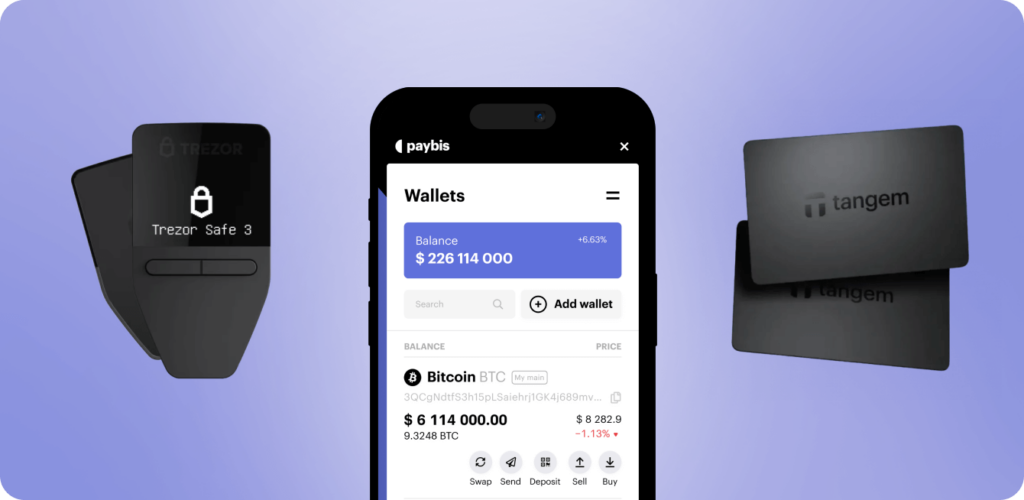
A multi-party computation (MPC) wallet eliminates the single private key. The key is split into shares held by separate parties, and transactions are signed collaboratively without the full key ever existing in one place. That removes the two failure modes businesses fear most: one person losing the key, and one person running off with it.
Compared with the older alternatives, MPC gives multisig-style control without multisig’s on-chain cost and chain-by-chain limitations. It also gives custodial convenience without trusting a provider’s single key store.
Paybis Business Wallets are built on MPC custody, supporting BTC, ETH, SOL, and USDC across the Ethereum, Tron, Polygon, and Base networks. Customizable authorization policies layer on top.
How to Choose: The 6-Point Business Wallet Checklist
Security, compatibility, and usability all matter, and they matter more once a wallet carries company money. These six checks separate a business-grade wallet from a consumer app with a company logo. Run them against any provider before committing.
- Custody model. Who holds the keys, and how? For company funds, the answer should be MPC or multisig with role-based approvals, not a single key on someone’s laptop.
- Licensing, authorization, and registration. Check what the provider actually holds and under which regulator. Paybis holds an EU MiCA CASP authorisation (27-55/2026/6) and a PSD2 Payment Institution licence (27-55/2026/7), and is separately registered with FinCEN in the US and FINTRAC in Canada. Real supervision means KYB, AML, and transaction monitoring are overseen rather than promised.
- Fiat rails. Built-in on/off ramps and bank connectivity (SEPA, SEPA Instant, Faster Payments, SWIFT) decide whether converting and settling is one step or a second vendor.
- Limits and scale. Check per-transaction ceilings against real needs. Paybis business accounts handle $500 to $5,000,000 per transaction, rail-dependent, with OTC execution at the top of that range.
- Integration effort. The gap between a widget-and-dashboard setup and a months-long custody integration project is months of engineering time. Paybis verification completes in under 24 hours, and select integrations go live in under 48 hours.
- Support. Business funds get stuck at 2am too. Expect 24/7 human support and a dedicated account manager.
Paybis OTC & Business Wallets
Paybis offers its own solution for this: the OTC & Business Wallet. It is built for businesses of all sizes adopting crypto for payment operations.
Paybis designed Business Wallets around simplicity and usability. The integration work sits on the Paybis side, so a business does not need an in-house technical team to run it.
The product covers instant deposits, security, global reach, and fiat support. The goal is to make crypto adoption in business operations reliable and secure.
OTC & Business Wallet Features
Paybis has operated in the crypto market since 2014. Business Wallets include these features:
- Extensive crypto management. Store, buy, sell, send, swap, receive, and manage available cryptocurrencies, including Bitcoin (BTC), Ethereum (ETH), Solana (SOL), and stablecoins and USDC, held in MPC custody across the Ethereum, Tron, Polygon, and Base networks.
- Built-in fiat-to-crypto and crypto-to-fiat exchanges. Convert to and from fiat as Business Wallets have integrated on/off ramping for smooth transitions between fiat and crypto.
- Straightforward integration process. Paybis handles the heavy lifting, so integrating Business Wallets does not require an in-house team of technical experts.
- Simplified user experience (UX). Business Wallets come with a minimalistic dashboard, so anyone on the team can navigate the platform and manage digital assets.
- Streamlined onboarding process. Onboarding is one of the biggest obstacles to crypto adoption, either too slow or absent. Paybis verification completes in under 24 hours, and select integrations go live in under 48 hours.
- Global accessibility. Paybis operates in 180+ countries and 48 US states.
- Extensive payment method support. Business Wallets support payment methods like SEPA, Instant SEPA, Faster Payments, and SWIFT Wire.
- Regulated across the EU. Paybis holds an EU MiCA CASP authorisation (27-55/2026/6) and a PSD2 Payment Institution licence (27-55/2026/7), both secured in May 2026, covering regulated crypto and payment services across all 27 EU states.
- Enhanced security & compliance. Paybis protects transactions and digital assets with advanced security measures, including customizable authorization policies, and adheres to Know Your Customer (KYC) and Anti-Money Laundering (AML) standards.
- 24/7 dedicated support. Paybis assigns a dedicated account manager to every client, alongside handling the technical side of the product.
The list does not stop there. Paybis works with every client individually. To learn more, contact the Paybis sales team and explore how the OTC & Business Wallet fits the business.
Choosing with Confidence
The wallet decision looks reversible on paper and is expensive in practice. Migrating custody, retraining a finance team, and re-integrating payment flows all cost more than choosing carefully once. Run the six-point checklist against any provider, match the wallet type to the actual job, and treat licensing and custody model as non-negotiable.
Crypto adoption started as a trend and is now an operational decision. Choosing the right wallet is what makes the integration work, and it opens the digital economy to the business safely. Compare the best corporate crypto accounts if the business needs fiat and crypto in one place.
Paybis specialists can walk through wallet integration questions for a specific business. Businesses that also need named fiat accounts should see the Paybis guide to dedicated IBANs and mass crypto payouts. Book a consultation to get started.
Key Terminology
Custodial wallet: the provider holds the private keys and manages security.
Non-custodial wallet: the business holds its own keys, and the risk of losing them.
MPC (multi-party computation): key shares split across parties, signing without a single complete key.
Multisig: transactions requiring multiple on-chain signatures.
On/off ramp: the conversion layer between fiat and crypto.
KYB (Know Your Business): the corporate version of identity verification.
AML (Anti-Money Laundering): the monitoring and reporting rules a regulated provider operates under.
Volatility: how sharply an asset’s price moves, and the reason merchants settle to fiat on arrival.
FAQ
What Businesses Can Adopt Crypto Solutions?
The business benefits of adopting crypto solutions depend on the industry and the specific use case. Almost any business can adopt cryptocurrencies. Retailers and eCommerce platforms operating globally are the clearest examples.
Adding cryptocurrencies expands reach and opens access to more remote regions through cross-border payments. By adopting cryptocurrencies, these businesses can use blockchain technology for faster, cheaper, and more transparent transactions.
How Do Crypto Wallets for Businesses Work?
Most crypto wallets offer similar features. For businesses, the additions are multiple cryptocurrency and fiat currency support, integrations with payment gateways, and in-depth dashboards for transaction transparency and control.
The provider manages most of the technical work. Businesses get full reports on asset performance plus custom reporting.
How Do I Set Up a Crypto Wallet for My Business?
The process with Paybis is straightforward. Once the details are agreed, Paybis runs an automated onboarding process, and verification completes in under 24 hours. Paybis then handles the technical integration. Contact the Paybis sales team for more information.
What Are the Fees for Using Paybis Business Wallets?
Paybis designed the OTC & Business Wallet to scale with a growing business. Pricing is quoted per account rather than published as a price list.
What Is the Best Crypto Wallet for a Business?
There is no single best: match the wallet type to the job. Payment acceptance needs custodial wallets with fiat settlement, payouts need API infrastructure, treasury needs MPC or multisig custody, and active conversion needs built-in ramps with high limits. Whatever the use case, the six-point checklist above separates business-grade wallets from consumer apps with a company logo.
What Is an MPC Wallet?
An MPC wallet splits the private key into shares held by separate parties, and transactions are signed collaboratively without the complete key ever existing in one place. Businesses use MPC because it removes single-point key loss and insider theft. Paybis Business Wallets use MPC custody for BTC, ETH, SOL, and USDC.
Can an LLC or Company Open a Crypto Wallet?
Yes. Business crypto accounts are opened in the company’s name through a KYB (Know Your Business) process covering registration documents and beneficial owners, the corporate equivalent of individual KYC. Paybis onboards businesses through an automated process, and verification completes in under 24 hours. After that, the wallet, limits, and fiat rails run under the company entity rather than any individual.
Disclaimer: Don’t invest unless you’re prepared to lose all the money you invest. This is a high‑risk investment and you should not expect to be protected if something goes wrong. Take 2 mins to learn more at: https://go.payb.is/FCA-Info