
Paying a Contractor in Stablecoins: What Changes When the Rails Are Regulated

- Paying a contractor in stablecoins now runs on regulated rails in the EU. The whole arrangement sits inside supervised payment law.
- The stablecoin has to be a regulated e-money token. USDC and EURC qualify. Some non-compliant coins left the EU market.
- The provider moving the money needs a MiCA CASP licence. Since March 2026, a provider that moves stablecoins for clients also needs PSD2 payment authorisation.
- Your business does not become a regulated provider by paying in stablecoins, as long as you do not custody or transfer crypto for others.
- Paybis holds both a MiCA CASP authorisation and a PSD2 Payment Institution licence, and runs contractor payouts through Paybis Send.
Paying contractors in stablecoins is not new. Marketplaces and payroll platforms have done it for years to reach people faster and cut cross-border costs. What is new is the rulebook around it.
Since 2026, both the stablecoin and the rails that move it fall under EU regulation. MiCA governs the coin. Payment law governs the transfer. For a business, that turns an operational choice into a supervised payment flow with clearer legal footing.
This guide covers what actually changes. Which stablecoins you can use, and what to check before you route payouts through any provider.
What Does “Regulated Rails” Actually Mean for Stablecoin Payouts?
Regulated rails means two things are now licensed: the stablecoin you pay with and the provider that moves it. The coin has to be a MiCA-authorised e-money token. The provider has to hold a CASP licence and, for stablecoin transfers, payment authorisation.
Before MiCA, a stablecoin payout was a private arrangement. You picked a coin and a provider and hoped both were sound. There was no EU standard for either.
MiCA changed that. It set rules for who can issue a stablecoin and how it must be backed. Separate rules set who can move it for you. Both layers now sit under a regulator that can inspect them and remove a licence.
For a payroll or marketplace operator, this is the change that matters. The rails your contractors get paid on are now supervised, the same way a bank transfer is.
Which Stablecoins Can You Use to Pay an EU Contractor Now?
You can pay with a regulated e-money token, or EMT. These are stablecoins pegged to one currency and issued by a licensed institution. USDC and EURC are the common examples. Coins that did not meet MiCA rules withdrew from the EU market.
Under MiCA, a fiat-backed stablecoin is an e-money token. Its issuer must be an authorised e-money institution or a bank. It has to hold reserves one-to-one and let holders redeem at face value at any time.
Circle, the issuer of USDC and EURC, secured that authorisation in France. Both coins are supported across EU-licensed platforms. A euro contractor can be paid in EURC. A dollar contractor can be paid in USDC.
Some older stablecoins chose to leave the EU rather than apply. If a provider offers you a coin that is not a regulated EMT, treat that as a signal to look closer.
What Changed for the Provider That Moves the Money?
A big change landed in 2026. The EU decided that moving a stablecoin for a client can count as a payment service. So a licensed crypto provider now needs payment authorisation as well as a CASP licence to keep offering stablecoin transfers.
Here is the background. An e-money token is legally a form of electronic money. When a provider transfers it on your behalf, that looks like a payment service under EU law. The European Banking Authority confirmed this view.
A grace period let providers keep operating while the rules settled. That window closed on 2 March 2026. Since then, a provider that transfers stablecoins for clients needs one of two things. It holds payment authorisation itself, or it works with a licensed payment partner.
For you, the practical test is simple. A provider that only holds a CASP licence may not be able to run compliant stablecoin payouts on its own. Ask whether it also holds payment authorisation.
What Does Regulation Change About Your Own Compliance?
Regulation adds checks to the payout, but it does not turn your business into a licensed provider. As long as you do not custody or transfer crypto for other people, you stay a customer of the rails. Your provider’s licence carries the compliance weight.
Two obligations reach the payout itself. First, crypto transfers must carry sender and recipient details under the EU’s Transfer of Funds Regulation. This is the crypto version of the bank Travel Rule. Your provider handles it, but the data has to be collected.
Second, recipients still go through identity checks. A contractor being paid has to be verified, the same as any payee. A good provider runs this in the background through its own KYC process.
So your compliance load stays manageable. You choose a licensed provider and give it accurate recipient information. It carries the regulated parts of the transfer.
What Are the Practical Benefits Once the Rails Are Regulated?
Regulated rails keep the original benefits of stablecoin payouts and add legal certainty. You still get fast cross-border payments at low cost. On top of that, you get a supervised provider and a coin you can always redeem.
The speed advantage remains. A stablecoin payout can reach a contractor in minutes, across borders, without a chain of correspondent banks. This is why marketplaces and payroll platforms adopted it early.
The new part is confidence. A regulated EMT can be redeemed at face value at any time. A licensed provider answers to a regulator. If something goes wrong, there is a supervised entity behind the transfer.
There is also a cleaner audit trail. Every payout carries transfer data and settles on a public ledger. Reconciliation gets easier when each payment has a traceable record.
What Should You Look for in a Stablecoin Payout Partner?
Look for a provider that holds both a CASP licence and payment authorisation. It should also support regulated EMTs and handle Travel Rule data for you, without making you hold crypto on your own balance sheet.
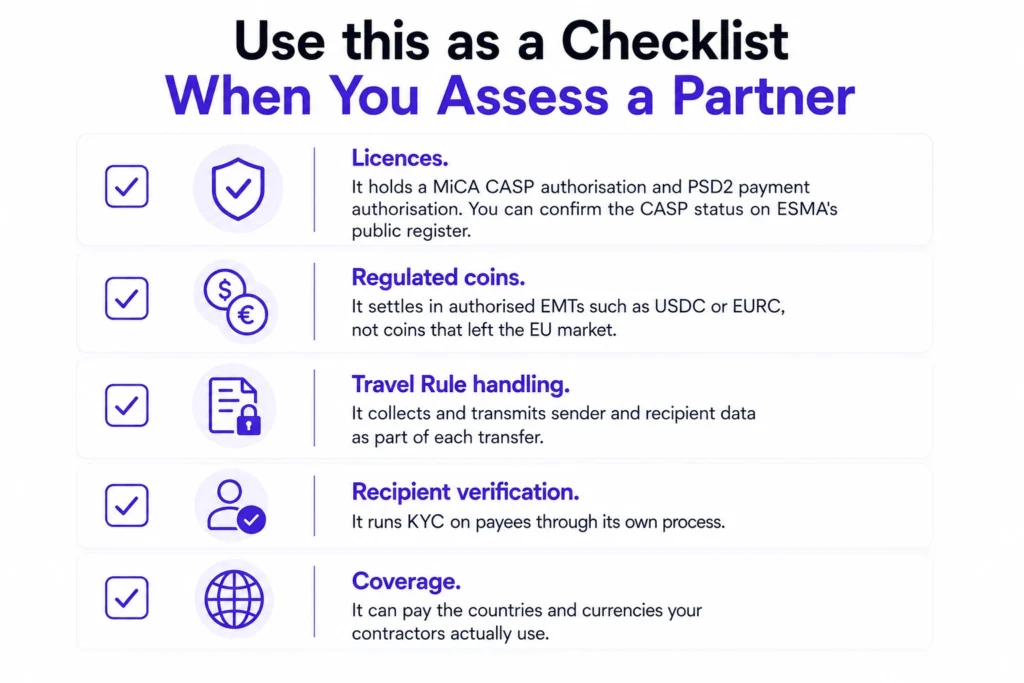
Use this as a checklist when you assess a partner:
- Licences. It holds a MiCA CASP authorisation and PSD2 payment authorisation. You can confirm the CASP status on ESMA’s public register.
- Regulated coins. It settles in authorised EMTs such as USDC or EURC, not coins that left the EU market.
- Travel Rule handling. It collects and transmits sender and recipient data as part of each transfer.
- Recipient verification. It runs KYC on payees through its own process.
- Coverage. It can pay the countries and currencies your contractors actually use.
A provider that meets these points turns contractor payouts into a routine, supervised payment.
How Does Paybis Fit Here?
Paybis holds both licences that regulated stablecoin payouts require. It has full MiCA CASP authorisation from the Bank of Latvia, granted in May 2026. It also holds a PSD2 Payment Institution licence from the same regulator. Both passport across all 27 EU member states.
That combination is the point. The CASP licence covers the crypto side. The Payment Institution licence covers the payment side of moving stablecoins. Together they match what EU rules now ask of a stablecoin payout provider.
Paybis runs business payouts through Paybis Send, its API-based payout product. A business can fund in fiat and pay contractors in crypto across 180+ countries, without holding crypto on its own balance sheet. Stablecoin payouts include USDC.
Paybis has operated since 2014 and serves more than 7 million users. Alongside its EU licences, it is registered with FinCEN in the United States and FINTRAC in Canada. It also holds a VASP registration in Poland and is PCI DSS certified for card security.
Bottom Line
Paying a contractor in stablecoins used to sit in a grey area. It now sits inside a regulated payment flow. The coin is a supervised e-money token, and the rails are run by a licensed provider.
For a payroll platform or marketplace, that lowers the risk of the whole arrangement. You get the speed you always wanted, with a regulator standing behind the transfer.
Paybis holds the MiCA CASP and PSD2 licences these payouts now require. You can run contractor payouts through Paybis Send on rails built for regulated stablecoin payments.
FAQ
Is paying a contractor in stablecoins legal in the EU?
Yes, when you use a regulated stablecoin and a licensed provider. The coin should be an authorised e-money token, and the provider should hold a CASP licence and payment authorisation.
Do I need a licence to pay contractors in stablecoins?
Generally no. If you do not custody or transfer crypto for other parties, you are a customer of the rails. Your payout partner carries the licensing.
Which stablecoin should I use to pay in euros?
A euro-pegged regulated EMT such as EURC. It references the euro one-to-one and can be redeemed at face value.
What is the Travel Rule for crypto payouts?
It is a requirement to include sender and recipient details with each crypto transfer. In the EU it comes from the Transfer of Funds Regulation. Your provider applies it.
Disclaimer: Don’t invest unless you’re prepared to lose all the money you invest. This is a high‑risk investment and you should not expect to be protected if something goes wrong. Take 2 mins to learn more at: https://go.payb.is/FCA-Info