
High-Risk Merchant Crypto Payouts: Why Standard Payment Rails Fail and How PSPs Can Build Resilience
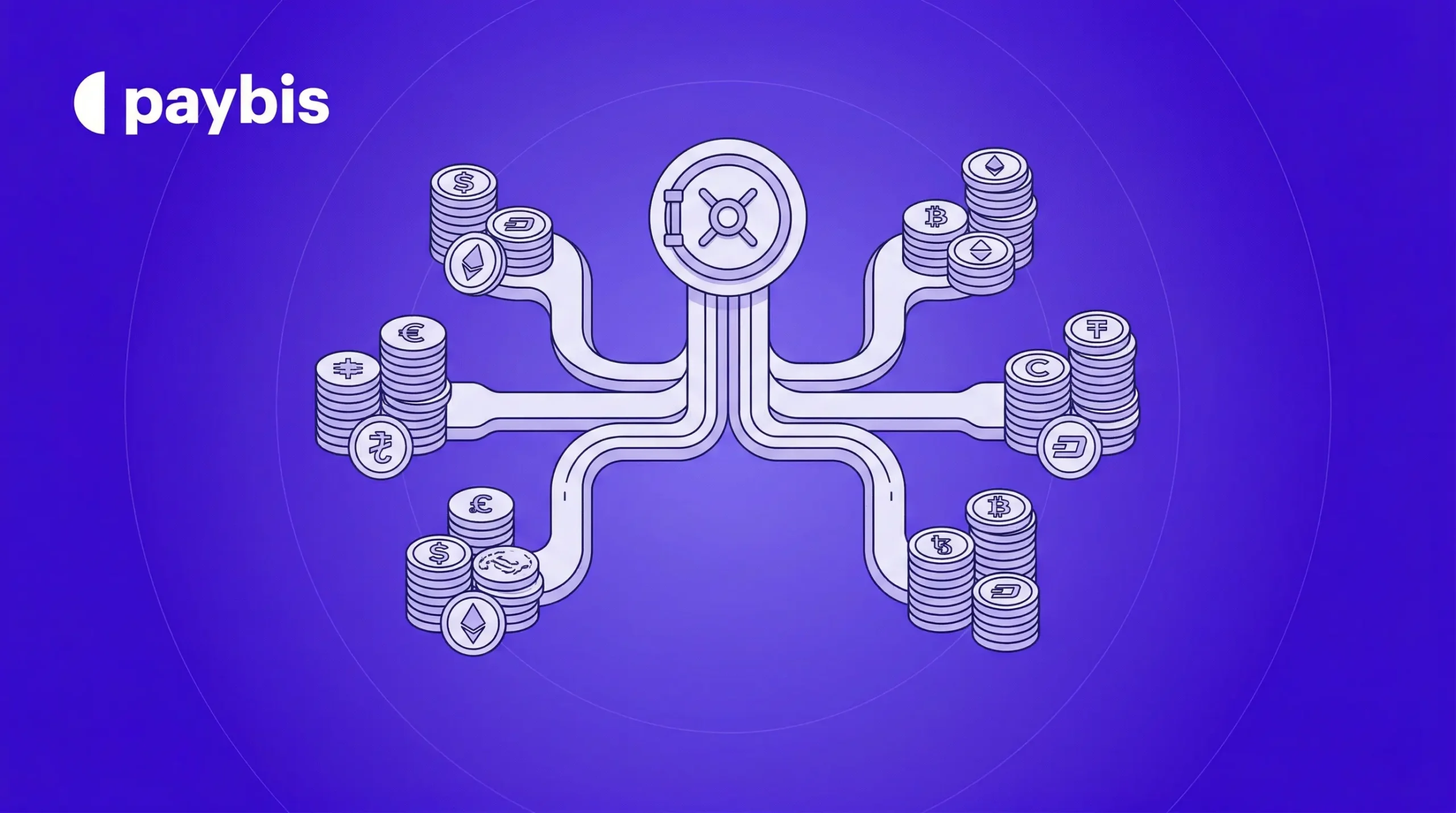
Key Takeaways:Standard payment rails fail high-risk merchants because single-acquirer dependency creates revenue outages, settlement lags lock capital for days, and compliance gaps expose PSPs to regulatory liability across jurisdictions. Purpose-built crypto payout infrastructure solves this through segregated payout layers, stablecoin settlement, and multi-acquirer cascade routing. PSPs must look past headline fees to “net received” across transaction tiers, verify VASP, MSB, and FCA registrations before signing any contract, and validate integration speed before committing engineering resources. Paybis Send and Smart Cascade Routing were built specifically for this challenge.
Crypto assets can increase or decrease in value. Paybis is a payment gateway, not an investment service. This content is for informational purposes only and does not constitute financial advice.
Authorization rates dominate PSP discussions about high-risk merchants while merchant capital sits locked in manual payout queues, rolling reserves, and chargeback disputes for days. The infrastructure gap isn’t just about avoiding chargebacks. It’s about settlement speed, compliance posture, and the resilience to survive a banking partner exit with no warning.
High-risk verticals such as iGaming, nutraceuticals, adult content, and forex often face elevated chargeback exposure and stricter payment processing requirements. While crypto rails can reduce some card-related risks, they also introduce operational challenges such as settlement delays, acquirer dependency, and more complex compliance workflows.
High-Risk Payouts: Unique Demands on Crypto Infrastructure
Crypto settlement infrastructure for high-risk PSPs operates on fundamentally different mechanics than standard card processing. Blockchain networks use consensus mechanisms to validate and finalize transactions, eliminating the reversibility that makes chargebacks possible. But that irreversibility also removes the dispute mediation layer that merchants in regulated verticals rely on for fraud resolution. PSPs serving these categories need infrastructure that replaces it with segregated fund management, on-chain transaction monitoring, and AML reporting.
Controlling Nutraceutical Chargeback Risk
Nutraceuticals sit in one of the highest chargeback categories in card-not-present commerce. Friendly fraud (where a customer disputes a legitimate charge) is endemic to subscription billing models common in this vertical. Crypto’s irreversibility eliminates friendly fraud at the payment layer, but it doesn’t eliminate disputes over product quality or delivery. PSPs must implement off-chain dispute protocols, including escrow-style settlement flows and documented refund policies, to manage post-settlement merchant risk without relying on card network dispute mechanisms.
Settlement Lag and Volatility Buffers
Bitcoin confirmation times run ten minutes per block, and merchants processing high-value transactions typically wait six confirmations before treating settlement as final, meaning up to an hour of exposure per transaction. Ethereum averages twelve seconds per block but still requires multiple confirmations for risk management. The irony for high-risk merchants is that standard crypto rails can introduce settlement lags comparable to the banking rails they were escaping. Compare this to SEPA Instant, which the European Payments Council mandates processes within 10 seconds.
Stablecoins function as volatility buffers in high-risk payout flows. USDC is issued by Circle and USDT by Tether, each backed by USD reserves held by the respective issuer. For merchants receiving payouts in volatile assets, a BTC price move during settlement can erode margins before funds reach their wallet. Routing payouts through USDC or USDT removes that exposure entirely. The PSP wires fiat to the payout provider, who converts it into existing stablecoins such as USDC or USDT, and the merchant receives stable-value funds that can be held or converted to local fiat on demand.
Standard Rails’ Crypto Payout Limitations
Single-Acquirer Dependency Creates Revenue Outages
On-ramps that route all transactions through a single banking relationship have no fallback when that relationship changes. High-risk businesses face elevated account termination risk because acquiring banks apply heightened scrutiny to chargeback ratios, volume spikes, and vertical classification. When an acquirer exits, every payout tied to that relationship halts simultaneously.
Paybis Smart Cascade Routing addresses this structurally. When a card payment fails, the routing engine retries the transaction across multiple acquirers selected by BIN range and regional approval rate, with 3DS (Three-D Secure) authentication decoupled from the retry sequence. The 3DS check happens once and retries run silently across the acquirer network. Paybis’s implementation has increased successful transactions for partners by over 11%, and analysis of intelligent routing implementations in comparable verticals indicates authorization rate improvements of 5 to 15%.
Untangling Multi-Jurisdiction Crypto Regulations
A PSP operating across EU, UK, US, and APAC markets faces a different regulatory framework in each jurisdiction. In the US, FinCEN classifies cryptocurrency providers as money transmitters requiring MSB registration, with state-level licenses adding requirements in most states. In Europe, MiCA came into full effect in December 2024, creating a unified licensing framework for VASPs across all 27 member states. Obtaining independent multi-jurisdiction compliance coverage is a significant regulatory undertaking before processing a single transaction.
Paybis absorbs this overhead through existing registrations: MiCA CASP authorisation from the Bank of Latvia, which passports across all 27 EU member states, FinCEN MSB in the US (covering 48 states, excluding New York and Louisiana), FINTRAC in Canada (national coverage), FCA in the UK, and VASP in Poland (RDWW-805, covering Poland as the registered jurisdiction). Partners inherit this coverage on day one.
Optimizing High-Risk KYC Flow
Mandatory identity verification before the first transaction kills conversion in high-risk categories where users expect immediate access. Paybis’s No-KYC flow allows transactions up to $1,000 per user per year via background compliance checks, with standard KYC (photo ID plus selfie) completing typically within 2 minutes for higher thresholds. For high-risk merchants whose users transact at low-to-moderate initial values, this preserves conversion without creating compliance gaps.
Crypto Payout Auth Gaps by Vertical
Authorization rate performance in high-risk verticals degrades faster than in standard categories because issuing banks apply additional fraud scoring to BINs associated with these merchant category codes. Without multi-acquirer routing, a PSP sees an irreducible floor on approval rates. With cascade routing and BIN-level optimization, Paybis partners have documented successful transaction increases of 11%+.
Merchant Crypto Payouts: Current Pain Points
Direct Wallet Payout Limitations
Manual wallet-to-wallet transfers become difficult to manage at mass payout scale. Operators disbursing commissions to hundreds of affiliates across multiple countries must handle recipient address verification, chain-specific network fees, reconciliation across blockchain networks, and failed transaction handling. Purpose-built payout infrastructure such as Paybis Send centralizes these workflows through a pre-funded fiat account, API-driven batch payouts, and transaction monitoring tools designed for operational visibility.
That visibility is especially important in segregated payout environments, where operators need transaction-level tracking across merchant or affiliate sub-accounts. Funds are delivered to an external wallet address supplied by the recipient, or held in a Paybis custodial wallet where private keys and assets are secured by Paybis on the recipient’s behalf.
Cost of Workarounds: Spread, Delay, and Compliance Risk
PSPs that piece together payout infrastructure from multiple vendors typically discover the cost in three places: FX markup embedded in conversion rates, settlement delays from manual batch processing, and compliance exposure in markets where no vendor has confirmed VASP or MSB registration. The table below compares payout architectures across the dimensions that matter most.
Table 1: Payout architecture comparison for high-risk merchants. Traditional and standard crypto rails introduce chargeback risk or settlement delays that purpose-built infrastructure eliminates.
| Feature | Traditional Rails (SWIFT/Wire Transfer) | Crypto Rails (Standard) | Purpose-Built Crypto (Paybis Send) |
|---|---|---|---|
| Chargeback risk | High | None (irreversible) | None (irreversible) |
| Settlement time | 2–5 business days | 10 min to 1 hour | Fast settlement (network-dependent) |
| Fee transparency | Low (hidden FX fees) | Variable (often embedded spreads) | High (upfront net received) |
| High-risk suitability | Poor (account freezes) | Limited (acquirer risk) | Purpose-built and underwritten |
| Regulatory coverage | Per-jurisdiction | Varies by provider | Inherited (MiCA CASP, PSD2 PI, FinCEN, FINTRAC, VASP Poland) |
The Case for Segregated, Purpose-Built Mass Payout Layers
Segregated payout layers in crypto differ from traditional banking segregated accounts. In crypto infrastructure, merchant sub-accounts use isolated on-chain addresses, preventing cross-contamination between merchant funds for AML purposes. For PSPs serving regulated high-risk categories, this architecture is essential.
Stable Crypto Payouts via Multi-acquirer Fallback
Routing logic in a purpose-built payout layer functions across two dimensions: payment method and acquirer. When a card transaction fails on the primary acquirer, the cascade engine selects the next best acquirer based on BIN match and historical approval rate for that card type and region. The user completes one 3DS authentication challenge regardless of how many acquirer attempts occur behind the scenes. Paybis 150+ PSP integrations mean the acquirer pool available for cascade is broad enough to maintain coverage even when individual banking relationships shift.
Audit Your Crypto Payout Transparency
The difference between an advertised fee and the actual amount received can materially affect payout costs. Some providers may apply additional spread or conversion costs that are not reflected in the headline service fee alone. “Net received” refers to the final crypto or fiat amount delivered to the recipient after applicable fees, spreads, and network costs are applied.
Displaying estimated net received amounts during the quote stage can help operators evaluate expected settlement outcomes before transaction execution.
Fast Crypto Settlements: Your Competitive Edge
SWIFT cross-border settlement runs two to five business days depending on correspondent banking chains and time zone overlap. For a high-risk merchant paying affiliates in Southeast Asia, Latin America, or sub-Saharan Africa, that lag is a churn trigger. Crypto rails settle significantly faster regardless of geography. Stablecoin payouts remove the FX exposure that traditional cross-border wires carry, delivering a fixed USD-equivalent value to the recipient wallet in near real-time. For PSPs competing on payout speed, this is a measurable edge over traditional rails.
What PSPs Must Implement to Serve High-Risk Merchants Profitably
Crypto Payout License Requirements
The minimum viable compliance stack for a PSP offering crypto payouts across US, EU, and UK markets includes MSB registration with FinCEN, FINTRAC registration for Canada, VASP registration in at least one EU member state under MiCA, and FCA registration or authorized partnership in the UK. Each license type carries different AML reporting obligations and transaction monitoring thresholds. [Paybis compliance registration page](https://support.paybis.com/hc/en-us/articles/5118098190237-Do-you-have-permission-to-provide-crypto-services?) documents the specific registration numbers and scope for each jurisdiction currently in force.
Streamlining KYC for Higher Funnel Conversion
The Paybis No-KYC flow enables the majority of first-time users in eligible countries to transact up to $1,000 per year without document upload. Standard KYC via photo ID and selfie completes typically within 2 minutes for higher thresholds. For high-risk merchants whose user base includes first-time crypto buyers, this approach reduces the primary abandonment point in the funnel.
Branded Crypto Payouts, No Dev Work
URL redirect integration goes live in minutes. The checkout page is hosted with your branding and handles every layer underneath: payment processing, KYC, AML monitoring, fraud prevention, and acquirer routing. Full SDK (Software Development Kit) integration on iOS, Android, or web launches in hours, not sprints. No backend is required for the initial integration, meaning engineering resources remain on the core product roadmap rather than on compliance infrastructure.
How to Evaluate Payout Solutions for High-Risk Categories
True Payout Costs Across Tiers
Model costs using the all-in framework: provider base rate plus partner margin plus network fees. Paybis B2B base rate starts at 0.49% per transaction, and you set your own end-user margins above that floor. Here’s what net received looks like at three common transaction tiers:
- $1,000 transaction: $4.90 base fee. At 2% end-user pricing, you keep $15.10 margin per transaction.
- $5,000 transaction: $24.50 base fee. At 2% end-user pricing, you keep $75.50 margin per transaction.
- $10,000 transaction: $49 base fee. At 2% end-user pricing, you keep $151 margin per transaction.
Some providers advertise base fees that exclude FX spread embedded in conversion rates. At a $10,000 transaction, a 2-3% embedded spread would cost $200-$300 more than the headline fee suggests. Request net received comparisons at these exact tiers from any vendor before accepting headline fee claims.
VASP & MSB License Verification
Use this checklist to verify a payout provider’s regulatory coverage before integration:
- Request registration numbers directly for FinCEN MSB, FINTRAC, VASP, and FCA registrations.
- Verify FinCEN registration on the FinCEN MSB Registrant Search using the provided number.
- Cross-reference FINTRAC registration on the FINTRAC MSB Registry with the Canadian registration number provided.
- Check VASP registration against the relevant national competent authority in the EU member state where the vendor holds its license.
- Request SOC 2 Type II or SOC 1 Type II documentation (System and Organization Controls audits that independently verify a provider’s security, availability, and processing integrity controls) confirming audited controls for custody and transaction handling.
- Confirm asset segregation proof: ask for documentation showing client fund isolation from operating capital and insurance coverage scope.
- Verify geographic exclusions: Paybis covers 48 US states but excludes New York and Louisiana. Confirm the exclusion list for any vendor before assuming full coverage.
Validate Integration Speed in Sandbox
Test integration speed claims in the sandbox before committing to any internal timeline. Here’s your validation checklist:
- Request API documentation and a test environment: confirm the provider can demonstrate the integration flow before you commit development resources.
- Clock time-to-first-transaction: the Paybis URL redirect option has no backend requirement, so you’re measuring pure configuration time, not development time.
- Test cascade routing behavior: simulate a failed card transaction and verify it retries across acquirers with one 3DS check.
- Validate the net received display: confirm all fees appear before checkout, not after payment details are entered.
- Request reference calls: ask for integration timelines from PSPs processing comparable volume in your vertical.
Incident Resolution for Payout Resilience
Uptime percentages don’t capture what matters during an outage: detection speed, merchant notification timeline, and resolution time. Paybis operates at approximately 99.4% platform uptime with 24/7 support and an average response time of one to two minutes. Before signing any infrastructure contract, request an incident response log covering the last three significant events, including root cause, detection time, and resolution timeline.
Troubleshooting High-Risk Crypto Payments
Identifying High-Risk Crypto Merchants
PSPs differentiate risk assessment across verticals using chargeback history, vertical classification, average transaction value, and geographic distribution of end users. Adult content, iGaming, forex, and nutraceuticals carry the highest classification risk because each vertical has documented histories of elevated chargeback rates and regulatory scrutiny.
For crypto payout specifically, add on-chain risk variables: wallet address screening results, transaction velocity relative to account age, and counterparty wallet risk scores.
Standard PSP Limits for High-Risk Crypto
Standard payment processors impose rolling reserves of 5 to 15% of sales, held for 90 to 180 days, on high-risk merchants. Volume caps restrict monthly processing regardless of merchant demand. For PayFac flow transactions, Paybis absorbs chargeback liability, which reduces the reserve pressure that standard processors impose on high-risk categories. Transaction size limits for corporate ramps run from $1,000 to $5,000,000 per transaction, accommodating high-volume merchants that standard rails cannot serve at scale.
Benchmark Crypto Payout Rates by Vertical
Industry benchmarks for card-funded crypto authorization rates across standard categories typically range in the low-to-mid 70s percentage points. Purpose-built cascade routing with multi-acquirer fallback increases successful transactions by 11%+ for Paybis partners. For high-risk verticals, the unrouted baseline tends to sit below the standard category average due to elevated scrutiny.
Industry analysis indicates intelligent routing delivers authorization recoveries in the 5 to 15% range, translating to significant recovered transaction volume at scale. The baseline to benchmark against is your current approval rate by BIN and region, not a blended average.
How Do I Verify a Payout Provider’s Compliance Coverage?
Start with the public registries. FinCEN’s MSB Registrant Search accepts registration numbers and returns the registered name, date, and activity type of any registered money services business. For VASP registration in the EU, check the relevant national competent authority in the member state where the vendor claims registration. For FCA registration in the UK, the FCA Register is public and searchable by firm name or reference number. If a vendor cannot provide a specific registration number for any jurisdiction they claim to cover, treat that jurisdiction as uncovered until they can.
Ready to validate these claims against your stack? Document your time-to-first-transaction against the integration method you select, or request a custom net received comparison for your exact transaction tiers and primary payment methods.
Key Terminology
- Net received: The final amount of cryptocurrency or fiat that a recipient actually receives after all service fees, processing fees, spread, and network fees are deducted from the gross payout amount. It is the only all-in metric that accurately reflects true transaction cost.
- Cascade routing: A payment orchestration method where failed transactions are automatically retried across multiple acquirers in sequence, selected by BIN range and historical approval rate, with 3DS (Three-D Secure) authentication decoupled from the retry sequence so the user authenticates only once.
- Segregated payout layer: A crypto custody and disbursement architecture where merchant or client sub-accounts maintain isolated fund balances, preventing cross-contamination between merchant funds for AML purposes and protecting client assets from custodian insolvency.
- VASP registration: Virtual Asset Service Provider registration, required under national VASP frameworks and EU MiCA, authorizing a company to offer crypto exchange, custody, or transfer services. Registration is jurisdiction-specific and must be verified against the relevant national competent authority’s public registry. Note: VASP registration does not grant EU passporting rights; only CASP authorization under MiCA provides passporting.
- Authorization hold: A temporary reservation of funds placed on a payment method to confirm that a sufficient balance or credit is available before a transaction is finalized, settled, or captured. The held amount is typically released if the transaction is cancelled or not completed within the issuer’s defined timeframe.
- KYC (Know Your Customer): A compliance process used to verify a customer’s identity, assess potential risk, and confirm relevant personal or business information before providing financial services. KYC procedures commonly include identity verification, document review, and risk-based due diligence requirements.
- AML (Anti-Money Laundering): A set of compliance controls, monitoring procedures, and reporting obligations designed to detect, prevent, and investigate potentially illegal financial activity, including money laundering, fraud, sanctions evasion, and terrorist financing.
FAQ
What Makes a Payment Rail "High-Risk" for Crypto Merchants?
A payment rail is classified as high-risk when the underlying banking relationship imposes rolling reserves, volume caps, or elevated chargeback monitoring due to the merchant’s vertical classification (iGaming, adult, nutraceuticals, forex). High-risk rails also face higher card decline rates at the issuer level.
What Is the Minimum Licensing Required to Offer Crypto Payouts in the US and EU?
In the US, a provider needs FinCEN MSB registration plus state money transmitter licenses in any state where users transact. In the EU, two frameworks currently coexist. VASP (Virtual Asset Service Provider) registration, such as Paybis’s Poland registration (RDWW-805), is a national-level authorization under pre-MiCA member state law that remains valid but does not grant passporting rights beyond its registered jurisdiction. CASP (Crypto-Asset Service Provider) authorization under MiCA, which came into full effect in December 2024, is the current EU-wide framework where authorization in any one member state grants passporting rights across all 27 EU member states.
How Does "Net Received" Differ from the Advertised Fee on a Crypto Payout?
Net received is the actual amount of crypto or fiat the recipient receives after all fees and spreads are deducted, while the advertised fee often excludes the spread embedded invisibly in the exchange rate. A provider advertising 1% can still deliver less crypto than one advertising 1.5% if the former bundles a 2% spread into the rate, meaning at a $10,000 transaction the hidden spread costs the merchant $200 more than the headline suggests.
How Long Does It Take to Go Live with a Crypto Payout Integration?
A URL redirect integration with Paybis Send goes live in minutes, with no backend development required, and full SDK (Software Development Kit) integration on web, iOS, or Android launches in hours. Licensing and compliance coverage is inherited on day one, removing the 12 to 24 month build queue that independent licensing would otherwise impose.
Disclaimer: Don’t invest unless you’re prepared to lose all the money you invest. This is a high‑risk investment and you should not expect to be protected if something goes wrong. Take 2 mins to learn more at: https://go.payb.is/FCA-Info