
Getting a Crypto License in 2026: Step-by-Step Guide
- The most common reason applications fail is weak compliance infrastructure. Regulators check that it is actually running, not only that it has been written down.
- Banking must start in parallel with licensing. A licence does not come with a bank account, and most banks require at least a draft application before they will engage.
- 48% of crypto firms hire legal consultants to manage the process. The cost is consistently less than a rejection and a second attempt.
- The MiCA CASP authorisation covers all 27 EU member states from one application, making it the most commercially efficient licence available in 2026.
- Responding slowly to regulator follow-up is the second most common cause of delays after poor preparation.
- While your licence is in progress, the Paybis on/off-ramp lets you serve customers through a CASP-licensed partner.
Most founders who go through the crypto licensing process say the same thing afterwards: they wish someone had told them what it actually involved. The timeline slips. The capital requirement is higher than expected. A key person fails their fit-and-proper check two weeks before submission. The banking setup falls through after the licence arrives because nobody started those conversations early enough.
None of these are unavoidable. They happen because licensing is treated as a form-filling exercise rather than an operational build. This guide covers the full process in sequence, including the steps most articles skip.
Step 1: Define Your Business Model and Services
At a glance:
- Write a description of what your platform does with customer funds
- Map each service to a licence category before choosing a jurisdiction
- The service flow document becomes the foundation for everything that follows
The licence type you need is determined by what your business actually does. Choosing a jurisdiction before answering this question is the single most common sequencing mistake, and it costs time.
The questions to answer are specific. Does your platform hold customer funds, or does it only facilitate transfers between wallets the customer controls? Do you execute trades for clients, or do you operate an order book where users trade against each other? Do you give advice on crypto assets, or do you only provide information?
Each distinction maps to a different service category. Under MiCA, ten service categories exist, each with different capital requirements and review scope. Start with a written description of the service flow: who the customer is, what they do on your platform, what your platform does with their assets, and how funds move in and out. That document drives every decision that follows.
For a breakdown of which business models map to which licence types, the types of crypto licences guide covers every major framework.
Step 2: Choose Your Jurisdiction
At a glance:
- Target market determines which licence you actually need, matching it to where your users actually are
- Timeline, regulator experience, and banking availability all matter as much as capital requirements
- A licence in a jurisdiction without workable banking solves half the problem
With a clear service description in hand, the jurisdiction question becomes answerable. Without it, jurisdiction selection is guesswork.
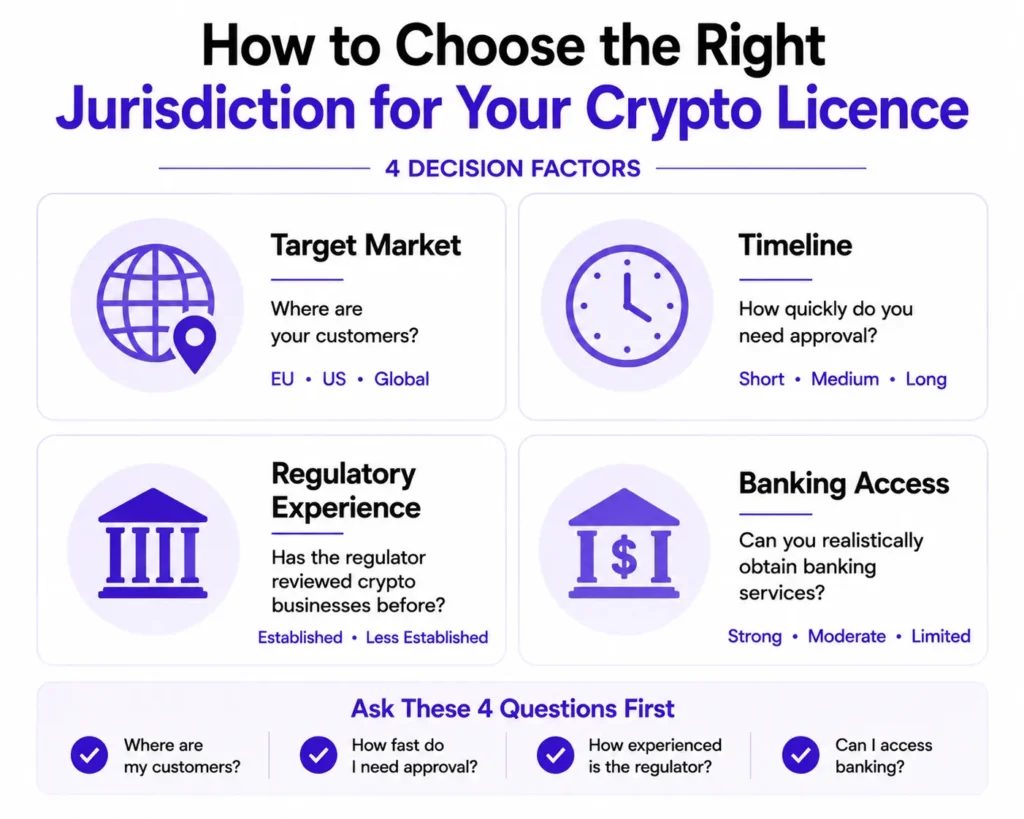
- Target market first. A CASP licence in the EU covers all 27 member states through passporting. If your users are in Europe, licensing there is the most efficient structure. If your users are in the US, FinCEN MSB registration and state-level Money Transmitter Licences apply regardless of where the company is incorporated.
- Regulatory timeline. Lithuania and the Czech Republic have processed CASP applications in six months. Singapore regularly takes over twelve. New York’s BitLicense takes one to two years. Speed to market is a real variable in this decision.
- Regulator familiarity with crypto. Malta’s MFSA and Ireland’s CBI have reviewed crypto licensing applications for years. Regulators newer to the sector can be unpredictable. A predictable review is often worth more than a nominally faster one that stalls halfway through.
- Banking availability. This is covered fully in Step 8, but it belongs here too. Switzerland has Sygnum and SEBA. Latvia and Lithuania have established crypto banking relationships. A licence in a jurisdiction where you cannot open a bank account is an incomplete solution.
The crypto licences by country guide covers capital requirements, timelines, and banking options across every major jurisdiction. For EU licensing specifically, the How to get a crypto licence in Europe guide goes deeper on the MiCA CASP process.
Step 3: Engage Legal and Compliance Advisors Early
At a glance:
- Regulatory lawyers know what the regulator actually expects, beyond the official guidance
- The compliance officer must typically be named in the application itself
- Advisory costs typically run €80K–€250K, consistently less than a failed first attempt
Once the jurisdiction is chosen, bring in legal and compliance support immediately. This is not a step to defer until the application is ready to submit.
Regulatory lawyers who have submitted applications to your target regulator before know what the reviewers actually look for, beyond what is written in the official guidance. They also catch gaps before submission. That matters because the completeness check, which resets the review clock if anything is missing, is avoidable with proper preparation.
On the compliance side, most jurisdictions require a qualified MLRO or AML specialist to be named in the application with verifiable credentials. Hiring this person early means they can build the AML program during the preparation phase. Appointing them on paper at the last moment leaves you with a programme that looks right but has no operating history, which regulators detect quickly.
Total spend on legal and compliance advisors for a first application typically runs between €80,000 and €250,000. That number is significant. It is consistently less than the cost of a rejection and a second attempt.
Step 4: Set Up Your Legal Entity
At a glance:
- The entity must be registered and operational before the application can be submitted
- Regulators check for genuine substance: real office, real staff, demonstrable local activity
- Set up the entity structure correctly now. Unwinding a rushed structure later is expensive
With advisors engaged, the entity can be built correctly from the start. Rushing this step to meet a deadline creates problems that surface during the review.
For a MiCA CASP application, the EU entity needs a registered office address, a local bank account, and genuine activity in the jurisdiction. A forwarding address and no local staff fails the substance requirements. Most regulators conduct a physical office visit during the review process.
In the US, the entity must be incorporated at the state level and registered in each state where it plans to operate, alongside the federal FinCEN MSB registration.
Entity structure also affects tax, investor relations, and future capital raising. Getting it right at this stage is worth the time it takes. Getting it wrong is worth considerably more to undo.
Step 5: Build Your Compliance Infrastructure
At a glance:
- This is where most applications fail. Regulators check that the compliance program is actually running, with evidence of operation
- AML policy, governance, IT security, and minimum capital all must be in place before submission
- Starting this in parallel with entity setup saves two to four months in most applications
With the entity registered and operational, the compliance build begins. This is the heaviest step in the process, and it is where most applications either succeed or quietly fall apart.
Regulators review compliance for substance. An AML policy downloaded from a template and signed without evidence of implementation gets identified during review. The questions that follow ask for proof the policy has actually been applied. Answering those questions can take months and delays the whole process.
What the compliance build covers:
- AML and KYC program. A risk-based policy built around how your specific business model generates risk. Generic templates will be flagged. The crypto compliance guide covers what each layer needs to include.
- Governance documentation. Org charts, board terms of reference, role descriptions, and documented decision-making processes. The regulator will test whether the governance described on paper actually functions in practice.
- IT security documentation. Under DORA, IT risk frameworks, vendor assessments, and incident response procedures must be documented. Penetration testing records are expected for exchange and custody applications.
- Minimum capital in the entity. The required capital must be in the entity’s accounts and verifiable at submission. Applying before the capital is there is a straightforward rejection.
Starting this build at the same time as entity setup, rather than after it, saves between two and four months in most applications.
Step 6: Run Fit-and-Proper Checks on Key Personnel
At a glance:
- Every director and key function holder is individually assessed by the regulator
- One person who fails this check can block an otherwise complete application
- Run these checks internally before submission to address any issues in advance
While the compliance infrastructure is being built, the people running it need to pass their own separate review. This step catches founders off guard more often than any other.
Fit-and-proper checks cover criminal record, prior regulatory sanctions, and professional credentials relevant to the role. In some jurisdictions, regulators assess the educational background of the compliance officer and want evidence of genuine authority, not simply a named appointment.
The practical approach is to run these checks internally before submission:
- Background checks on every named key person
- Professional history documentation and qualification records for each
- Early identification of any issues, with time to address them before submitting
A finding surfaced during the regulator’s own review, rather than yours, is one of the most common causes of applications stalling for months. The difference is simply who finds it first.
Step 7: Open Pre-Application Dialogue With the Regulator
At a glance:
- Most regulators offer pre-application meetings and expect serious applicants to use them
- The meeting confirms what the regulator actually wants, beyond what the official guidance says
- Prepare this meeting as thoroughly as the application itself
With the team cleared and the compliance build underway, the first formal contact with the regulator should happen before submission. Most offer pre-application meetings, and using them is close to mandatory for a first-time applicant.
The meeting gives you a direct channel to confirm expectations, flag anything unusual about your business model, and begin a working relationship before the formal review clock starts. Regulators who know the business before the application lands tend to be more forthcoming with feedback during the review.
Prepare for the meeting seriously. A clear summary of the business model, the planned compliance structure, and specific questions about areas of uncertainty signals that the business is ready. Coming in without preparation signals something else, and that impression follows the application.
The pre-application meeting is also the right moment to confirm the completeness requirements for your specific jurisdiction. Every framework has documentation expectations beyond the official guidance. The regulator will tell you what they specifically need to see.
Step 8: Start Banking Conversations in Parallel
At a glance:
- A crypto licence does not guarantee a bank account. This is the step most founders discover too late
- Tier-one banks frequently decline crypto clients regardless of regulatory standing
- Banking conversations must start during the compliance build phase, not after the licence arrives
This is the step most founders skip and then regret.
A crypto licence does not come with a bank account. Tier-one traditional banks frequently decline crypto clients regardless of their compliance status. The realistic banking universe for a newly licensed crypto business is a set of crypto-friendly banks, EMI providers, and payment processors who will only engage once there is a draft application or a letter of intent from the regulator in hand.
That means banking conversations need to start during the compliance build phase. The typical sequence:
- Identify banks and EMIs in your target jurisdiction with a track record of onboarding licensed crypto businesses
- Make initial contact during the preparation phase, before submission
- Share your regulatory status and intended licence type
- Progress the account opening in parallel with the review
Waiting until after the licence arrives adds three to six months to the timeline in many jurisdictions before the business becomes operationally functional. In some markets, the gap between receiving the licence and being able to use it is longer than the review process itself.
One more uncomfortable reality: the best jurisdiction for licensing is sometimes different from the one with the best banking options. Building a decision that accounts for both at the outset is worth the extra time it takes.
Step 9: Prepare and Submit the Application
At a glance:
- The application must be complete at submission. A missing document stops the review clock
- Completeness and organisation signal to the regulator how the business runs
- Submitting everything in one clean package is worth taking the extra time
With banking in progress and the preparation complete, the application can be assembled and submitted. This stage is less about creativity and more about completeness.
Most licensing applications require:
- Completed application form from the regulator
- Business plan with the operating model, target markets, and financial projections
- Governance documentation: board composition, internal controls, and compliance structures
- AML and KYC policy documentation
- IT security documentation and infrastructure description
- Background checks and biographical profiles for all key persons
- Evidence of minimum capital in the entity’s accounts
- Application fee
The completeness check happens before the formal review clock starts. A single missing document stops the clock, and it does not restart until the missing material is accepted. One gap in an otherwise complete application can cost weeks.
Submitting with everything in place and well-organised tells the regulator something about how the business runs. Submitting with gaps and expecting to fill them during review tells them something different.
Step 10: Work Through the Review
At a glance:
- Statutory timelines are the floor. Actual reviews consistently take longer
- Follow-up questions from the regulator are normal and not a negative signal
- Responding within 48 hours consistently is the most effective way to keep the timeline on track
Submission is not the end of the work. The review starts immediately, and how the business handles the next few months determines whether the timeline stretches or holds.
Statutory review periods vary: 25 working days for MiCA CASP applications, three to six months for most VARA applications in Dubai, up to twelve months for Singapore MAS. These are the statutory periods. Actual timelines extend when follow-up questions require detailed responses.
Follow-up questions are normal in almost every application. They are a sign the regulator is engaged. What matters is response time and quality. The practical approach:
- Designate a single point of contact for all regulator communications
- Reply to every question within 48 hours where possible
- Provide complete, specific answers rather than general reassurances
- If a question touches on something that needs correcting in the application, address that directly
The quality of engagement during the review shapes the relationship that follows the licence grant. Regulators notice which businesses take it seriously.
Step 11: Maintain the Licence
At a glance:
- The compliance infrastructure built for the application now becomes the permanent operating model
- Annual audits, regulatory reporting, and incident reporting obligations start from day one of authorisation
- Material changes to the business trigger notification requirements with strict timelines
When authorisation arrives, the compliance function shifts from a build project to an operating function. The infrastructure that passed the application is now the infrastructure required to keep the licence.
Annual audits assess whether the AML program is functioning, whether capital is maintained, and whether governance reflects how the business actually operates. Regular reports on transaction volumes and material incidents go to the regulator. Under DORA, major IT incidents must be reported within hours. Under MiCA, suspicious activity reports must be filed within five business days of the detection that triggers the obligation.
Material changes, including new products, management changes, and ownership restructuring, trigger notification requirements with defined timelines. These are not optional disclosures.
The compliance function built before the application is the ongoing operating model of the licensed entity. For a full breakdown of what the ongoing obligations look like in practice, the crypto exchange regulations guide covers each requirement in detail.
What If You Need Licensed Infrastructure Before Your Licence Is Ready?
The licensing process typically takes six to eighteen months. For businesses that want to serve customers during that period, integrating a CASP-licensed partner is the practical path.
Paybis holds the MiCA CASP licence and the PSD2 Payment Institution licence, both issued by the Bank of Latvia in May 2026. The CASP licence covers all 27 EU member states. Alongside that, Paybis holds FinCEN MSB registration in the US, FINTRAC registration in Canada, VASP registration in Poland, and FCA authorisation in the UK.
The Paybis on/off-ramp allows businesses to offer crypto buy, sell, and swap functionality through a licensed integration. KYC, AML, and Travel Rule compliance are handled on the Paybis side. Your licensing process does not need to pause your business.
The Paybis Corporate On/Off Ramp handles institutional-scale operations including KYB for corporate clients. The full context of what the Paybis licensing process involved is in the official MiCA and PSD2 licence announcement.
Bottom Line
Getting a crypto licence is a process that rewards preparation and punishes shortcuts. The compliance infrastructure has to be built before submission and demonstrably operational. Banking has to be arranged during the licensing process, running in parallel, because the account will not open on the strength of a licence alone. Key people have to be assessed before their names appear on the application. Follow-up questions during review have to be answered fast and completely. The businesses that handle this well treat licensing as an operational build. The ones that treat it as a form-filling exercise tend to find out what that distinction costs when the completeness check comes back with gaps.
FAQ
How long does it take to get a crypto licence?
Timeline depends on jurisdiction and preparation quality. In efficient EU jurisdictions like Lithuania or the Czech Republic, a well-prepared MiCA CASP application can complete in six to eight months. Singapore’s MAS process regularly takes twelve months or more. New York’s BitLicense typically takes one to two years. Dubai’s VARA process runs twelve to twenty-four months depending on the licence category. The statutory review period in each jurisdiction is defined, but actual timelines extend with pre-application preparation, completeness checks, and response cycles during review. Budget for longer than the statutory period in any jurisdiction.
How much does it cost to get a crypto licence?
First-year costs vary significantly by jurisdiction and business scale. In an efficient EU jurisdiction at startup scale, total first-year costs including legal fees, compliance build, capital requirement, annual audit, and compliance officer salary typically run between €250,000 and €500,000. At exchange scale, the same items run €500,000 to €2,000,000. New York’s BitLicense adds surety bond requirements that push costs higher. Offshore jurisdictions like El Salvador or Cayman can be accessed for a fraction of these costs, but the commercial value of the resulting licence is proportionally lower. The crypto licences by country guide includes cost breakdowns for fifteen jurisdictions.
What is the most common reason crypto licence applications are rejected?
Weak compliance infrastructure is the leading cause. Regulators reject applications that present AML policies without evidence they have been implemented, name a compliance officer without demonstrating genuine authority, or describe governance structures that do not match how the business actually operates. Incomplete documentation at submission, which triggers a completeness hold and resets the review timeline, is the second most common cause. Management suitability issues discovered during the regulator’s review of key persons that were not identified during preparation come third.
Do I need a local office to get a crypto licence?
In most jurisdictions that offer meaningful licensing, yes. MiCA CASP applications require genuine substance in the EU member state where the application is made: a real office, local staff, and demonstrable economic activity. Singapore’s MAS requires a resident director and local presence. Dubai’s VARA requires a physical office. Jurisdictions that accept virtual addresses or minimal presence tend to be the lighter-touch offshore registrations, where the resulting licence carries proportionally less commercial weight.
Can I apply for multiple licences at the same time?
Yes, and most serious operators do. A MiCA CASP licence and a FinCEN MSB registration are commonly pursued simultaneously by businesses targeting both EU and US markets. The applications are separate processes with different regulators, and progress in one does not affect the other. Running parallel applications requires enough qualified legal and compliance resource to manage both without compromising either.
Disclaimer: Don’t invest unless you’re prepared to lose all the money you invest. This is a high‑risk investment and you should not expect to be protected if something goes wrong. Take 2 mins to learn more at: https://go.payb.is/FCA-Info