
Europe’s Crypto Regulation Landscape: MiCA & Beyond
- MiCA is the EU’s single rulebook for crypto, and it replaces a patchwork of national regimes across all 27 member states.
- The grandfathering window for unlicensed platforms closes on July 1, 2026, with no extension.
- MiCA is only the headline act. Several other rules run alongside it, including the Travel Rule and DORA.
- One MiCA CASP authorisation lets a platform serve clients across the entire EU.
- If you want a licensed European platform to start with, you can buy crypto on Paybis in minutes.
For years, crypto regulation in Europe meant 27 different answers to the same question. Each country wrote its own rules, and a platform that was legal in one place could be barred in the next. MiCA changed that.
The Markets in Crypto-Assets Regulation gives the EU a single rulebook for crypto, and 2026 is the year it bites. On July 1, the grace period for platforms still running on old national licences ends. After that date, an exchange either holds a full EU authorisation or it stops serving European clients.
This guide explains how European crypto regulation actually works in 2026. We start with MiCA, then move to the rules that sit beyond it, the ones that quietly shape how every licensed platform operates. If you would rather skip ahead and start with a licensed European exchange, you can buy crypto on Paybis with a card or bank transfer.
What Is MiCA, and Why Does It Matter?
MiCA is the European Union’s single regulation for crypto-asset markets. It replaces 27 national regimes with one set of licensing and consumer-protection rules.
Before MiCA, a crypto firm operating across Europe had to deal with a different regulator and a different set of rules in every country. That fragmentation made compliance slow and left wide gaps in consumer protection.
MiCA folds all of that into one framework. A platform authorised in any single member state can then serve customers across the whole EU, a principle known as passporting. For users, the promise is consistency: the same baseline protections apply whether your exchange is licensed in Ireland or Latvia.
The full rulebook covers three broad areas:
- Crypto-asset service providers (CASPs), meaning the exchanges and custodians that handle crypto for customers.
- Stablecoin issuers, with separate rules for euro-backed and asset-backed tokens.
- Market conduct, including rules against insider dealing and market manipulation.
The MiCA glossary entry covers the framework in more depth, and the crypto exchange regulations guide sets it against other regimes around the world.
What Changes on July 1, 2026?
On July 1, 2026, the EU’s transitional period ends. Any platform serving EU clients without full MiCA authorisation has to stop, and ESMA has confirmed there will be no extension.
When MiCA took full effect at the end of 2024, the EU gave existing platforms a grace period. They could keep operating under their old national licences while they applied for MiCA authorisation. That bridge expires on July 1, 2026.
A few details make the deadline sharper than it first looks:
- Some national windows closed even earlier. Germany and Ireland ended theirs at the close of 2025, so platforms there are already past the point of grace.
- A pending application is not a free pass. ESMA has told regulators to treat last-minute filings with caution, and firms without authorisation are expected to have wind-down plans ready.
- The authorised club is small. As of mid-2026, fewer than 200 firms hold full MiCA authorisation, and only around 14 of them are EU-wide trading platforms.
For the running list of who made the cut, the MiCA-licensed exchanges guide and the CASP-authorised exchanges guide both stay current.
What Licences and Capital Does MiCA Require?
MiCA scales its requirements to what a platform does. Capital thresholds start at 50,000 euros for the lightest services and rise to 150,000 euros for full trading platforms.
Not every CASP carries the same obligations. MiCA matches its demands to the risk a service involves, so a firm that only gives advice faces a lighter bar than one holding customer funds.
The capital tiers break down roughly like this:
- 50,000 euros for lower-risk services, such as taking and passing on orders or giving advice.
- 125,000 euros for exchange and custody services, where a platform handles client assets directly.
- 150,000 euros for operating a full trading platform.
On top of the capital, an authorised platform has to keep client funds separate from its own money. It also has to show clear pricing and run a regulated complaints process. The crypto license glossary entry explains how authorisation differs from a basic registration, and the guide to getting a crypto licence in Europe walks through the application itself.
How Does MiCA Treat Stablecoins?
MiCA puts stablecoins in their own category. Issuers need authorisation and must back every token with full reserves.
Stablecoins got special treatment because they touch the wider payment system. MiCA splits them into two types:
- E-money tokens (EMTs) are pegged to a single currency, such as the euro or the dollar.
- Asset-referenced tokens (ARTs) are backed by a basket of assets or currencies.
Issuers of both must hold reserves that fully cover the tokens in circulation, and they answer to the European Banking Authority for the largest ones. The effect has already been felt. Several stablecoins that could not meet the reserve and authorisation rules were removed from EU platforms during the transition. For users, that means the euro and dollar tokens you find on a licensed European exchange now sit under far tighter rules than before.
What Rules Sit Beyond MiCA?
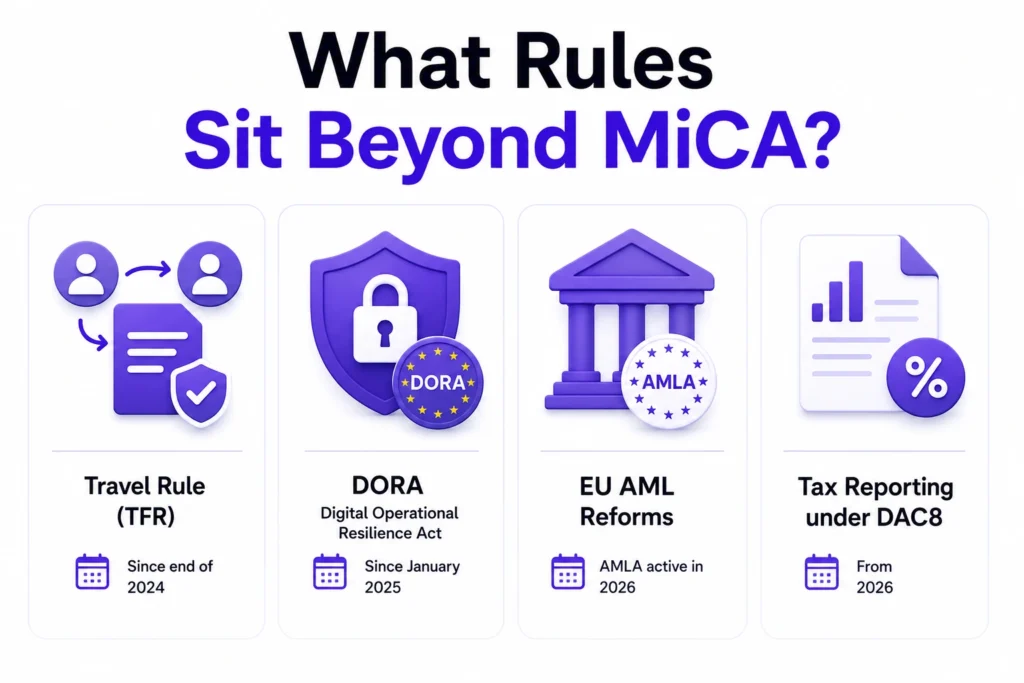
MiCA is the headline act, and a stack of other rules sits underneath it. The Travel Rule and DORA are the two that shape day-to-day operations most.
Think of MiCA as the front door. Once a platform is through it, a second layer of rules governs how it runs. These get less attention than MiCA, yet they shape your experience as a user just as much.
- The Travel Rule (TFR). Since the end of 2024, licensed platforms must collect and pass on sender and recipient details for crypto transfers. For a transfer to a self-hosted wallet above 1,000 euros, the platform also has to verify that you control the wallet.
- DORA, the Digital Operational Resilience Act. In force since January 2025, DORA sets standards for IT security and incident reporting, so a licensed exchange has to prove its systems can withstand outages and attacks.
- The EU anti-money laundering reforms. A new EU authority, AMLA, took on direct supervision of the largest cross-border crypto firms in 2026. A single AML rulebook, the AMLR, follows in July 2027.
- Tax reporting under DAC8. From 2026, platforms collect and report user transaction data to tax authorities, who then share it across member states.
None of this is visible when you place an order. It runs in the background, and it is part of what your exchange’s licence actually pays for.
Who Enforces Europe’s Crypto Rules?
Enforcement is shared. National regulators issue the licences, while EU-level bodies such as ESMA and the EBA set standards and coordinate supervision.
Crypto oversight in Europe runs on two levels. Your platform’s actual licence comes from a national competent authority, the financial regulator in the country where it is based. The EU-level bodies sit above them to keep the rules consistent.
- National competent authorities (NCAs) grant and supervise MiCA licences. The Bank of Latvia and Ireland’s Central Bank are two examples.
- ESMA writes the technical standards and maintains the public register of authorised firms.
- The European Banking Authority (EBA) focuses on stablecoin issuers and reserve rules.
- AMLA, the new Anti-Money Laundering Authority, directly supervises the largest cross-border firms from 2026.
The takeaway for you is simple. When you check whether a platform is licensed, you look it up on ESMA’s register, then confirm which national regulator stands behind it.
What Does All This Mean for You?
For everyday users, the message is reassuring. The rules exist to protect your money, and your job is simply to use a platform that follows them.
You do not need to read the regulations to benefit from them. What matters is choosing a platform that holds the right licence, because that licence is what puts all these protections to work on your behalf.
Two habits cover most of it:
- Verify before you deposit. Look the platform up on ESMA’s register and confirm its licence and the regulator behind it.
- Keep your own keys for the long term. Regulation protects funds held on the platform, though self-custody remains the safest home for anything you plan to hold for years.
When you are ready to act, you can buy Bitcoin with a bank account on a licensed European platform in a few minutes.
Bottom Line
Europe spent years with a fractured set of crypto rules. MiCA pulled them into one framework, and 2026 is when that framework becomes the only way to operate. Around it sits a quieter set of rules, from the Travel Rule to DORA, that together decide how a licensed platform protects you.
For users, none of this requires a law degree. Pick a platform that holds a current MiCA authorisation, verify it on ESMA’s register, and the protections come built in. If you want a licensed European exchange that shows every fee upfront, you can buy crypto on Paybis with a card or bank transfer in minutes.
About Paybis
Paybis is a licensed cryptocurrency exchange and on and off-ramp, operating since 2014. It holds MiCA CASP authorisation and a PSD2 Payment Institution licence from the Bank of Latvia. On top of that, it carries FinCEN registration in the US. It also holds FINTRAC registration and a VASP registration in Poland.
The platform serves 7 million users across 180+ countries and supports 90+ cryptocurrencies through 22 payment methods. To date it has handled over $5.5 billion in volume.
On Trustpilot, Paybis holds a 4/5 rating across more than 30,000 reviews. Its mobile apps score 4.6 on the Apple App Store and 4.4 on Google Play. Live chat runs 24/7 and usually replies within 1 to 2 minutes. Paybis is available on web and on mobile through iOS and Android.
FAQ
Is MiCA in force across the whole EU now?
Yes. MiCA took full effect on December 30, 2024, and applies in all 27 EU member states. The transitional period for platforms still using old national licences ends on July 1, 2026, after which full authorisation is required to serve EU clients.
What is the difference between MiCA and the Travel Rule?
MiCA is the licensing and conduct framework that decides which platforms can operate. The Travel Rule is a separate anti-money laundering measure that requires those platforms to share sender and recipient information for crypto transfers. A licensed exchange has to comply with both.
Does MiCA apply to non-EU crypto companies?
Yes, if they serve EU clients. MiCA applies wherever crypto services are provided inside the EU, regardless of where the company is based. A non-EU firm targeting European users generally has to set up an authorised EU entity or stop serving them.
How do I check if my exchange is MiCA authorised?
Search the ESMA interim register, which lists every platform with full MiCA authorisation and updates regularly. You can also confirm the licence details, including the issuing regulator and a reference number, on the platform’s own regulatory page.
Disclaimer: Don’t invest unless you’re prepared to lose all the money you invest. This is a high‑risk investment and you should not expect to be protected if something goes wrong. Take 2 mins to learn more at: https://go.payb.is/FCA-Info