
What Backs USDC? How the Reserve Model Actually Works
USDC is backed 1:1 by cash and short-term US Treasuries, held in reserve by Circle, the company that issues it.
- Every USDC in circulation is backed by cash and short-term US Treasuries, held on a 1:1 basis.
- The reserve mix targets roughly 80% Treasuries and 20% cash, held through regulated banks and the Circle Reserve Fund.
- Circle publishes a reserve report every month, checked by an independent accounting firm.
- US federal law now requires stablecoin issuers to hold full reserves in safe, liquid assets.
- If you want to hold USDC yourself, you can buy USDC on Paybis.
A dollar stablecoin is only as good as what stands behind it. USDC is meant to always equal one dollar, and that promise depends entirely on what Circle, the company that issues it, actually holds in reserve.
This piece breaks down what backs USDC, where the reserve sits, and who checks that it is real.
What Backs USDC?
USDC is backed 1:1 by cash and short-term US Treasuries, kept separate from Circle’s own corporate funds.
There is no algorithm and no basket of other cryptocurrencies behind USDC. The backing is plain cash and government debt, the kind of assets a money market fund would hold. That is a deliberate choice. Simple, boring assets are easier to value and easier to sell quickly if a lot of people redeem at once.
Circle cannot use these reserve assets for its own business. They sit in dedicated accounts, set aside for USDC holders only.
What Is Inside the Reserve?
The USDC reserve targets roughly 80% short-dated US Treasuries and repo agreements, and 20% cash at regulated US banks.
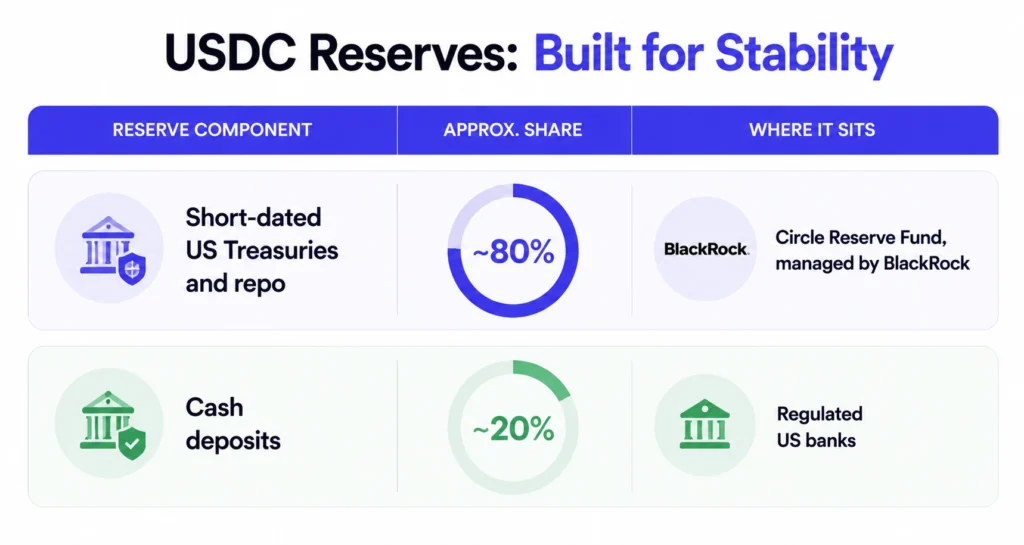
The Treasury portion is held in a government money market fund built specifically for Circle. It buys Treasury bills that mature in a matter of weeks, which keeps the assets easy to sell without a loss if redemptions pick up.
The cash portion sits at a group of banks rather than a single one. Circle spread this out after a stretch of reserve cash briefly sat at Silicon Valley Bank in 2023, before the bank failed.
Who Checks That the Reserves Are Real?
An independent accounting firm reviews Circle’s reserve report every month, and US federal law now requires this disclosure for any dollar stablecoin issuer.
Each report lists the value of the reserve against the total USDC in circulation on that date, along with a breakdown by asset type. Circle also publishes more detailed data on its own transparency page, down to individual Treasury holdings.
Since the GENIUS Act took effect, US stablecoin issuers must publish monthly attestations and have executives certify the numbers personally. Circle already ran a similar process before the law required it.
What Happens When You Redeem USDC?
Approved Circle clients send USDC back and receive dollars in return, and Circle burns the returned tokens. Most everyday users redeem indirectly, by selling USDC on an exchange instead.
Direct redemption through Circle is built for large institutional clients moving significant amounts. They send USDC, Circle burns it, and wires the matching dollars back to their account.
A typical retail user does not need to go through that process. Selling USDC on an exchange has the same effect from the user’s side. The token leaves their account for cash, without needing a direct line to Circle.
Every mint and burn is visible on the blockchain, which means anyone can check that the circulating supply moves in step with what Circle reports.
What If Circle Ever Failed?
Federal rules require Circle to keep reserve assets segregated from its own creditors, giving USDC holders a priority claim on those assets if Circle became insolvent.
This segregation is one of the core protections in the GENIUS Act. Reserve assets cannot be lent out, pledged as collateral, or mixed with Circle’s operating funds. That keeps them set aside specifically for token holders.
Priority in a bankruptcy is not the same as an instant guarantee. A failure would still take time to sort out. It is one reason to treat USDC as a well-backed digital asset rather than a direct substitute for a bank account.
Bottom Line
USDC is backed by cash and short-term US Treasuries, held on a 1:1 basis and checked every month by an outside accounting firm. The mix leans heavily toward safe, short-dated government debt, with the rest sitting as cash at regulated banks.
That does not make USDC risk-free, but it does make the backing easy to verify. If you want to see how the token itself works day to day, read what USDC is. If you already hold some, you can sell USDC on Paybis too.
FAQ
Is USDC really backed 1:1?
Yes, Circle holds cash and short-term Treasuries equal to at least the full value of USDC in circulation, confirmed in monthly reserve reports.
Does USDC pay interest to holders?
No. Circle earns interest on the reserve assets, but current US rules block stablecoin issuers from passing that yield directly to holders.
Can I see the reserve report myself?
Yes, Circle publishes a monthly attestation and a detailed transparency page listing the reserve breakdown by asset type.
What happened to USDC's reserves in 2023?
A portion of Circle’s reserve cash sat at Silicon Valley Bank when it failed in March 2023, and USDC briefly traded below $1 before returning to its peg within days.
Are USDC reserves insured like a bank deposit?
No, the reserve is checked monthly, but USDC does not carry deposit insurance the way a bank account does.
Disclaimer: Don’t invest unless you’re prepared to lose all the money you invest. This is a high‑risk investment and you should not expect to be protected if something goes wrong. Take 2 mins to learn more at: https://go.payb.is/FCA-Info