
Types of Crypto Licenses Explained: CASP, VASP, MSB, BitLicense and More

- There are two fundamentally different categories of crypto licence: registrations that confirm a business exists and has committed to AML rules, and full authorisations where a regulator has reviewed and approved the business to handle client funds.
- CASP (EU) and BitLicense (New York) are full authorisations. FinCEN MSB registration and most VASP registrations are notifications.
- A CASP authorisation under MiCA passports across all 27 EU member states from a single application. No other licence type offers equivalent multi-market coverage.
- The US requires a FinCEN MSB registration at federal level plus separate Money Transmitter Licences in most states. National coverage means dozens of individual state applications.
- VARA (Dubai), MAS (Singapore), and FINMA (Switzerland) are the leading institutional-grade licences outside the EU and US.
- Paybis holds the MiCA CASP licence, PSD2 Payment Institution licence, FinCEN MSB registration, FINTRAC registration, VASP registration in Poland, and FCA authorisation in the UK. You can buy crypto on a platform with that full licensing stack.
Not all crypto licences are same. A FinCEN MSB registration takes six weeks. A New York BitLicense takes up to two years and involves a full regulatory review of the business before a single New York resident can be served. The gap between those two outcomes tells you everything about why the type of licence a platform holds actually matters.
This guide breaks down every major type of crypto licence in use in 2026, what each one requires, and what it actually means.
What Are the Main Categories of Crypto Licence?
Every crypto licence falls into one of two categories: a registration or an authorisation. The difference determines what a regulator actually checked before granting it.
Here is the full list at a glance:
| Licence Type | Jurisdiction | Category | Passporting | Min. Capital |
|---|---|---|---|---|
| CASP | EU (MiCA) | Full authorisation | 27 EU states | €50K–€150K |
| PI Licence | EU (PSD2) | Full authorisation | EU states | Varies |
| VASP | Global (FATF) | Registration/AML | None | Varies |
| DASP/PSAN | France, El Salvador | Registration | None | None fixed |
| FinCEN MSB | US (federal) | Registration | None | None |
| MTL | US (state) | Authorisation | State only | Varies |
| BitLicense | New York | Full authorisation | NY only | DFS-set |
| DFAL | California (from Jul 2026) | Full authorisation | CA only | Varies |
| FCA Registration | UK | Registration | None | None fixed |
| VARA Licence | UAE (Dubai) | Full authorisation | None | AED 500K–1.5M |
| MAS PI Licence | Singapore | Full authorisation | None | SGD 100K–250K |
| FINMA | Switzerland | Full authorisation | None | CHF 20K–100K |
| FSA Registration | Japan | Full authorisation | None | ¥50M |
| FINTRAC MSB | Canada | Registration | None | None |
The dividing line between the two categories runs through every jurisdiction in the table. Registrations are fast because there is no real review. Authorisations take months or years because the regulator is actually checking whether the business should be allowed to operate at all.
What Is a CASP Authorisation?
A CASP authorisation is the most significant regulatory credential a crypto business operating in Europe can hold. It is the result of a full review by a national financial regulator and grants access to the entire EU market through a single application.
CASP stands for Crypto-Asset Service Provider. The licence was created under MiCA, which became fully enforceable in December 2024. Any business providing exchange, custody, portfolio management, or advisory services involving crypto to EU clients must hold one.
Capital requirements under MiCA Article 67:
- €50,000 for advisory and order reception services
- €125,000 for custody, exchange, and execution services
- €150,000 for operating a trading platform or trading on own account
What the review covers:
- Governance structures and management fit-and-proper assessments
- Capital adequacy verification
- IT security documentation and penetration testing records
- AML program substance and evidence of operation
- Operational resilience under DORA
The commercial advantage: One CASP authorisation passports across all 27 EU member states. No other licence type provides equivalent multi-market coverage from a single application.
Timeline: 6 to 18 months depending on jurisdiction and application quality. The July 1, 2026 transitional deadline has now closed the window for legacy national registrations.
The full process is covered in the how to get a crypto licence in Europe guide. For the list of exchanges currently holding CASP authorisation, the CASP authorised exchanges guide covers the current register.
What Is a VASP Registration?
VASP stands for Virtual Asset Service Provider. It is the global term introduced by FATF in 2019 to bring crypto businesses under AML frameworks. A VASP registration says a business exists and has committed to AML rules. It says nothing about whether a regulator checked that the business is safe to run.
FATF defines a VASP as any entity that engages in exchanging virtual assets for fiat, exchanging one virtual asset for another, transferring virtual assets, providing custody or administration of virtual assets, or offering services related to virtual asset issuance.
Countries that adopted FATF’s recommendations translated this into national law by requiring VASPs to register with their financial intelligence unit and commit to AML compliance. The registration process is primarily a notification. Most jurisdictions do not conduct a substantive review of governance, capital adequacy, or management before granting VASP registration status.
In the EU, VASP registration has been replaced by CASP authorisation under MiCA. In most other markets globally, including the BVI, Cayman Islands, Georgia, Mauritius, and Seychelles, VASP registration remains the standard framework.
A business holding only a VASP registration can claim regulatory status for AML purposes. What it cannot claim is that a regulator has assessed and approved its operations. That distinction is exactly what the VASP vs CASP guide unpacks.
What Is a DASP and Where Is It Used?
DASP stands for Digital Asset Service Provider. It is the name France and El Salvador gave to their own national crypto licensing frameworks, which functioned as local equivalents of VASP registration before MiCA existed.
In France, DASP is also known as PSAN (Prestataire de Services en Actifs Numériques). It served as France’s national crypto licence before MiCA replaced national frameworks across the EU. French DASPs had until July 1, 2026 to upgrade to full CASP authorisation under MiCA. The DASP framework no longer accepts new applicants in France.
In El Salvador, the DASP framework remains in use as part of that country’s crypto-friendly regulatory environment, separate from MiCA. Capital requirements are low compared to other jurisdictions. That makes it one of the more accessible entry points for businesses testing a model before committing to a full EU or US authorisation.
DASP is sometimes described as the legislative blueprint that influenced MiCA’s framework for crypto-asset services. The principles are similar, but the EU’s CASP authorisation requires significantly more to obtain.
How Does the US Crypto Licence System Work?
The US crypto licence system has two layers: a federal registration and a patchwork of state-level authorisations. Both are required for a business with national reach, and the total application burden for full national coverage runs to dozens of separate processes.
Layer one: FinCEN MSB Registration (federal)
Every crypto business handling exchange or money transmission in the US must register with FinCEN as a Money Services Business. The registration takes one to two months, requires no minimum capital, and applies nationally. It is the floor of US compliance. Most states require a great deal more before a business can actually serve their residents.
Layer two: Money Transmitter Licences (state-level)
Beyond federal registration, most states require a separate MTL before a business can legally operate there. The requirements differ state by state, and a company targeting the full US market is realistically processing 40+ separate applications.
Three states with standalone regimes:
- New York BitLicense: Administered by NYDFS, $5,000 application fee, capital requirements set by DFS on a case-by-case basis, 12 to 24 months to process. Considered the most demanding state-level crypto licence in the US. Businesses without it cannot legally serve New York residents.
- California DFAL: California’s Digital Financial Assets Law became enforceable from July 1, 2026, administered by DFPI. Companies serving California residents must have a DFAL or have submitted a completed application by the launch date.
- Montana: Also maintains its own distinct approach rather than fitting the general MTL pattern.
The federal picture also includes SEC and CFTC oversight depending on the assets involved. The GENIUS Act, passed in 2025, established a federal licensing track specifically for US-dollar payment stablecoins.
What Are the Major Crypto Licences Outside the EU and US?
Each major financial hub outside the EU and US operates its own framework, and none of them talk to each other. A MAS licence in Singapore covers Singapore. A VARA licence in Dubai covers Dubai. Cross-border coverage requires separate applications in each target market.
UAE: VARA Licence (Dubai)
Dubai built a crypto licensing framework specifically for the industry rather than adapting an existing financial services regime. The result is one of the more structured regimes in the world. The process runs in two stages: an initial Approval to Incorporate, then the full VARA Licence. Capital requirements start at AED 500,000 for payment services and reach AED 1,500,000 for exchange or custody operations. Budget 12 to 24 months for the process. Abu Dhabi operates a parallel framework through its ADGM and FSRA, giving businesses a second UAE pathway depending on where they want to be based.
Singapore: MAS Payment Services Licence
Singapore’s MAS process has a reputation for being the most substantive crypto licensing regime in Asia, and that reputation is accurate. A Standard Payment Institution licence requires SGD 100,000 in capital. Most serious exchanges need the Major Payment Institution licence, which requires SGD 250,000. Multiple review stages, shareholder wealth verification, and a technology audit sit between application and approval. The timeline regularly exceeds twelve months. What you get at the end is real institutional credibility across Asia-Pacific that lighter offshore registrations simply cannot match.
Switzerland: FINMA Authorisation
Switzerland started publishing clear crypto guidance during the ICO era, years before most regulators had formed a coherent position. That head start made Zug the geographic hub of the European crypto industry, and the canton has kept that status through multiple market cycles. Required capital runs from CHF 20,000 to CHF 100,000. Private capital gains on crypto are taxed at 0% for individuals, which has made Switzerland attractive to founders and investors as well as businesses. Dedicated crypto-friendly banks like Sygnum and SEBA give Swiss-licensed companies banking access that is harder to find almost anywhere else.
Japan: FSA Registration
Japan requires approximately ¥50 million in capital, around $350,000, from crypto-asset exchange service providers. The FSA process is thorough and the supervision that follows is ongoing and active. Japan’s framework is among the stricter Asian regimes, and the compliance demands that come with it are substantial relative to most offshore alternatives.
UK: FCA Registration
The FCA’s crypto registration is an AML-focused regime rather than a full business authorisation. The FCA reviews whether a business meets AML standards but does not conduct the kind of comprehensive review that CASP authorisation involves. A more comprehensive UK cryptoasset regime is expected from October 2027. Until then, FCA registration is the relevant credential, and the FCA has historically rejected most of the applications it has received.
Canada: FINTRAC MSB Registration
Canada requires Money Services Business registration with FINTRAC for most crypto activities. No fixed capital requirement applies. The framework is AML-focused and registration-level, placing it in the same category as FinCEN MSB in the US: necessary, but not a substitute for the full authorisations required in more demanding markets.
For the full breakdown of requirements, capital thresholds, and timelines by country, the crypto licences by country guide covers every major jurisdiction.
What Is the Difference Between a Registration and a Full Authorisation?
A registration tells a regulator a business exists. A full authorisation tells the market a regulator has reviewed the business and approved it.
That gap changes what happens when something goes wrong.
A business with only a VASP registration or FinCEN MSB registration has no obligation to:
- Hold client funds separately from company assets
- Show fees before transaction confirmation
- Maintain minimum capital reserves assessed by a regulator
- Submit to ongoing regulatory supervision of operations
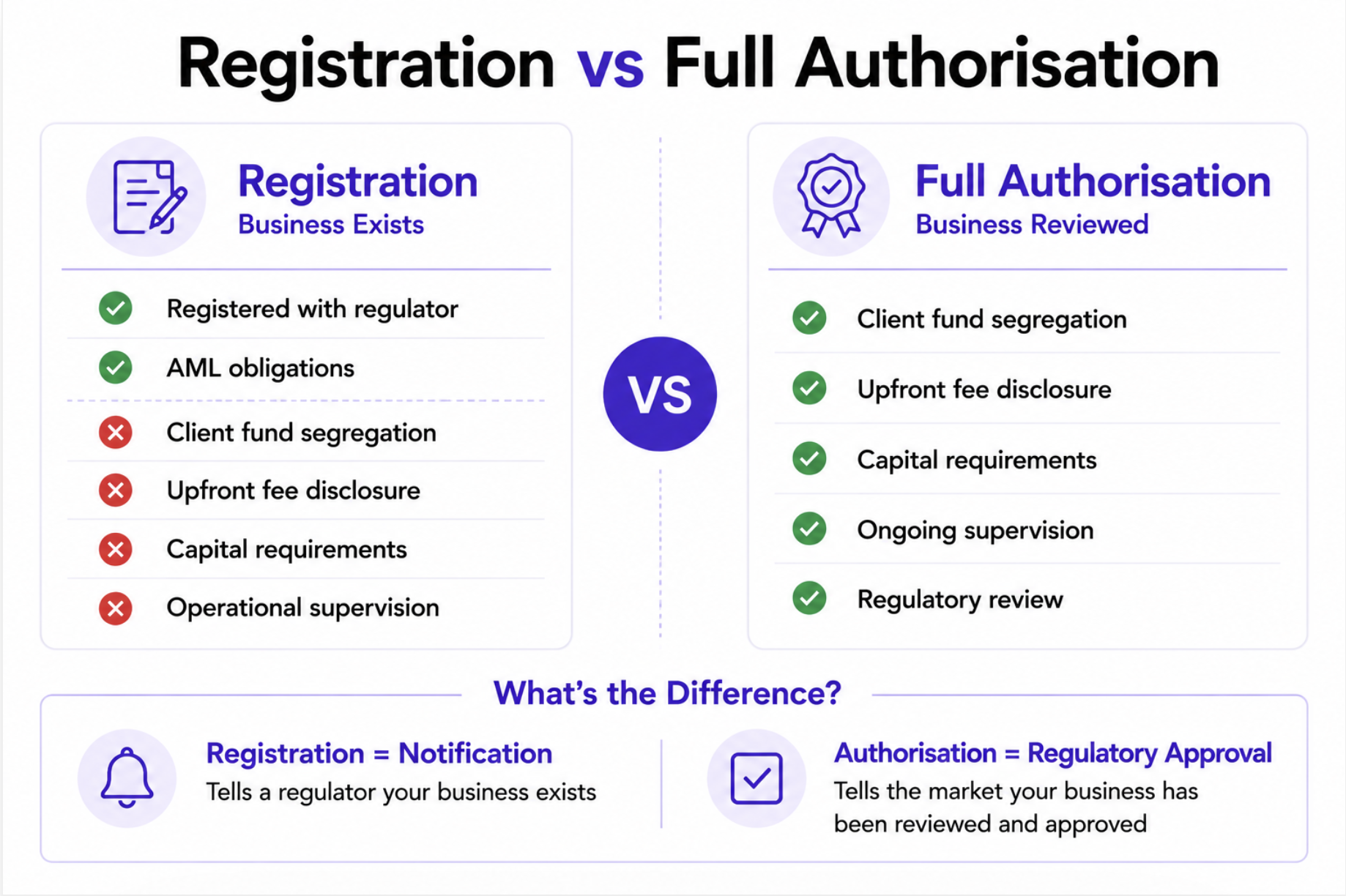
A business with a full authorisation, whether CASP, BitLicense, or VARA, has been reviewed on all of these dimensions before receiving its licence, and must maintain all of them to keep it. The type of licence a platform holds is the most direct signal of what protections actually apply to your funds. The crypto exchange regulations guide covers what the ongoing obligations look like in practice.
Which Types of Crypto Licence Does Paybis Hold?
Paybis holds a full licensing stack across five jurisdictions, combining full authorisations with the relevant registration-level credentials in additional markets.
- MiCA CASP Licence: issued by the Bank of Latvia, May 2026. Covers crypto-asset services across all 27 EU member states and the broader EEA through MiCA passporting.
- Payment Institution Licence (PSD2): issued by the Bank of Latvia alongside the CASP licence. Covers payment services under the EU’s payments regulatory framework.
- FCA Authorisation: UK Financial Conduct Authority registration.
- FinCEN MSB Registration: US federal Money Services Business registration, number 31000272911973.
- FINTRAC Registration: Canada Money Services Business registration, number C100000816.
- VASP Registration Poland: number RDWW-805.
The official MiCA and PSD2 licence announcement covers what the EU licensing process involved. For businesses evaluating Paybis as a counterparty or infrastructure partner, this credential stack covers the EU, US, Canada, UK, and Poland without requiring a separate compliance review in each market.
You can buy Bitcoin, buy Ethereum, and 90+ other cryptocurrencies on Paybis with fees shown before confirmation, client funds held separately, and 24/7 live chat available.
Bottom Line
Every crypto licence belongs to one of two categories: a registration or a full authorisation. The gap between them is where most user protection differences live. The EU’s MiCA CASP authorisation covers all 27 member states from a single application and is the most comprehensive single-jurisdiction framework available. The US stacks FinCEN MSB registration at the federal level with state-by-state MTLs underneath, with New York’s BitLicense and California’s DFAL as the strictest standalone state regimes. Outside both blocs, VARA in Dubai, MAS in Singapore, and FINMA in Switzerland are the institutional benchmarks. Most operating exchanges end up holding several licence types simultaneously because no single credential covers every market where their users sit.
FAQ
What is the difference between a CASP and a VASP?
VASP is the global umbrella term introduced by FATF in 2019. It covers any business involved in exchange, custody, transfer, or issuance of virtual assets, and most jurisdictions outside the EU apply it through registration-level frameworks. CASP is the EU-specific term under MiCA, requiring a full authorisation from a national financial regulator rather than a registration. The practical difference is substantial: a CASP has been reviewed and approved to handle client funds. A VASP has confirmed it exists and has committed to AML rules. Every CASP meets the VASP definition, but VASP status alone does not qualify a business for CASP authorisation under the EU’s higher standards.
Does a FinCEN MSB registration cover all US states?
No. FinCEN MSB registration is a federal AML registration that applies across all states, but it does not replace state-level Money Transmitter Licences. Most US states require a separate MTL before a crypto business can legally operate there. A company targeting the full US market typically holds FinCEN MSB registration plus 40 or more state-level MTLs, plus specific treatment for New York (BitLicense) and California (DFAL from July 2026). The federal registration is the minimum entry point. State licences are the commercial requirement for actually serving customers.
Which crypto licence covers the most markets?
The MiCA CASP authorisation covers the most markets from a single application. One CASP licence issued by any EU national regulator passports across all 27 EU member states and the broader EEA. No other licence type currently provides equivalent multi-market coverage without separate applications in each country. Outside the EU, no passporting equivalent exists. US, Singapore, UAE, and UK licences each cover only their own jurisdiction.
Do I need different licence types for different services?
In most jurisdictions, yes. MiCA defines ten distinct service categories, and a CASP authorisation specifies exactly which of those a business is permitted to offer. A business that wants to provide both exchange services and portfolio management needs authorisation covering both categories. In the US, custody services and exchange services may each trigger separate regulatory requirements. A single business model can require two or three licence categories within the same jurisdiction. Understanding which services a specific licence covers matters as much as confirming the licence exists.
How long does it take to get a crypto licence?
Timeline depends entirely on the jurisdiction and the type of licence. FinCEN MSB registration takes one to two months. A MiCA CASP application in an efficient EU jurisdiction takes six to twelve months with a well-prepared submission. Singapore’s MAS process frequently exceeds twelve months. New York’s BitLicense and Dubai’s VARA both typically take twelve to twenty-four months. The statutory review period is usually defined clearly, but the actual time is extended by completeness checks, follow-up questions, and preparation time before the application is submitted.
Disclaimer: Don’t invest unless you’re prepared to lose all the money you invest. This is a high‑risk investment and you should not expect to be protected if something goes wrong. Take 2 mins to learn more at: https://go.payb.is/FCA-Info