95% of All Bitcoin Is Already Mined: What It Means for You
- On March 10, 2026, the 20 millionth Bitcoin was mined at block height 939,999 by the Foundry USA mining pool
- 95.24% of all Bitcoin that will ever exist is already in circulation. Only 1 million remain
- Between 2.3 and 3.7 million Bitcoin are estimated to be permanently lost, meaning the real available supply is well below 20 million
- The halving mechanism cuts new supply in half every four years. The next halving is 2028, dropping daily issuance from 450 BTC to roughly 225
- Every previous halving has been followed by a significant price rally within 12 to 18 months, though macro conditions have increasing influence on timing
On March 10, 2026, the Foundry USA mining pool quietly added block 939,999 to the Bitcoin blockchain and collected a reward of 3.125 BTC. Nothing about that block looks unusual. But that block contained the 20 millionth Bitcoin ever created, and it crossed a threshold that Satoshi Nakamoto wrote into the code in 2008 and that the network has been counting toward for 17 years.
There are now fewer than 1 million Bitcoin left to mine, ever. Let’s get into the details.
How Does Bitcoin’s Supply Cap Actually Work?
Most people have heard that Bitcoin has a 21 million coin limit. Fewer understand the mechanism behind it, and the mechanism is what makes the 20 million milestone genuinely interesting.
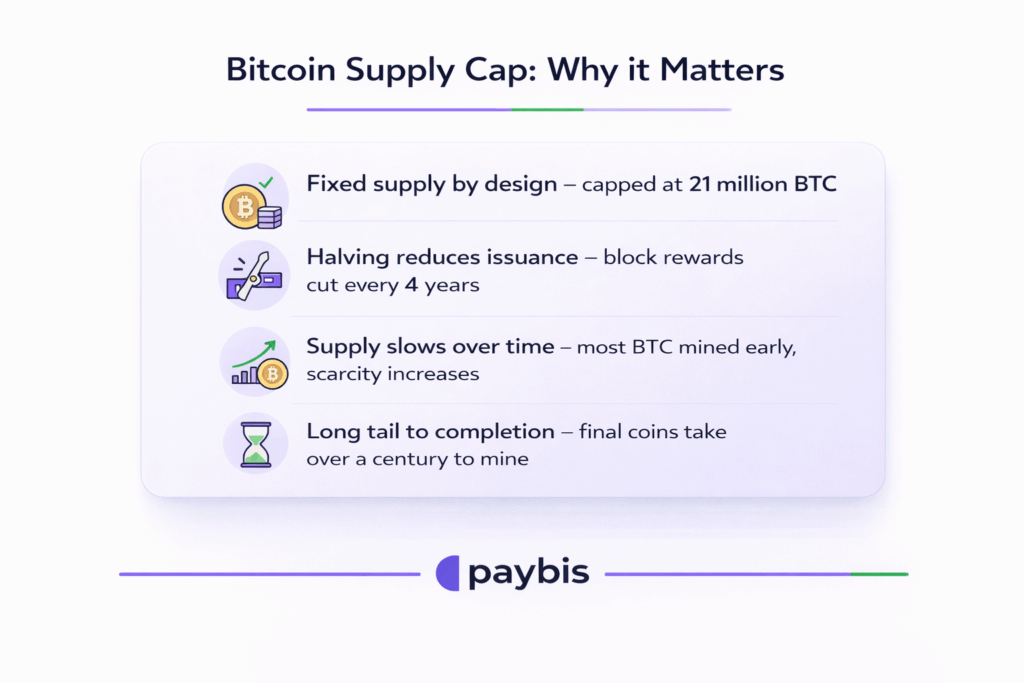
When Bitcoin launched in January 2009, miners received 50 BTC for every block they added to the blockchain. Every 210,000 blocks (roughly four years), that reward gets cut in half. This is the halving, and till now, it has happened four times. The reward went from 50 to 25 to 12.5 to 6.25 and, after the April 2024 halving, down to 3.125 BTC per block. The next halving in 2028 will drop it to 1.5625.
The effect of this is not linear. Satoshi front-loaded Bitcoin’s issuance heavily. The first 10 million coins took about 4 years to mine (2009 to 2012). The next 5 million took another 4 years, and the next 2.5 million took 4 more years after that. The final 1 million will take 114 years, because the reward keeps halving and the pace of new supply keeps slowing to near zero. By the 2040s, daily issuance will fall below 30 BTC. By the 2060s, below 2 BTC per day.
For a deeper look at how the mining process works, the Paybis guide to Bitcoin mining explains the mechanics from scratch. And if you want to understand Bitcoin’s underlying architecture, how Bitcoin works is worth reading alongside it.
Why the Real Available Supply Is Much Lower Than 20 Million
The 20 million figure already overstates how much Bitcoin is actually circulating, and by a meaningful margin.
Blockchain analytics firms Chainalysis and River Financial estimate that between 2.3 million and 3.7 million BTC are permanently inaccessible. They are gone forever. These are coins lost due to different reasons, like forgotten passwords or misplaced hardware wallets. The genesis block itself contains coins that can never be moved. Another 230 BTC is locked in early outputs with unspendable scripts.
If you subtract the conservative estimate of 2.3 million lost coins from the 20 million mined, you are looking at an effective circulating supply of around 17.7 million Bitcoin. Subtract the higher estimate of 3.7 million, and you get closer to 16.3 million. The true liquid supply, meaning coins that could actually be bought or sold today, is considerably lower still when you account for long-term holders, institutional custody, and coins sitting dormant in wallets untouched for years.
The practical consequence is that Bitcoin’s scarcity is more severe than the 21 million headline number implies. The market is not competing for 21 million coins. It is competing for a meaningfully smaller pool, and that pool shrinks a little every time someone loses their keys.
What Has Historically Happened to Price When Supply Tightens?
The halving is the most documented supply-tightening event in crypto. The historical record is worth understanding clearly before drawing conclusions.
After the first halving in November 2012, Bitcoin was trading around $12, but by the end of 2013, it had crossed $1,100. That is roughly a 9,000% gain in about a year.
After the second halving in July 2016, Bitcoin climbed from around $650 to nearly $20,000 by December 2017, a 3,000% move. After the third halving in May 2020, it ran from roughly $8,500 to just under $69,000 by November 2021, a gain of around 700%. After the fourth halving in April 2024, Bitcoin reached an all-time high of approximately $126,000 in October 2025, a roughly 100% gain from the halving price.
The pattern is consistent: supply gets cut, price eventually rises. But the percentage gain has shrunk with each cycle, which matters. A 9,000% move from a market cap of a few hundred million is mathematically different from a 100% move from a market cap of over a trillion dollars. The asset is maturing, and the supply shock has less absolute impact each time because the market already anticipates it.
What has not disappeared is the directional relationship. Every halving has been followed by a new all-time high. The timeline has varied, and macro conditions have increasingly influenced when the move arrives, but the pattern holds.
Does the 20 Million Milestone Change Anything Right Now?
Analysts were largely unified on one point when the milestone hit: the number itself does not move the price in the short term. Markets already knew this was coming. The supply growth rate of Bitcoin has been lower than gold’s for years, and the 20 million mark was on the calendar well in advance.
“Already priced in, markets know the supply growth rate of BTC with certainty, and it’s already lower than gold.”
Charles Edwards of Capriole Investment
The current environment adds its own context. Bitcoin was trading around $69,000 at the time of the milestone, down roughly 46% from its October 2025 all-time high of $126,000. US spot Bitcoin ETFs recorded approximately $4.5 billion in net outflows year-to-date through early March, reflecting a broader risk-off shift among institutional investors. The scarcity story is intact. The macro backdrop is not cooperating with it in the short term, which is normal for Bitcoin at this stage of a cycle.
What Happens to Bitcoin Mining After All 21 Million Are Mined?
This question comes up whenever the supply cap gets attention. Let’s address it directly.
Miners currently earn two types of revenue:
- The block reward (newly minted Bitcoin)
- Transaction fees paid by users for having their transactions included in a block.
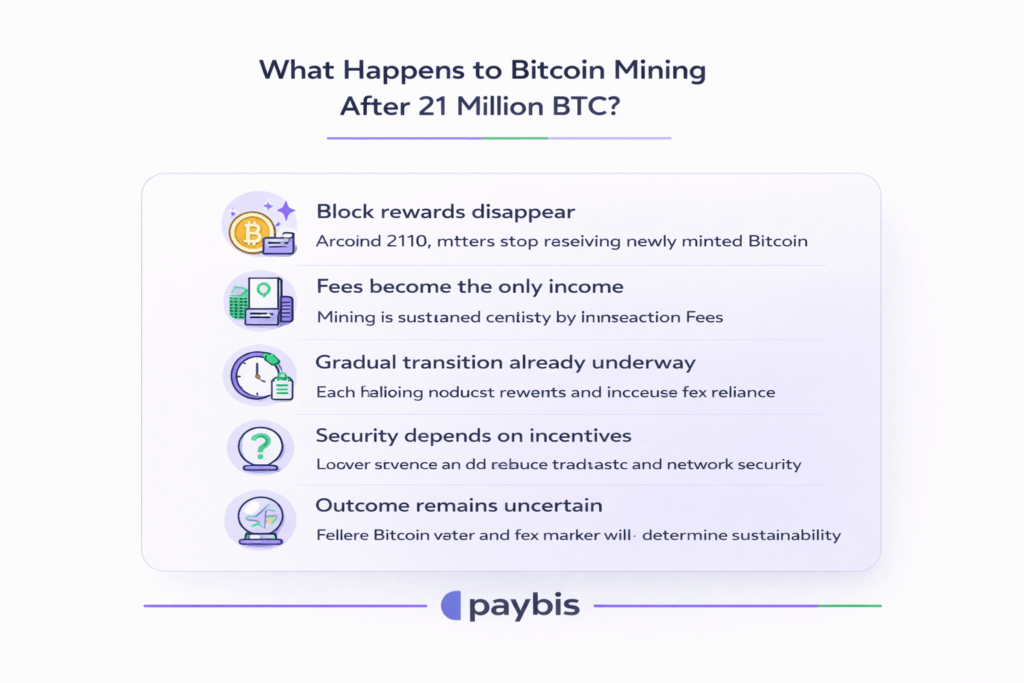
Right now, the block reward dominates. As halvings continue, that balance changes. By the 2040s, the block subsidy becomes a small fraction of what it was, and by around 2140, it hits zero.
At that point, miners survive entirely on transaction fees. Whether those fees can sustain the level of computational security Bitcoin currently has is an open question. The concern is that lower miner revenue could reduce the hash rate and make the network theoretically more vulnerable to attacks. The counter-argument is that Bitcoin’s value would be so large by then that even a small fee on a small fraction of transactions would provide enormous miner incentive in dollar terms.
There is no consensus on how this resolves. What is clear is that it is not an immediate problem. We have 114 years to watch it develop, and Bitcoin has demonstrated an ability to adapt to economic challenges that looked intractable at the time.
For anyone curious about what the mining side of this looks like today, Paybis Bitcoin mining rig guide covers current hardware, costs, and profitability with real numbers. For comparison, mining other proof-of-work coins is covered in the How to Mine Dogecoin, How to Mine Litecoin, and How to Mine Monero guides.
Bottom Line
The 20 million milestone is not a trigger. Markets already knew it was coming, and the short-term price impact is minimal. What it does is put a number on something that was always abstract: 95% gone, 1 million left, and somewhere between 2 and 4 million already lost forever. The supply schedule has run exactly as Satoshi wrote it for 17 years without a single deviation, and the remaining 5% will follow the same path at an increasingly slower pace. And every halving since 2012 has eventually been followed by a new all-time high. You can buy Bitcoin on Paybis with a credit card, debit card, or SEPA bank transfer.
FAQ
What does the 20 million Bitcoin milestone actually mean?
On March 10, 2026, the 20 millionth Bitcoin was mined, meaning 95% of the total supply has now been issued. Fewer than 1 million coins remain to be mined. However, the real available supply is even tighter: analysts estimate between 2.3 and 3.7 million BTC are permanently lost due to different reasons. So the market is effectively competing for significantly less than 20 million coins.
Will Bitcoin's price go up now that 20 million have been mined?
Not necessarily in the short term. The milestone was known well in advance, so markets had already priced it in. What has historically moved prices is the halving: the event that halves miner rewards every four years. Every halving since 2012 has been followed by a new all-time high, although percentage gains have declined with each cycle as Bitcoin’s market capitalization has grown. The scarcity story remains intact, but macro conditions play an increasingly large role in timing.
Disclaimer: Don’t invest unless you’re prepared to lose all the money you invest. This is a high‑risk investment and you should not expect to be protected if something goes wrong. Take 2 mins to learn more at: https://go.payb.is/FCA-Info