Bitcoin Crash History: What Past Crashes Teach Us
- Bitcoin has experienced at least 6 major crashes exceeding 50% since 2011, with the worst dropping 93%
- Recovery time from major crashes ranges from 3 months to 3+ years depending on crash severity and market conditions
- Every crash followed similar patterns: parabolic rally, euphoric top, sharp correction, capitulation, slow recovery
- Crashes typically happen after new all-time highs when retail FOMO peaks and leverage reaches extremes
- Despite multiple 80%+ crashes, Bitcoin has always recovered to surpass previous all-time highs eventually
Bitcoin has crashed spectacularly, multiple times. If you bought near the top in 2017, you watched your investment drop 84%. If you bought the 2021 peak, you endured a 78% collapse. And if you’re holding through 2026, you’re watching another correction unfold in real time.
Bitcoin has crashed before, and every single time, it eventually recovered to new highs. But why do they happen? And since we are in a crash period again, the most important question: what does typically come next?
This guide walks through Bitcoin’s major crashes from 2011 to today. What triggered each collapse, how long recovery took, and what patterns you should look for.
Before we dive deeper, if you see the recent crash as an opportunity, Paybis is the platform to buy Bitcoin with a credit card.
Table of contents
- The 2011 Crash: Bitcoin’s First Major Collapse
- The 2013 Crash: China’s First Bitcoin Ban
- The 2017-2018 Crash: ICO Mania Ends Badly
- The 2021-2022 Crash: Terra Luna and Rising Interest Rates
- What Patterns Emerge Across All Bitcoin Crashes?
- The 2025-2026 Crash: How Does This One Compare?
- What Do Bitcoin Crashes Teach About Crypto Market Cycles?
- How Long Do Bitcoin Bear Markets Actually Last?
- What Happens to Other Cryptocurrencies During Bitcoin Crashes?
- Should You Buy Bitcoin During Crashes?
- Bottom Line
The 2011 Crash: Bitcoin’s First Major Collapse
Bitcoin’s first major crash happened in June 2011. Price peaked at $31.50 on June 8, then collapsed to $2.01 by November, a 93.6% drop. Recovery took until February 2013 (20 months) to regain the previous high.
In early 2011, Bitcoin was still experimental, and most people had never heard of it. Price sat under $1 for most of 2010.
Then things changed in early 2011.
Media coverage started picking up, and tech enthusiasts discovered Bitcoin. Price climbed from $0.30 in January to $1 by February. By April, it hit $3. The rally accelerated through May, reaching $8, then $16, then $31.50 on June 8, 2011.
That 100x rally in six months attracted attention for all the wrong reasons. New buyers rushed in at the top. Then, Mt. Gox, the dominant exchange handling 70% of Bitcoin volume, got hacked. Someone compromised accounts, sold massive amounts of Bitcoin, and crashed the price to $0.01 briefly before Mt. Gox rolled back trades.
But the damage was done. By November 2011, Bitcoin traded at $2.01. Anyone who bought near the June peak lost 93.6% of their investment.
What made this crash different: Bitcoin had no established recovery pattern yet, and no one knew if it would survive. The Mt. Gox hack raised questions about security, since media coverage turned negative. Many early adopters gave up and sold at the bottom.
Recovery came slowly: the price chopped sideways for months in the $2-$5 range. Only in February 2013, we finally saw Bitcoin reclaim $31.50 and push higher. Total recovery time: 20 months of painful waiting.
| Event | Peak Price | Bottom Price | Drop | Recovery Time |
|---|---|---|---|---|
| 2011 Crash | $31.50 | $2.01 | -93.6% | 20 months |
| 2013 Crash | $1,163 | $152 | -86.9% | 48 months |
| 2017-2018 Crash | $19,783 | $3,122 | -84.2% | 36 months |
| 2021-2022 Crash | $69,000 | $15,476 | -77.6% | 24 months |
| 2025-2026 Crash | $126,000 | $67,000* | -47%* | Ongoing |
* Current crash still developing as of February 2026
The 2013 Crash: China’s First Bitcoin Ban
Bitcoin crashed 86.9% in 2013 after China banned financial institutions from handling Bitcoin. Price peaked at $1,163 on November 30, crashed to $152 by January 2015. Recovery to new highs took 48 months (4 years), making it Bitcoin’s longest bear market.
The 2013 rally was Bitcoin’s first taste of mainstream attention. Price started the year at around $13, but by March, it hit $266. After a brief correction, the rally resumed in October and went parabolic.
Bitcoin appeared on major news networks, and people who’d never heard of cryptocurrency started buying. Price climbed from $200 in October to over $1,000 by November. On November 30, 2013, Bitcoin peaked at $1,163.
Then China intervened. On December 5, 2013, the People’s Bank of China banned financial institutions from handling Bitcoin transactions. Chinese exchanges could still operate, but banks couldn’t service them. This cut off a major source of buying pressure since China represented enormous trading volume.
Price dropped 50% within weeks, but the real pain came slowly over the next year. Since every bounce got sold, Bitcoin bled from $600 to $400 to $300, and eventually, by January 2015, Bitcoin touched $152. If you bought Bitcoin at the November 2013 peak, you would have lost 86.9%.
The long recovery: Unlike 2011’s relatively quick recovery, the 2013 bear market dragged on. Price chopped between $200-$500 through 2015 and most of 2016. Not until late 2016 did sustained upward momentum return. Bitcoin finally broke above $1,163 in January 2017, a full 48 months after the peak.
This taught an important lesson about Bitcoin crashes: recovery time varies dramatically. Quick crashes can recover in months. Deep, grinding bear markets can last years.
If you see the recent crash as an opportunity, you can buy Bitcoin with Paybis now, with a credit card or a Paypal.
The 2017-2018 Crash: ICO Mania Ends Badly
Bitcoin crashed 84.2% from December 2017 to December 2018 after an ICO-fueled bubble popped. Price peaked at $19,783, fell to $3,122. Mainstream retail FOMO drove the top. Tightening regulations, exchange hacks, and ICO failures drove the crash. Recovery took 36 months.
The 2017 rally is legendary. Bitcoin started the year around $1,000, and by June, it doubled to $2,000. By September, it hit $5,000. Then retail discovered Bitcoin.
Everyone started talking about crypto. Even your uncle might have asked how to buy Bitcoin. Coinbase crashed due to enormous traffic, and Bitcoin futures launched on traditional exchanges. Price went vertical, hitting $10,000 in late November, $15,000 in early December, and peaking at $19,783 on December 17, 2017.
But it wasn’t just Bitcoin rallying. ICOs (Initial Coin Offerings) were raising hundreds of millions for projects with nothing but whitepapers. Ethereum rallied because every ICO required buying ETH first. Everyone was getting rich on paper.
The crash came fast. By late December, Bitcoin had dropped to $14,000. January 2018 saw it fall to $10,000, and a few weeks later, it fell to under $7,000. The bleeding continued throughout the entire year. Every bounce got sold aggressively. By December 2018, Bitcoin touched $3,122.
Several factors compounded the selloff:
- South Korea and China tightened crypto regulations
- Major exchanges got hacked
- ICO projects that raised millions dumped their ETH and Bitcoin treasuries
- Retail investors who bought the top capitulated after months of losses
Recovery pattern: Bitcoin bottomed around $3,200 in December 2018 and stayed there through Q1 2019. April 2019 brought the first major bounce to $5,000, then $10,000 by June.
The real recovery started in 2020. COVID initially crashed Bitcoin to $3,800 in March 2020, but stimulus money and institutional interest drove a new rally. Bitcoin finally surpassed $19,783 in December 2020, exactly 36 months after the peak.
The 2021-2022 Crash: Terra Luna and Rising Interest Rates
Bitcoin crashed 77.6% from November 2021 to November 2022, driven by Federal Reserve interest rate hikes, Terra/Luna collapse, and contagion through crypto lenders. Price peaked at $69,000, fell to $15,476. Recovery took 24 months, with Bitcoin reaching new highs by March 2024.
Bitcoin’s 2021 rally had different characteristics than previous cycles. Institutional money was flowing in: for example, Tesla bought $1.5 billion of Bitcoin. Also, MicroStrategy was accumulating aggressively.
Price climbed steadily through 2021, hitting $64,000 in April before correcting to $30,000 over the summer. The rally resumed in September, pushing to new highs. November 9, 2021, saw Bitcoin peak at $69,000.
Then macro conditions shifted. The Federal Reserve signaled interest rate hikes to combat inflation. Risk assets across the board started declining. Bitcoin fell with them, dropping from $69,000 to $35,000 by January 2022.
May 2022 brought catastrophe. Terra/Luna, a supposed “stablecoin” project with a $40 billion market cap, collapsed to zero in 48 hours. The implosion triggered contagion. Celsius, a major crypto lender, froze withdrawals, and Three Arrows Capital blew up. Voyager filed for bankruptcy, and BlockFi collapsed.
Each failure triggered more sales. Institutions that had loaned to these entities faced losses. Retail investors who’d deposited crypto on these platforms lost everything. Bitcoin crashed through support after support, hitting $17,500 by June 2022 and eventually bottoming at $15,476 in November 2022.
Different recovery dynamics: This crash recovered faster than previous major collapses. Bitcoin ETF applications were still pending, providing a forward-looking catalyst. By January 2024, spot Bitcoin ETF approvals drove massive inflows. Bitcoin surged past $69,000 in March 2024, just 24 months after the bottom.
The faster recovery reflected crypto’s maturation. Infrastructure improved. Regulation increased (for better or worse). Institutional participation provided buyer support that didn’t exist in previous cycles.
What Patterns Emerge Across All Bitcoin Crashes?
Yes. Every major crash followed similar phases: parabolic rally creating euphoria, blow-off top on massive volume, sharp initial drop of 30-50%, relief rally giving false hope, grinding decline to true bottom, long consolidation, then slow recovery. Timing varies but structure repeats.
Looking at Bitcoin crashes from 2011 to 2026 reveals consistent patterns that repeat with strange similarity:
1. Parabolic rallies precede every crash
Bitcoin doesn’t crash from steady uptrends. It crashes after vertical, unsustainable rallies where the price doubles or triples in weeks. The faster the rally, the harder the crash that follows. Every major top formed after Bitcoin went parabolic.
2. Euphoria marks the top
Mainstream media coverage, your relatives asking how to buy Bitcoin, “this time is different” narratives, and predictions of $1 million Bitcoin. These sentiment indicators consistently mark tops. When common people like taxi drivers are starting to give Bitcoin advice, you’re near the peak.
3. The initial drop happens fast
Bitcoin typically loses 30-50% quickly from the peak. This shakes out weak hands and leveraged traders. Then comes a relief rally that convinces people the worst is over. But it never is.
4. The grind lower breaks spirits
After the relief rally fails, Bitcoin enters a grinding decline. Months of slow bleeding, and every bounce getting sold. This phase breaks investor psychology more than the initial crash. People capitulate not at the bottom, but during this grinding phase.
5. Bottoms form when no one cares
True bottoms happen when the media stops covering Bitcoin. Trading volume dries up, and the sentiment reaches maximum pessimism. You start to see more “Bitcoin is dead” articles. That’s usually when the price has bottomed.
6. Recovery takes longer than the crash
Bitcoin can lose 80% in 12 months but take 3 years to fully recover. The psychology of climbing back requires time. Each failed rally attempt discourages buyers until sentiment slowly changes.
What happens after crashes:
- Bitcoin has never failed to eventually exceed its previous all-time high
- Recovery times range from 20 months to 48 months
- Subsequent bull markets typically reach 5-10x the previous peak
- Each cycle brings more institutional involvement and infrastructure
The 2025-2026 Crash: How Does This One Compare?
The 2025-2026 crash shows both familiar patterns and new dynamics. Similar: parabolic rally to $126,000, euphoric top, institutional profit-taking. Different: Bitcoin ETFs exist, corporate treasuries hold Bitcoin, recovery might follow different timeline due to institutional participation.
Bitcoin peaked at $126,000 in October 2025 after a rally driven by institutional adoption through newly approved Bitcoin ETFs. Corporate buying from companies like MicroStrategy and ETF inflows from BlackRock’s IBIT provided constant demand.
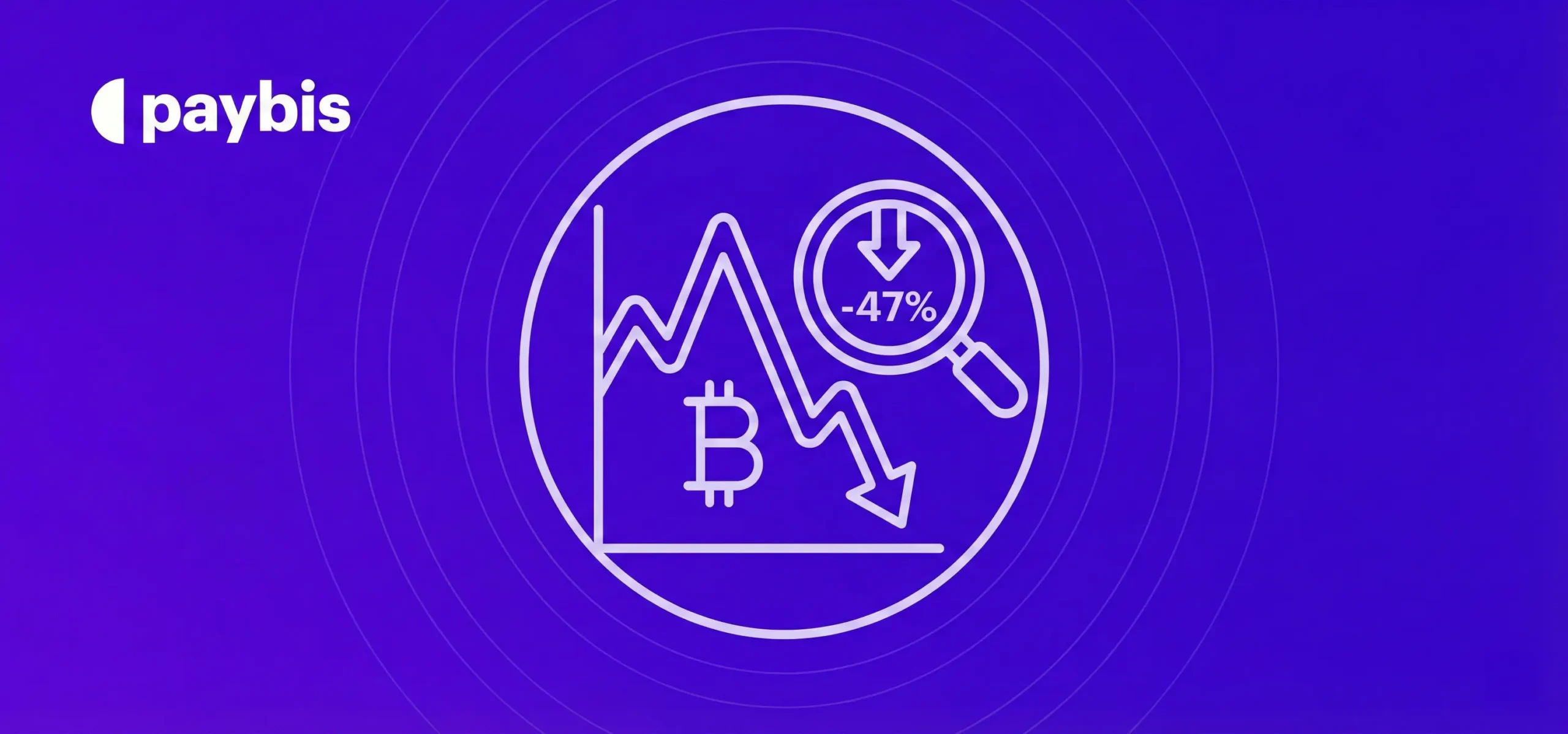
By February 2026, Bitcoin had fallen to around $66,000, a 47% drop. Not yet approaching the 80%+ crashes of previous cycles, but following similar patterns:
Familiar elements:
- Parabolic rally preceded the top
- Institutional profit-taking accelerated the decline
- Macro uncertainty (Fed policy, geopolitical tensions) triggered risk-off behavior
- Leveraged positions getting liquidated ($2B+ in forced selling)
- Each support level broke faster than the previous one
New elements:
- Regulated Bitcoin ETFs change buying/selling dynamics
- Corporate treasury holdings create a different holder base than retail
- Traditional financial infrastructure is directly involved
- Institutional risk management may prevent previous extremes
- The political and regulatory environment is more defined than in past cycles
Where this crash might go: Historical patterns suggest Bitcoin could fall 50-80% from peak before bottoming. That would put the price between $25,000 and $63,000. Analysts are watching key technical levels at $70,000, $58,000 (200-week moving average), and $56,000 (realized price).
However, institutional participation might change the pattern. ETF buying on dips could provide support that didn’t exist in previous cycles. Or institutional risk management could accelerate selling if Bitcoin breaks key levels. The outcome is still developing.
What Do Bitcoin Crashes Teach About Crypto Market Cycles?
Bitcoin crashes teach that volatility is inherent to crypto, timing tops is nearly impossible, holding through 80% drops requires conviction, and every previous crash eventually recovered to new highs. Crashes are features of Bitcoin cycles, not bugs.
Every Bitcoin crash reinforces lessons about how crypto markets work:
- Volatility is permanent, not temporary. Bitcoin isn’t becoming less volatile as it matures. The 2021-2022 crash was nearly as severe as the 2017-2018 crash despite far more institutional involvement. Crypto’s volatility comes from a lot of factors, including 24/7 trading, global participation, and relatively thin liquidity compared to traditional assets. That won’t change.
- Timing tops is effectively impossible. In 2017, Bitcoin hit $19,000, and many thought it would crash. It went to $19,783. In 2021, Bitcoin hit $60,000 and crashed to $30,000, then rallied to $69,000. Trying to perfectly time tops leaves you either selling too early or holding too long.
- Recovery is certain, but timing is not. Bitcoin has always recovered from crashes, but recovery can take months or years. If you need the money within 2-3 years, Bitcoin’s volatility creates real risk. If you can hold 5+ years, historical patterns favor recovery.
- Crashes create an opportunity for patient money. Every previous Bitcoin bottom in hindsight looks like a gift. $152 in 2015. $3,122 in 2018. $15,476 in 2022. Buying crashes works if you can withstand further drops and wait for recovery.
- Market structure evolves but patterns persist. Each cycle brings new infrastructure, regulations, and participants. But human psychology around fear and greed remains constant. The specific triggers change (China ban, ICO bubble, Terra collapse, Fed policy) but the pattern of boom, euphoria, crash, capitulation, recovery repeats.
For those looking to track Bitcoin’s price movements through volatile periods, tools like the Bitcoin calculator help evaluate position sizes at different price points. Paybis offers you ways to buy Bitcoin with bank account during crashes when others are panicking.
How Long Do Bitcoin Bear Markets Actually Last?
Recovery time from Bitcoin crashes ranges from 20 months to 48 months depending on crash severity and market conditions. The 2011 crash recovered in 20 months. The 2013 crash took 48 months. The 2017 crash needed 36 months. The 2021 crash recovered in 24 months.
Recovery doesn’t mean returning to previous highs. It means the long-term uptrend resuming. Bitcoin’s recovery phases show distinct patterns:
Phase 1: Capitulation (1-6 months)
Bitcoin finds a bottom after panic selling exhausts itself. Price stabilizes in a range. Volume drops significantly. Media coverage disappears. This phase can last weeks or months depending on how much selling pressure remains.
Phase 2: Accumulation (6-18 months)
Price chops sideways in a range. Smart money accumulates while retail remains discouraged. Failed rally attempts test buyers’ patience. This is where most people give up and sell near the bottom.
Phase 3: Early recovery (6-12 months)
Price breaks out of the range and starts making higher highs. Media notices but remains skeptical. Retail begins returning cautiously. Momentum slowly builds.
Phase 4: New bull market (6-24 months)
Bitcoin decisively breaks its previous all-time high. FOMO returns. New buyers flood in. The cycle repeats toward the next euphoric top and subsequent crash.
Total time from peak to new peak:
- 2011: 20 months ($31.50 to $31.50)
- 2013: 48 months ($1,163 to $1,163)
- 2017: 36 months ($19,783 to $19,783)
- 2021: 24 months ($69,000 to $69,000)
The trend suggests recovery times are shortening as Bitcoin matures and infrastructure improves. But 2-4 years of patience remains the norm.
What Happens to Other Cryptocurrencies During Bitcoin Crashes?
Yes. Most altcoins crash 80-95% during Bitcoin bear markets, exceeding Bitcoin’s losses. Ethereum typically falls 70-85%. Smaller altcoins often lose 90%+ or go to zero. Bitcoin dominance (its share of total crypto market cap) rises during crashes as money flows to relative safety.
Bitcoin crashes pull down the entire cryptocurrency market, but not equally:
- Ethereum crashes almost as hard as Bitcoin. The 2018 crash took ETH from $1,400 to $80 (94% drop) while Bitcoin fell 84%. The 2022 crash brought ETH from $4,800 to $880 (82% drop) while Bitcoin fell 77%. Ethereum’s larger drops reflect its different use cases and higher perceived risk.
- Major altcoins lose 80-95%. Litecoin, Bitcoin Cash, and other established cryptocurrencies typically crash harder than Bitcoin. The 2018 bear market saw most major altcoins drop 85-95% from their peaks.
- Smaller altcoins often die. Hundreds of altcoins that existed in 2017 no longer trade or have essentially zero volume. The 2018-2019 bear market wiped out most ICO projects. The 2022 crash killed numerous DeFi tokens and NFT projects.
- Stablecoins like Tether theoretically hold $1. In practice, even stablecoins face scrutiny during crashes. Terra/Luna’s UST stablecoin collapsed to zero in 2022 despite being “algorithmic” and supposedly stable. This shook confidence across all stablecoins.
Why altcoins crash harder: Less liquidity means smaller sell orders move price more dramatically. Less institutional interest means fewer buyers during panics. Higher risk perception means they get sold first when people reduce exposure. Newer projects with less track record face existential questions during bear markets.
Bitcoin dominance (percentage of total crypto market cap) typically rises from 30-40% at bull market peaks to 60-70% during bear markets as money flows back to Bitcoin’s relative safety.
Should You Buy Bitcoin During Crashes?
Historical data shows buying Bitcoin during crashes (50%+ drops from all-time highs) produced strong returns for holders willing to wait 2-4 years. But timing exact bottoms is nearly impossible. Dollar-cost averaging during crashes tends to work better than trying to catch falling knives.
Every Bitcoin bottom in hindsight looks like an amazing opportunity. But in the moment, buying crashes feels terrifying because further drops are always possible.
The case for buying crashes:
Historical returns from major Bitcoin bottoms have been extraordinary:
- Buy at the 2015 bottom of $152 and hold to the 2017 peak: 130x return.
- Buy at the 2018 bottom of $3,122 and hold to 2021 peak: 22x return.
- Buy at the 2022 bottom of $15,476 and hold to the 2025 peak: 8x return.
Even buying partway through crashes produced strong results. Anyone who bought Bitcoin under $10,000 during the 2018-2019 bear market and held saw 5-10x returns by 2021.
Crashes remove speculative froth and weak hands. What’s left are committed holders and patient buyers. This creates a foundation for the next rally.
The case for caution:
Bitcoin can keep falling long after you think it bottomed. In 2018, Bitcoin bounced to $6,000 in February, and many thought that was the bottom. It eventually fell to $3,122 by December. People who bought the February “bottom” endured 50% more losses.
Bottom Line
Your timing might be terrible. Buying crashes requires capital when others are panicking. It requires emotional strength to keep holding on as losses mount. And you need a time horizon of years, not months.
No guarantee the pattern continues. Bitcoin has always recovered because it survived. Future crashes could be different if fundamental issues emerge or regulatory crackdowns intensify.
Platforms like Paybis make it straightforward to buy Bitcoin during crashes using various payment methods like Paypal. The key is having a plan before the crash and sticking to it when emotions are running high.
FAQ
Will Bitcoin crash again after recovering?
Yes, almost certainly. Bitcoin has crashed multiple times throughout its history, and each recovery led to an eventual new all-time high followed by another crash. Volatility is inherent to Bitcoin’s market structure. The cycle of boom, euphoria, crash, capitulation, and recovery has repeated every 3-4 years since 2011. Nothing suggests this pattern will change fundamentally.
How do you know when a Bitcoin crash is over?
You don’t know for certain until months later in hindsight. Historical indicators include: price stabilizing in a range for months, trading volume declining significantly, media coverage disappearing, sentiment reaching maximum pessimism, and long-term holders accumulating rather than selling. But false bottoms happen frequently. The 2018 crash had multiple bounces that looked like bottoms before the real bottom formed in December.
What's the worst Bitcoin crash in history?
The 2011 crash from $31.50 to $2.01 remains Bitcoin’s worst, losing 93.6% of value. However, the 2013 crash from $1,163 to $152 (86.9% drop) took the longest to recover at 48 months. The 2017-2018 crash from $19,783 to $3,122 (84.2% drop) affected the most people since Bitcoin had much wider adoption by then.
Can Bitcoin crash to zero?
It’s theoretically possible, but Bitcoin crashing to zero would require catastrophic failure of the entire network or global regulatory bans, making it worthless. Neither seems likely given Bitcoin’s decentralized structure and growing institutional adoption. Even during the worst crashes, Bitcoin maintained significant value. The bigger risk for investors is crashes of 80%+ that still represent devastating losses if you bought near the top.
Disclaimer: Don’t invest unless you’re prepared to lose all the money you invest. This is a high‑risk investment and you should not expect to be protected if something goes wrong. Take 2 mins to learn more at: https://go.payb.is/FCA-Info