Crypto Apps vs Traditional Exchanges: Which Should You Use?
Key Takeaways
1. Crypto apps are for buying and holding. Exchanges are for active trading.
2. Apps have simpler interfaces but fewer features. Exchanges have more tools but steeper learning curves.
3. Apps verify faster and accept more payment methods. Exchanges focus on trading pairs and advanced orders.
4. Apps work better for amounts under $10,000. Exchanges make sense for larger portfolios and frequent trades.
5. You can use both: Apps for quick purchases, exchanges for portfolio management.
6. Paybis offers the app experience: Fast verification, 20+ payment methods, FCA-regulated, no trading complexity.
You want to buy Bitcoin. So you search “best place to buy crypto” and discover two types of platforms that sound almost identical.
Crypto apps and crypto exchanges.
Both let you buy cryptocurrency. Both require verification and charge fees. The marketing language is nearly identical: “secure,” “trusted,” “easy to use.”
So what’s actually different? And more importantly, which one should you use?
We are not declaring one better than the other. We are matching the right tool to what you’re actually trying to do with crypto.
Table of contents
What’s the Real Difference Between Crypto Apps and Crypto Exchanges?
The difference isn’t obvious until you use them.
Crypto apps are built for one thing: converting your regular money into cryptocurrency as quickly as possible. Your pathway with crypto apps look like this:
- Connect a payment method
- Verify your identity
- Enter an amount
- Receive crypto
That’s the entire process.
Exchanges are trading platforms. They’re designed for people who want to:
- Buy, sell, trade between different cryptocurrencies
- Set limit orders
- Read price charts
- Actively manage positions
Think of it like this: A crypto app is like using Venmo to send money. An exchange is like opening an E-TRADE account to trade stocks.
Both involve money moving around, but they’re solving completely different problems.
Here’s what that looks like in practice:
Crypto Apps: You want $500 of Bitcoin. You open the app and choose Bitcoin. Then you enter $500, pay with your credit card, and Bitcoin appears in your wallet within minutes. The interface shows you one number: how much crypto you’ll get for your money.
I pulled everything off exchanges after some downtime scares and now use wallet. It’s non-custodial so I hold the keys, and I can still buy Bitcoin with my card when needed. Feels a lot safer and gives me peace of mind.
Nickdeodev99, on Reddit
Crypto Exchanges: You want to buy Bitcoin for $500, so you deposit USD to your exchange account (this can take 1-5 days). Then you place a market order or limit order for BTC/USD. There you see order books, price charts, trading volume, and multiple order types. After purchasing, you decide whether to keep it on the exchange or transfer to a separate wallet.
Same end goal, but different experience getting there.
The confusion happens because exchanges also let you buy crypto with a credit card. So they technically offer both services. But their primary purpose is trading, and that complexity shows up everywhere in the interface.
When Crypto Apps Make More Sense Than Crypto Exchanges
Apps exist for people who want to own crypto without becoming traders.
You fit the app category if you’re doing any of these things:
- Making your first crypto purchase. Skip advanced features. You need clarity about what you’re actually buying and confidence that the platform won’t scam you. Apps remove everything except the essential transaction.
- Buying specific amounts at specific times. You want $200 of Bitcoin today, not “0.004 BTC at market price.” Apps let you think in dollars rather than crypto units. It matches how most people actually conceptualize purchases.
- Using payment methods exchanges don’t accept. Apps typically support credit cards, debit cards, Apple Pay, Google Pay, and regional payment methods. Many exchanges only accept bank transfers or wire deposits. It add days to the process.
- Buying crypto quickly when you see an opportunity. Price drops and you want to buy immediately. Apps process purchases in minutes. Exchanges require you to have USD already deposited, which means you needed to predict this days in advance.
- Avoiding trading temptation. Some people know they’ll overtrade if given access to charts and order books. Apps eliminate that option entirely. You buy crypto and that’s it.
The typical app user buys crypto once or twice a month. They’re accumulating rather than trading and they care more about simplicity than accessing every possible trading pair.
Most importantly, apps prioritize speed of the first purchase. Choosing the right crypto app means finding one that verifies you quickly and accepts your preferred payment method. Exchanges optimize for different priorities.
When Crypto Exchanges Make More Sense Than Crypto Apps
Exchanges serve a different purpose: active portfolio management.
You fit the exchange category if you’re doing these things:
- Trading between different cryptocurrencies. You own Bitcoin and want to trade some for Ethereum. Apps don’t offer crypto-to-crypto trading. You’d have to sell Bitcoin for cash, then buy Ethereum separately, paying fees twice. Exchanges let you trade directly between coins.
- Using limit orders and advanced trading tools. You want to buy Bitcoin only if it drops to $60,000. Exchanges let you set limit orders that execute automatically at your target price. Apps only offer instant market-rate purchases.
- Holding large amounts of crypto long-term. If you have $50,000+ in crypto, exchanges offer better security options like cold storage integration, multi-signature wallets, and institutional custody. Apps are fine for smaller amounts but weren’t designed for serious portfolios.
- Making frequent transactions. Active traders pay lower percentage fees on exchanges, especially with volume discounts. If you’re buying and selling weekly, those fee differences add up significantly.
- Analyzing markets before buying. Exchanges provide real-time charts, order book depth, trading volume data, and technical indicators. Apps show you the current price and that’s about it.
The typical exchange user checks prices daily. They follow multiple coins and they have opinions about market timing. This segment treats crypto as an active investment rather than something to buy and forget.
Exchanges assume you understand trading concepts. They don’t hold your hand through basic decisions. That can be liberating or overwhelming depending on your experience level.
The Cost of Choosing Wrong Option Between Apps and Exchanges
Using the wrong platform type costs you more than just convenience.
- If you use an exchange when you needed an app: You’ll spend hours on navigation you don’t need and your funds will sit in limbo while bank transfers process. Additionally, you second-guess every purchase because charts show you real-time price movements. You might even avoid buying crypto entirely because the interface intimidated you.
- If you use an app when you needed an exchange: You’ll pay higher fees on frequent transactions. You can’t trade between cryptocurrencies without selling back to cash first. You’ll have limited coin selection compared to what exchanges offer. If you want to move large amounts, you’ll hit transaction limits that exchanges don’t have.
So choosing the wrong one wastes time during price movements. Crypto prices change fast. If you waste three days figuring out an exchange when you just wanted to buy Bitcoin, that delay might cost you more than fee differences ever would.
So can you use both?
Yes, and many people do.
The two-platform approach looks like this:
Use an app for initial purchases. When you decide to buy crypto, you want it now. Apps get you from decision to ownership in minutes. This handles 80% of actual buying needs for most people.
Transfer larger amounts to an exchange for management. Once you’ve accumulated $5,000+ and want to trade between coins or implement a more sophisticated strategy, move that to an exchange. You’re not making frequent purchases anymore. So speed matters less than features.
Keep small amounts in the app for quick additions. When you want to add another $500, using the app is still faster than depositing to an exchange and waiting for clearing.
This approach costs slightly more in fees but saves significantly more in time and stress. You’re using each platform for what it does best.
The main thing you give up is consolidated tracking. Your portfolio lives in two places. But most people find that acceptable once their holdings grow large enough to justify exchange features.
Some platforms fit into both categories. Let’s take Paybis as example.
Where Paybis Fits In
Paybis takes the best of both approaches: app simplicity for buying plus essential exchange features when you need them.
- Same-day verification processes your account in hours, not days. You can buy today, not wait until next week hoping prices don’t move.
- 20+ payment methods including credit cards, debit cards, Apple Pay, Google Pay, and bank transfers. Your preferred payment method probably works. If your bank blocks crypto purchases, alternatives process instantly.
- Crypto swapping lets you trade between different cryptocurrencies directly. Want to swap Bitcoin for Ethereum? You can do it without selling back to cash first. This covers the most common exchange use case without the complexity.
- FCA regulation means real oversight and consumer protection. Not an unregulated platform that could disappear. Actual accountability to UK Financial Conduct Authority standards.
- Available in 180+ countries with local payment options. Global access with payment methods that actually function in each region, not just technical availability.
- Clear fee structure shown before purchase. Total cost appears upfront with no spread markups added after checkout. The price you see is what you pay.
- 24/7 customer support when you need help with verification or payment processing. Real assistance, not email responses three days later.
- 90+ cryptocurrencies covering Bitcoin, Ethereum, and other established coins people actually want to own. Not every obscure altcoin, but everything mainstream buyers need.
- The simple interface with no complex charts, order books, or advanced trading tools. Buy crypto instantly, swap between coins when needed, sell back to cash easily.
This is the hybrid approach: app-level simplicity for buying, plus the one exchange feature most people actually use (swapping between cryptos). Paybis works smoothly without overwhelming you with advanced trading tools you probably don’t need.
Bottom Line
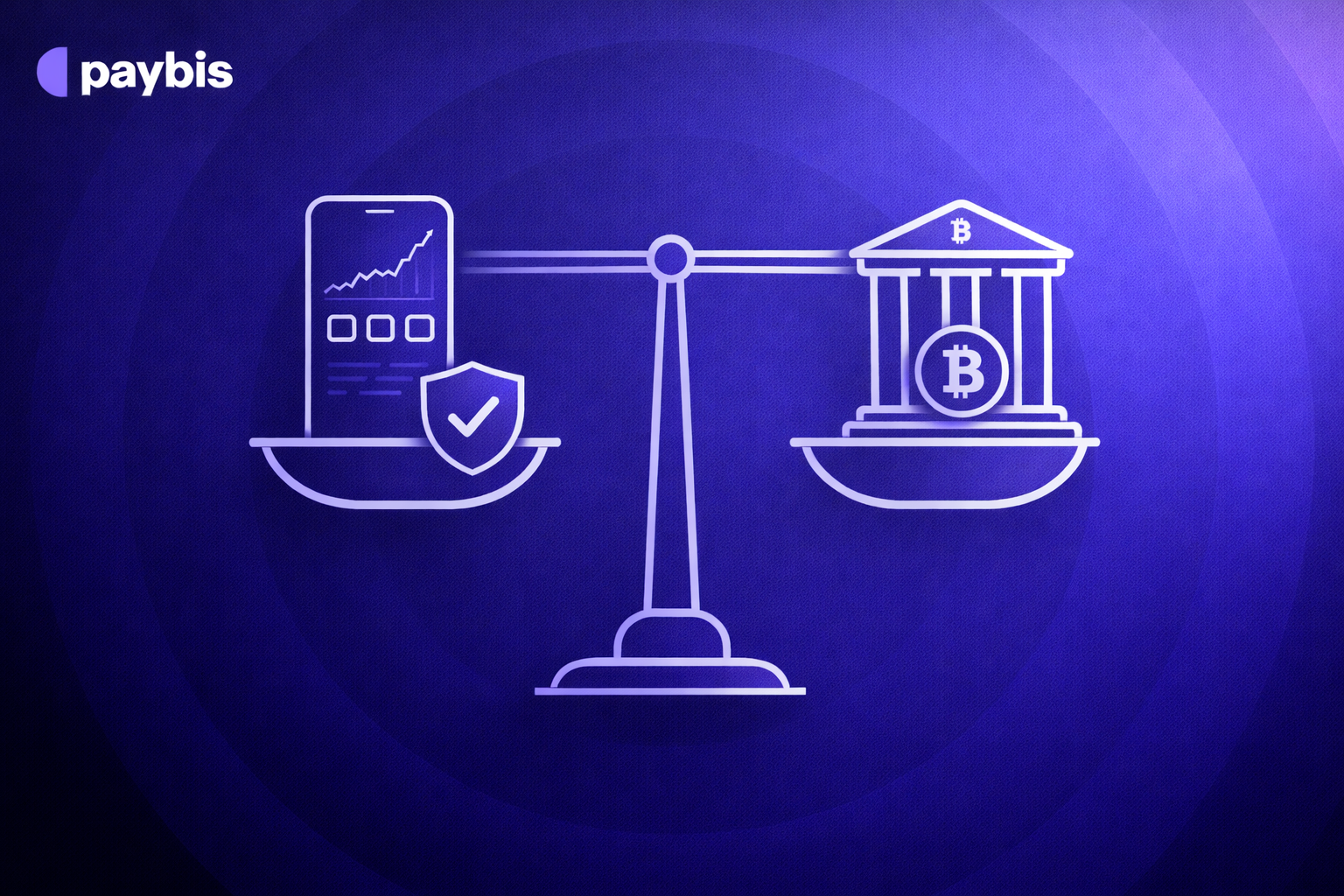
Crypto apps and exchanges serve different purposes. Neither is universally better.
Use apps when you want to buy crypto quickly with flexible payment methods. Use exchanges when you want to trade actively and need advanced features.
The best choice depends entirely on what you’re actually trying to do. Try not to overestimate how much you’ll trade and underestimate how much you value simplicity.
If you’re unsure which you need, start with an app. You’ll know within a month if you need exchange features. Moving from app to exchange is easy. Starting with an exchange when you just wanted to buy Bitcoin wastes time you won’t get back.
FAQ
What's the main difference between a crypto app and an exchange?
Apps are built for buying crypto quickly with fiat currency. Exchanges are built for trading between different cryptocurrencies with advanced features like limit orders and charts. Apps prioritize simplicity and speed. Exchanges prioritize trading tools and features.
Can I trade crypto on an app?
Most traditional crypto apps only let you buy and sell for cash, not trade between cryptocurrencies. However, some platforms like Paybis now offer crypto swapping, which lets you exchange one cryptocurrency for another without selling to cash first. This covers the most common trading need without exchange complexity.
Do crypto apps have higher fees than exchanges?
Apps typically charge higher percentage fees on individual purchases. But they offer faster access and more payment methods. Exchanges have lower trading fees but often charge for deposits, withdrawals. They may also require minimum balances. For occasional buyers, app fees are usually worth the convenience. For frequent traders, exchange fees work out cheaper.
Which is safer: crypto apps or exchanges?
Safety depends on regulation and security practices, not platform type. Look for FCA, FinCEN, or MiCA regulation regardless of whether it’s an app or exchange. Regulated platforms of both types must follow security standards and hold reserves. Unregulated platforms of both types carry risk.
Disclaimer: Don’t invest unless you’re prepared to lose all the money you invest. This is a high‑risk investment and you should not expect to be protected if something goes wrong. Take 2 mins to learn more at: https://go.payb.is/FCA-Info