Ethereum vs Bitcoin: 10 Key Differences Explained
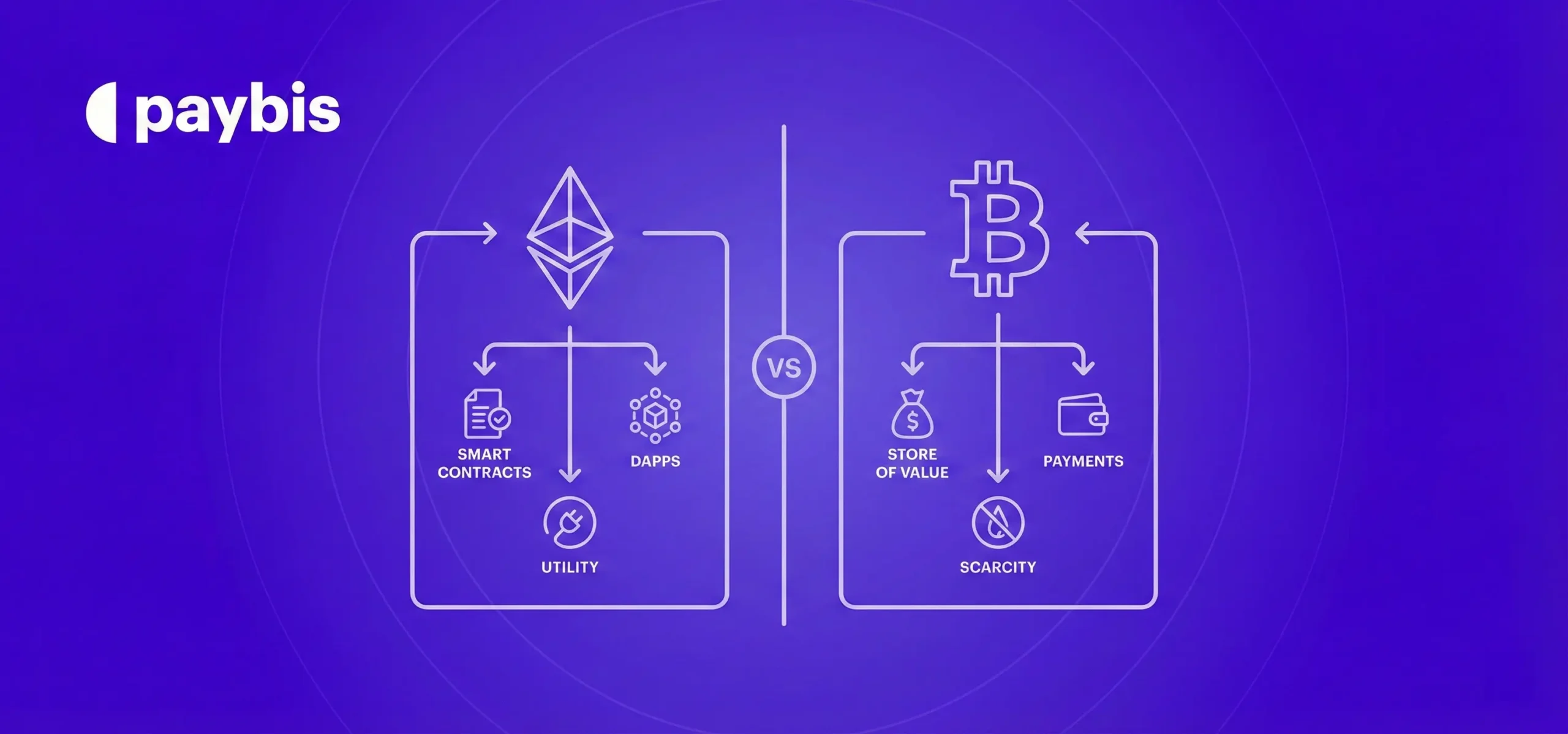
- Bitcoin was built to be digital money. Ethereum was built as a platform where developers create applications.
- Bitcoin has a maximum supply of 21 million coins. Ethereum has no maximum supply.
- Bitcoin transactions take 10 minutes per block. Ethereum transactions confirm in 12 seconds.
- Bitcoin runs simple payment transactions. Ethereum executes complex smart contracts that power DeFi and NFTs.
- Bitcoin uses energy-intensive proof-of-work mining. Ethereum switched to proof-of-stake in 2022 and cut energy use by 99.95%.
- Bitcoin upgrades rarely with extreme caution. Ethereum ships multiple network upgrades every year.
- Bitcoin dominates as a store of value and payment system. Ethereum dominates in decentralized applications and developer activity.
- Bitcoin processes 7-10 transactions per second. Ethereum processes 15-30 transactions per second.
- Bitcoin leads with a $1.3 trillion market cap. Ethereum sits at $370 billion as the second-largest cryptocurrency.
- Bitcoin exhibits lower volatility within crypto markets. Ethereum offers higher potential returns with higher risk and 3-4% staking yields.
Bitcoin and Ethereum dominate cryptocurrency conversations. You see both in headlines constantly. Both trade on every major exchange and have dedicated communities arguing their merits.
Most beginners assume Bitcoin and Ethereum are just competing cryptocurrencies. They’re not; Bitcoin focuses on being money, and Ethereum focuses on being a platform for building financial services and applications.
These differences matter if you’re deciding which cryptocurrency to buy, use, or learn about. And the “which is better” question misses the point entirely, because they serve different purposes. In this guide, we break down 10 key differences between Bitcoin and Ethereum by looking at what makes each unique, where they compete, and where they complement each other.
Table of contents
- Difference #1: Core Purpose and Design Philosophy
- Difference #2: Supply Economics and Monetary Policy
- Difference #3: Transaction Speed and Throughput
- Difference #4: Smart Contract Capabilities
- Difference #5: Consensus Mechanism and Energy Use
- Difference #6: Development Activity and Ecosystem
- Difference #7: Use Cases and Applications
- Difference #8: Network Upgrades and Governance
- Difference #9: Market Position and Adoption
- Difference #10: Investment Characteristics
- Bottom line
Difference #1: Core Purpose and Design Philosophy
Bitcoin is money with a narrow focus on storing and transferring value. Ethereum is a programmable platform where developers build decentralized applications. Bitcoin optimizes for security and stability. Ethereum optimizes for functionality and flexibility. This difference drives every other distinction between the two networks.
Bitcoin was designed to be digital money that works without banks or central authorities controlling it. The Bitcoin whitepaper describes it as “a peer-to-peer electronic cash system.”
Every design decision in Bitcoin optimizes for being a store of value and medium of exchange:
- Fixed supply creates scarcity like gold
- A simple transaction model keeps the system secure and predictable
- Conservative upgrades prioritize stability over new features
- Decentralization maximizes censorship resistance
Bitcoin’s creator (or creators) wrote the code, launched the network, and disappeared. The philosophy is “Bitcoin does one thing extremely well: be money.”
Ethereum takes the opposite approach.
Ethereum was designed as a platform for building applications. Its creator, Vitalik Buterin, described it as “a blockchain with a built-in programming language.”
The Ethereum design optimizes for flexibility and functionality:
- Smart contracts let developers build complex applications
- Regular upgrades add new capabilities
- Larger blocks allow more transactions and data
- Developer-friendly tools encourage innovation
Where Bitcoin says “we’re perfecting digital money,” Ethereum says “we’re enabling a programmable financial system.”
How this affects you:
If you’re looking for a way to store value digitally similar to gold, Bitcoin’s narrow focus and conservative approach might appeal to you. The network does one thing and does it well.
If you’re interested in decentralized finance, NFTs, or blockchain applications beyond payments, Ethereum provides the platform on which those services run. You need ETH to interact with most DeFi protocols.
Difference #2: Supply Economics and Monetary Policy
Bitcoin has a fixed maximum supply of 21 million coins enforced by the code. Ethereum has no maximum supply but implements a burn mechanism where transaction fees get destroyed. Ethereum can be inflationary or deflationary depending on network activity, while Bitcoin is always disinflationary with a predictable schedule ending in 2140.
Bitcoin has a hard cap of 21 million coins. It’s not 21 million coins “planned” or “expected”, the Bitcoin code itself enforces this limit. No one can change it without consensus from the entire network.
Bitcoin’s supply schedule:
- New Bitcoin is created through mining rewards
- Rewards started at 50 BTC per block in 2009
- Rewards halve every 210,000 blocks (roughly 4 years)
- Current reward: 3.125 BTC per block (as of April 2024)
- The final Bitcoin will be mined around the year 2140
As of February 2026, approximately 19.6 million Bitcoins exist. Only 1.4 million remain to be mined over the next 114 years. The scarcity model is similar to gold and creates a predictable supply inflation that decreases over time.
Ethereum has no maximum supply.
The network continuously issues new ETH to validators who secure the network. However, Ethereum implemented a burn mechanism in August 2021 (EIP-1559) that destroys a portion of transaction fees.
Ethereum’s current dynamics:
- New ETH issued: ~800,000 ETH annually through staking rewards
- ETH burned: varies with network activity (300,000-1,000,000 ETH annually)
- Net effect: Can be inflationary or deflationary, depending on usage
When network activity is high and fees spike, Ethereum burns more ETH than it creates. This makes ETH temporarily deflationary. During quiet periods, more ETH gets issued than burned, creating mild inflation.
Current supply figures:
- Bitcoin: ~19.6 million BTC (93.3% of maximum supply)
- Ethereum: ~120.5 million ETH (no maximum)
Why this matters:
Bitcoin’s fixed supply creates a scarcity narrative that appeals to people seeking “digital gold.” The supply is knowable and unchangeable, which attracts investors who prioritize scarcity.
Ethereum’s variable supply reflects its different purpose. The network needs to balance security incentives (issuing new ETH to validators) with economic sustainability (burning ETH to control inflation). This creates a more dynamic but less predictable supply model.
You can check current Bitcoin prices using the Bitcoin calculator or check Ethereum prices with the Ethereum calculator to see how supply dynamics affect market values.
Difference #3: Transaction Speed and Throughput
Bitcoin processes transactions slowly by design. The network finds a new block approximately every 10 minutes. Each block contains roughly 2,000-3,000 transactions, depending on transaction complexity.
Bitcoin transaction timing:
- Block time: 10 minutes (average)
- Confirmation time: 30-60 minutes for 3-6 confirmations
- Throughput: 7-10 transactions per second maximum
- Transaction finality: probabilistic, becomes more certain with each block
For a Bitcoin transaction to be considered “confirmed,” it should be included in a block plus have several additional blocks built on top of it. Each additional block makes reversing the transaction exponentially harder. Most services require 3-6 confirmations, meaning 30-60 minutes.
Ethereum processes transactions much faster.
The network produces a new block every 12 seconds. Each block can contain more transactions than Bitcoin due to Ethereum’s higher gas limit and more efficient block space usage.
Ethereum transaction timing:
- Block time: 12 seconds (average)
- Confirmation time: 12-15 seconds for practical finality
- Throughput: 15-30 transactions per second on the base layer
- Transaction finality: near-instant after 2 epochs (~13 minutes for absolute finality)
Ethereum’s proof-of-stake consensus provides faster practical finality. Once a block is confirmed, reversing it would require destroying billions of dollars’ worth of staked ETH. This makes Ethereum transactions feel final almost immediately.
Real-world comparison:
- Bitcoin: You send payment to a merchant. They see the transaction immediately but wait 30-60 minutes before considering it fully confirmed. Large payments might require even more confirmations.
- Ethereum: You send payment. It confirms in 12-15 seconds. The recipient can treat it as final almost immediately unless you’re transferring millions of dollars.
Layer 2 solutions change the equation:
Both networks have Layer 2 scaling solutions that dramatically improve speed:
- Bitcoin: Lightning Network enables instant payments
- Ethereum: Rollups like Arbitrum and Optimism process thousands of transactions per second
But on the base layer, Ethereum is significantly faster than Bitcoin.
Why Bitcoin is slower:
Bitcoin prioritizes security and decentralization over speed, so longer block times give nodes worldwide more time to receive and validate blocks. This keeps the network decentralized, even with slower internet connections.
Ethereum’s faster blocks create more orphaned blocks (blocks that don’t make it into the main chain), but the network handles this through its consensus mechanism.
Difference #4: Smart Contract Capabilities
Bitcoin has limited scripting capabilities that handle basic transactions and multisig wallets but cannot run complex programs or applications. Ethereum was built specifically for smart contracts with a Turing-complete programming language. Bitcoin prioritizes simplicity and security. Ethereum prioritizes programmability and flexibility. So Ethereum is the primary platform for blockchain applications.
Bitcoin uses a limited scripting language for transactions. This language can do basic things like:
- Send Bitcoin from address A to address B
- Require multiple signatures to spend funds (multisig)
- Create time-locked transactions that can only be spent after a certain date
- Build simple conditional payments
Bitcoin’s scripting was deliberately kept simple to minimize security risks and keep the network focused on its core purpose: transferring money.
What Bitcoin’s script cannot do:
- Run complex programs or applications
- Access external data sources
- Execute conditional logic based on real-world events
- Create tokens or additional assets
- Build lending protocols or decentralized exchanges
Some developers have built additional functionality on top of Bitcoin (like the Lightning Network or Ordinals for NFTs), but these require workarounds or separate networks.
Ethereum is built for smart contracts.
The Ethereum Virtual Machine (EVM) is a Turing-complete programming environment. Developers can write programs of arbitrary complexity that run on every Ethereum node simultaneously.
What Ethereum’s smart contracts enable:
- Decentralized exchanges, where you trade tokens without a company operating the exchange
- Lending protocols where you borrow or lend money without a bank
- NFT marketplaces where digital assets are bought and sold automatically
- Prediction markets where people bet on real-world events
- Decentralized autonomous organizations (DAOs), where groups make collective decisions
- Stablecoins that maintain a value fixed to dollars or other currencies
Real example of the difference:
Bitcoin: You want to create a will that automatically distributes your Bitcoin to family members after you die. You can use time-locked transactions, but setting this up requires technical knowledge, and the functionality is limited.
Ethereum: You deploy a smart contract that holds your ETH and monitors your activity. Then it automatically distributes funds according to your instructions after a period of inactivity. The contract can include complex conditions, multiple beneficiaries, and even governance mechanisms where beneficiaries vote on distributions.
The tradeoff:
Bitcoin’s limited scripting means fewer attack vectors and simpler security analysis. So every transaction does basically the same thing, making bugs less likely.
Ethereum’s flexibility means more complexity and more potential for bugs. Smart contract exploits have resulted in hundreds of millions of dollars in losses because smart contract code is hard to write securely.
Paybis supports both buying Bitcoin and buying Ethereum, letting you access either network based on your needs.
Difference #5: Consensus Mechanism and Energy Use
Bitcoin uses proof-of-work (PoW) for consensus, so miners compete to solve complex mathematical puzzles. The first miner to find a solution gets to add the next block and receives the block reward.
How Bitcoin proof-of-work works:
- Miners run specialized hardware (ASICs) that compute trillions of hashes per second
- Finding a valid block requires randomly guessing until you find a solution
- Difficulty adjusts every 2,016 blocks to maintain the 10-minute average block time
- More miners = greater difficulty = more energy consumption
The competition requires enormous amounts of electricity. The entire Bitcoin network consumes roughly 127 terawatt-hours annually (comparable to Argentina’s total electricity consumption).
Bitcoin’s energy consumption:
- Annual electricity use: ~127 TWh
- Carbon footprint: ~65 million tons CO2 annually
- Energy per transaction: ~700 kWh
- Environmental criticism: Bitcoin faces regular criticism for its environmental impact
The Bitcoin community argues that this energy secures the network and that significant mining uses renewable energy or would otherwise be wasted.
Something those articles never mention is that Bitcoin is able to use energy that would otherwise go to waste. That is why energy companies are partnering with miners to sell excess energy in times of low grid usage, providing more stability to the grid. This gets reported as Bitcoin using the energy, when the alternative is it’s just wasted.
SmokeandSkate on Reddit
Ethereum switched to proof-of-stake (PoS) in September 2022.
The transition (called “The Merge”) replaced energy-intensive mining with validator staking. Instead of solving puzzles, validators lock up 32 ETH as collateral to participate in consensus.
How Ethereum proof-of-stake works:
- Validators deposit 32 ETH to become active
- The protocol randomly selects validators to propose and attest to blocks
- Validators earn rewards for honest participation
- Malicious behavior results in slashing (and lose staked ETH)
- No mining hardware or massive electricity consumption required
Ethereum’s energy consumption after The Merge:
- Annual electricity use: ~0.01 TWh
- Reduction: 99.95% decrease from proof-of-work
- Energy per transaction: ~0.03 kWh
- Environmental impact: Comparable to running a few thousand homes
The big reduction in energy use addressed one of Ethereum’s biggest criticisms and changed its public perception.
Security implications:
- Bitcoin’s proof-of-work: Attacking Bitcoin requires obtaining 51% of the network’s hashrate. This means building or acquiring enough mining hardware to outcompete all existing miners. The capital cost and ongoing electricity expenses make attacks prohibitively expensive.
- Ethereum’s proof-of-stake: Attacking Ethereum requires controlling 51% of staked ETH. At current prices, this means acquiring roughly $65+ billion worth of ETH. The protocol would also slash (destroy) the attacker’s stake and make successful attacks financially suicidal.
Both systems are extremely secure, but they achieve security through different economic incentives.
Difference #6: Development Activity and Ecosystem
Ethereum has significantly more developer activity with over 8,000 active developers contributing monthly across thousands of applications. Bitcoin has approximately 1,000 active developers focused mainly on core infrastructure, Lightning Network, and security tools. Ethereum’s design as a programmable platform naturally attracts application developers, while Bitcoin’s design as money attracts developers working on financial infrastructure and payment systems. Both approaches serve their respective purposes effectively.
Bitcoin development moves deliberately and slowly, because the network prioritizes stability over new features. Major upgrades take years of discussion, testing, and gradual activation.
Bitcoin’s development approach:
- The core development team is small but highly experienced
- Changes require extensive review and consensus-building
- Backward compatibility is paramount
- Upgrades are rare and conservative
Recent significant Bitcoin upgrades:
- Segregated Witness (2017): Increased transaction capacity and fixed transaction malleability
- Taproot (2021): Improved privacy and smart contract capabilities
- Soft forks: Activated through miner signaling and node adoption
This conservative approach has both benefits and drawbacks. Bitcoin remains incredibly stable and secure. But it also means the network adopts new technology slowly compared to competitors.
Ethereum development is rapid and ambitious.
The network undergoes regular upgrades, adding new capabilities. Ethereum has a roadmap with planned improvements extending years into the future.
Major Ethereum upgrades:
- The Merge (2022): Switched from proof-of-work to proof-of-stake
- Shanghai (2023): Enabled staked ETH withdrawals
- Dencun (2024): Reduced Layer 2 transaction costs through proto-danksharding
- Upcoming: Verkle trees, full danksharding, statelessness
Ethereum executes several network upgrades annually. Each upgrade adds features, improves efficiency, or fixes problems.
Developer ecosystem comparison:
Bitcoin:
- Approximately 1,000 active developers are contributing to Bitcoin-related projects
- The main focus is on wallets, Lightning Network, infrastructure, and security tools
- Fewer developers are building applications directly on Bitcoin
- Development is concentrated on Bitcoin Core and major infrastructure
Ethereum:
- Over 8,000 active developers are contributing to Ethereum projects monthly
- Thousands of applications spanning DeFi, NFTs, DAOs, games, and social networks
- Multiple programming languages (Solidity, Vyper) for smart contracts
- Extensive tooling and documentation for developers
This doesn’t mean Ethereum is “better” than Bitcoin. It means Ethereum’s design as a platform naturally attracts more application developers, while Bitcoin’s focus on being money attracts developers working on financial infrastructure.
Real-world implications:
If you’re looking for a stable asset that changes slowly and predictably, Bitcoin’s conservative approach is a feature, not a bug. The network does what it does reliably.
If you want to participate in DeFi, use NFT marketplaces, or interact with decentralized applications, you’ll see Ethereum constantly because that’s where most applications are built.
Difference #7: Use Cases and Applications
Bitcoin primarily serves as digital money for storing value, international payments, remittances, and as a hedge against inflation. It functions like “digital gold” with a focus on being a decentralized, censorship-resistant store of value. Ethereum functions as a platform for decentralized applications including DeFi protocols, NFT marketplaces, DAOs, games, and smart contracts. Bitcoin excels at being money. Ethereum excels at being programmable infrastructure for financial services and applications.
Bitcoin excels at being money, so the network’s primary use cases all relate to storing and transferring value.
Bitcoin use cases:
- Store of value: People buy Bitcoin as a hedge against inflation or currency devaluation. The fixed supply and decentralized nature make it attractive for long-term savings. Some compare it to “digital gold.”
- International payments: Bitcoin enables transferring money across borders without banks or intermediaries. No one can freeze your transaction or block your payment. This matters in countries with capital controls or unstable banking systems.
- Remittances: Workers sending money home to family can use Bitcoin to avoid high Western Union or bank transfer fees. Though transaction fees on Bitcoin can be high during network congestion, they’re often cheaper than traditional services for large amounts.
- Savings in unstable economies: People in countries with high inflation (Argentina, Turkey, Venezuela) use Bitcoin to preserve purchasing power when local currencies collapse.
- Corporate treasury: Companies like MicroStrategy hold Bitcoin on their balance sheets as a treasury reserve asset, treating it like a more liquid version of gold.
What Bitcoin isn’t used for:
- Buying coffee (too slow and expensive for small purchases)
- Lending and borrowing (requires smart contracts)
- Creating new tokens or assets
- Running decentralized applications
- NFTs or digital collectibles (though Ordinals emerged in 2023)
Ethereum powers a vast ecosystem of applications:
Decentralized Finance (DeFi)
- Lending protocols where you earn interest on deposits (Aave, Compound)
- Decentralized exchanges where you trade tokens without KYC (Uniswap, Curve)
- Derivatives and options platforms (dYdX, GMX)
- Stablecoins that maintain dollar pegs (USDC, DAI, USDT)
NFTs and Digital Assets
- Art marketplaces (OpenSea, Blur)
- Gaming items and virtual real estate (Axie Infinity, Decentraland)
- Music and entertainment NFTs
- Domain names (Ethereum Name Service)
Decentralized Autonomous Organizations (DAOs)
- Community governance and decision-making
- Treasury management
- Coordinating groups without traditional corporate structures
Identity and Credentials
- Verifiable credentials and diplomas
- Reputation systems
- Web3 authentication
Gaming and Metaverse
- Play-to-earn games
- Virtual worlds with user-owned assets
- In-game economies
Ethereum can also function as money, but that’s not its primary purpose. People do buy Ethereum as an investment or to hold as an asset, but most ETH usage involves paying for transactions within applications rather than direct peer-to-peer payments.
Which one you need depends on your goal:
Want to store value long-term or make peer-to-peer payments? Bitcoin serves that purpose directly.
Want to earn yield on your crypto, trade without centralized exchanges, or interact with blockchain applications? You’ll need Ethereum to participate in that ecosystem.
Difference #8: Network Upgrades and Governance
Bitcoin upgrades through a highly conservative consensus process. There’s no “Bitcoin CEO” or foundation with authority to change the protocol. Changes require overwhelming agreement from multiple stakeholder groups.
Bitcoin’s upgrade process:
- Bitcoin Improvement Proposals (BIPs): Developers write formal proposals describing potential changes. These proposals get discussed extensively in developer meetings, mailing lists, and public forums.
- Review period: Proposals go through months or years of technical review. Developers look for security risks and potential attacks.
- Implementation: If there is a consensus, developers implement the change in the Bitcoin Core software. But implementation doesn’t mean activation.
- Activation: Most upgrades use soft forks that activate when a supermajority of miners signal readiness. This ensures broad support before changes take effect.
This process is slow, but it protects Bitcoin’s stability. Bad ideas rarely make it through the gauntlet of review and consensus-building.
Notable Bitcoin governance conflicts:
- The blocksize debate (2015-2017) led to a contentious split where Bitcoin Cash forked off
- Segwit activation (2017) took years and required compromise
- Taproot activation (2021) used a new signaling method after extensive discussion
Ethereum upgrades through a different model:
Ethereum has a more centralized development process led by the Ethereum Foundation and core developers. Vitalik Buterin, Ethereum’s creator, remains heavily involved in protocol decisions.
Ethereum’s upgrade process:
- Ethereum Improvement Proposals (EIPs): Anyone can submit an EIP, but core developers ultimately decide which proposals to include in upgrades.
- All Core Developers calls: Developers meet regularly to discuss technical issues and coordinate upgrades. These calls shape Ethereum’s roadmap.
- Testnets: Upgrades are deployed to test networks first. Developers find and fix bugs before mainnet launch.
- Hard forks: Ethereum uses hard forks for major upgrades. All nodes must upgrade to stay on the network. This creates coordination requirements but allows breaking changes.
- Scheduled upgrades: Ethereum operates on a predictable upgrade schedule with network-wide upgrades happening multiple times per year.
This process helps with faster innovation but concentrates decision-making power. The Ethereum community generally trusts the core development team to make good technical decisions.
Neither approach is objectively right or wrong; they just reflect different priorities and serve different purposes.
Difference #9: Market Position and Adoption
Bitcoin dominates the cryptocurrency market by capitalization, name recognition, and institutional adoption. It’s the cryptocurrency most people know about.
Bitcoin market statistics (February 2026):
- Market cap: ~$1.3 trillion
- Bitcoin dominance: ~55% of total cryptocurrency market cap
- Daily trading volume: ~$35 billion
- Number of addresses with balance: ~50+ million
- Price: ~$67,000 per BTC
Bitcoin benefits from being first. It has 15 years of operational history without major security failures or network downtime, which builds trust with institutions and conservative investors.
Institutional Bitcoin adoption:
- Public companies holding Bitcoin: MicroStrategy holds over 500,000 BTC on its balance sheet. Tesla held Bitcoin (though it later sold most). Square (now Block) maintains Bitcoin reserves. Numerous public companies have allocated capital to Bitcoin.
- Bitcoin ETFs: Spot Bitcoin ETFs launched in January 2024 with BlackRock, Fidelity, and others offering products. These ETFs collected over $30 billion in their first year, giving mainstream investors easy exposure.
- Corporate acceptance: Major companies like Microsoft, PayPal, and Block accept Bitcoin or integrate Bitcoin services. Payment processors enable Bitcoin payments for merchants.
- Regulatory clarity: Bitcoin increasingly receives regulatory clarity in major markets. The SEC treats Bitcoin as a commodity rather than a security, simplifying compliance for institutions.
Ethereum occupies second place but leads in different metrics:
Ethereum market statistics (February 2026):
- Market cap: ~$370 billion
- Ethereum dominance: ~16% of total cryptocurrency market cap
- Daily trading volume: ~$18 billion
- Number of addresses with balance: ~100+ million
- Price: ~$3,100 per ETH
Where Ethereum leads:
- Developer activity: More developers build on Ethereum than all other smart contract platforms combined. The ecosystem includes thousands of projects.
- DeFi dominance: Ethereum hosts ~60% of all DeFi value locked across all blockchains. Major DeFi protocols (Uniswap, Aave, MakerDAO) run on Ethereum or Ethereum Layer 2s.
- NFT marketplace: Most NFT trading happens on Ethereum. The network processed billions in NFT sales, though activity has declined from the 2021 to 2022 peaks.
- Enterprise adoption: Companies use Ethereum for different purposes, including supply chain tracking, tokenization projects, and private permissioned networks. The Enterprise Ethereum Alliance includes Microsoft, JPMorgan, and hundreds of companies.
- Stablecoin infrastructure: Major stablecoins (USDC, USDT, DAI) run on Ethereum, consisting of hundreds of billions in transactions monthly.
Difference #10: Investment Characteristics
Bitcoin and Ethereum have different risk/return profiles and investment characteristics. Neither is objectively “better” as an investment, since they serve different roles in portfolios.
Bitcoin’s investment characteristics:
- Market leader: Bitcoin moves first. When institutional money enters crypto, it almost certainly buys Bitcoin initially and creates a first-mover advantage in bull markets.
- Lower volatility (relative to other cryptocurrencies): Although it’s volatile enough, Bitcoin still exhibits less volatility than most altcoins, including Ethereum. During market crashes, Bitcoin typically falls less than Ethereum percentage-wise.
- Store of value narrative: Bitcoin’s fixed supply and “digital gold” narrative attracts investors who are looking for inflation hedges or alternatives to gold.
Simpler investment thesis: Bitcoin’s value proposition is straightforward: scarce digital money. You don’t need to understand smart contracts, DeFi, or complex technology.
Historical returns:
- 2015-2020: ~8,000% gain
- 2020-2021: ~600% gain
- 2022: -65% (bear market)
- 2023-2025: ~400% gain
- Long-term: Exceptional returns but extreme volatility
Ethereum’s investment characteristics:
- Higher volatility: Ethereum often moves more dramatically than Bitcoin in both directions. It tends to fall harder in bear markets but rally more aggressively in bull markets.
- Technology platform narrative: Ethereum’s value depends partly on network usage and application adoption. More DeFi activity and users theoretically should increase the ETH value.
- Staking yield: Ethereum offers ~3-4% annual yield through staking, and provides income in addition to price appreciation. Bitcoin offers no native yield.
- More speculative: Ethereum faces more competition from other smart contract platforms (Solana, Avalanche, Binance Smart Chain). Its dominance is less certain than Bitcoin’s.
Historical returns:
- 2016-2020: ~15,000% gain
- 2020-2021: ~1,400% gain
- 2022: -68% (bear market)
- 2023-2025: ~450% gain
- Long-term: Higher returns than Bitcoin, but higher volatility
Portfolio management approaches:
- Conservative crypto allocation: 70-80% Bitcoin, 20-30% Ethereum. This weights toward the more established asset while maintaining exposure to Ethereum’s growth potential.
- Balanced allocation: 50% Bitcoin, 50% Ethereum. This splits between “digital gold” and “programmable money” narratives.
- Aggressive allocation: 30-40% Bitcoin, 60-70% Ethereum. This overweights the higher-risk, and potentially higher-return asset.
Both cryptocurrencies remain highly volatile and risky compared to traditional assets. Most financial advisors recommend limiting crypto to 1-5% of an overall portfolio.
Paybis makes it easy to buy both Bitcoin and Ethereum through bank transfers or with a credit card.
Questions to ask yourself before deciding on which to purchase:
- What’s your time horizon? Long-term holders focused on 5-10 year time horizons mostly prefer Bitcoin’s stability. Short-term traders usually prefer Ethereum’s volatility and application ecosystem growth.
- What’s your risk tolerance? Lower risk tolerance suggests Bitcoin allocation, while higher risk tolerance allows more Ethereum exposure.
- Do you want to actively use your crypto? If you want to lend, borrow, trade, or use DeFi applications, you need Ethereum. If you just want to hold and occasionally send payments, Bitcoin works fine.
- How much time can you invest in learning? Bitcoin’s simpler design requires less technical knowledge. Ethereum’s ecosystem requires understanding smart contracts, gas fees, DeFi protocols, and more complex concepts.
Bottom line
Bitcoin excels at being money, Ethereum excels at being programmable infrastructure. Both have proven themselves over years of operation and face ongoing challenges and competition.
If you understand the differences well, you can make informed decisions about which cryptocurrency aligns with your goals.
FAQ
Can Ethereum replace Bitcoin?
No. Ethereum wasn’t designed to replace Bitcoin. The networks serve different purposes. Bitcoin focuses on being money and a store of value. Ethereum focuses on being a platform for decentralized applications. They’re complementary rather than directly competitive.
Is Ethereum more scalable than Bitcoin?
Yes, in terms of base layer throughput. Ethereum processes 15-30 transactions per second compared to Bitcoin’s 7-10 transactions per second. Ethereum also has more active scaling solutions (Layer 2 rollups) that dramatically increase capacity. However, both networks face scalability limitations and rely on Layer 2 solutions for mass adoption. Ethereum’s roadmap prioritizes scaling more aggressively than Bitcoin’s conservative approach.
Which is more secure, Bitcoin or Ethereum?
Both networks are extremely secure, but achieve security differently. Bitcoin uses proof-of-work with 15 years of operational history without major hacks or downtime. Attacking Bitcoin requires obtaining a majority hashrate at a prohibitive cost. Ethereum uses proof-of-stake, requiring an attacker to acquire and destroy billions in ETH. Neither has had its base layer successfully attacked. Bitcoin has a longer operational history. Ethereum has a newer consensus mechanism with less battle-testing but strong economic security.
Disclaimer: Don’t invest unless you’re prepared to lose all the money you invest. This is a high‑risk investment and you should not expect to be protected if something goes wrong. Take 2 mins to learn more at: https://go.payb.is/FCA-Info