How Does Bitcoin Work? A Complete Guide to Understanding Cryptocurrency
- Bitcoin runs on a distributed ledger called blockchain where every transaction is recorded across thousands of computers globally
- Miners verify transactions and add them to the blockchain by solving complex mathematical problems, earning new Bitcoin as reward
- Bitcoin uses cryptographic keys (public and private) to control ownership without requiring banks or intermediaries
- Transactions typically confirm within 10-60 minutes depending on network congestion and fees paid
- The Bitcoin network has built-in scarcity with only 21 million coins that will ever exist
You’ve heard about Bitcoin for years. Maybe you’ve seen the price charts, watched friends make (or lose) money, or noticed companies adding it to their balance sheets. But when someone asks, “How does Bitcoin actually work?” most people freeze up.
The truth is simpler. Bitcoin operates on principles that sound complicated but break down into understandable pieces once you see how they fit together. No computer science degree or advanced math required.
This guide will walk you through exactly how Bitcoin functions, from the blockchain that records every transaction to the miners who secure the network. We will also cover what happens when you actually use it to send or receive money.
Table of contents
- What Is Bitcoin and Why Does It Need to “Work” Differently?
- How Does Bitcoin Blockchain Actually Work?
- How Does Bitcoin Mining Work?
- How Do Bitcoin Transactions Actually Work?
- How Do Bitcoin Addresses and Keys Work?
- How Does Bitcoin Prevent Double-Spending Without Banks?
- How Does Bitcoin Mining Difficulty Adjustment Work?
- How Do Bitcoin Transactions Get Confirmed and Finalized?
- How Does Bitcoin Work Compared to Other Cryptocurrencies?
- How Can You Actually Use Bitcoin?
- How Does Bitcoin Fix Supply Work?
- Bottom Line
What Is Bitcoin and Why Does It Need to “Work” Differently?
Bitcoin is digital money maintained by thousands of computers worldwide instead of banks. No central authority controls it. Transactions get recorded on a shared ledger (blockchain) that everyone can see but no one can alter. It works 24/7, crosses borders instantly, and costs the same to send $100 or $100 million.
Bitcoin is digital money that exists purely as computer code. No physical coins and no bills, just entries in a shared database that everyone can see, but no one can cheat. This open design is a big reason behind Bitcoin’s dominance, as it reinforces trust, security, and Bitcoin’s leading position in the crypto market.
Traditional money relies on banks to keep track of who owns what. Your bank account shows a number, which represents the amount of money the bank says you have. You trust the bank to maintain accurate records, prevent fraud, and let you access your money. The entire financial system runs on this trust model with institutions acting as middlemen for every transaction.
Bitcoin flips this completely. Instead of one institution controlling the ledger, thousands of computers around the world maintain identical copies. When you send Bitcoin to someone, that transaction gets broadcast to the entire network. Miners verify it’s legitimate. Once confirmed, it becomes a permanent record that can never be altered or erased.
This creates money that functions without requiring permission from banks. It also operates 24/7, including weekends and holidays, and crosses borders instantly without currency conversion. It almost costs the same to send $100 or $100 million. The mechanics that make this possible involve three core components: the blockchain, cryptographic keys, and the mining network.
How Does Bitcoin Blockchain Actually Work?
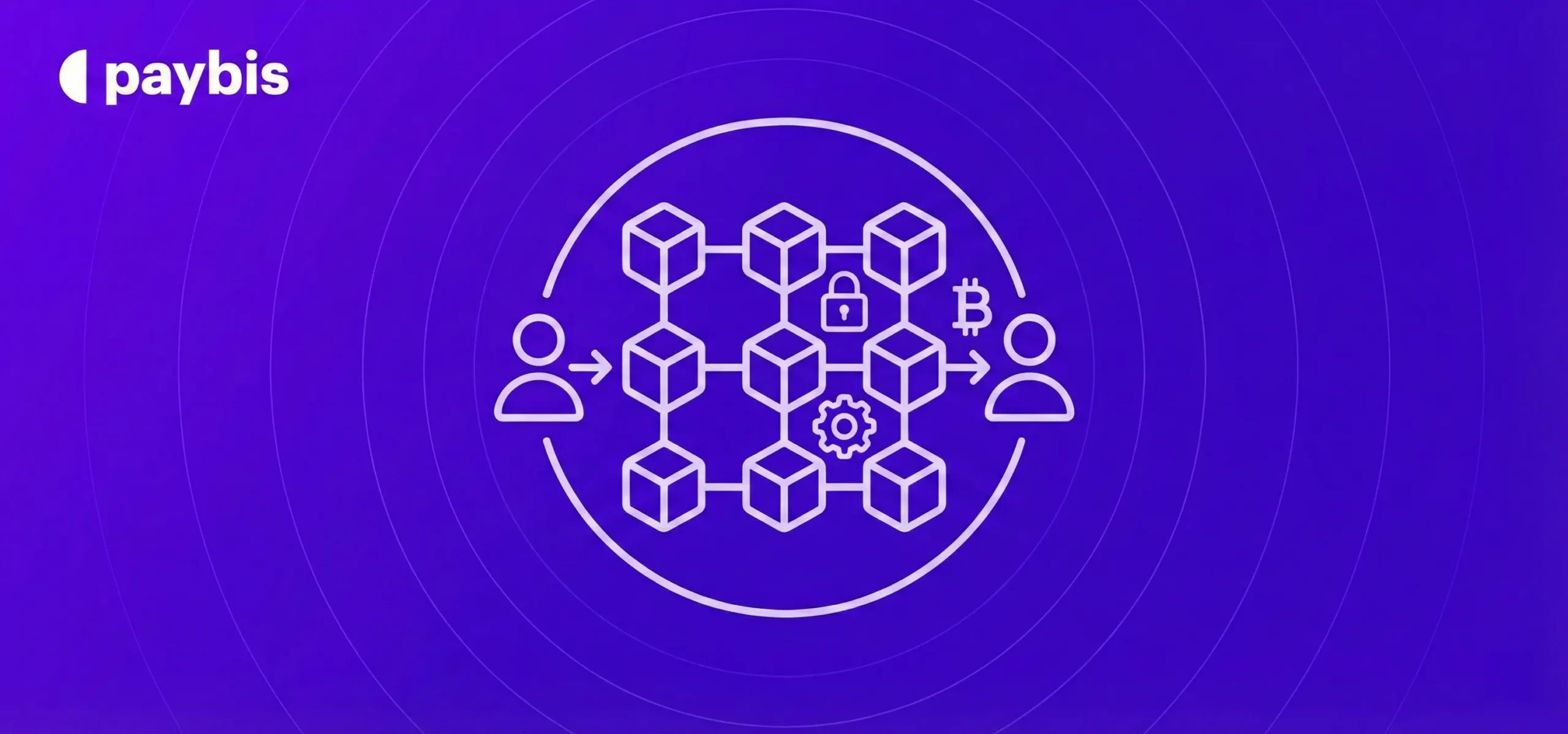
The blockchain is a chain of “blocks” where each block contains batches of transactions. New blocks get added every 10 minutes. Each block links to the previous one through cryptography, making the entire history tamper-proof. Change one old transaction and you break the entire chain.
Blockchain is Bitcoin’s innovation. You can think of it as a continuous chain of blocks, where each block contains a batch of recent transactions bundled together.
Here’s what happens step by step:
Someone initiates a Bitcoin transaction. Maybe you’re buying Bitcoin on Paybis and sending it to your personal Bitcoin wallet. That transaction gets broadcast to the Bitcoin network as unconfirmed.
Miners collect unconfirmed transactions into a candidate block. Each block can hold roughly 1-2 MB of transaction data, which translates to a few thousand individual transactions depending on their complexity.
Miners compete to validate this block by solving a cryptographic puzzle. The first miner to solve it gets to add their block to the chain and broadcast it to the network.
Other computers (nodes) verify that the new block follows all of Bitcoin’s rules. They check that transactions are valid, coins haven’t been double-spent, and the cryptographic puzzle was solved correctly. If everything checks out, they add this block to their copy of the blockchain.
The chain grows by one block roughly every 10 minutes. This timing isn’t random. Bitcoin’s protocol automatically adjusts the difficulty of the cryptographic puzzle to maintain this average regardless of how many miners are competing.
Why the chain structure matters: Each block contains a cryptographic reference to the previous block. Change anything in an old block, and you break the chain. To successfully alter historical transactions, you’d need to redo all the computational work for that block and every block that came after it, while simultaneously outpacing the current mining network, adding new blocks. The computational power required makes this effectively impossible.
This is how Bitcoin achieves security without a central authority. The blockchain becomes an immutable record of every transaction ever made, maintained by thousands of independent computers with no single point of failure.
| Component | Function | Purpose |
|---|---|---|
| Blockchain | Distributed ledger of all transactions | Creates permanent, tamper-proof record |
| Miners | Validate transactions, add blocks | Secures network, prevents fraud |
| Nodes | Store complete blockchain copy | Verify blocks, maintain consensus |
| Cryptographic Keys | Control Bitcoin ownership | Enables spending without banks |
| Protocol Rules | Define valid transactions, supply cap | Ensures consistency across network |
How Does Bitcoin Mining Work?
Mining is competitive accounting. Miners collect transactions, bundle them into blocks, then compete to solve complex math puzzles. The first to solve it adds their block to the blockchain and earns newly created Bitcoin (currently 3.125 BTC per block) plus transaction fees.
Mining sounds like digging for gold, but it’s actually competitive accounting. Miners are the processors who verify transactions and maintain the blockchain, and they get paid in newly created Bitcoin for doing this work.
The mining process breaks down like this:
1. Gathering transactions from the mempool
Miners collect unconfirmed transactions from the network’s memory pool. They select which ones to include based on fees. Higher fees mean higher priority for getting into the next block.
2. Creating a candidate block
Miners bundle selected transactions together and add a special transaction, rewarding themselves with new Bitcoin. Currently, that’s 3.125 BTC per block. This reward halves every four years in an event called the “halving.”
3. Solving the cryptographic puzzle
Now comes actual mining. Miners must find a specific number called a nonce that when combined with the block’s data and run through a hash function, produces an output meeting Bitcoin’s difficulty target. This requires the hash to start with a certain number of zeros.
4. Racing to find the solution
Finding the nonce requires trillions of random guesses. Modern mining hardware (ASICs) attempts over 100 trillion hashes per second. Even at that speed, the network collectively takes about 10 minutes on average to find a valid solution.
5. Broadcasting and verification
The first miner to find a valid nonce broadcasts their block to the network. Other miners immediately verify the solution is correct (takes microseconds, unlike the hours it might have taken to find). They add the block to their blockchain copy and start working on the next block.
Why this matters for security: Mining creates a massive computational cost to attack the network. To double-spend Bitcoin or rewrite transaction history, an attacker would need to control more computing power than all honest miners combined. The Bitcoin network currently processes over 600 exahashes per second (that’s 600 quintillion hashes every second). The electricity cost alone to attack it would run into hundreds of millions of dollars per hour, making attacks economically irrational.
| Mining Step | What Happens | Time Required |
|---|---|---|
| Collect Transactions | Gather unconfirmed transactions from mempool | Seconds |
| Create Block | Bundle transactions plus reward transaction | Seconds |
| Solve Puzzle | Find valid nonce through trillions of guesses | ~10 minutes (average) |
| Broadcast Block | Send block to network for verification | Seconds |
| Network Verification | Other nodes verify and add to their blockchain | Seconds |
Mining also distributes new Bitcoin in a predictable, transparent way. No central bank decides how much to print. The protocol sets the supply schedule in stone. Currently, 900 new Bitcoins enter circulation daily (3.125 BTC per block times roughly 144 blocks per day). This rate halves every 210,000 blocks until the total supply reaches 21 million coins around the year 2140.
How Do Bitcoin Transactions Actually Work?
You create a transaction specifying where Bitcoin goes, sign it with your private key, and broadcast it to the network. Miners include it in a block. Once that block gets added to the blockchain, your transaction is confirmed. After 6 confirmations (roughly 1 hour), it’s considered permanent.
When you send Bitcoin to someone, you’re not actually moving digital coins from one place to another. You’re creating a transaction that transfers control over specific Bitcoin amounts from your cryptographic keys to someone else’s keys.
Every Bitcoin transaction has three essential components:
Inputs: These reference previous transactions where you received Bitcoin. Think of them as saying “I’m spending the Bitcoin I received in transaction XYZ.”
Outputs: These specify where the Bitcoin is going. Usually, this includes the recipient’s address and a change of address, sending any leftover amount back to yourself.
Digital signature: This proves you control the private key associated with the Bitcoin you’re spending. Without the correct signature, the transaction is invalid, and miners will reject it.
Here’s a practical example. Say you have 1 BTC and want to send 0.3 BTC to a friend:
You create a transaction with an input referencing where you received that 1 BTC. The outputs might show 0.3 BTC going to your friend’s address, 0.699 BTC going back to your change address, and 0.001 BTC designated as the miner fee. You sign this transaction with your private key.
This transaction gets broadcast to the Bitcoin network, where it sits in the mempool waiting to be included in a block. Miners see your transaction and the 0.001 BTC fee you offered. They’re more likely to include transactions with higher fees, especially when the mempool is congested.
Once a miner includes your transaction in a block and that block gets added to the blockchain, your transaction has “1 confirmation.” As more blocks get added on top of it, the number of confirmations increases. Most services consider 6 confirmations (roughly 1 hour) as fully settled and irreversible.
Transaction fees work differently from bank fees. You’re not paying based on the dollar amount sent. Fees depend on the transaction’s data size (measured in bytes) and how busy the network is. Sending $100 or $1 million costs roughly the same if the transaction size is similar. During periods of high network activity, fees spike because users compete to get their transactions included quickly.
You can check estimated transaction times and costs using tools like the Bitcoin calculator to plan transfers effectively.
How Do Bitcoin Addresses and Keys Work?
Bitcoin addresses are like email addresses for receiving money, but they’re generated through complex cryptography that makes them secure without requiring a central authority to manage them.
The system uses two types of keys:
- Private keys are random 256-bit numbers that control your Bitcoin. Think of this as your master password. Anyone who has your private key can spend your Bitcoin. If you lose it, your Bitcoin is gone forever with no customer service to call for account recovery.
- Public keys are mathematically derived from private keys using elliptic curve cryptography. You can freely share public keys without compromising security because the math works in only one direction. Creating a public key from a private key is instant. Figuring out a private key from a public key would take all the world’s computers billions of years.
- Bitcoin addresses are shortened, formatted versions of public keys designed to be easily shared. Modern addresses start with “bc1” or “1” or “3”, depending on the address type. They include checksums to catch typing errors.
When you set up a Bitcoin wallet, the software generates these key pairs for you. You see addresses for receiving Bitcoin. Behind the scenes, the wallet stores private keys that let you spend Bitcoin sent to those addresses.
The security model is elegant: You can publish your address anywhere without risk. People can verify that you control Bitcoin at that address by checking the blockchain. But only someone with the private key can create valid signatures to move that Bitcoin.
This eliminates the need for banks to verify identity and authorize transactions. The cryptography itself proves ownership. The blockchain prevents double-spending. Together, they create money that works peer-to-peer without trusted intermediaries.
How Does Bitcoin Prevent Double-Spending Without Banks?
Private keys are secret passwords controlling your Bitcoin. Public keys and addresses are derived from private keys and can be shared freely. You share your address to receive Bitcoin. You use your private key to spend it. Lose the private key and your Bitcoin is gone forever with no recovery.
Double-spending is the fundamental problem Bitcoin solved. With digital files, you can copy them infinitely. What prevents someone from spending the same Bitcoin twice?
Traditional digital payments avoid this by having banks maintain authoritative ledgers. When you pay with a debit card, the bank checks that you have a sufficient balance, then deducts from your account and adds to the recipient’s account atomically. The bank’s centralized control prevents you from spending the same dollar twice.
Bitcoin solves this through the combination of the blockchain and the mining network working together.
Here’s how it works in practice:
Imagine someone tries to double-spend by creating two transactions spending the same Bitcoin. Transaction A sends it to a merchant. Transaction B sends the same Bitcoin back to themselves. They broadcast both transactions to the network simultaneously.
These conflicting transactions enter the mempool. Miners will only include one of them in the next block because the protocol rules forbid spending the same input twice. Whichever transaction a miner includes first becomes the “real” one.
Let’s say Transaction A gets included in block 500. Transaction B becomes invalid and gets discarded from the mempool. Even if the person who attempted the double-spend somehow got Transaction B included in a competing block, the Bitcoin network would choose the chain that gets extended first. Orphaned blocks (valid blocks that don’t become part of the main chain) get discarded along with any transactions unique to them.
This is why merchants wait for confirmations. With 1 confirmation, reversal requires mining a competing block faster than the rest of the network. With 6 confirmations, reversal would require mining 6 blocks faster than the entire global mining network, which is computationally infeasible.
The economic incentive structure reinforces this security. Miners earn block rewards plus transaction fees. Attacking the network (which requires enormous computational resources) would crash Bitcoin’s price and destroy the value of their mining equipment and the Bitcoin they just earned. Honest mining is more profitable than attempting attacks.
How Does Bitcoin Mining Difficulty Adjustment Work?
Bitcoin aims for new blocks roughly every 10 minutes, regardless of how much mining power is active. This requires automatically adjusting how hard the cryptographic puzzle is.
The difficulty adjustment happens every 2,016 blocks (about two weeks):
1. Measuring actual block time
The protocol tracks how long it took to mine the last 2,016 blocks. Target time is 20,160 minutes (2,016 blocks times 10 minutes each). If blocks came faster, the network was processing too quickly. If slower, blocks were lagging.
2. Adjusting difficulty proportionally
Difficulty changes match the timing difference. Blocks came 25% faster than the target? Difficulty increases 25%. Blocks came 25% slower? Difficulty decreases 25%. There’s a cap on maximum change per adjustment to prevent wild swings.
3. Creating self-regulation
When Bitcoin’s price rises, mining becomes more profitable. More miners join. Hash rate increases. Blocks start coming faster than every 10 minutes. After two weeks, the difficulty adjusts upward to bring block time back to the target. The opposite happens when the price falls, and miners leave.
4. Protecting Bitcoin’s supply schedule
This mechanism is crucial for security and predictable supply. Without it, a sudden influx of mining power could create blocks every second, issuing new Bitcoin far faster than designed and breaking the 21 million supply cap.
5. Scaling with network growth
Currently, Bitcoin mining difficulty sits at record highs because participation has grown enormously. The cryptographic puzzles miners solve today are over 90 trillion times harder than when Bitcoin launched in 2009.
How Do Bitcoin Transactions Get Confirmed and Finalized?
First confirmation takes roughly 10 minutes (the next block). Most services wait for 6 confirmations (about 1 hour) before considering transactions final. Network congestion can delay low-fee transactions for hours or days during busy periods.
Transaction confirmation is the process of a transaction moving from unconfirmed to a permanent record on the blockchain. Understanding this helps you know when a Bitcoin payment is actually complete.
The confirmation process step by step:
You broadcast a signed transaction to the network. Within seconds, nodes around the world receive it and add it to their mempool. At this point, you have 0 confirmations. The transaction is visible but not finalized.
Miners select your transaction (likely because you paid competitive fees) and include it in a candidate block. When a miner successfully solves the cryptographic puzzle and broadcasts their block, your transaction receives its first confirmation.
Each subsequent block added to the chain adds another confirmation. After 6 blocks (roughly one hour), most services consider transactions fully settled. The computational work required to reverse a transaction grows exponentially with each additional confirmation.
Why 6 confirmations became the standard: Early Bitcoin developer Satoshi Nakamoto calculated that with 6 confirmations, an attacker would need to control more than 50% of the network’s computing power and get extremely lucky to successfully reverse a transaction. The probability becomes vanishingly small.
For large transactions, recipients might wait for even more confirmations. For small payments like buying coffee, merchants might accept 0 confirmations or 1 confirmation. The risk calculation depends on transaction size and how quickly someone could profit from a successful double-spend versus the cost of attempting it.
Network congestion affects confirmation times significantly. When the mempool is empty, transactions with even minimal fees are confirmed in the next block (roughly 10 minutes). During periods of extreme demand, low-fee transactions can sit unconfirmed for days while miners prioritize higher-paying transactions.
You can track your transactions using block explorers that show confirmation status in real time. Most wallets also display confirmation counts and estimated time to final settlement based on current network conditions.
How Does Bitcoin Work Compared to Other Cryptocurrencies?
Bitcoin’s architecture established the template that other cryptocurrencies followed, but each implements different tradeoffs.
- Ethereum modified the model to enable smart contracts. While Bitcoin’s scripting language is intentionally limited to prevent bugs and maintain security, Ethereum created a Turing-complete programming language. This enables complex financial applications, decentralized exchanges, and NFT platforms, but introduces additional attack surfaces and complexity.
- Litecoin tweaked Bitcoin’s parameters for faster transactions. It targets 2.5-minute block times instead of 10 minutes, uses a different hashing algorithm (Scrypt instead of SHA-256), and has a 84 million coin supply cap instead of 21 million. The core principles of proof-of-work mining and blockchain validation remain identical.
- Solana sacrificed decentralization for speed. While Bitcoin can process roughly 7 transactions per second, Solana claims thousands per second through requiring more powerful hardware to run nodes. Fewer nodes can afford the hardware, concentrating control, but transactions confirm in seconds instead of minutes.
- Stablecoins like Tether abandoned mining entirely. They run on existing blockchains (Ethereum, Tron) and maintain price stability by backing tokens with dollar reserves. The mechanics of how transactions work depend on the underlying blockchain they use.
Bitcoin is optimized for security and decentralization over speed and features. This makes it slower and less flexible than newer cryptocurrencies, but also more resistant to attacks and regulatory pressure. The tradeoffs are intentional, not oversights.
How Can You Actually Use Bitcoin?
Using Bitcoin requires understanding the practical mechanics beyond the technical theory.
Getting Bitcoin involves several methods:
- Buy directly on platforms like Paybis using bank accounts, PayPal, credit cards, or other payment methods. You specify an amount, provide a Bitcoin address, pay in your local currency, and receive Bitcoin sent directly to your wallet. Transaction times depend on payment method and verification requirements.
- Receive Bitcoin as payment for goods, services, or from another person. You simply provide your Bitcoin address and they send to it. Once confirmed on the blockchain, you control those funds.
- Mine Bitcoin if you have access to cheap electricity and significant capital for specialized hardware. Home mining is generally unprofitable due to competition from industrial operations, but it’s still how new Bitcoin enters circulation.
Storing Bitcoin securely requires choosing the right wallet type:
Software wallets on your phone or computer offer convenience for amounts you might spend regularly. You control the private keys, but they’re stored on internet-connected devices vulnerable to malware.
Hardware wallets store private keys on physical devices that never connect directly to the internet. Much more secure for larger amounts you plan to hold long-term. Bitcoin wallets come in many forms, balancing security and convenience.
Exchange wallets hold Bitcoin on platforms like Paybis or Coinbase. Convenient for active trading but you don’t control the private keys directly. The exchange controls them on your behalf, creating counterparty risk.
Spending Bitcoin happens through several channels:
Some merchants accept Bitcoin directly for goods and services. You scan a QR code with your wallet, enter the amount, and broadcast the transaction. Settlement happens after confirmations complete.
You can sell Bitcoin back to fiat currency on exchanges and platforms, receiving dollars, euros, or your local currency in your bank account.
Bitcoin debit cards let you spend Bitcoin anywhere credit cards are accepted by automatically converting to local currency at the point of sale.
Peer-to-peer transactions between individuals work by simply exchanging Bitcoin addresses and amounts. No third-party involvement is needed beyond the mining network validating the transaction.
How Does Bitcoin Fix Supply Work?
Bitcoin’s most distinctive economic feature is absolute scarcity. Only 21 million Bitcoins will ever exist. No mechanism exists to create more regardless of demand.
The supply schedule is programmed into Bitcoin’s protocol:
1. Reward decreases every 4 years
When Bitcoin launched in 2009, miners got 50 BTC per block. The reward was halved to 25 BTC in 2012, 12.5 BTC in 2016, 6.25 BTC in 2020, and 3.125 BTC in 2024. This continues until the reward rounds to zero around 2140.
2. Most Bitcoin already exists
Over 19.6 million Bitcoins have been mined. Only 1.4 million remain to be issued over the next 116 years. The rate of new supply decreases dramatically with each halving, making Bitcoin increasingly scarce.
3. Lost coins make it even scarcer
Forgotten passwords and deceased owners permanently remove the supply. Some estimates suggest 3-4 million Bitcoins are already lost forever. Traditional currencies inflate as central banks print money. Bitcoin deflates because issuance decreases while coins disappear.
4. Different economic incentives
This creates opposite incentives from inflationary currency. Instead of spending quickly before money loses value, Bitcoin holders have an incentive to save. Instead of borrowing being encouraged, Bitcoin makes saving more attractive.
5. Absolute scarcity enforced by math
Whether deflationary money creates better economic outcomes remains debated. But the mechanics are clear: Bitcoin’s supply is mathematically capped and provably scarce in ways no previous form of money achieved.
Bottom Line
Bitcoin works through three simple pieces: a blockchain that records every transaction, cryptographic keys that prove ownership, and miners who validate everything. No banks required.
The complexity happens behind the scenes. When you actually use Bitcoin, you’re just sending to addresses and waiting for confirmations. The blockchain, mining, and cryptography handle security automatically.
Understanding how it works removes the mystery. You don’t need to trust institutions or worry about access being denied. The math and the network handle that. Once you grasp the basics, using Bitcoin becomes straightforward.
Want to see how simple it is in practice? You can buy Bitcoin on Paybis in minutes using your preferred payment method and send it to any wallet address. The mechanics we covered here happen automatically in the background.
FAQ
How does Bitcoin mining work and can I mine at home?
Bitcoin mining involves computers solving complex mathematical puzzles to validate transactions and add new blocks to the blockchain. Miners compete to find a specific number (nonce) that produces a valid hash, with the winner receiving newly created Bitcoin plus transaction fees. Home mining is generally unprofitable today due to specialized ASIC hardware used by industrial operations and electricity costs exceeding potential Bitcoin rewards unless you have access to extremely cheap power.
How does Bitcoin work without a central authority controlling it?
Bitcoin uses a distributed network of thousands of computers (nodes) that each maintain a complete copy of the blockchain. Consensus rules encoded in the protocol determine which transactions are valid. Miners compete to add new blocks, but other nodes verify their work. No single entity can change Bitcoin’s rules without overwhelming agreement from the network. This decentralization means no government, company, or individual controls Bitcoin.
What is Bitcoin and how does it maintain value?
Bitcoin is a digital currency that exists as entries on a distributed ledger (blockchain) secured by cryptography. It maintains value through absolute scarcity (21 million coin cap), network effects as adoption grows, utility for censorship-resistant payments, and perceived value as “digital gold.” Like any currency or commodity, Bitcoin’s price reflects supply and demand, but unlike government money, supply is fixed by mathematics rather than policy.
How does Bitcoin work on apps like Cash App compared to self-custody?
Apps like Cash App provide custodial wallets where the company controls the private keys on your behalf. They maintain an internal database of balances and only settle Bitcoin blockchain transactions when you deposit or withdraw. This is convenient but means you’re trusting the company with your Bitcoin. Self-custody through personal Bitcoin wallets means you control private keys directly, giving you full ownership but requiring you to manage security and backups yourself.
Disclaimer: Don’t invest unless you’re prepared to lose all the money you invest. This is a high‑risk investment and you should not expect to be protected if something goes wrong. Take 2 mins to learn more at: https://go.payb.is/FCA-Info