How to buy Crypto ETFs: Step-by-Step Guide
- You need a brokerage account – Fidelity, Vanguard, Schwab, Robinhood, and other major brokerages all offer Bitcoin ETF trading with $0 commissions.
- The process takes about 5 minutes – Log in, search for a ticker (IBIT, FBTC, ARKB, HODL), enter your investment amount, and place your order. It’s identical to buying stocks.
- No crypto wallets or private keys required – Your brokerage handles everything. You just need cash in your account and basic information for setup.
- Choose between IRAs and taxable accounts – Traditional IRAs defer taxes until withdrawal, Roth IRAs eliminate taxes on gains forever, and taxable accounts offer immediate access without restrictions.
- Market orders work for most investors – Execute immediately at current price during trading hours (9:30am-4pm ET). Use limit orders only during volatile periods.
- Fractional shares aren’t universal – Some brokerages let you invest specific dollar amounts like $500. Others require whole shares. Check before placing orders.
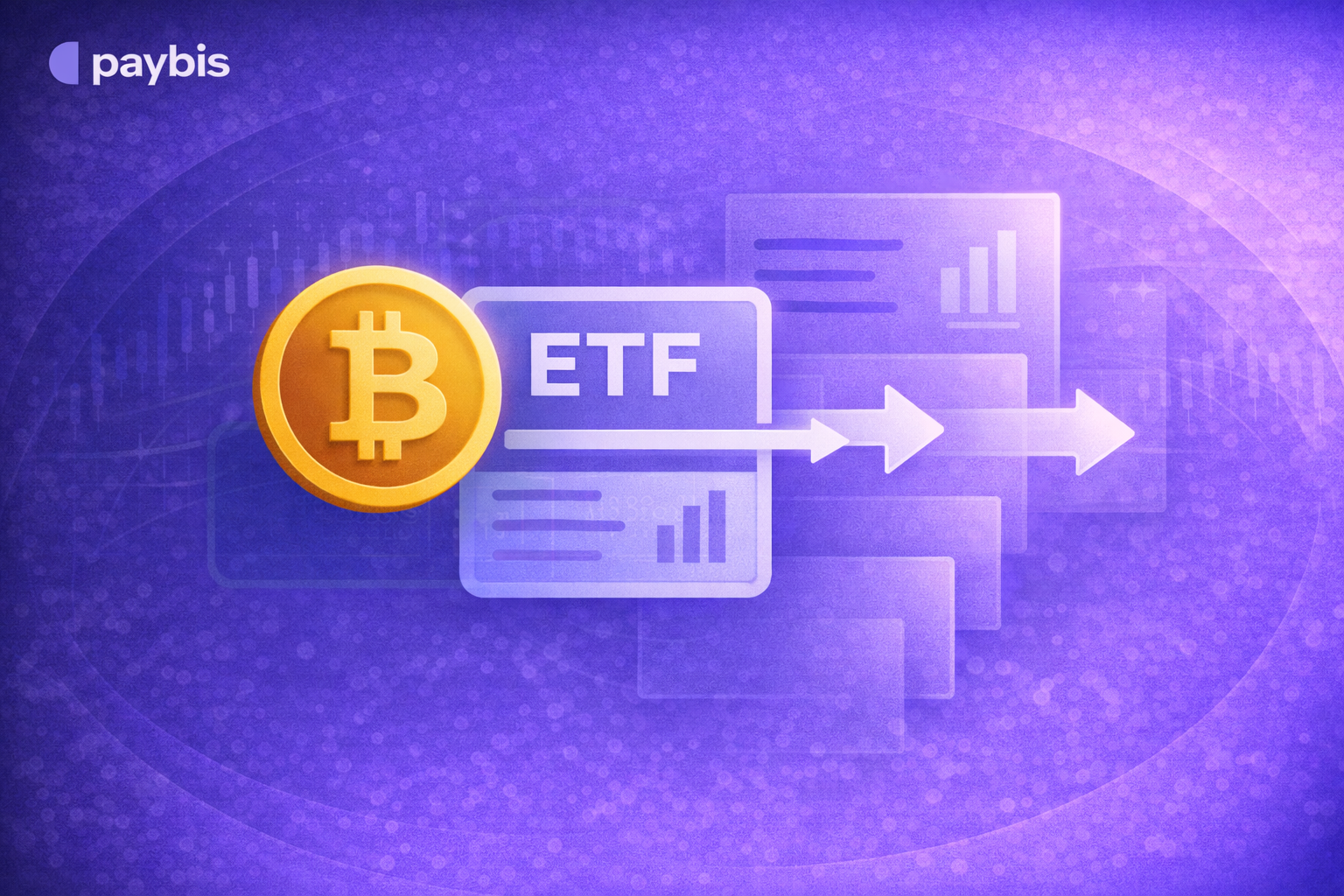
Bitcoin ETFs pulled $107 billion in their first year. BlackRock’s IBIT became the fastest-growing ETF in history across all asset classes. The demand is real, and buying shares is simpler than most people expect.
If you’ve ever bought a stock through a brokerage account, you already know how to buy a Bitcoin ETF. The process is nearly identical. No crypto wallets, no private keys, and no learning curve beyond what you’d face buying any other security.
This guide walks through exactly how to buy Bitcoin ETFs at major brokerages and what you need to know before placing your first order. We have also included a practical tool to help you easily simulate the process.
Table of contents
- What You Need Before Buying Bitcoin ETFs
- Choosing Which Bitcoin ETF to Buy
- How to Buy Bitcoin ETFs on Fidelity
- How to Buy Bitcoin ETFs on Vanguard
- How to Buy Bitcoin ETFs on Other Major Brokerages
- Understanding Order Types and When to Use Each
- Bitcoin ETFs in Retirement Accounts: IRA and 401(k) Options
- Tax Implications: What You Need to Know Before Buying
- Common Mistakes to Avoid When Buying Bitcoin ETFs
- What Happens After You Buy: Managing Your Bitcoin ETF Position
- Bottom Line
What You Need Before Buying Bitcoin ETFs
No. Any standard brokerage account that lets you buy stocks also lets you buy Bitcoin ETFs. You don’t need approval or special permissions.
Start with the basics, as missing any of these can create delays.
- A brokerage account at a firm that offers ETF trading. Fidelity, Vanguard, Charles Schwab, TD Ameritrade, E\*TRADE, Robinhood, and Interactive Brokers support the purchase of Bitcoin ETFs. If you already have an account somewhere, you’re probably good to go. If not, opening an account takes 10-15 minutes online.
- Funding in your account. You need cash available to buy shares. Most brokerages let you link a bank account and transfer funds electronically. This usually takes 1-3 business days for the first transfer, though some brokerages offer instant deposits up to certain limits.
- Basic information for account setup if you’re opening a new one. You’ll need Social Security number, employment information, bank account details for funding. Standard stuff you’d provide for any financial account.
- A decision on account type. Regular taxable brokerage account, traditional IRA, Roth IRA, or 401(k) if your employer’s plan offers ETF options. This matters for taxes, which we’ll cover later.
That’s it. You don’t need to verify your identity on a crypto exchange, set up two-factor authentication for a wallet, or learn about blockchain technology. The brokerage handles everything behind the scenes.
Prefer direct Bitcoin ownership instead? Paybis offers an alternative path with same-day verification, 20+ payment methods, and transparent fees. You get actual Bitcoin you can move, use, or hold in your own wallet. No ongoing management fees are eating into your returns. FCA-regulated with straightforward pricing across 180+ countries.
Choosing Which Bitcoin ETF to Buy
- IBIT (BlackRock): $67.6B in assets, 0.25% fee, highest liquidity
- FBTC (Fidelity): $13B in assets, 0.25% fee, good for existing Fidelity customers
- ARKB (ARK 21Shares): 0.21% fee, appeals to ARK followers
- HODL (VanEck): 0.20% fee, lowest cost option
Eleven Bitcoin ETFs trade in the U.S. as of early 2026. They all track Bitcoin’s price, but some differences matter.
- BlackRock’s IBIT dominates with $67.6 billion in assets. It’s the largest, most liquid option with the tightest bid-ask spreads. For most investors, IBIT is the default choice because size creates advantages. Higher trading volume means you can buy and sell shares easily without moving the price. Institutional investors prefer it, which reinforces liquidity. The 0.25% annual fee sits in the middle of the pack.
- Fidelity’s FBTC makes sense if you already use Fidelity. It holds $13+ billion in assets and charges the same 0.25% fee as IBIT. If your 401(k) or IRA is already at Fidelity, keeping everything in one place simplifies management. The fund is large enough that liquidity isn’t a concern.
- ARK 21Shares’ ARKB appeals to Cathie Wood followers. It charges 0.21%, slightly below the big two. If you already own ARKK or other ARK funds and like their investment philosophy, ARKB fits that portfolio naturally. Assets sit around $3+ billion, which is solid but noticeably smaller than the leaders.
- VanEck’s HODL offers the lowest fee at 0.20%. For large positions, that 0.05% difference from BlackRock adds up. A $100,000 investment saves $50 annually. Over 20 years, the fee savings become visible. The tradeoff is slightly lower liquidity than IBIT, though it’s still perfectly tradeable for most retail investors.
- Grayscale’s GBTC charges 1.50% and may not be ideal unless you have specific tax reasons to hold it. That’s six times more expensive than competitors. GBTC exists mainly as a legacy product from before spot ETFs launched.
The honest truth? For most people, IBIT or FBTC works fine. The performance differences between major Bitcoin ETFs are minimal because they all track the same underlying asset. Fees matter more than brand names over long time horizons.
How to Buy Bitcoin ETFs on Fidelity
Fidelity manages over $4 trillion in assets and offers straightforward ETF purchasing. We provide the process in 2 ways:
- An illustrative tool to make the process easier for you
- Textual explanation to make it even clearer
Here’s the exact process.
Go to Fidelity.com and sign in with your credentials. If you don’t have an account, click “Open an Account” and complete the registration process.
- Account approval typically takes 1 business day
- You’ll need basic personal info and a funding source
Once logged in, look for “Trade” in the top navigation menu and click it. This opens the trade ticket interface.
In the symbol field, type the ticker for your chosen Bitcoin ETF:
Market order: Best for most investors. Executes immediately at current price.
Limit order: More control, but may not execute if price moves away from your limit.
Enter how much you want to invest. Fidelity supports fractional shares for many ETFs, so you can invest a specific dollar amount like $500.
Choose which account should hold this investment. This affects tax treatment.
Review all details carefully. Fidelity typically charges $0 commission for ETF trades. Click “Place Order” to execute.
Market orders fill within seconds during trading hours. You’ll receive immediate confirmation.
Step 1: Log in to your Fidelity account
Go to Fidelity.com and sign in. If you don’t have an account, click “Open an Account” and follow the prompts. You’ll need basic personal information and a funding source. Account approval usually happens within one business day.
Once logged in, look for “Trade” in the top navigation menu. Click it. You’ll see a trade ticket interface where you enter order details.
Step 3: Enter the ticker symbol
In the symbol field, type the ticker for the Bitcoin ETF you want:
- IBIT for BlackRock
- FBTC for Fidelity’s own Bitcoin fund
- ARKB for ARK 21Shares
- HODL for VanEck
The system will auto-populate the ETF name once you enter the ticker.
Step 4: Choose your order type
For most investors, a market order works fine. This buys shares at the current market price immediately. You’ll see the last traded price displayed, which gives you a sense of what you’ll pay.
If you want more control over the exact price, use a limit order instead. Enter the maximum price you’re willing to pay per share. Your order only executes if the ETF trades at or below that price. This prevents you from overpaying during volatile moments but risks not getting filled if the price moves away from your limit.
Step 5: Specify quantity
Decide whether you’re buying by dollar amount or share count. Fidelity supports fractional shares for many ETFs, meaning you can invest $500 rather than buying whole shares only. Check if fractional shares are available for your chosen ETF.
Step 6: Select the account
If you have multiple accounts at Fidelity (taxable brokerage, IRA, Roth IRA), choose which account should hold this purchase. This matters for tax treatment.
Step 7: Review and submit
Fidelity shows you an order preview with estimated costs and commissions (typically $0 for ETF trades). Review everything, then click “Place Order.”
Your order fills within seconds for market orders during trading hours. You’ll receive a confirmation showing the exact shares purchased and price paid.
How to Buy Bitcoin ETFs on Vanguard
Vanguard takes a more conservative approach to crypto but does offer Bitcoin ETF access. The process differs slightly from Fidelity.
Again, let’s look at it through an interactive tool and a comprehensive explanation of the steps.
Use your username and password to sign in. If you’re new to Vanguard, opening an account requires providing personal information and funding details.
- Vanguard’s approval process takes 2-3 business days (slightly longer than competitors)
- Have your SSN and funding source ready
From your account dashboard, click “Buy & sell” in the main navigation. This opens Vanguard’s trading interface.
Vanguard separates its own ETFs from external ones in the interface. Bitcoin ETFs are external products, so choose the non-Vanguard option.
Type the ticker for your chosen Bitcoin ETF. Vanguard will display the ETF details including current price and expense ratio.
Select which account should hold this investment, then choose your order type.
💡 Vanguard generally requires whole shares for external ETFs. Fractional shares may not be available.
Vanguard generally requires whole shares for external ETFs, though this is changing gradually. Check whether fractional shares are available for your chosen Bitcoin ETF. If not, you’ll need to buy in whole-share increments.
Vanguard shows a detailed order preview with all costs. ETF trades are typically commission-free.
Step 1: Log into Vanguard.com
Use your username and password. If you’re new to Vanguard, opening an account requires providing personal information and funding details. Vanguard’s approval process can take 2-3 business days, slightly longer than some competitors.
Step 2: Go to “Buy & sell”
From your account dashboard, click “Buy & sell” in the main navigation. This opens the trading interface.
Step 3: Select “Trade Vanguard ETFs and non-Vanguard ETFs”
Vanguard separates its own ETFs from external ones in the interface. Bitcoin ETFs are external products, so choose the non-Vanguard option.
Step 4: Enter the Bitcoin ETF ticker
Type IBIT, FBTC, ARKB, or whichever Bitcoin ETF you’ve chosen. Vanguard will display the ETF details, including current price and expense ratio.
Step 5: Choose account and order type
Select which Vanguard account should hold this investment. Then choose your order type—market order for immediate execution or limit order for price control.
Step 6: Enter investment amount
Vanguard generally requires whole shares for external ETFs, though this is changing gradually. Check whether fractional shares are available for your chosen Bitcoin ETF. If not, you’ll need to buy in whole-share increments.
Step 7: Review and confirm
Vanguard shows a detailed order preview with all costs. ETF trades are typically commission-free. You need to submit your order and wait for the fill confirmation.
Important Vanguard note: Vanguard has historically taken a cautious stance on crypto. They were slower to offer Bitcoin ETF access than competitors and may have additional risk disclosures you need to acknowledge before trading. This doesn’t prevent you from buying, but expect an extra step confirming you understand the risks.
How to Buy Bitcoin ETFs on Other Major Brokerages
The process is nearly identical across brokerages. Here’s the quick version for other popular platforms.
Charles Schwab: Log in → Trade → Enter ticker symbol → Choose quantity and order type → Place order. Schwab supports fractional shares for many ETFs and charges no commissions.
TD Ameritrade (now part of Schwab): Similar interface to Schwab. Use the thinkorswim platform if you want advanced charting and analysis tools alongside your purchase.
E*TRADE: Log in → Trading → ETFs → Enter ticker → Select account and quantity → Review and buy. E*TRADE offers both web and mobile app purchasing with no commissions on ETF trades.
Robinhood: Open the app → Search for ticker (IBIT, FBTC, etc.) → Tap “Trade” → Enter dollar amount → Swipe up to buy. Robinhood specializes in fractional shares and simple interfaces. Good for smaller investments and beginners.
Interactive Brokers: More complex interface geared toward active traders. Log in → Trading → Order Entry → Enter symbol → Configure order parameters → Submit. IBKR offers advanced order types and international access but has a steeper learning curve.
All major U.S. brokerages now offer Bitcoin ETF trading with zero commissions. The main differences are interface design, fractional share support, and additional features like research tools or mobile app quality.
Understanding Order Types and When to Use Each
Market order for most situations: Executes immediately at current price. Best during normal trading hours when spreads are tight.
Limit order for volatile periods: Sets maximum price you’ll pay. Protects against overpaying but might not fill if price moves away.
Order type matters more than most beginners realize. Choosing wrong can cost you money unnecessarily.
- Market orders execute immediately at the best available price. You’re guaranteed to get shares, but not guaranteed a specific price. During normal trading hours with major ETFs like IBIT or FBTC, the bid-ask spread is typically just a penny or two. Market orders work fine in these conditions. You’ll pay the displayed price.
- Limit orders let you set the maximum price you’ll pay per share. Your order only fills if someone’s willing to sell at or below your limit. This protects you during volatile periods when prices swing rapidly. The downside is your order might not fill at all if the price moves above your limit and stays there.
When to use market orders:
- Trading during regular market hours (9:30 am-4 pm ET)
- Buying liquid ETFs like IBIT with tight spreads
- Investing for the long term, where small price differences don’t matter
- You want to ensure your order fills today
When to use limit orders:
- Trading at market open or close when volatility spikes
- Bitcoin is moving rapidly (up or down 5%+ in a day)
- You have a specific target entry price
- You’re buying fewer liquid ETFs with wider spreads
Stop orders and stop-limit orders exist, but rarely make sense for ETF purchases. These trigger when the price hits a certain level. They’re more useful for selling positions or advanced trading strategies than for initial purchases.
For most people buying Bitcoin ETFs as long-term investments, a simple market order during regular trading hours gets the job done without overthinking it.
Bitcoin ETFs in Retirement Accounts: IRA and 401(k) Options
Yes for IRAs, as all major brokerages allow Bitcoin ETF purchases in traditional and Roth IRAs. For 401(k)s, it depends whether your employer’s plan includes ETF options in its investment menu.
Retirement accounts are one specific situation where ETFs solve a problem that’s harder to address with direct Bitcoin.
- IRAs give you complete control over Bitcoin ETF purchases. Open a traditional or Roth IRA at Fidelity, Schwab, Vanguard, or any brokerage. Fund it with your annual contribution limit ($7,000 for 2026, or $8,000 if you’re 50+). Buy whichever Bitcoin ETF you want. The process is identical to buying in a taxable account, but the tax treatment changes everything.
- Traditional IRA: Your Bitcoin ETF investment grows tax-deferred. You pay no taxes on gains until you withdraw in retirement. If you’re in a high tax bracket now, the immediate deduction for contributions saves money today.
- Roth IRA: You contribute after-tax dollars, but growth is completely tax-free forever if you follow withdrawal rules. A $10,000 Roth IRA Bitcoin ETF investment that grows to $100,000 over 20 years? You pay zero taxes on that $90,000 gain when you withdraw after age 59.
- 401(k) plans are trickier. Your employer chooses which investments are available in the plan menu. Some plans offer brokerage windows or self-directed options that let you buy any ETF including Bitcoin ETFs. Many don’t. Check with your plan administrator or HR department to see if Bitcoin ETFs are available.
If your 401(k) doesn’t offer Bitcoin ETF access, you have options:
- Invest in Bitcoin ETFs through a separate IRA
- Wait until you leave the company and roll your 401(k) into an IRA with full investment control
- Buy Bitcoin ETFs in a taxable account instead
The tax advantages of holding Bitcoin ETFs in retirement accounts are substantial enough that it’s worth prioritizing if you’re eligible. A $50,000 investment growing to $200,000 tax-free in a Roth IRA beats the same investment in a taxable account, where you’d owe capital gains taxes on the $150,000 profit.
Tax Implications: What You Need to Know Before Buying
- In taxable accounts: Capital gains when you sell (short-term if held <1 year, long-term if held 1+ years)
- In IRAs: No taxes until withdrawal (traditional) or no taxes ever (Roth, if rules followed)
- Your brokerage sends a 1099-B form showing all transactions for easy tax filing
Tax treatment is simpler than direct Bitcoin, but it still has implications you should understand before buying.
Bitcoin ETFs are taxed as securities, not as collectibles. This matters because it means standard capital gains rates apply. The IRS treats direct cryptocurrency as property subject to capital gains, but with some complexity. ETFs eliminate that complexity entirely.
Hold less than one year, and you pay short-term capital gains. These are taxed at your ordinary income rate (10% to 37% depending on your bracket). Buy IBIT in January and sell in November at a profit? You’re paying your regular income tax rate on the gain.
Hold more than one year, and you qualify for long-term capital gains rates. These are significantly lower: 0%, 15%, or 20%, depending on your income. For most people, that’s 15%. Buy IBIT in 2026 and sell in 2028 at a profit? You’re paying 15% federal tax on the gain instead of potentially 24% or 32% at ordinary rates.
Dividends don’t apply because Bitcoin ETFs don’t pay dividends. Bitcoin doesn’t generate income. The ETF just holds Bitcoin. You only owe taxes when you sell shares at a profit.
Wash sale rules technically don’t apply to crypto, but might apply to Bitcoin ETFs. This is unsettled tax law. The wash sale rule prevents you from claiming a loss if you sell a security and buy it back within 30 days. The IRS has said wash sales don’t apply to direct cryptocurrency. Whether they apply to Bitcoin ETFs is unclear. To be safe, wait 31 days before repurchasing if you’re selling at a loss for tax purposes.
Retirement account tax treatment is straightforward. Traditional IRAs defer all taxes until withdrawal. Roth IRAs eliminate taxes on gains if you follow the rules (age 59½+, account open 5+ years). This makes retirement accounts incredibly powerful for Bitcoin ETFs since Bitcoin’s potential volatility could generate huge gains that would otherwise trigger major tax bills.
Your brokerage sends you a 1099-B form in January showing all your ETF sales from the previous year, with cost basis calculated. Hand this to your accountant or import it into tax software. It’s far simpler than tracking cost basis across multiple crypto wallets and exchanges for direct Bitcoin ownership.
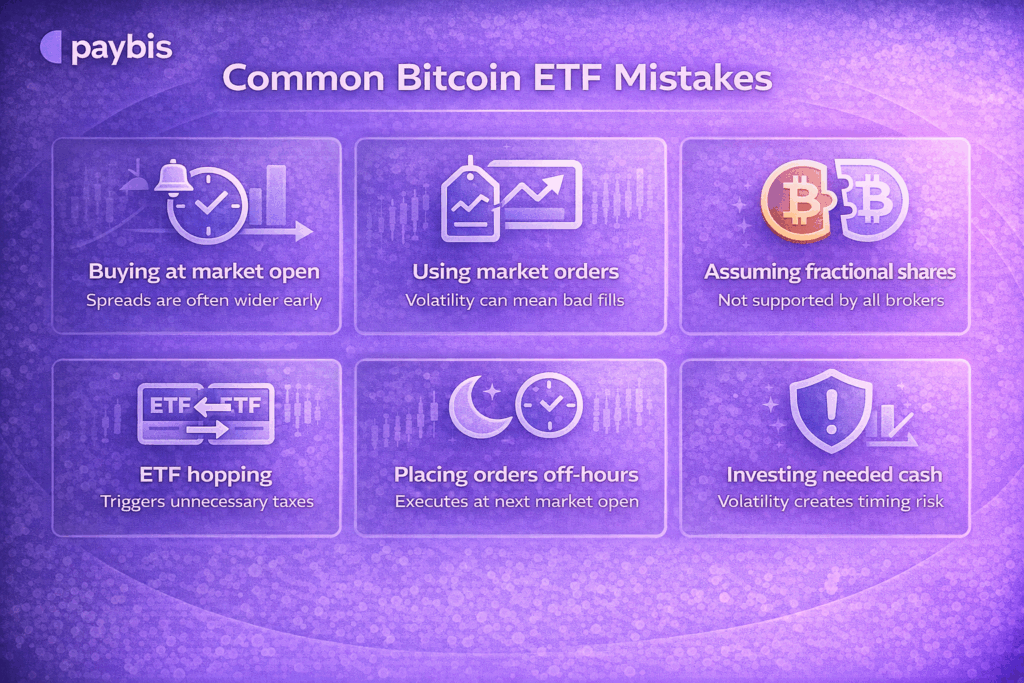
Common Mistakes to Avoid When Buying Bitcoin ETFs
- Buying at market open when spreads are wide
- Using market orders during extreme volatility
- Not checking if their brokerage supports fractional shares
- Forgetting about the tax advantages of IRAs
- Chasing performance by constantly switching between ETFs
Learning from others’ mistakes saves you money. Here are the ones that cost people unnecessarily.
- Trading right at market open (9:30 am ET). The first 10-15 minutes often have wider bid-ask spreads as prices settle and market makers adjust. Experienced investors prefer waiting for spreads to tighten, though it matters less for smaller purchases.
- Using market orders during volatile periods. When Bitcoin is moving 10% in a day, market orders can execute at unexpected prices. Limit orders let you set a maximum price rather than accepting whatever the market offers in that moment.
- Assuming fractional shares work everywhere. Some brokerages let you buy $100 worth of shares even if one share costs $50. Others only allow whole shares. Worth checking before placing your order if you’re investing a specific dollar amount.
- Switching between similar Bitcoin ETFs frequently. IBIT and FBTC track the same asset, so selling one to buy another doesn’t change your exposure. But it triggers capital gains reporting. Most investors pick one and hold it.
- Placing orders outside trading hours. ETFs only trade 9:30 am-4 pm ET on weekdays. An order placed Saturday evening sits until Monday morning, executing at whatever Bitcoin’s price is then, rather than Saturday’s price.
- Investing money you need soon. Bitcoin’s regular 30-40% drops create timing risk if you need to sell when markets are down. Money needed within a year or two faces challenges with this level of volatility.
What Happens After You Buy: Managing Your Bitcoin ETF Position
You’ve bought shares. Now what?
Check your position in your brokerage account. You’ll see the number of shares owned, current value, and your cost basis (what you paid). This updates in real-time during market hours.
Set up alerts if you want to monitor actively. Most brokerages let you set price alerts. Get notified if IBIT drops below $45 or rises above $55, for example. Useful if you’re actively managing position size.
Consider setting up automatic investments. Many brokerages let you schedule recurring purchases. Buy $500 of IBIT on the 1st of every month automatically. This creates dollar-cost averaging without requiring you to remember to place orders manually.
Rebalance if Bitcoin becomes too large a portion of your portfolio. If you intended Bitcoin to represent 5% of your portfolio but it grows to 15% after a big rally, you might need to sell some and rebalance. Set a calendar reminder to review quarterly or semi-annually.
Tax-loss harvesting opportunities arise during downturns. If you’re in a taxable account and your Bitcoin ETF position is down, you can sell it to realize the loss for tax purposes, then buy a different Bitcoin ETF immediately (or the same one after 31 days if you’re concerned about wash sale rules). This locks in a tax deduction while maintaining Bitcoin exposure.
Don’t obsess over daily price movements. Bitcoin is volatile. Your ETF will swing 3-5% in a day regularly. If you’re investing for years or decades, these daily moves are noise. Check your position occasionally, but don’t let volatility drive emotional decisions.
Consider your exit strategy eventually. Are you holding until retirement? Until Bitcoin hits a specific price target? Having a plan helps prevent emotional selling during crashes or euphoric buying during rallies.
Bottom Line
Buying Bitcoin ETFs takes about five minutes once you have a funded brokerage account. The process is identical to buying any stock or ETF; enter a ticker symbol, choose your quantity, and place an order.
The real decisions happen before you click “buy”: which ETF to choose, whether to use a taxable account or IRA, and how much to invest. Those choices affect your returns far more than picking the perfect entry price or mastering advanced order types.
You need to start with a major brokerage you trust, pick either IBIT or FBTC unless you have specific reasons to choose otherwise, and buy through an IRA if you’re eligible. That covers 90% of what matters for most investors.
FAQ
Can I buy Bitcoin ETFs without a crypto wallet or exchange account?
Yes. Bitcoin ETFs trade like regular stocks through your standard brokerage account. You don’t need a crypto wallet, exchange account, or any knowledge of private keys. Just log into Fidelity, Schwab, Vanguard, or any brokerage, search for the ETF ticker (like IBIT or FBTC), and buy shares the same way you’d buy Apple or Tesla stock. The brokerage and ETF custodian handle all the Bitcoin storage and security behind the scenes.
Which brokerage is best for buying Bitcoin ETFs?
Any major U.S. brokerage works: Fidelity, Vanguard, Charles Schwab, E*TRADE, TD Ameritrade, Robinhood, and Interactive Brokers all offer Bitcoin ETF trading with zero commissions. The main differences are fractional share support (helpful for smaller investments), mobile app quality, and whether you already have accounts there. If you’re investing through an IRA, using a brokerage where you already have retirement accounts simplifies management. For most investors, Fidelity and Schwab offer the best combination of features and ease of use.
Can I buy Bitcoin ETFs in my 401(k) or IRA?
IRAs: Yes, you can buy Bitcoin ETFs in both traditional and Roth IRAs at any major brokerage. This gives you tax advantages, tax-deferred growth in traditional IRAs or completely tax-free growth in Roth IRAs.
401(k)s: It depends on your employer’s plan. Some offer brokerage windows or self-directed options that include Bitcoin ETFs. Many don’t. Check with your plan administrator. If your 401(k) doesn’t offer Bitcoin ETF access, you can buy them through a separate IRA or in a regular taxable brokerage account instead.
Disclaimer: Don’t invest unless you’re prepared to lose all the money you invest. This is a high‑risk investment and you should not expect to be protected if something goes wrong. Take 2 mins to learn more at: https://go.payb.is/FCA-Info