From Garage Startup to $6 Billion: The Paybis Story
In 2014, buying crypto with a bank card felt like a gamble. The fees were unclear, the process was complex, and if something went wrong, there was no one to call. The technology existed, but the experience of actually using it was enough to put most people off. Most who tried gave up.
Paybis launched that April with a straightforward goal: let people buy digital assets using payment methods they already trusted, with pricing they could understand and support available when they needed it. No trading interfaces, no complicated flows, just access.
“Back in 2014, buying crypto felt like unclear territory. It was complicated, and the industry lacked trust,” says Arturs Markevics, Co-founder and Treasury Manager. “We started Paybis because we wanted to build the most trusted, responsive, and easy-to-use gateway for people to access crypto and digital assets.”
The early team was small, and the work was scrappy.
“Everyone wore multiple hats, we were learning as we went, and we genuinely enjoyed building something from the ground up,” says Innokenty Isers, Co-founder and CEO.
Twelve years later, 6.9 million customers across 251 countries have used the platform. $5.47 billion has moved through it. And the same principle that guided day one still guides the product today.
Table of contents
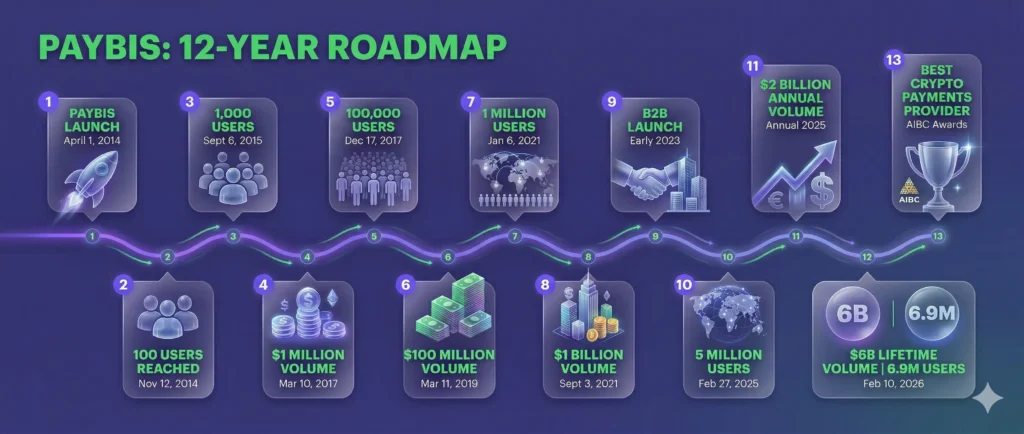
12 Key milestones during the past 12 years
- April 1, 2014: Paybis launches to make crypto access simpler for everyday users.
- November 12, 2014: the company records its first 100 users.
- September 6, 2015: proudly served our first 1000 users.
- March 10, 2017: Paybis passes $1 million in lifetime transaction volume.
- December 17, 2017: the platform reaches 100,000 users during crypto’s first major retail wave.
- March 11, 2019: lifetime transaction volume surpasses $100 million.
- 2021: Paybis exceeded 1 million users on January 6 and $1 billion in lifetime volume on September 3, while deepening its direct card acquiring and risk infrastructure.
- Early 2023: the company launches its B2B on- and off-ramp offering into production.
- February 27, 2025: Paybis reaches 5 million users served.
- 2025: Paybis records its strongest year on record by volume at $2 billion, with 266% year on year growth
- February 10, 2026: lifetime volume exceeds $5 billion, total users reached 6.9 million
- 2026: Paybis is recognised as Best Crypto Payments Provider at the AIBC Awards during Sigma Dubai.
What 6.9 Million Customers Actually Taught Us
The most telling number from 12 years of operation isn’t the volume. It’s this: in 2017, nearly 73% of activity came from first-time users. Today, over 76% comes from people who’ve been here before.
Returning users come back because something worked. The process was clear, the money arrived, and the experience didn’t leave them second-guessing whether they’d done it right. That shift from a new-user-driven platform to a returning-user-driven one is the closest thing to a report card that exists in this industry.
The assets people buy have diversified too. Bitcoin was the first ever purchased on Paybis, and it remains central to what people come for. But LTC, ETH, USDT, SOL, and TRX all see significant demand alongside it today, reflecting a market that has matured well beyond its early days and into something closer to everyday financial behaviour.
Built for People Who Don’t Want to Become Crypto Experts
“We have always tried to make the product clear enough for someone coming from the regular web, not just for crypto-native users,” says Konstantins Vasilenko, Co-founder and CBDO.
That’s a harder thing to build than it sounds. Most platforms in this space were designed by people who already understood crypto, for people who already understood crypto. Paybis was built for everyone else: the person who wants to buy some Bitcoin without reading a manual, the small business owner who needs to accept a crypto payment without hiring a developer, the user in a country where traditional financial infrastructure is thin.
Support for PayPal, Revolut, and other familiar payment methods was part of that thinking from the start. So was round-the-clock customer support, transparent pricing, and a deliberate effort to keep the interface from becoming a product that required onboarding to understand.
Why Businesses Started Coming
Individual users were the foundation, but over the last several years, a different kind of customer emerged: companies that needed crypto infrastructure baked into their own products, without the overhead of building it themselves.
The need made sense. Businesses in fintech, e-commerce, digital goods, and virtual assets increasingly needed to move between fiat and crypto as a normal part of how they operated. Building that capability from scratch meant navigating compliance, custody, payment rails, and identity verification across multiple jurisdictions. Most companies didn’t want to do that. They wanted it solved so they could focus on their own product.
Today, Paybis has served 624 businesses, with $4.13 billion in B2B volume processed to date. In the last 12 months alone, that figure reached $2.29 billion. Clients like Softswiss, Payouts.com, Pion, Sends.co, and Unity Finance use Paybis infrastructure to handle crypto access, payouts, and financial flows inside their own platforms. What they’re buying is the accumulated compliance work, payment coverage, and operational reliability that Paybis has spent a decade building.
“Today, we have real confidence in our ability to build a world-class service not only for private customers, but also for businesses that can benefit from the depth of experience we have built over the past 12 years,” says Isers. “Our vision has matured, and we are executing it with much greater clarity, scale, and purpose.”
The Infrastructure Underneath
Operating across 251 countries requires more than good intentions. Paybis works with OpenPayd and Paysafe for payment infrastructure, Sumsub for identity verification and compliance, Fireblocks for digital asset custody, and Nsure for risk decisioning. These partnerships exist because reliability across jurisdictions, currencies, and regulatory environments isn’t something one company builds alone.
In 2026, Paybis was recognised as Best Crypto Payments Provider at the AIBC Awards during Sigma Dubai.
Bottom Line
Twelve years is a long time in an industry that moves as fast as this one. Platforms that launched alongside Paybis in 2014 are mostly gone. The ones that remain are the ones that treated every transaction as something worth getting right.
That’s still the job.
FAQ
What is Paybis?
Paybis is a platform for buying and selling crypto using payment methods people already trust. Bank cards, PayPal, Revolut, and others. It launched in April 2014 with a straightforward goal: to make crypto accessible without the complexity. Over 6.9 million customers across 251 countries have used it since.
What can businesses use Paybis for?
Companies in fintech, e-commerce, and digital goods need to move between fiat and crypto as a normal part of how they operate. Building that from scratch is a lot of work. Paybis offers B2B on- and off-ramp infrastructure so businesses can plug into what’s already been built over the past decade instead. Over 600 businesses use it today.
Is Paybis trustworthy?
Twelve years of operation is a decent answer on its own. Most platforms that launched in 2014 are gone. Paybis works with established partners: Fireblocks for custody, Sumsub for identity verification, and OpenPayd and Paysafe for payments. And over 76% of current activity comes from returning users, which tends to mean something worked well enough to come back to.
What crypto can you buy on Paybis?
Now you can buy more than 90 cryptocurrencies via Paybis. Bitcoin was the first asset ever purchased on the platform, and it’s still central to what people come for. But the market has matured since 2014. Today, LTC, ETH, USDT, SOL, and TRX all see significant demand alongside it. What people buy has changed a lot, in the same way the industry has.
Disclaimer: Don’t invest unless you’re prepared to lose all the money you invest. This is a high‑risk investment and you should not expect to be protected if something goes wrong. Take 2 mins to learn more at: https://go.payb.is/FCA-Info