No More Surprise Fees: Paybis vs. MoonPay Pricing for First-Time Buyers
Key Takeaways:
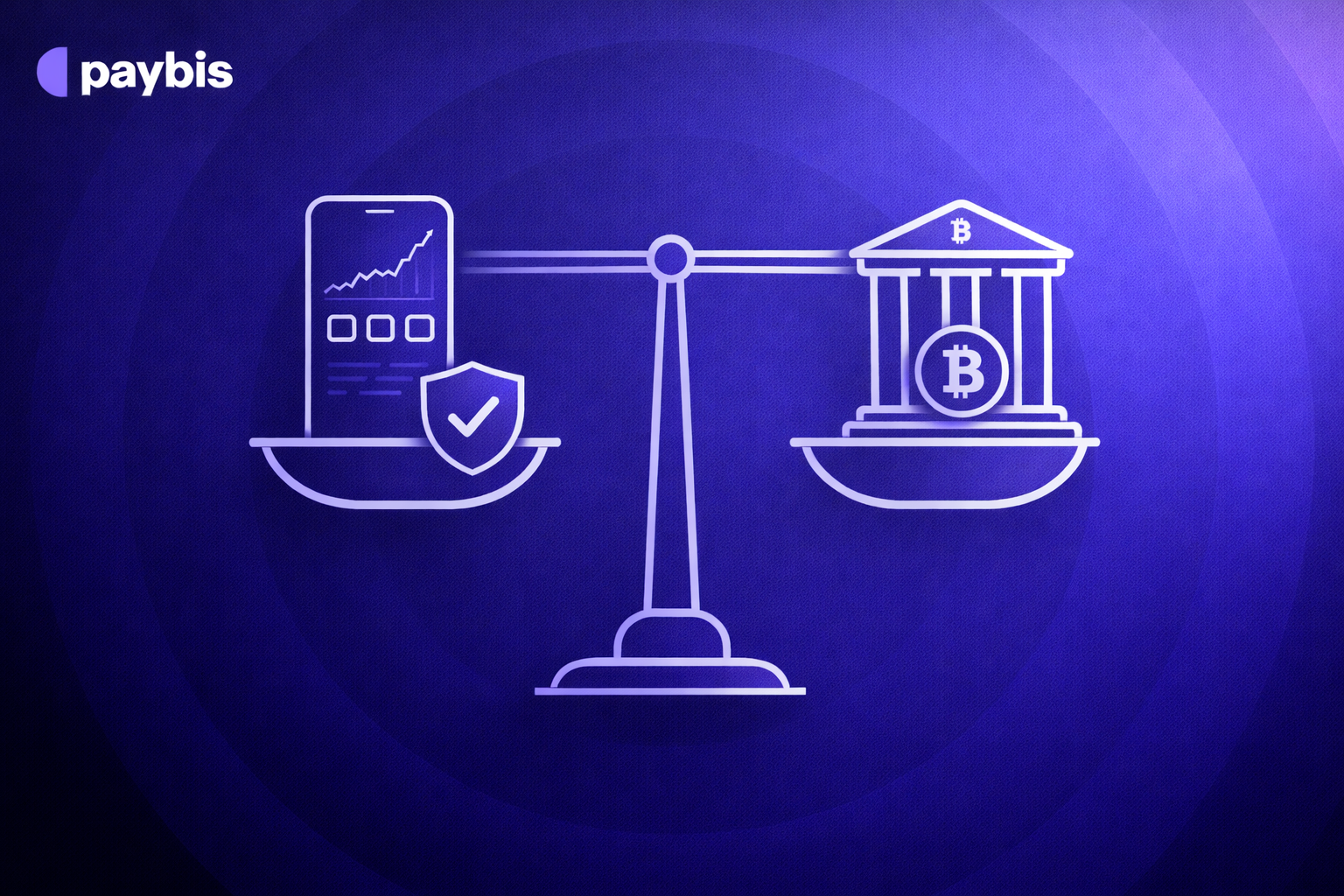
Paybis delivers superior transparency for first-time buyers who prioritize knowing exact costs upfront and accessing real human support. Our fee calculator shows the complete breakdown; service fee (starts from 1.49%), processing fee, and network fee, before you enter payment details. MoonPay embeds a 1-3% spread into the displayed price, making the true cost harder to predict. We offer 24/7 live human support with ~15-second response times. MoonPay routes users through AI chatbots first. Both platforms are FinCEN-registered, but our direct-to-consumer model means you talk to us when issues arise; not a wallet app middleman.
Table of contents
- At a Glance: Paybis vs. MoonPay Comparison
- Fee Transparency: Why “Hidden Costs” Destroy Trust
- Verification Speed: Minutes vs. Days
- Customer Support: Live Humans vs. AI Chatbots
- Security and Compliance: Who Holds the Keys?
- Pros and Cons: The Honest Trade-Offs
- The Verdict: When to Choose Paybis Over MoonPay
- Key Terminology
At a Glance: Paybis vs. MoonPay Comparison
When you’re buying crypto for the first time, the platform you choose determines whether you see surprise charges or transparent pricing. This table breaks down the core differences between our direct approach and MoonPay’s embedded infrastructure model.
| Feature | Paybis | MoonPay |
|---|---|---|
| Fee clarity | Final price shown | Variable fees |
| First deal | $0 service fee | No discount |
| Support | 24/7 live chat | AI chatbot |
| Verification | <2 min | Hours–days |
| Model | Direct platform | Infrastructure layer |
| Regulation | FinCEN MSB | FinCEN + MTLs |
| Best for | Cost certainty | Quick checkout |
Paybis’ verification process takes under 5 minutes for most users. MoonPay’s embedded model means verification often loops through partner platforms, adding friction.
“I just pick how much crypto I want, pay with my card… and in about 10-15 minutes the coins are already in my wallet.” – Christine K on Trustpilot
Fee Transparency: Why “Hidden Costs” Destroy Trust
The fee structure you choose determines whether you’re charged $525 or $537 for a “$500 Bitcoin purchase.” The difference isn’t always the dollar amount; it’s whether you see that cost before or after your card is charged.
How Paybis Shows Fees Upfront
Our fee calculator displays three components before you confirm payment.
Service fee: Starts from 0.49% on card purchases after your first transaction (which carries $0 service fee). Processing fee: 4.5% for card transactions over $50, covering Visa/Mastercard costs we don’t control. Network fee: The cost blockchain miners charge to confirm your transaction, varies by network congestion. For a $500 Bitcoin purchase using a credit card after your first purchase, you’d see approximately $2.45 service fee + $22.50 processing fee + ~$3-5 network fee = $30.65-$32.95 total.
The complete fee breakdown appears in the calculator before you enter card details.
“I especially appreciate the transparent fee structure; no hidden costs or surprises.” – Vladimir Z on G2
How MoonPay Structures Pricing
MoonPay charges up to 4.5% in platform fees, but the published disclosure reveals an additional layer: “MoonPay USA LLC may include a spread in the asset price shown to you during your transaction.” The spread, the difference between market price and the price you pay; typically ranges 1-3% based on testing data. One documented example showed a 4.31% spread when Bitcoin’s market price was $101,752 but MoonPay quoted $106,231.56.
Unlike Paybis’ transparent fee breakdown, some platforms bundle spreads into the displayed crypto price. When evaluating any crypto purchase, verify the price shown against live market rates to understand total costs.
The challenge for first-time buyers: the spread is embedded in the displayed crypto price, not broken out as a separate line item. MoonPay’s official pricing disclosure states: “All spreads are included in the price of the digital asset shown to you during your checkout flow.” You see one number, but that number already contains markup you can’t easily verify against live market rates.
What “Spread” Actually Costs You
A spread is the gap between the actual market price of Bitcoin and the price a platform sells it to you for. Think of airport currency exchange: the sign says $1 = €0.90, but the kiosk only gives you €0.85. That €0.05 difference is the spread, an extra cost hidden inside the exchange rate itself.
For crypto buyers, a 2% spread on a $500 purchase means you receive $490 worth of Bitcoin at market price while paying $500. Combined with MoonPay’s 4.5% platform fee, a $500 purchase could cost $22.50 (platform fee) + $10 (2% spread) + network fee = $32.50+ total. Our model separates these costs. MoonPay bundles them.
Check the crypto calculator guide for a visual walkthrough of how to verify you’re getting fair market rates.
Verification Speed: Minutes vs. Days
Account verification determines whether you own Bitcoin in 10 minutes or wait until next week. The difference comes down to automated systems versus manual review loops.
Paybis Verification Process
Our automated ID verification uses photo recognition technology. Upload a government-issued ID (driver’s license or passport) and take a selfie with your phone. The system cross-references your photo against the ID in real time. Most verifications complete in under 5 minutes, with an 80% first-check approval rate. The verification provider reports the average process takes 2.5 minutes per user.
When verification succeeds, you move directly to purchase.
“The platform itself is clean, user-friendly, and always dependable, making each transaction feel truly effortless.” – Egor N on G2
MoonPay Verification Variables
MoonPay doesn’t publish specific verification time targets in their official help documentation. Their buying page notes: “For first time customers, additional security checks could take up to a few hours.” User reports vary significantly, some experience instant approval, others wait days depending on region-specific requirements, document quality, and risk assessment factors.
The key challenge: MoonPay often operates as a third-party plugin inside wallet apps like MetaMask. When verification fails or requires additional documents, you’re navigating between the wallet app interface and MoonPay’s system. Error messages sometimes lack clarity on what specifically needs correction.
Our direct platform means when you upload an ID to Paybis, you’re verifying with Paybis. If something fails, our 24/7 support team can access your verification attempt and tell you exactly what to fix.
“Paybis is fast, accurate, exact to quote, offer promotions… clean, simple interface and provide email processing updates.” – G Cham on Trustpilot:
Watch our step-by-step verification guide to see the 2-minute process in action.
Customer Support: Live Humans vs. AI Chatbots
When $500 disappears into “pending” status at 11 PM on a Saturday, the support channel you chose determines whether you get answers in 2 minutes or 2 days.
Paybis Support Structure
We operate 24/7 live chat with real people available around the clock. Our average response time to online chats is ~15 seconds. Support is available in English, French, Korean, Arabic, Spanish, German, Italian, and Russian. When you send a message, a human reads it and responds, not a bot scanning for keywords. Our team works 24/7, 365 days a year.
Average response times for specific issues, such as account verification requests. We maintain a 4.0/5 rating on Trustpilot with 30,180+ reviews, with 75% rated as 5-star. The most common praise across reviews: quick response time and useful support.
“I have only used the paybis app 1 or 2 times so far… only problem I had was that when I sent a bitcoin payment… it wouldn’t let me get the unique code through my messages… but had help from the 24 hour live chat team and they found another way of making payment.” – Robert Pawson on Trustpilot
MoonPay Support Channels
MoonPay offers multiple contact methods: live chat (requires email address to initiate), phone (1-833-610-0735), email (support@moonpay.com), and a comprehensive help center. The primary channel routes through an AI chatbot first. The chatbot is equipped to handle general queries, but customers can request escalation to a human agent.
24-hour support is available, but response times vary based on inquiry complexity and whether the issue originated through MoonPay directly or through a partner wallet integration. When you buy crypto through MetaMask using MoonPay as the payment processor, determining who handles your support ticket, MetaMask or MoonPay, sometimes requires clarification.
The structural difference: our B2C model means you’re always talking to Paybis support about a Paybis transaction. MoonPay’s B2B2C infrastructure can create situations where you’re a user of one service, but trying to resolve a MoonPay payment issue, and both companies point you toward the other’s support queue.
For common questions about our process, check our safety and security overview.
Security and Compliance: Who Holds the Keys?
Regulatory registration doesn’t guarantee safety, but it does create legal accountability when things go wrong. Both platforms operate as the Merchant of Record; the legal entity that processes your payment and takes responsibility for the transaction.
What “Merchant of Record” Means for You
A Merchant of Record (MoR) is the company whose name appears on your credit card statement and who is legally liable if the transaction fails or fraud occurs. When Paybis acts as MoR, we handle payment processing, tax collection, and chargebacks directly. You have one point of contact: us.
This matters because some crypto platforms act as intermediaries, connecting you to third-party payment processors. When disputes arise, you’re bouncing between companies trying to determine who actually controls your funds. Both Paybis and MoonPay act as MoR, meaning we each take direct responsibility, but the difference emerges in how we’re structured.
Paybis Compliance and Security
We’re registered with FinCEN (US) as MSB #31000224635628 and FINTRAC (Canada) as M22061209. We’ve operated since 2014 with zero major security breaches. Our infrastructure includes cold storage for the majority of user funds, SSL encryption for all data transmission, required two-factor authentication (2FA), and PCI DSS Level 1 compliance; the highest certification for payment processing.
When you buy Bitcoin through Paybis, your funds move through regulated channels from card authorization through blockchain delivery.
It feels good knowing that my funds go directly into a wallet address I control (not mixed with others), which gives me a sense of transparency and security.” – Christine K on Trustpilot
MoonPay Compliance Structure
MoonPay operates under FinCEN registration #31000301673327 in the United States and holds Money Transmitter Licenses in 47 US states. In Canada, they’re registered with FINTRAC as M24701825. They also hold registrations in the UK (FCA FRN 944746), Australia (AUSTRAC DCE100858195-001), and the EEA (Dutch AFM 41000002).
MoonPay’s security infrastructure includes encryption, compliance with local regulations, and integration with major wallet providers who have their own security requirements. The company has built partnerships with over 300 apps and wallets, which requires maintaining consistent security standards across integrations.
Both platforms meet baseline regulatory requirements. The distinction for first-time buyers: when you verify your identity and link a payment method, are you interacting directly with the platform that holds the license, or through an embedded widget? Paybis model eliminates the middleman layer.
For concerns about crypto security risks, watch a breakdown of top 5 security issues like phishing and rug pulls below:
Pros and Cons: The Honest Trade-Offs
No platform is perfect for everyone. Choosing between transparent fees with human support and embedded convenience depends on what you value most.
Paybis Advantages
Transparent fee breakdown: Our calculator shows service fee, processing fee, and network fee as separate line items before you enter payment details. You know the exact total before your card is charged.
Human support access: 24/7 live chat with ~15-second response times. Real people who can investigate stuck transactions, explain rejection reasons, and walk you through verification issues.
Speed: <2-minute verification and instant processing (<1 minute) after approval.
First purchase promotion: $0 service fee on your first card purchase, reducing entry cost for new buyers testing the platform.
“Paybis made it very simple and straightforward to get into the exciting world of crypto in a matter of minutes! I also like its broad support for 40+ fiat currencies.” – Islam R. on G2
Paybis Limitations
Not embedded everywhere: You need to visit paybis.com directly rather than clicking “Buy” inside MetaMask. This adds 30 seconds but ensures you’re transacting with us, not through a middleman. Processing fees: The 4.5% card processing fee we charge reflects actual Visa/Mastercard costs, but it’s higher than bank transfer alternatives if you’re willing to wait 1-3 business days.
MoonPay Advantages
Ubiquitous integration: Embedded in 300+ wallet apps including MetaMask, and OpenSea. If you’re already in the app, buying crypto takes one tap.
Broad asset support: Wide selection of cryptocurrencies available across multiple blockchains.
Global reach: Operates in numerous countries with local payment method support.
MoonPay Limitations
Opaque spread: The 1-3% spread is embedded in the displayed crypto price, making it difficult to verify you’re getting fair market rates without checking external price sources.
AI-first support: The chatbot handles initial inquiries, requiring escalation to reach human agents. Response times vary.
Verification variability: No published time targets, and the embedded model means verification issues sometimes require coordinating between MoonPay and the partner wallet app.
One user testing across platforms noted MoonPay “was quoting a price of $106,231.56, while the Bitcoin price at the time was only around $101,752”-a4.31% spread that wasn’t broken out as a separate fee.
Want to see the buying process in action? Watch a beginner’s guide to buying Bitcoin instantly.
The Verdict: When to Choose Paybis Over MoonPay
Your platform choice depends on whether you prioritize convenience or transparency. Both work, but they optimize for different outcomes. If you want to see exactly what you’re paying before your card is charged, not after, Paybis shows itemized fees upfront.
If you’re making your first crypto purchase, their $0 service fee promotion reduces entry costs. And when transactions need troubleshooting at 11 PM on Saturday, you’ll reach a human support agent in seconds, not navigate chatbot tiers.
Choose Paybis if: You want to see the exact cost breakdown before your card is charged. You value talking to a human in <2 minutes when transactions stall. You’re making your first crypto purchase and want zero service fees to reduce entry cost. You prefer a direct platform where the company processing your payment is the same company providing your support.
“My experiences with Paybis were great… the buying fees via bank cards are high but it’s mainly because Visa and Mastercard implement high fees. Paybis constantly have promo codes to help with the fees.” – Hattan on Trustpilot
Ready to buy crypto with zero surprises? Check our fee calculator now to see your exact rate, or watch how to buy Bitcoin with a credit card for a complete walkthrough. Our first purchase carries $0 service fees. You’ll only pay processing and network costs.
Key Terminology
Merchant of Record: The legal entity authorized to process your payment and liable for the transaction. Both Paybis and MoonPay act as Merchant of Record, meaning they take direct responsibility for your purchase and appear on your credit card statement.
Spread: The difference between the actual market price of a cryptocurrency and the price a platform sells it to you for. A 2% spread on Bitcoin priced at $100,000 means you pay $102,000 while receiving $100,000 worth of BTC at market value.
Processing fee: The cost charged by credit card networks (Visa/Mastercard) or payment processors to handle fiat currency transactions. Paybis charges 4.5% for card purchases over $50, covering costs we don’t control.
Network fee: The cost blockchain miners charge to confirm and record your cryptocurrency transaction on the distributed ledger. This fee varies based on network congestion and goes directly to miners, not the platform.
Service fee:The platform’s commission for facilitating your crypto purchase. Paybis charges 0.49% after your first card purchase, which carries $0 service fee.
FinCEN (Financial Crimes Enforcement Network): US Treasury Department bureau that regulates Money Services Businesses. Paybis registration #31000224635628, MoonPay registration #31000301673327.
FAQ
What are the main alternatives to MoonPay for buying crypto?
The top alternatives include Paybis (direct B2C platform with transparent fees and 24/7 human support), Coinbase (US-focused exchange with regulatory strength but slower verification), and Binance (lowest fees at 0.1% but complex interface for beginners).
How do MoonPay's fees compare to Paybis?
MoonPay charges up to 4.5% platform fee plus a 1-3% spread embedded in the displayed price, totaling ~5.5-7.5%. Paybis charges 0.49% service fee + 4.5% processing fee + network fee after your first purchase ($0 service fee), totaling ~4.99-5.5% before network costs.
Is MoonPay's customer support reliable?
MoonPay offers 24-hour support through live chat (AI chatbot first with escalation to humans), phone (1-833-610-0735), and email. Response times vary depending on inquiry complexity and whether you’re accessing through a partner wallet or directly.
What are the pros and cons of using MoonPay?
Pros: embedded in 300+ wallet apps for one-tap convenience, broad cryptocurrency selection, operates globally. Cons: spread costs hidden in displayed price, AI-first support requires escalation for complex issues, verification times unpredictable.
Does Paybis charge lower fees than MoonPay for credit card purchases?
After your first purchase, total fees are similar (both ~5-7% range), but Paybis breaks out each component (service, processing, network) in the calculator before purchase. MoonPay embeds the spread in the crypto price, making comparison harder without checking external market rates.
Which platform verifies identity faster?
Paybis completes most verifications in under 5 minutes using automated photo ID and selfie recognition with an 80% first-check approval rate. MoonPay doesn’t publish verification time targets—reports range from instant to several days depending on region and document quality.
Disclaimer: Don’t invest unless you’re prepared to lose all the money you invest. This is a high‑risk investment and you should not expect to be protected if something goes wrong. Take 2 mins to learn more at: https://go.payb.is/FCA-Info