PayPal Crypto Purchase Limits: How Much Can You Buy?
Key Takeaways:PayPal caps weekly crypto purchases at $100,000 for verified US accounts, up from $20,000 before the July 2021 limit increase. There is no annual limit. But PayPal’s terms and conditions confirm you receive rights to the crypto, not the actual coins or a private key. We offer a transparent alternative at Paybis: buy Bitcoin in under 15 minutes using a credit card, with identity verification typically completed within a few minutes, instant processing on subsequent purchases, and fees starting from 1.49% shown in full before you confirm. We’ve served 5M+ users with 30,780+ Trustpilot reviews rated 4.1 or “Great”.
You want to buy Bitcoin using PayPal, but you need to know whether the weekly limits will block your planned purchase. The answer depends on your account verification status, and the limits are just one part of the picture. PayPal also charges fees that are harder to calculate upfront than they appear, and its terms and conditions describe an ownership model that surprises many first-time buyers.
This guide covers the exact limits, how PayPal determines them, and what to do when the platform restricts your transaction. If you need crypto today with no hidden fees and actual ownership, there is a faster path.
Table of contents
- Types Of PayPal Crypto Limits (Daily, Weekly, Total)
- How PayPal Sets Limits For Eligible Customers
- Finding Your Specific PayPal Limits
- What To Do If You Hit A Limit
- Impact On Your Crypto Buying Strategy
- PayPal Crypto Fees And Minimum Transfer Amounts
- Buying “Rights” To Crypto Vs. Actual Ownership
- How To Buy Crypto Instantly With Paybis
- Ready To Buy Crypto With Transparent Fees?
- Key Terminology
Types Of PayPal Crypto Limits (Daily, Weekly, Total)
PayPal structures its crypto limits around weekly purchase volumes rather than daily caps. Here is the full breakdown according to PayPal’s crypto FAQs:
| Limit Type | Unverified / New Account | Verified Account |
| Weekly purchase limit | Lower limits apply | Up to $100,000 |
| Weekly transfer limit | Restricted | $25,000 |
| Annual purchase limit | None | None |
| Daily purchase limit | Not officially stated | Not officially stated |
PayPal does not publish a specific daily purchase cap in its official documentation. The weekly $100,000 ceiling is the primary constraint. PayPal removed its $50,000 annual limit in 2021, which was a meaningful improvement for higher-volume buyers.
For minimum amounts, the PayPal crypto transfer help page confirms internal transfers start at $0.01, while external Bitcoin transfers require a minimum of 0.001 BTC.
How PayPal Sets Limits For Eligible Customers
“Eligible PayPal customers” means US account holders who have completed identity verification through PayPal’s Cryptocurrencies Hub. Before accessing the hub, PayPal requires your full legal name, physical address, date of birth, and taxpayer identification number (Social Security Number or ITIN). PayPal’s terms and conditions also note that the platform may request a government-issued photo ID or proof of residency, such as a utility bill.
Once verified, your weekly purchase limit scales upward based on account history and compliance standing. There is no dedicated form to request a faster limit increase. Verification and consistent transaction history are the only mechanisms that move the ceiling.
PayPal’s full crypto buying and selling features are primarily available in the US, with limited functionality in other markets. Check PayPal’s crypto availability page for your specific country.
Finding Your Specific PayPal Limits
To see your current weekly limit inside your account:
- Log in to PayPal.com and navigate to the top menu.
- Click Finances, then select Buy under the cryptocurrency section.
- Your current weekly limit appears before you enter a purchase amount.
For the full terms, PayPal directs users to the Transaction Limits section of their Cryptocurrencies Terms and Conditions.
What To Do If You Hit A Limit
If your purchase exceeds your current weekly allowance, PayPal will block the transaction. The primary route to a higher limit is completing or improving identity verification. Linking a bank account and confirming your SSN or ITIN are the steps most likely to move your tier upward.
If you need more than $100,000 per week, or if you are outside the US and cannot access PayPal’s crypto features, a dedicated crypto gateway is the practical alternative. We support 20+ payment methods across 180+ countries, including credit and debit cards, with transaction limits set independently of PayPal’s framework.
Our support team is available 24/7 via live chat with an average response time of 1-2 minutes, which helps if a transaction does not complete as expected.
Impact On Your Crypto Buying Strategy
A $100,000 weekly cap covers most casual buyers. However, PayPal may impose lower limits on newer accounts, potentially constraining larger first purchases during market moves.
Purchase protection on PayPal is also more limited than the name suggests. According to PayPal’s official crypto FAQ, PayPal Buyer Protection does not apply to cryptocurrency transactions. Protection covers unauthorized account activity only. It does not cover market losses, failed transfers, or disputes about the value of crypto at the time of purchase.
Do not rely on PayPal’s dispute resolution as a safety net for crypto purchases. It does not work that way.
PayPal Crypto Fees And Minimum Transfer Amounts
Limits are only half the story. The fees PayPal charges are harder to calculate than they first appear.
PayPal charges a spread on every crypto transaction. The platform’s own terms and conditions confirm the spread is estimated at approximately 1%, but the actual spread varies by market conditions and PayPal will not separately calculate or disclose it per trade. The spread is embedded in the exchange rate you see at checkout, and PayPal also displays a separate transaction fee that varies based on the USD value of your purchase or sale.
We take the opposite approach to fee transparency. Here is how the two compare:
| Fee Type | PayPal | Paybis |
| Service fee | Embedded spread (not separately disclosed) | Starts from 1.49% (0% on first card transaction) |
| Processing fee | Included in spread | 4.5–8.5% for card transactions over $50 |
| Network fee | Not disclosed separately | Variable, shown upfront before confirmation |
| Total cost visibility | Spread already included at confirmation | Full itemized breakdown before payment |
For a $500 Bitcoin purchase with us, fees are shown before you enter payment details: Service Fee ($7.45 after first purchase; first card transaction has 0% service fee), Processing Fee ($22.50-$42.50), and Network Fee (variable based on blockchain demand). What you see is what you pay.
Buying “Rights” To Crypto Vs. Actual Ownership
Beyond limits and fees, the ownership model matters more than most first-time buyers realize.
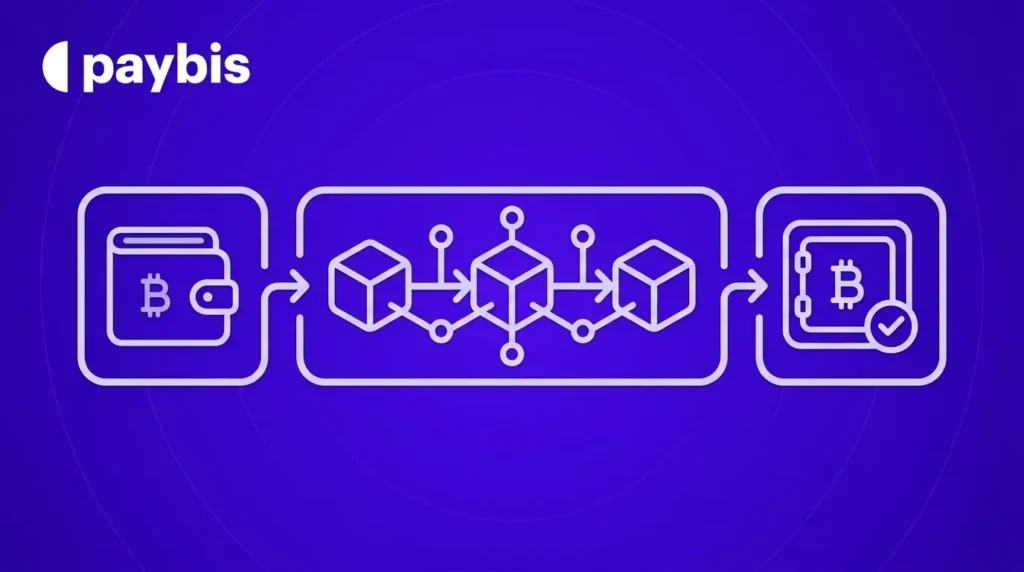
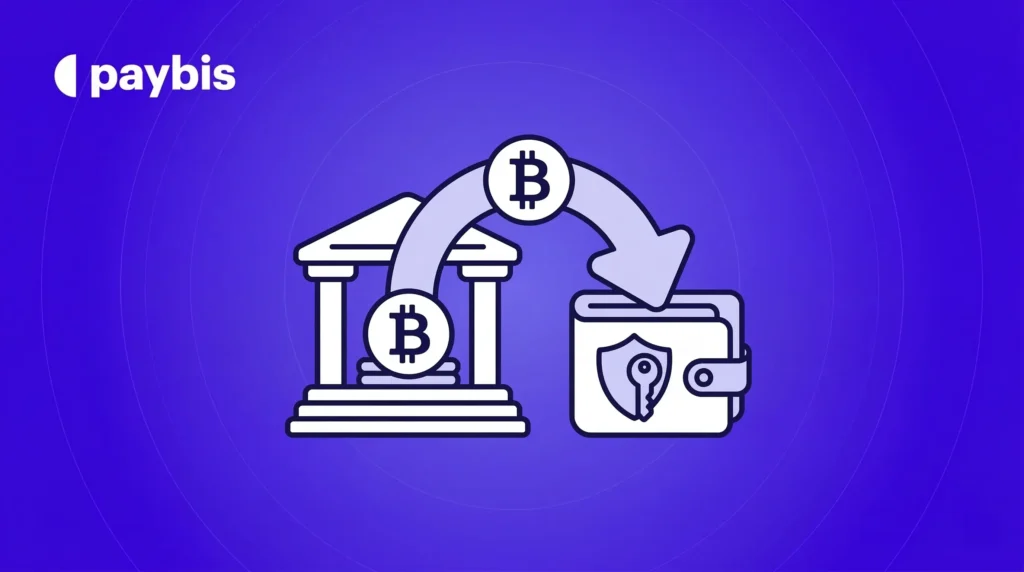
PayPal’s terms and conditions state directly: “Any balance in your Cryptocurrencies Hub represents your ownership of the amount of each Crypto Asset shown. You will not hold the digital Crypto Assets themselves in your Crypto Asset balance.” PayPal does not provide a private key.
In plain terms: you own a record in PayPal’s system, not actual crypto in a wallet you control. If PayPal suspends your account, your access depends entirely on PayPal’s cooperation.
PayPal added external transfer functionality in 2022, allowing users to move Bitcoin, Ethereum, Bitcoin Cash, and Litecoin to external wallets. PYUSD can also be sent to compatible Ethereum, Arbitrum, and Solana addresses. This is a useful step, but it still requires PayPal to approve every outbound transfer.
How To Buy Crypto Instantly With Paybis
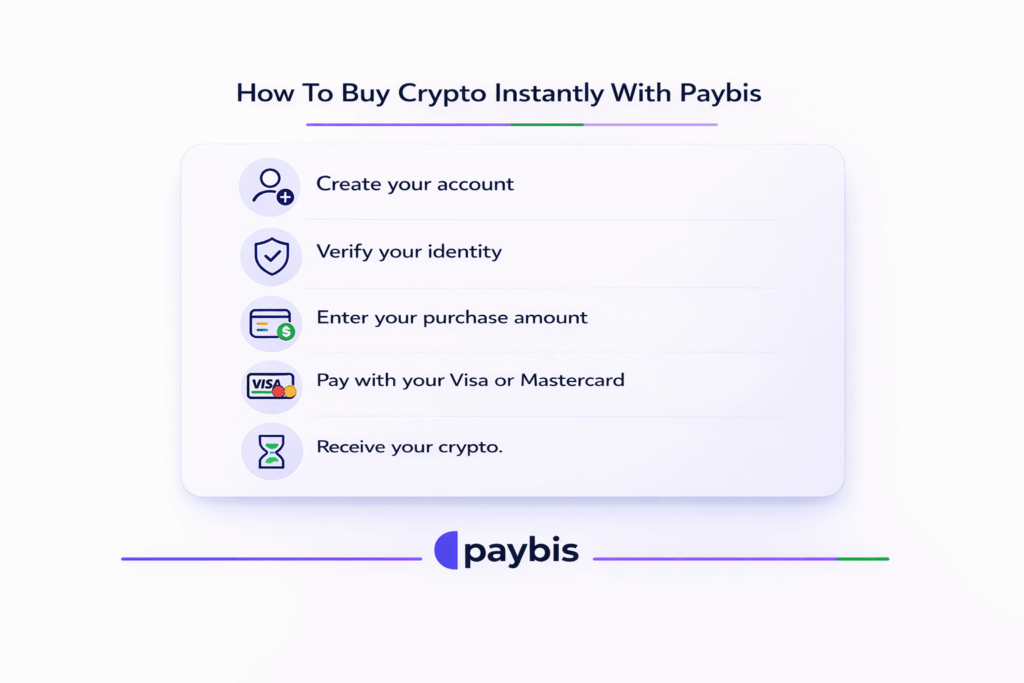
We built Paybis for people who want to buy crypto today, not next week. Here is the complete process, from decision to Bitcoin in your wallet:
1. Create your account at paybis.com (takes under 2 minutes to set up).
2. Verify your identity by uploading a government-issued photo ID and taking a selfie. Most users complete verification within a few minutes (see the step-by-step Know Your Customer (KYC) process below). Per Paybis documentation, your first transaction takes about 10 minutes on average including verification, and subsequent purchases with the same card can take around 30 seconds.
3. Enter your purchase amount and review the full cost breakdown before confirming. Service fee, processing fee, and network fee are all shown separately.
4. Pay with your Visa or Mastercard and receive Bitcoin or your chosen crypto near-instantly (settlement depends on the blockchain).
Users describe the experience consistently:
“Paybis has the absolute easiest platform to purchase crypto. And the processing is extremely fast!” – Sandra Jenkins on Trustpilot
We operate in 180+ countries with 20+ payment methods and access to 90+ cryptocurrencies. We’ve processed $1.2B+ in transaction volume (last 12 months as of Oct 2025) and serve 5M+ retail users. The FXEmpire review of Paybis and the 99Bitcoins Paybis review both highlight fee transparency and verification speed as key differentiators.
We’re FinCEN-registered (Financial Crimes Enforcement Network, US entity 31000272911973), FINTRAC-registered (Financial Transactions and Reports Analysis Centre of Canada, CA entity C100000646), and PCI DSS Level 1 compliant (Payment Card Industry Data Security Standard), with no security breaches since 2014. Our 30,780+ Trustpilot reviews carry a rating of 4.1 or “Great”.
Ready To Buy Crypto With Transparent Fees?
PayPal’s weekly limits and hidden spreads create unnecessary friction when you want to move fast. We built Paybis to eliminate that friction: identity verification is typically completed within a few minutes, instant card transactions for repeat purchases, and every fee is shown before you confirm.
Create your Paybis account, complete identity verification, and see your exact total at checkout. Your first card transaction carries a 0% service fee. Need help? Our 24/7 live chat responds in 1-2 minutes on average.
Key Terminology
Spread: The difference between the market price PayPal pays for crypto and the price displayed to you. PayPal embeds this cost in the exchange rate and will not separately disclose it per transaction, per PayPal’s terms.
Private key: A unique code that proves direct ownership of crypto on a blockchain. PayPal does not provide private keys, which means crypto held in PayPal’s hub is accessible only through PayPal’s platform.
Network fee: The cost paid to miners or validators to process a transaction on the blockchain. This fee is external to any platform and fluctuates based on blockchain congestion. We show network fees separately before you confirm a purchase.
Custodial wallet: A wallet where a third party holds your crypto on your behalf. A non-custodial wallet gives you direct control via a private key. After buying on Paybis, you can withdraw to an external wallet you control at any time.
FAQ
What is PayPal's weekly crypto purchase limit?
Verified US accounts can purchase up to $100,000 in crypto per week. New or unverified accounts start at $1,000 per week, per PayPal’s official crypto FAQ.
Does PayPal have an annual crypto limit?
No. PayPal removed its $50,000 annual purchase limit in July 2021, per the PayPal newsroom announcement. There is no annual cap for verified accounts.
What is the minimum Bitcoin transfer amount on PayPal?
The minimum external Bitcoin transfer is 0.001 BTC. Internal transfers start at $0.01, per PayPal’s transfer help page.
Does PayPal Buyer Protection cover crypto purchases?
No. PayPal Buyer Protection does not apply to cryptocurrency purchases, sales, or transfers. Only unauthorized account activity is covered, per PayPal’s crypto FAQ.
What is Paybis's fee for a first-time buyer?
The first card transaction has a 0% service fee. After that, we charge a service fee starting from 1.49%, a processing fee of 4.5-8.5% for card transactions over $50, and a variable network fee shown before confirmation.
Which cryptocurrencies can be transferred out of PayPal?
Bitcoin, Ethereum, Bitcoin Cash, and Litecoin can be sent to external wallets. PYUSD supports Ethereum, Arbitrum, and most Solana addresses, per PayPal’s 2022 transfer announcement.
Disclaimer: Don’t invest unless you’re prepared to lose all the money you invest. This is a high‑risk investment and you should not expect to be protected if something goes wrong. Take 2 mins to learn more at: https://go.payb.is/FCA-Info