PayPal vs Credit Card: Best Payment Method for Buying Crypto
Key Takeaways:The payment method you choose determines whether you actually own your crypto. Buying with a credit card through a dedicated gateway delivers Bitcoin to your own wallet, with every fee shown before you confirm. PayPal is familiar and fast for small amounts, but its custodial model means you don’t hold the private keys, transfer options are limited, and standard buyer protection doesn’t apply to crypto transactions.
Most first-time buyers choose PayPal because it’s already on their phone. But when you try to send that Bitcoin to an external wallet, you’ll discover bank-funded purchases are locked for 3-5 business days before a transfer is even possible. This guide breaks down the exact fees, speeds, and security differences between both methods so you can make a clear call before you spend a dollar.
Table of contents
How to Choose Between PayPal and Credit Cards for Crypto
The right payment method depends on three factors: how quickly you need the crypto, the total fees you’ll pay, and whether you want to control the coins after purchase. We’ve compared the two options head-to-head below.
| Payment Method | Speed | Fee Structure | Custody / Ownership |
|---|---|---|---|
| PayPal (buy via PayPal app) | Instant for debit-funded; 3–8 days hold for bank-funded | ~1.5–2.5% spread + 1% withdrawal fee | Custodial: no private key provided |
| Credit/Debit Card (via Paybis) | Processing instant (<1 min); Bitcoin arrives in ~5–15 min | Service from 1.49% (0% first purchase) + Processing 4.5–8.5% + Network fee | Non-custodial: send to your own wallet |
Transaction Speed and Settlement Times
For returning users who have already completed verification and are purchasing with the same card, Paybis processes credit card purchases within 30 seconds. For most other transactions, standard review takes 10–20 minutes. Bitcoin then arrives in your wallet within 5-15 minutes for both new and returning users. New users can expect identity verification to take around 15 minutes before that first purchase clears.
PayPal’s speed depends on how you fund the purchase. Debit-funded purchases are instant. If you use a bank transfer, PayPal holds funds up to 8 days before you can transfer crypto externally, depending on risk factors. Once you can transfer, blockchain confirmation adds another ~2 hours on average.
The takeaway: a credit card purchase can have Bitcoin in your wallet before a PayPal bank transfer even clears.
Fee Structures and Hidden Costs
PayPal’s fee structure isn’t fully visible upfront. According to PayPal’s cryptocurrency terms, the exchange rate includes “an estimated spread of one percent (1.00%),” but spreads range from 1.5% to 2.5% depending on transaction size, with smaller purchases under $25 carrying spreads closer to 2.5%. On top of that, PayPal charges a 1% withdrawal fee when you move crypto to an external wallet, plus the blockchain network fee.
We show every fee component before you confirm payment. Here is what a $500 credit card Bitcoin purchase looks like using our fee structure:
- Service Fee: Starts from 1.49% (0% on your first card transaction)
- Processing Fee: $22.50-$42.50 (4.5-8.5% for card transactions over $50, depending on currency)
- Network Fee: Varies by Bitcoin network demand, typically $0.70-$3.00 (can spike during congestion)
- Total on first purchase: approximately $523-$546
That full breakdown appears on screen before you click confirm.
“Paybis is fast, accurate, exact to quote, offer promotions, offer paybis or external address, clean, simple interface and provide email processing updates. Bravo!” – G Cham on Trustpilot
Security and Buyer Protection Differences
Here is the key fact most buyers miss: PayPal Buyer Protection doesn’t cover cryptocurrency purchases. PayPal only protects you against unauthorized account access, with a lifetime cap of $50,000 for unauthorized transfers. If you have a dispute about the crypto transaction itself, there is no recourse through standard buyer protection.
Credit card purchases carry fraud protections under federal law, giving you the ability to dispute unauthorized charges with your card issuer, as chargebacks911 explains. In practice, crypto’s irreversibility makes chargebacks complex at the exchange level, but the cardholder protection layer still exists as a safety net for fraud cases.
We’ve operated since 2014 with no security breaches, hold FinCEN registration (US entity 31000272911973) and FINTRAC registration, and are PCI DSS Level 1 compliant. Coin Bureau and 99Bitcoins both confirm this compliance track record, alongside 30,180+ Trustpilot reviews with a rating of 4 or “Great” as of January 2025.
One account-freeze risk specific to PayPal: PayPal can limit, suspend, or terminate accounts at its discretion. When crypto holdings are inside a restricted PayPal account, recovery options are limited and slow. We deliver crypto to your own wallet, so platform-level restrictions never lock up your funds.
Custody and Wallet Transfer Limits
“Custody” means who actually controls the crypto. With PayPal, you receive rights to the cryptocurrency you buy but no private key. PayPal holds the crypto in omnibus accounts (pooled accounts holding multiple users’ assets) on your behalf. If you can’t log in, your access is gone.
By default, we offer a custodial Paybis wallet where we secure the private keys and assets on your behalf using enterprise-grade security. However, you can choose to send purchased crypto directly to your own external wallet address at checkout. When you do this, you hold the private keys and control the coins. If you’d prefer not to manage a wallet address immediately, you can use our free custodial Paybis wallet option.
Buying Crypto Directly on PayPal
PayPal’s crypto hub lets US, UK, and select European users buy Bitcoin, Ethereum, Litecoin, Bitcoin Cash, Solana, Chainlink, and PayPal USD (PYUSD) within the app. PayPal recently expanded PYUSD to 70 countries, but buying and selling standard cryptocurrencies remains primarily limited to the US and UK.
Supported Cryptocurrencies and Regional Limits
PayPal supports approximately 15-20 cryptocurrencies as of 2026, with US users limited to BTC, ETH, BCH, LTC, Solana, Chainlink, and PYUSD. That covers the basics, but anyone looking for altcoins beyond that list is out of options within PayPal’s ecosystem.
We support 80+ cryptocurrencies across 180+ countries with 20+ payment methods. If you’re in Brazil, the Philippines, Nigeria, or Eastern Europe, you’re much more likely to find a supported payment method with us than within PayPal’s crypto service.
The Reality of PayPal Buyer Protection for Crypto
PayPal doesn’t apply standard buyer protection to crypto transactions, as confirmed by PayPal’s crypto protection FAQ. The only protection covers unauthorized account access, not disputes over the transaction itself, and crypto transactions cannot be reversed once confirmed.
Our help center warns about PayPal-related crypto scams as a known risk. If someone asks you to buy crypto on PayPal and send it to them, that’s a scam pattern, not a payment method.
Buying Crypto with a Credit Card
Using a Visa or Mastercard with us takes four steps. Watch the full walkthrough in this Paybis card verification tutorial or the Paybis card buying guide.
- Enter your amount: Choose the cryptocurrency and enter how much local currency you want to spend. The total fee breakdown appears immediately.
- Add your wallet address: Provide your personal wallet address or select our free Paybis wallet option.
- Pay with your card: Enter your Visa or Mastercard details. Your card must be enrolled in 3D Secure (Verified by Visa/Mastercard) for the security check.
- Verify your identity (first-time only): Upload a government-issued ID and take a selfie. We require this once, and it takes ~2 minutes for most users.
FXEmpire and Benzinga both independently confirm the speed and straightforward checkout process.
“The Paybis app it’s the easiest I’ve ever used… it was the easiest to just complete the account setup and then I did use it one time and it was the easiest.” – Tammy on Trustpilot
“Paybis offers transactions in a quick and easy format with thorough security measures. I’ve been using their app for quite some time and have had no issues.” – Amanda Stringfellow on Trustpilot
Why Credit Cards Offer True Crypto Ownership
When you buy crypto with a card through us and send it to your own wallet address, the coins go directly onto the blockchain. You hold the private keys. You can send that Bitcoin to any wallet address in the world, anytime, without asking a platform for permission. With us, your crypto is yours the moment the transaction confirms.
Avoiding Cash Advance Fees and Declined Transactions
Some banks classify crypto purchases as cash advances and charge an additional fee up to 5% on top of the transaction amount. We receive none of this fee. It comes entirely from your card issuer. Before your first purchase, call your bank and confirm they don’t apply cash advance treatment to crypto transactions.
If your card is declined, the most common reason is your bank’s automated fraud detection, as blockchain.com’s support page explains. Calling your bank’s fraud line to pre-authorize the transaction solves it in most cases. If you’re still stuck, our 24/7 live chat responds in an average of 1-2 minutes.
Using PayPal as a Payment Method on Crypto Exchanges
There’s an important distinction between buying crypto on PayPal (inside the PayPal app) versus using PayPal as a funding source on a third-party exchange. We accept PayPal as a payment method, meaning you can fund a purchase with your PayPal balance and still receive the crypto directly to your own wallet. See how to pay with PayPal in our help center for setup instructions.
This combines PayPal’s familiar checkout with true ownership and transparent fees.
Alternative Payment Methods: Venmo and Cash App
Venmo is owned by PayPal and shares the same custodial model and transfer limitations. You can move crypto between PayPal and Venmo, but external transfers remain restricted.
Cash App allows Bitcoin withdrawals to external wallets, making it more flexible than PayPal for Bitcoin specifically. However, it remains primarily Bitcoin-focused with limited altcoin availability. Both apps work for casual holders, but limit your options if you want to move crypto freely or access a broader range of cryptocurrencies.
The Verdict: Which Payment Method Wins?
Credit cards win on speed, fee transparency, and ownership. PayPal wins on familiarity, especially for buyers who only want to hold crypto inside their existing app and never transfer it.
Here is the practical breakdown:
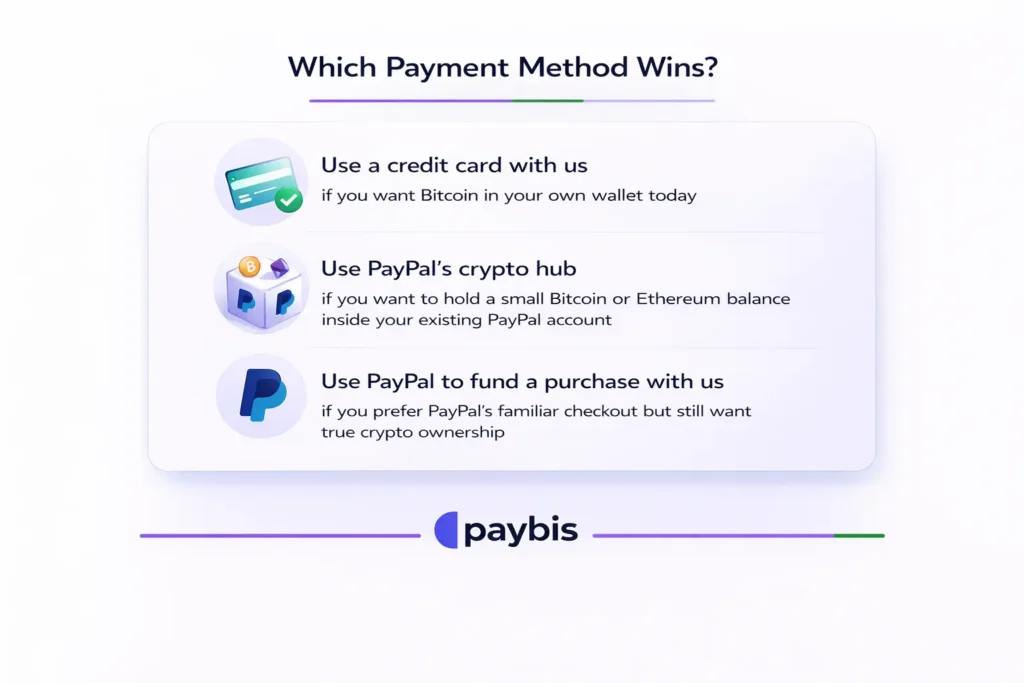
- Use a credit card with us if you want Bitcoin in your own wallet today, with every fee visible before you confirm, and 24/7 human support if anything goes wrong.
- Use PayPal’s crypto hub if you want to hold a small Bitcoin or Ethereum balance inside your existing PayPal account and never intend to move it to an external wallet.
- Use PayPal to fund a purchase with us if you prefer PayPal’s familiar checkout but still want true crypto ownership.
We serve 5M+ retail users across 180+ countries. The DigiChick Paybis tutorial and user reviews on Google Play often mention fee transparency and verification speed as primary reasons buyers return.
“I like using Paybis to buy Bitcoin. The system and how it works are fast, efficient, and easy to understand. And it’s reliable.” – Frau Regina Rosyanna Sinuhadji on Trustpilot
“Paybis is so easy to use compared to many other companies in the same field. It is quick and you get your receipt and information right away. Simply the best.” – Tuula Rantanen on Trustpilot
Ready to buy? Use our fee calculator to see the exact cost of your first credit card purchase. Your first card transaction carries a 0% service fee, and identity verification takes about 2 minutes.
Key Terminology
Custody: Who holds your crypto on the blockchain? Custodial (PayPal model) means the platform holds the crypto, and you hold an account balance. Non-custodial (our model) means the crypto is sent directly to a wallet you control, secured by your private key.
Network fee: The cost paid to blockchain miners to confirm and process your transaction. This fee is set by the blockchain network, not by PayPal or us, and varies based on how congested the network is at the time of purchase.
Spread: The difference between the market price of a cryptocurrency and the price a platform charges you to buy it. PayPal’s spread is built into the exchange rate and isn’t always itemized separately at checkout. With us, fees are shown as separate line items before you confirm.
3D Secure: A security layer added to online card payments (called “Verified by Visa” or “Mastercard SecureCode”). When you buy crypto with a card through us, your bank sends a one-time code to your phone to confirm the purchase is authorized by you.
FAQ
Can I use PayPal credit to buy Bitcoin?
PayPal does not support PayPal Credit as a funding source for crypto purchases within its app. PayPal’s crypto terms limit eligible payment methods to debit cards, bank transfers, and PayPal balance.
What are the exact credit card processing fees on Paybis?
For card transactions over $50, we charge a processing fee of 4.5% for USD, EUR, and GBP, and up to 6.5% for other currencies, plus the service fee (0% on your first transaction, then from 1.49%) and the variable blockchain network fee.
Can I send crypto bought on PayPal to my own external wallet?
Yes, but only from US accounts, only for BTC, ETH, BCH, LTC, PYUSD (ERC-20, Solana/SPL, and Arbitrum), LINK (ERC-20), and SOL, and only after completing additional identity verification. Bank-funded purchases must clear first, which can take up to 8 days.
What is the weekly purchase limit on Paybis vs PayPal?
We allow up to $20,000 per week or $50,000 per month for card purchases. PayPal’s US weekly buying limit is $100,000, though the sending limit is lower at $25,000 per week.
Disclaimer: Don’t invest unless you’re prepared to lose all the money you invest. This is a high‑risk investment and you should not expect to be protected if something goes wrong. Take 2 mins to learn more at: https://go.payb.is/FCA-Info