The SEC Just Declared Bitcoin, Ethereum, and 14 Other Cryptos Are Not Securities
- On March 17, 2026, the SEC and CFTC jointly published a 68-page framework classifying 16 cryptocurrencies as digital commodities, not securities, under US federal law
- Bitcoin, Ethereum, Solana, XRP, Dogecoin, Cardano, Chainlink, Polkadot, Litecoin, Shiba Inu, and six others are now formally outside securities regulation
- Staking, mining, and receiving airdrops of these assets are explicitly cleared. None of these activities constitutes securities transactions
- This is interpretive guidance, not a law. It takes effect immediately, but Congress still needs to pass the CLARITY Act to make it a permanent statute
- Your taxes on crypto have not changed. The SEC ruling is about classification, not how the IRS treats gains
For most of the past decade, buying crypto in the US came with a background hum of legal anxiety. The SEC, under former Chairman Gary Gensler, argued that most tokens beyond Bitcoin were unregistered securities. Exchanges got sued. Builders relocated offshore. Ordinary holders had no clear answer to the question: Is this thing I own even legal?
On March 17, 2026, that hum went quiet.
The SEC and CFTC jointly published Interpretive Release No. 33-11412, a 68-page document that formally classifies most major cryptocurrencies as digital commodities under federal law. SEC Chairman Paul Atkins announced it at the DC Blockchain Summit, and the line that landed hardest was this one: “We are not the Securities and Exchange Commission anymore.”
Here is what actually changed, what it means for the coins you hold, and what still has not been resolved.
Table of contents
- So What Did the SEC and CFTC Actually Announce on March 17, 2026?
- What Changes for Bitcoin, Ethereum, or One of the Other 14 Coin Holders?
- Does the SEC Ruling Change How Crypto Is Taxed in 2026?
- Why Did It Take a Decade to Get Regulatory Clarity on Crypto?
- Is It Finally Safe to Buy and Hold Crypto in the US?
So What Did the SEC and CFTC Actually Announce on March 17, 2026?
The SEC and CFTC had been fighting over jurisdictional territory for years. The SEC claimed most tokens were securities. The CFTC claimed many of the same tokens were commodities. Both agencies brought enforcement cases based on conflicting interpretations, which created legal paralysis for everyone operating in the space.
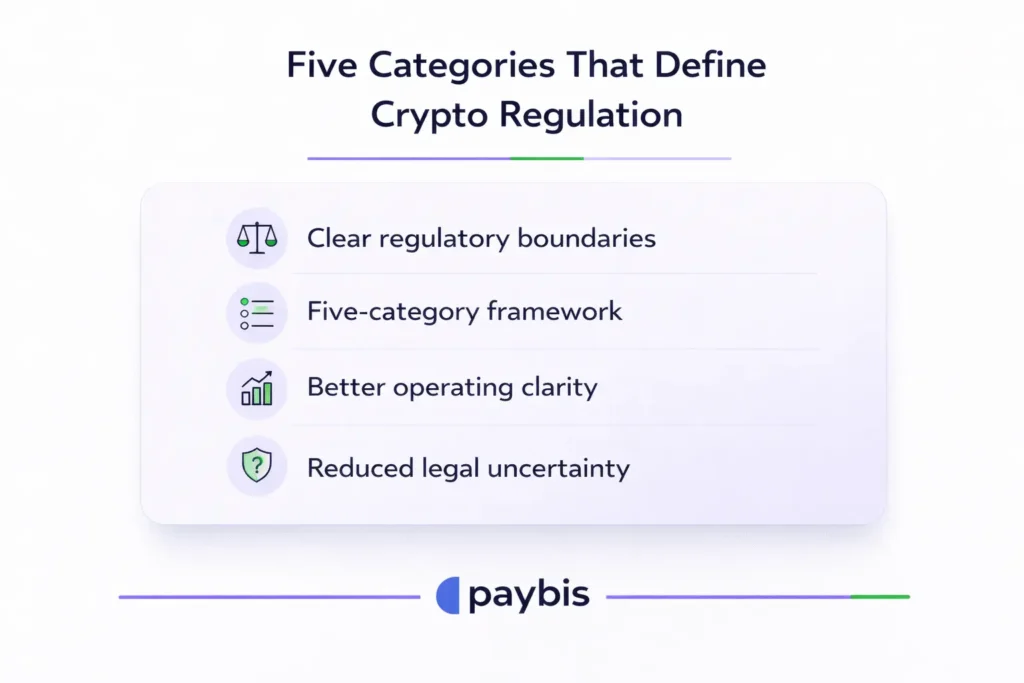
The March 17 release ended that standoff with a formal five-category taxonomy. Every crypto asset now falls into one of five buckets:
- Digital commodities: Assets like Bitcoin, Ethereum, and Solana that derive value from decentralized networks, not from a central issuer’s efforts. Not securities. Regulated by the CFTC.
- Digital collectibles: NFTs and similar assets tied to ownership or provenance. Not securities.
- Digital tools: Tokens used to access or operate blockchain applications. Not securities.
- Stablecoins: Tokens pegged to fiat currencies for payments and settlement. Conditionally outside securities law.
- Digital securities: Tokenized versions of traditional financial instruments. Still regulated by the SEC.
The 16 tokens explicitly named as digital commodities include Bitcoin, Ethereum, XRP, Dogecoin, Solana, Cardano, Bitcoin Cash, Aptos, Avalanche, Hedera, Litecoin, Polkadot, Shiba Inu, Stellar, Tezos, and Chainlink.
What Changes for Bitcoin, Ethereum, or One of the Other 14 Coin Holders?
The most immediate change is legal certainty. If you hold any of the 16 named assets, you now hold a formally recognized commodity under US law. That sounds abstract until you understand what the absence of that clarity has cost the market for the past decade.
When the SEC could actively declare a token a security, every exchange listing it faced legal exposure. Every institutional fund that considered it had to weigh regulatory risk, and every retail holder had to accept some level of uncertainty about what they actually owned. For a decade, traders operated under a system where the SEC could retroactively declare the asset in their portfolio a security. That ambiguity is over.
For you as a holder, the practical consequences are:
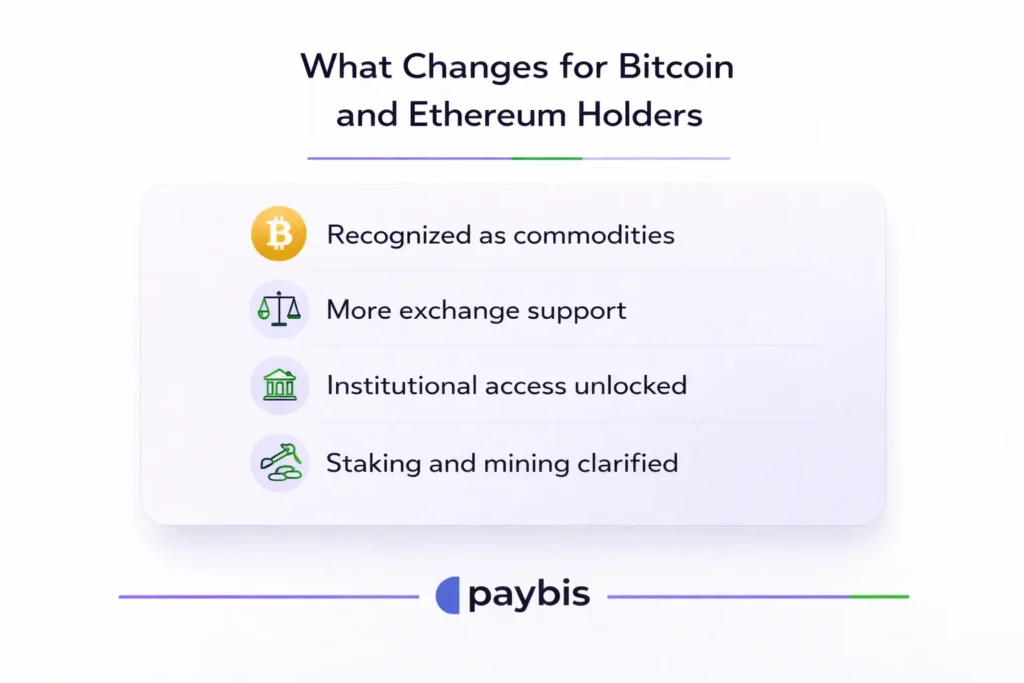
- More exchanges are listing these assets with confidence. Platforms that avoided certain tokens due to securities risk now have a defined framework to operate within.
- More institutional capital coming in. Asset managers, pension funds, and banks that were sidelined by legal uncertainty have a green light to build products around these assets.
- Staking and mining are fully cleared. The release explicitly states that solo mining and mining pool participation on proof-of-work networks, solo, custodial, and liquid staking on proof-of-stake networks, exchanging crypto for wrapped tokens on a 1:1 basis, and distributing tokens without consideration from recipients are all outside securities treatment. Staking your ETH or SOL is not a securities transaction. It never should have been uncertain, and now it is not.
Does the SEC Ruling Change How Crypto Is Taxed in 2026?
This is the question most retail holders have, and the answer is straightforward: the SEC ruling changes your legal classification, not your tax obligations.
Crypto is still taxed in the US the same way it was before March 17. The IRS treats cryptocurrency as property. It means selling, swapping, or spending it still triggers capital gains tax.
The SEC’s five-category framework is about which regulatory agency oversees what and whether certain activities require registration under securities law. The IRS operates independently and has not issued any guidance changing how gains are calculated or reported.
What could change is how new financial products built around these assets are structured and taxed, particularly as more institutional products come to market following this ruling. But for a retail holder buying, selling, staking, or holding any of the 16 named assets today, your tax position is unchanged.
Is Crypto Regulation in the US Finally Settled, or Are There Still Open Questions?
The March 17 release is significant, but it is important to understand what it is and what it is not.
The taxonomy is still interpretive guidance, not a statute or a law. Congress could override it. And until the CLARITY Act, or something like it, passes the Senate, the legal architecture remains fragile. The CLARITY Act passed the House in July 2025 and cleared the Senate Agriculture Committee in January 2026, but still needs a Senate Banking Committee vote before it can become law.
The guidance also applies going forward, not backward. The guidance applies prospectively and does not affect prior enforcement actions or ongoing litigation. This release does not wipe out the years of SEC lawsuits against exchanges and projects.
And importantly, the classification is not permanent for any individual asset. Classification as a digital commodity is not a permanent shield. These assets can become securities if an individual or group offers and sells them subject to an investment contract. If a team behind any of these tokens starts making promises about profits tied to their management efforts, that could pull the asset back into investment contract territory.
What the release does not address is thousands of smaller tokens that were not named. If you hold something outside the 16 listed assets, its status depends on the same five-category framework, but without the explicit named confirmation these assets now have.
Why Did It Take a Decade to Get Regulatory Clarity on Crypto?
Understanding why this announcement is a big deal requires a brief look at where the industry came from.
In 2017, the SEC applied the Howey test to crypto for the first time. The Howey test is the 1946 legal standard for determining whether something is an investment contract: if someone invests money in a common enterprise expecting profits from the efforts of others, it is a security. The SEC used that framework to argue that most tokens, including at various points Ethereum, XRP, and Solana, were unregistered securities.
That position led to years of enforcement actions against Coinbase, Ripple, Binance, and dozens of others. Courts repeatedly pushed back. The Ripple case in particular produced a landmark finding that XRP itself was not a security when sold to retail investors on secondary markets. But the SEC under Gensler kept pushing, and the uncertainty kept builders, institutional capital, and retail confidence at arm’s length.
The confirmation of Paul Atkins as SEC Chairman in early 2025 signaled a change in direction. By January 2026, the SEC had formally dropped crypto from its enforcement priorities. The March 17 guidance is the end result of that policy shift, and for anyone who has been in crypto for more than a couple of years, the speed of the reversal is still somewhat hard to process.
Is It Finally Safe to Buy and Hold Crypto in the US?
The March 17 ruling is the most consequential piece of US crypto regulation since Bitcoin was created. It does not answer every question, and it still needs Congress to make it permanent. But it formally ends the SEC’s presumption that most crypto is a security, designates 16 major assets as regulated commodities, and clarifies that staking, mining, and airdrops of those assets are not securities law violations.
If you have been waiting for a signal that holding, buying, or staking major cryptocurrencies in the US sits on solid legal ground, this is as close to that signal as the market has ever had.You can buy Bitcoin, Ethereum, Solana, XRP, Dogecoin, and most of the other newly classified assets with Paybis with a credit card, debit card, or bank transfer.
FAQ
Which cryptocurrencies were officially classified as digital commodities on March 2026?
The joint SEC and CFTC release named 16 assets as digital commodities: Bitcoin, Ethereum, XRP, Dogecoin, Solana, Cardano, Bitcoin Cash, Aptos, Avalanche, Hedera, Litecoin, Polkadot, Shiba Inu, Stellar, Tezos, and Chainlink. Holding any of these now means holding a formally recognized commodity under US federal law. Tokens not on this list aren’t automatically excluded, and they still fall under the same five-category framework. But they don’t have the same explicit named confirmation these 16 do.
Does the SEC's new crypto classification change how I pay taxes on my coins?
No. The ruling changes your legal classification, not your tax obligations. The IRS still treats cryptocurrency as property, meaning selling, swapping, or spending it triggers capital gains tax just as before. The SEC’s framework determines which regulatory agency oversees what, not how the IRS calculates your gains. Your tax position as a retail holder is unchanged by the March 17 release.
Disclaimer: Don’t invest unless you’re prepared to lose all the money you invest. This is a high‑risk investment and you should not expect to be protected if something goes wrong. Take 2 mins to learn more at: https://go.payb.is/FCA-Info