Why USDT Demand Is Rising as European Access Shrinks
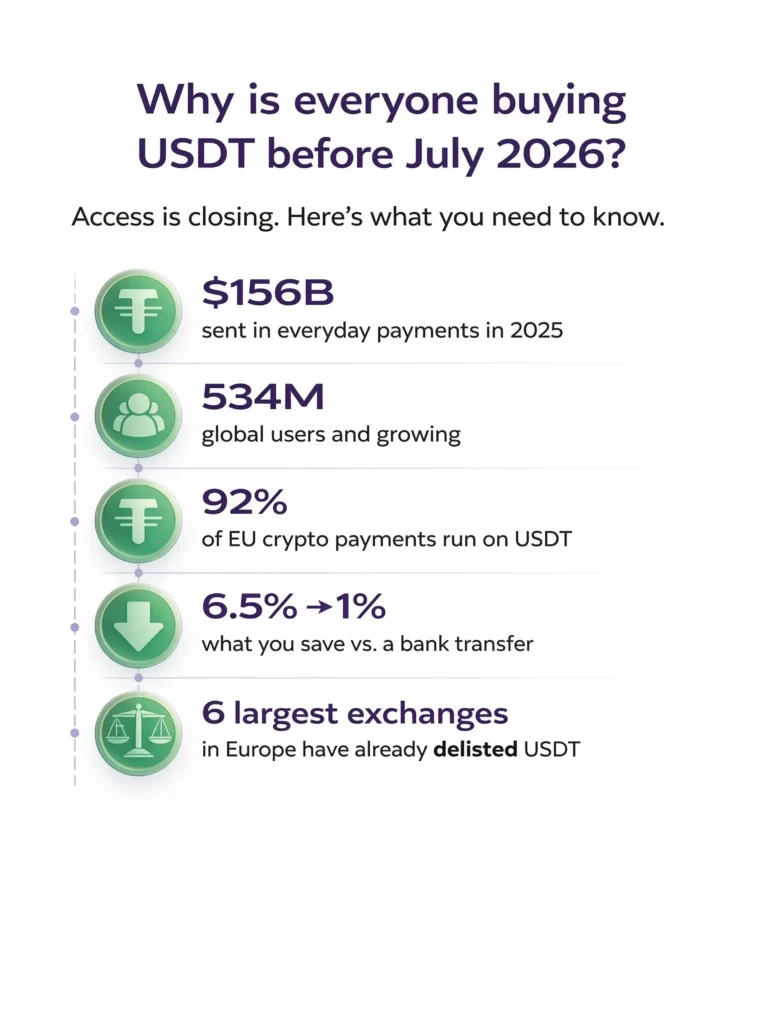
- Coinbase, Binance, Crypto.com, Kraken, Revolut and OKX have already cut USDT access for EU users
- USDT market cap surpassed $176 billion, with $45.6 billion in net inflows in Q3 2025 alone
- Europe accounts for roughly 14% of global USDT usage, concentrated in Germany, the Netherlands, and Turkey
- The July 1, 2026, MiCA deadline will close the last remaining window for regulated access
- Paybis is one of the very few regulated platforms in Europe still offering full USDT access today
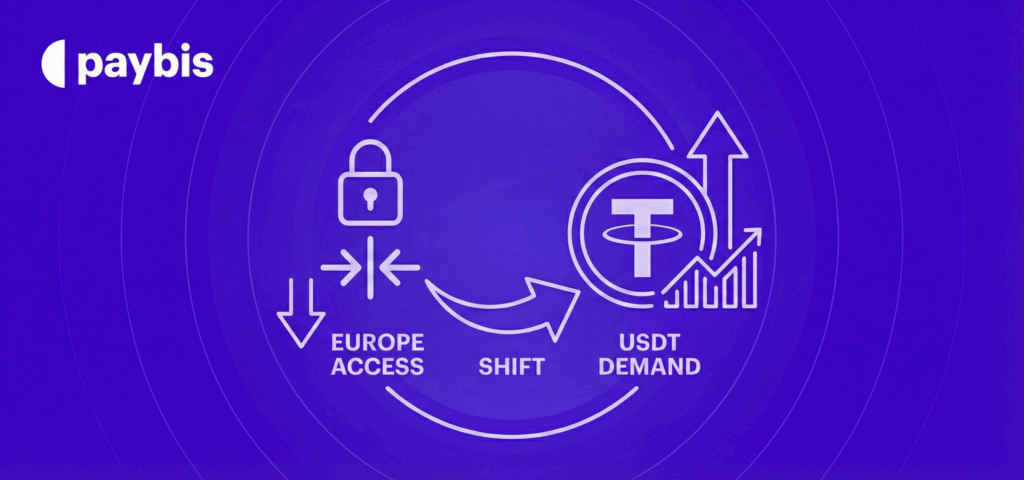
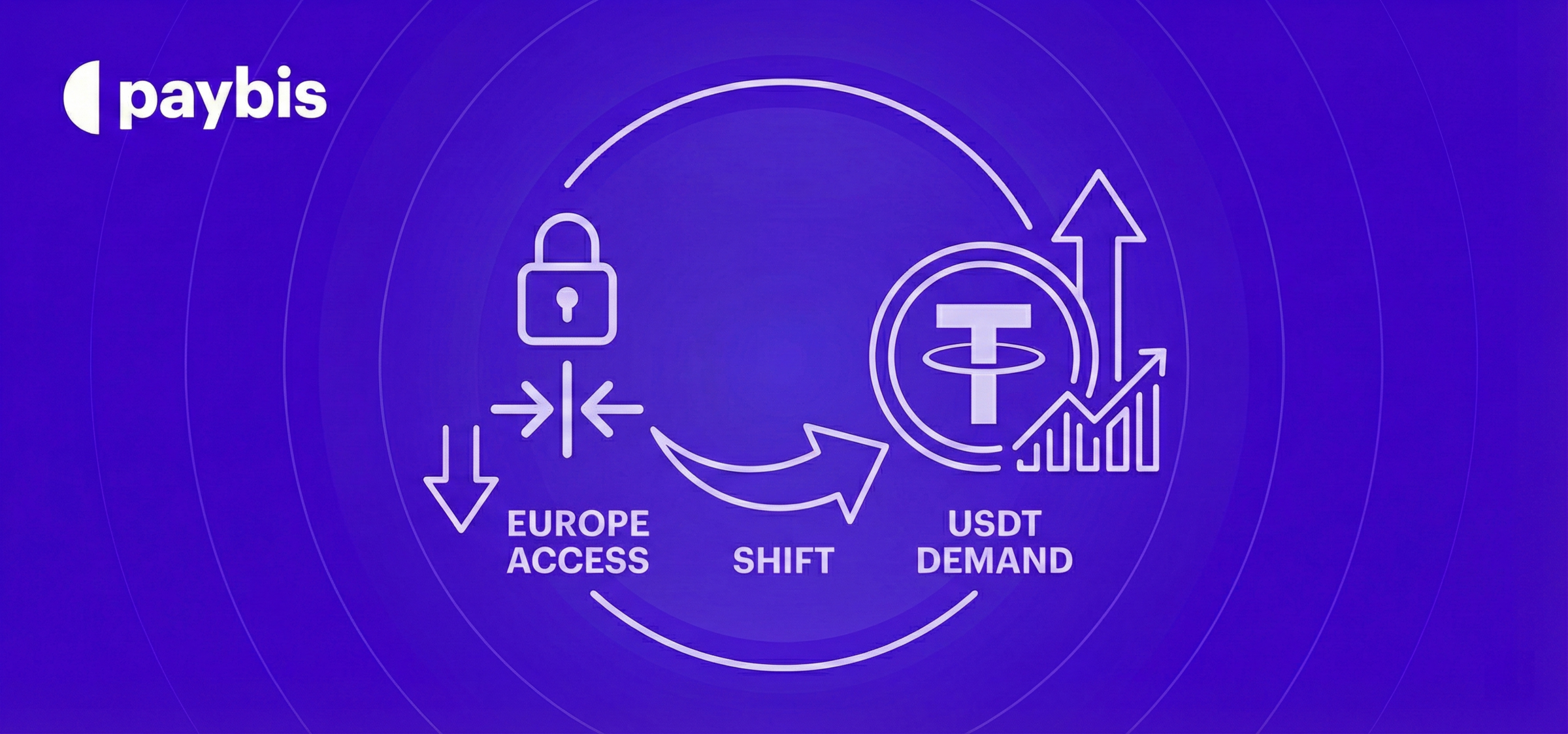
Six major exchanges removed USDT for EU users in the past year. You would expect demand to drop, but it went the other way.
Global USDT supply crossed $176 billion in late 2025, and net inflows hit $45.6 billion in Q3 alone. At the same time, the platforms that European users rely on to buy, hold, and move USDT have been shutting access down one by one. Paybis is an exception.
Table of contents
Why European Exchanges Stopped Offering USDT
MiCA, the EU’s Markets in Crypto-Assets regulation, requires stablecoin issuers to hold an EU e-money license to operate on European platforms. Tether, the company behind USDT, has not pursued that license. Without it, regulated exchanges operating in the EU have no legal basis to keep offering USDT. Every exchange that delisted it did so because continuing would have put its operating license at risk.
MiCA’s stablecoin rules came into force in June 2024. In December 2024, the full CASP framework was applied, and exchanges already operating in the EU received a transitional period that allowed them to continue under national rules while seeking full MiCA authorization. This period expires on July 1, 2026.
The timeline of what has already happened with various exchanges:
- Coinbase: delisted USDT for EU users in December 2024
- Crypto.com: stopped purchases in January 2025, full delisting by March 2025
- Kraken: moved to only USDT selling mode in March 2025
- Binance: removed all USDT spot trading pairs for EEA users on March 31, 2025
- OKX: restricted access for EU customers around the same time
As you can see, these are not small or obscure platforms. Between them, they represent the majority of regulated trading infrastructure available to European crypto users. And the second wave is still coming.
What Happens to The Demand When Access Gets Harder
Not historically; when regulated access gets tight, users who rely on USDT for practical purposes tend to act earlier rather than later. They secure their position while the platforms still work and the fees are still predictable. That behavior is one reason inflows stay elevated even as access shrinks.
There is a straightforward logic to this. If you send money to family every month using USDT, and you know the platform you use today may stop offering it before July 2026, waiting is risky. You move while the infrastructure is working smoothly.
This is especially true for remittance users. For someone working in Germany and sending money to the Philippines, Nigeria, or Venezuela, USDT is much more than a speculative asset. USDT is how they transfer value quickly, cheaply, and reliably. Traditional bank transfers to those corridors take days and lose 6% to 9% in fees, while USDT moves in minutes for a fraction of that.
If you are a freelancer receiving payment from US or UK clients, the same logic applies. Getting paid in USDT means receiving funds in hours rather than waiting on international bank processing, and not losing a percentage of every payment to currency conversion on both ends.
Europe accounts for roughly 14% of global USDT usage. It’s mostly concentrated in Germany, the Netherlands, and Turkey. As regulated access has narrowed, a share of those users moved to compliant alternatives like USDC. But globally, the trend has gone in the opposite direction. USDT market cap grew from just under $120 billion at the start of 2025 to more than $176 billion by year’s end. The supply is expanding because demand outside Europe is accelerating.
The July 2026 Deadline Most Users Have Not Planned For
July 1, 2026, is when the MiCA transitional period ends for all EU platforms. Any exchange still offering USDT after that date without full MiCA authorization will have no legal cover. The delistings of early 2025 were the first wave. Mid-2026 is when the final window closes.
Many users are unaware of this second deadline, since the exchange delistings of early 2025 gave away the main event vibes. For a lot of people, it was. But the clause that allowed some platforms to continue under national rules while pursuing MiCA authorization expires in July 2026. After that date, there will be no transitional provision left to rely on.
What that means practically for anyone using USDT in Europe:
- Platforms still offering it today are operating under a time-limited window
- After July 1, 2026, no EU-regulated exchange can legally offer USDT without full MiCA authorization
- Fees and access conditions will likely worsen as supply through regulated channels shrinks
- Users who switch under pressure tend to do so at worse prices and on worse timing than those who plan ahead
What the Alternatives Actually Look Like
USDC is the main compliant substitute for dollar-denominated stability. It holds an EU e-money license through Circle and is available on MiCA-compliant platforms. A euro stablecoin backed by nine European banks, including ING, UniCredit, and CaixaBank, has been announced for the second half of 2026, but it will not arrive before July and will take time to build meaningful liquidity.
For traders and users who need dollar-pegged stability, USDC works. It is fully MiCA-compliant, backed by cash and US Treasuries, and carries monthly reserve attestations.
For remittance users, the picture is a bit blurry. Switching stablecoins at the source end is not technically complicated. The harder question is whether the alternative has the same liquidity and accessibility at the destination. On that measure, no regulated alternative currently matches USDT in the remittance corridors where it matters most. This is part of why demand from users with practical payment needs has remained elevated even as the regulatory timeline has advanced.
Why Paybis Still Offers USDT and What That Means for You
So, can EU users still buy USDT on Paybis?
Yes. Paybis remains one of the few regulated platforms in Europe still offering full USDT access. Here is what that includes today:
- Buy USDT using more than 20 payment methods, including bank transfer, credit card, and debit card
- Swap to USDC or other compliant stablecoins with no fees during the MiCA transition period
- Full FCA-regulated platform with EU compliance, so your funds are protected throughout
Paybis is FCA-regulated in the UK and operates under applicable EU regulations. The platform has not removed USDT from its offering, and it continues to support full access while that remains legally permissible. If you are an EU user who needs USDT now, or who wants to secure a position before the July 2026 deadline, Paybis is one of the remaining options for doing that through a regulated platform.
If you need to swap to USDC or another compliant stablecoin, that option is available too. With the fee-free swap, you’re making the transition on your terms rather than being forced into it later.
Bottom Line
Six major exchanges have already pulled USDT access for European users. A sixth wave of delistings is set to follow in July 2026 when the MiCA transitional period expires. Meanwhile, global USDT demand has continued rising, driven by users who rely on it for real payments rather than speculation.
The pattern is consistent across regulatory transitions like this one. When access gets harder, the users who plan ahead act while their options are still open. If you wait, you’ll find yourself switching under worse conditions, on someone else’s schedule.
FAQ
Is USDT banned in the EU?
USDT is not banned. EU residents can still hold USDT in private wallets, transfer it, and use it. What MiCA restricts is regulated platforms offering it for purchase. The asset itself has not been declared illegal.
Why did Binance, Coinbase, and Kraken remove USDT?
All three operate under EU regulation, which requires stablecoin issuers to hold an EU e-money license. Tether has not applied for that license, so exchanges operating under MiCA have no legal basis to continue offering it. The delistings are a compliance response, not a judgment on USDT’s stability or value.
Will USDT come back to European exchanges after 2026?
Only if Tether obtains EU regulatory approval. Tether has not publicly committed to pursuing MiCA compliance. Without it, there is no regulatory pathway for licensed EU platforms to offer USDT after the July 2026 deadline.
Is USDC a safe replacement for USDT?
USDC is issued by Circle, which holds an EU e-money license and is fully MiCA-compliant. It is backed by cash and US Treasuries with monthly reserve attestations. It represents the most direct regulated substitute for dollar-denominated stability in Europe.
How long can I still buy USDT on Paybis?
Paybis offers full USDT access while it remains legally permissible under current regulations. The final MiCA deadline is July 1, 2026. Nothing in this article constitutes financial or legal advice.
Disclaimer: Don’t invest unless you’re prepared to lose all the money you invest. This is a high‑risk investment and you should not expect to be protected if something goes wrong. Take 2 mins to learn more at: https://go.payb.is/FCA-Info