Best Crypto Exchanges in South Korea 2026: Upbit, Bithumb, Coinone, Korbit & Paybis Compared
Upbit and Bithumb dominate South Korea’s crypto market with deep KRW liquidity, but both require a Korean real-name bank account and a local phone number, making them effectively off-limits for most expats and tourists. Coinone and Korbit carry the same restrictions. International users can bypass the local banking maze entirely and buy Bitcoin on Paybis using a Visa or Mastercard, with identity verification in 2 minutes and processing under 1 minute. You can also buy Bitcoin with PayPal or with Paysafe Card if you prefer alternative ways to buy crypto. Fees start from 1.49% and appear in full before payment is confirmed.
You tried to open an Upbit account. You submitted your passport, entered your phone number, and hit a wall: “Real-name bank account required.” No Korean bank account means no access, and no explanation of how to fix it. This guide compares South Korea’s top domestic exchanges, then shows exactly how international users and expats bypass local banking restrictions and buy Bitcoin in under 10 minutes using a Visa or Mastercard.
The State of South Korean Crypto Exchanges in 2026
South Korea operates one of the world’s most active crypto markets, and its regulatory framework reflects that intensity. The Financial Services Commission (FSC) and the Financial Intelligence Unit (FIU) jointly supervise all virtual asset service providers (VASPs) in the country.
To legally accept Korean won (KRW) deposits, exchanges must obtain VASP registration with the FIU and demonstrate they hold a real-name account agreement with a domestic bank. As of early 2026, only five exchanges hold verified partnerships: Upbit (K-Bank), Bithumb (KB Kookmin Bank), Coinone (Kakao Bank), Korbit (Shinhan Bank), and Gopax (Jeonbuk Bank).
In March 2025, the FSC introduced a 0.6% supervision fee on exchanges’ operating revenues to fund oversight activities. This cost filters into the market through exchange fee structures. These regulatory layers combine with strict KYC and AML obligations to create a walled garden: excellent liquidity for Korean residents, near-total inaccessibility for everyone else. Understanding how to choose which exchange to buy Bitcoin from is especially important in a market this segmented.
Top 5 Domestic Crypto Exchanges in South Korea
Upbit: The Market Leader
Founded in 2017 and backed by Dunamu, Upbit is South Korea’s largest crypto exchange by volume. Kakao Corp., the tech giant behind KakaoTalk, is Dunamu’s third-largest shareholder with a 23% stake, giving Upbit both strategic credibility and access to Kakao’s user network.
Trading fees are 0.25% on fiat markets and 0.2% on crypto markets, per TradingFinder’s exchange profile. The platform maintains 99% of customer digital assets in cold storage and enforces mandatory two-factor authentication for withdrawals. Upbit experienced a significant security incident in 2019 when hackers attributed to North Korean actors stole 342,000 ETH, valued at approximately $50 million at the time.Pros:
- Highest KRW trading volume and liquidity in South Korea
- ISO 27001 certified, strong cold storage practices
- Kakao Corp. ecosystem backing
Cons:
- Requires a K-Bank real-name account, blocking all foreign users
- Complex trading interface with charts and order types that overwhelm first-time buyers
- Limited English-language customer support
Bithumb: The Strong Runner-Up
Established in 2014, Bithumb is one of South Korea’s most recognized exchanges, known for high liquidity and a wide altcoin selection. Base taker and maker fees sit at 0.15%, with rates ranging from 0.04% to 0.25% depending on the transaction, per OneSafe’s Korean exchange breakdown. Pros:
- Wide altcoin selection with competitive 0.15% base fee
- Long operating history since 2014
- Deep KRW liquidity
Cons:
- Requires a KB Kookmin Bank real-name account
- Has faced AML regulatory scrutiny
- Limited English support
Coinone: Best for Altcoins
Coinone charges a flat 0.2% fee for main market trades, with taker fees tiered from 0.02% to 0.1% depending on volume, according to BitcoinWiki. The exchange partnered with Kakao Bank in November 2022.Pros:
- Competitive tiered fee structure starting at 0.02%
- Cold wallet majority storage
- Solid variety of newer token listings
Cons:
- Requires a Kakao Bank real-name account
- Only KRW fiat deposits and withdrawals are accepted, per Unblock’s Coinone review
Korbit and Gopax
Korbit, founded in 2013, is South Korea’s first crypto exchange, partnered with Shinhan Bank. Gopax rounds out the five fully licensed exchanges via a Jeonbuk Bank partnership. Both carry the same real-name account restrictions that block international users and hold a smaller market share than the top three.
The Expat Problem: Why Foreigners Struggle with Korean Exchanges
The real-name account requirement is a hard wall. Every deposit and withdrawal on a Korean exchange must flow through a verified bank account in the user’s legal name, at the exact bank that partners with that exchange. The system automatically rejects foreign bank accounts, joint accounts, and transfers from unlinked names with no human review.
Opening a Korean real-name bank account typically requires a long-term visa (over one year), an Alien Registration Card (ARC), a Korean phone number, and a Korean address, according to SeCondMin’s 2026 foreigner banking guide. Tourists and short-term expats have none of these.
Beyond the banking barrier, there is an interface problem. All five domestic exchanges are built for Korean-speaking day traders who understand spot markets, limit orders, and trading pairs. International users consistently report limited English support, complex interfaces with charts and terminology, and no clear path when something goes wrong. If a transaction fails on a domestic exchange, a multi-day support ticket wait is the standard experience, not the exception. This is part of a broader pattern of why users are reluctant to buy crypto on platforms that weren’t designed with them in mind.
Paybis: The Best International Alternative for Users in South Korea
Buy Crypto Instantly Without a Korean Bank Account
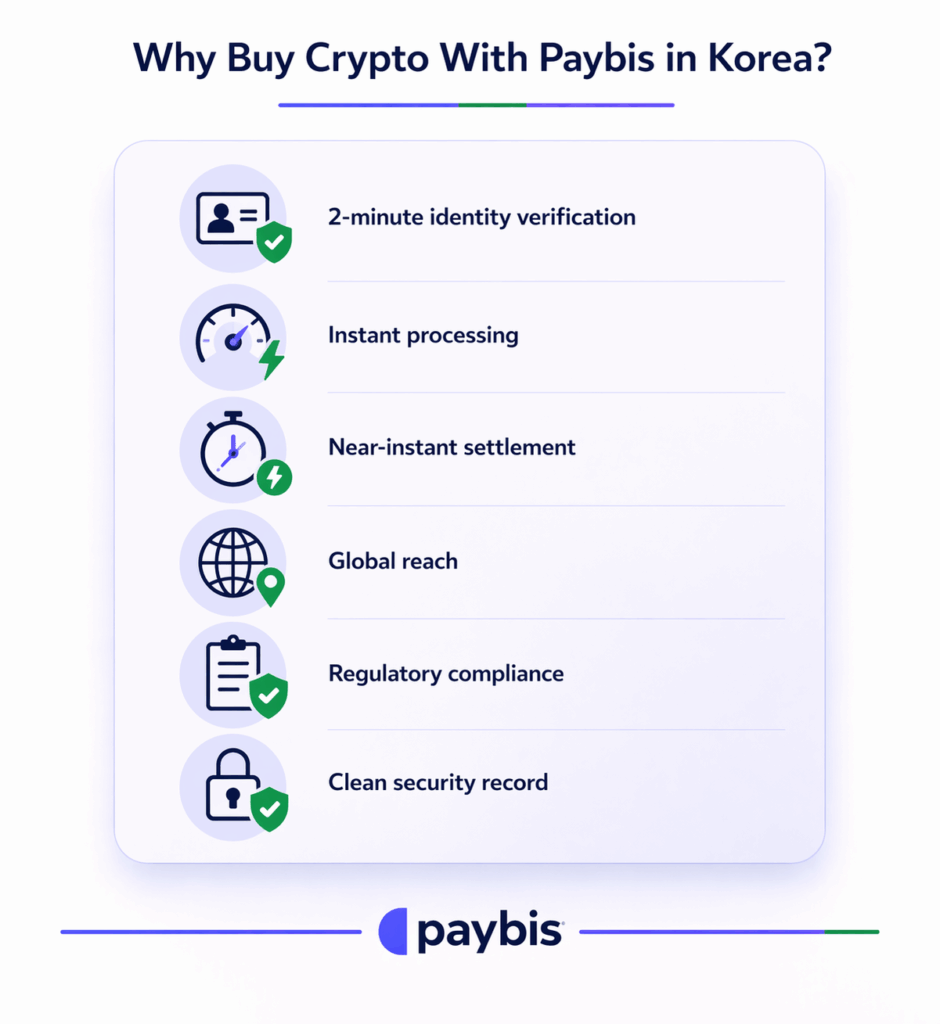
We accept international Visa and Mastercard, which means users need no Korean bank account, no ARC, and no local phone number. Here is what we offer:
- 2-minute identity verification: Upload a photo ID and take a selfie
- Instant processing: Under 1 minute to process transactions
- Near-instant settlement: Depends on the blockchain
- Global reach: 180+ countries, 5M+ retail users
- Regulatory compliance: FinCEN MSB registration (US entity 31000272911973) and FINTRAC registration in Canada
- Clean security record: No breaches or leaked customer data since 2014, confirmed by FXEmpire’s independent review
For anyone turned away by domestic exchanges, that timeline is the difference between owning Bitcoin today and waiting weeks to establish a local banking relationship. For context on how crypto on-ramps work and why they matter, see what is an on-ramp and why does your business need one.
Transparent Fees and Upfront Cost Calculation
We show every fee before users confirm payment. Zero hidden spreads, zero surprises at checkout. Here is what a $500 Bitcoin purchase with a credit card looks like on Paybis:
- Service Fee: $7.45 (1.49% after the first purchase; the first card transaction carries a 0% service fee)
- Processing Fee: $22.50 to $42.50 (4.5% to 8.5% for card transactions over $50, depending on currency)
- Network Fee: Approximately $0.70 to $3.00 (set by Bitcoin miners and fluctuates with blockchain congestion)
- Total charged to card: Approximately $530.70 to $552.95
The Service Fee and Processing Fee are set by Paybis. The Network Fee is determined by Bitcoin miners, not us, and changes with network demand.
“Fees and exchange rates are displayed transparently before confirmation, making it easy to understand exactly what you” – Joon Huh on Trustpilot
24/7 English Support
We provide 24/7 live chat with an average response time of approximately 15 seconds. This is a human agent, available in 9+ languages, who resolves a transaction issue or verification question in real time. The contrast with domestic Korean exchanges, where English-language support is limited and ticket resolution takes days, is direct.
“I found PayBis by accident and so glad I did. Their platform is so easy to use and straightforward. Their support team are extremely helpful and prompt in their replies and assistance.” – Jennifer on Trustpilot
The Paybis safety review video covers the platform’s security framework in plain terms:
For an independent third-party assessment, the FXEmpire Paybis Exchange Review is a useful starting point:Paybis has 30,705+ Trustpilot reviews with a rating of 4.1 out of 5 (“Excellent”) as of March 2026.
Comparing Fees, Security, and Features
The table below compares the top domestic Korean exchanges against Paybis on the criteria that matter most to international users.
| Platform | Trading Fee / Service Fee | Fiat Deposit Method | Foreigner Accessible |
|---|---|---|---|
| Upbit | 0.25% (fiat), 0.20% (crypto) | K-Bank real-name KRW account only | No (ARC + K-Bank required) |
| Bithumb | 0.15% base (up to 0.25%) | KB Kookmin Bank real-name KRW account only | No (ARC + KB Kookmin Bank required) |
| Coinone | 0.20% flat (tiered from 0.02%) | Korean bank real-name KRW account only | No (ARC + Korean bank required) |
| Paybis | Starts from 1.49% (0% first card transaction) | International Visa/Mastercard (20+ payment methods) | Yes (180+ countries, no Korean bank required) |
Security comparison:
- Upbit: ISO 27001 certified, 99% cold storage, mandatory 2FA, experienced a 2019 hack of 342,000 ETH attributed to North Korean actors
- Bithumb: Cold storage protocols, stable banking integration, VASP registered with FIU
- Coinone: Majority of funds in cold wallets, 2FA on all accounts, per BitcoinWiki
- Paybis: PCI DSS Level 1 compliant, 2FA available, no security breaches since 2014, FinCEN MSB registered, FINTRAC registered
For a deeper look at how different platforms compare on this front, the safest crypto exchanges security features and hack history breakdown is a useful reference. The Coin Bureau Paybis review from December 2024 confirmed the platform’s track record and accessibility for international users. For a consumer-level video breakdown, the MonetFin Paybis Pros and Cons review is a useful independent reference.
How to Buy Crypto in South Korea as an International User
Expats, tourists, and anyone in South Korea without a Korean bank account can follow this process. It takes under 10 minutes from start to finish.
- Go to Paybis.com and use the fee calculator. Enter the amount to spend. We show the exact Service Fee, Processing Fee, and Network Fee before collecting any personal information. Supported payment methods include Visa and Mastercard.
- Create an account and verify identity in 2 minutes. Upload a government-issued photo ID (passport or national ID card) and take a selfie. No Korean phone number, ARC, or local bank account is required.
- Select the crypto and confirm the amount. Paybis supports 80+ cryptocurrencies, including Bitcoin, Ethereum, and USDT. We display the full fee breakdown on screen before users confirm.
- Confirm payment with Visa or Mastercard. Card issuers may prompt a 3D Secure (3DS) verification step on users’ phones. Once approved, processing is instant (under 1 minute).
- Receive crypto in the designated wallet. Settlement is near-instant, depending on the blockchain. Users can send to any external wallet address or use the Paybis custodial wallet for simplicity.
- What to do if a bank blocks the transaction: Some international card issuers automatically flag and decline crypto purchases as high-risk. Call the card issuer’s fraud prevention line before attempting the transaction again and ask them to approve crypto exchange purchases. If the issue continues, Paybis support responds via live chat in approximately 15 seconds and can suggest alternative payment methods.
For a visual walkthrough of the platform, Paybis’s official wallet and swap guide demonstrates the interface step by step. If you’re also wondering how often you can buy and sell Bitcoin on exchanges, Paybis places no arbitrary limits on transaction frequency beyond standard compliance checks.
South Korean Crypto Taxes and Future Outlook
South Korea’s National Assembly passed the 2026 Tax Reform Bill in late 2024. Starting in 2027, individuals who profit from crypto trading will pay income tax on those gains, with a rate of 22% (including local income taxes) applied to annual gains exceeding 2.5 million won.
The tax has faced multiple delays since its first proposal, but the 2024 enactment makes 2027 the current legal implementation date. Individual investors in South Korea should track their purchase history and transaction records carefully ahead of that deadline.
On market structure, the FSC is actively investigating fee practices at domestic exchanges, per Invezz’s June 2025 report. Consolidation around the five fully licensed exchanges will likely continue as compliance costs rise. For expats and international users, global platforms that accept international payment methods and operate under recognized MSB registrations remain the most practical path to crypto access in South Korea, regardless of how domestic regulations evolve. The broader picture of global crypto adoption trends and regional insights shows that demand for accessible, international on-ramps continues to grow across markets like South Korea’s.
Ready to buy crypto in South Korea without a Korean bank account? Use the Paybis fee calculator to see the exact upfront cost, then complete 2-minute identity verification and confirm payment with a Visa or Mastercard. Fees start from 1.49% (0% on the first card transaction), and the total appears before payment is confirmed.
Key Terminology
- Real-name account: A South Korean banking requirement where a crypto exchange account must be registered under the exact same legal name as the user’s verified bank account at the exchange’s partner bank. The system automatically rejects transfers from any other account.
- FSC (Financial Services Commission): The South Korean government agency responsible for financial policy and crypto exchange regulation. Domestic virtual asset service providers must obtain FSC/FIU approval to legally operate KRW trading.
- FIU (Financial Intelligence Unit): The body within the FSC that handles VASP registration and monitors exchanges for anti-money laundering compliance. Only five exchanges currently hold active FIU-approved real-name account agreements.
- Network fee: The cost Bitcoin miners charge to process and confirm a transaction on the blockchain. Bitcoin miners charge this separately from exchange service fees, and it fluctuates with blockchain congestion.
- KYC (identity verification): The process of confirming a user’s identity using a government-issued photo ID and a selfie. On Paybis, this takes approximately 2 minutes. On Korean domestic exchanges, the process also requires a linked real-name bank account and a local phone number.
- MSB (Money Services Business): A regulatory classification in the United States and Canada for companies that facilitate money transfers or currency exchange. We hold MSB registration with FinCEN in the US and FINTRAC in Canada, providing verifiable compliance credentials for international users.
FAQ
Can a foreigner use Upbit or Bithumb?
Only with a valid Alien Registration Card (ARC) and a real-name bank account at the exchange’s partner bank (K-Bank for Upbit, KB Kookmin Bank for Bithumb). Tourists and short-term visitors without an ARC cannot access these platforms.
What is the fastest way to buy Bitcoin in South Korea without a Korean bank account?
Using an international Visa or Mastercard on Paybis takes under 10 minutes, including a 2-minute identity verification step and instant processing (under 1 minute). No Korean phone number, resident registration number, or local bank account is required.
Are there hidden fees on South Korean domestic exchanges?
Domestic exchanges charge between 0.04% and 0.25% for spot trading, but crypto withdrawal fees vary per asset and are not always displayed before initiating a transaction. Some domestic exchanges reportedly offer free KRW withdrawals to partner banks, but set crypto withdrawal fees per asset and do not always display them prominently before transactions.
What is the 0.6% supervision fee and does it affect users directly?
The FSC imposed a 0.6% supervision fee on Korean exchanges’ operating revenues to fund regulatory oversight. Exchanges pay this fee, not users directly, but it adds to operating costs that exchanges must cover through their trading fee structures.
Does Paybis support USDT and stablecoins for users in South Korea?
Yes. Paybis supports 80+ cryptocurrencies, including USDT and USDC, which function as lower-volatility savings vehicles. Users can buy stablecoins with a Visa or Mastercard and send them to any external wallet address.
What happens if Paybis rejects a transaction?
We occasionally reject transactions for security and compliance reasons to protect users and maintain platform integrity. Contact Paybis support via live chat (approximately 15-second average response) to get an explanation and explore alternative payment methods.
Disclaimer: Don’t invest unless you’re prepared to lose all the money you invest. This is a high‑risk investment and you should not expect to be protected if something goes wrong. Take 2 mins to learn more at: https://go.payb.is/FCA-Info