How Crypto Cost Basis Works
- On a $500 card purchase, your cost basis is approximately $531.45 to $555.45 once service, processing, and network fees are added. That total, not the $500 sticker price, determines your taxable gain or loss when you sell, trade, or spend crypto.
- FIFO (First In, First Out) is commonly treated as the default approach when you do not specify another method, and specific identification strategies like HIFO may change your tax outcome. Apply whichever method you choose consistently.
- Missing records may be recoverable. You may be able to reconstruct basis using exchange statements, blockchain explorers, and historical price data if you document your method.
- Keep your basis records at least through the IRS limitation periods: 3 years in the standard case, 6 years if you omitted more than 25 percent of gross income (IRS Publication 583, Table 3). Store transaction histories, fee receipts, and pricing sources with your tax returns.
- Inherited crypto receives a step-up in basis to fair market value at the date of death, while gifted crypto carries over the donor’s original basis.
Crypto assets can increase or decrease in value. Paybis is a payment gateway, not an investment service. This content is for informational purposes only and does not constitute financial advice.
Quick Answer: Crypto cost basis generally refers to your total acquisition cost: the purchase price plus exchange fees plus network fees. As a simplified example, if you bought $500 of Bitcoin and paid $31.45 in total fees, your cost basis would be $531.45. If you then sold that Bitcoin for $800, your taxable gain would be $268.55 ($800 minus $531.45). The IRS generally treats sales, trades, and spending of crypto as taxable events, so accurate basis tracking can protect you from overpaying taxes or failing an audit.
For long-term holders, this is a record-keeping discipline. If you bought Bitcoin in 2020, moved it to a hardware wallet, and now need to report a sale, you must prove what you originally paid. IRS Publication 551 says you must keep accurate records of all items that affect the basis of property. Without records, you may be unable to substantiate your original cost, and unsubstantiated cost can make your reported gain hard to defend.
This guide defines cost basis, compares accounting methods with a worked example, and provides steps to reconstruct missing records for coins acquired years ago.
What Is Cost Basis in Digital Assets?
Cost basis represents your investment in a digital asset for tax purposes. According to IRS guidance on virtual currency, your basis is the amount you spent to acquire the virtual currency, including fees, commissions, and other acquisition costs in U.S. dollars.
When you dispose of crypto (sell, trade, or spend it), you subtract your cost basis from the proceeds. For example, if you bought 0.1 BTC for $3,000 including fees, and later sold it for $8,000, your taxable gain would be $5,000. If you cannot document that $3,000 basis, the full $8,000 could potentially be treated as gain.
Here’s what goes into that number.
What Makes Up Your Crypto Cost Basis?
Your total cost basis includes more than just the sticker price of the crypto. Your cost basis generally includes the purchase price and eligible acquisition-related fees.
Calculating Your Crypto Purchase Price
The purchase price is generally the fiat amount (dollars, euros, etc.) you spent to buy the crypto. For crypto-to-crypto trades, the fair market value of the crypto you surrendered, documented in U.S. dollars, is generally used.
Exchange Fees and Your Cost Basis
Exchange fees (service fees, processing fees, and commissions) generally increase your cost basis. According to the IRS virtual currency FAQ, fees, commissions, and other acquisition costs are included in your basis in the virtual currency.
When you buy Bitcoin on Paybis, the platform displays a transparent fee breakdown before you confirm the transaction. Fees include a service fee starting from 1.49% (the first card purchase of each cryptocurrency has 0% service fee), a processing fee of 4.5% to 8.5% for card transactions over $50 (depending on currency), and a network fee. Exchange and processing fees paid to acquire crypto are generally included in your cost basis. The treatment of network fees is less clear-cut in public guidance, so confirm the details with a tax professional.
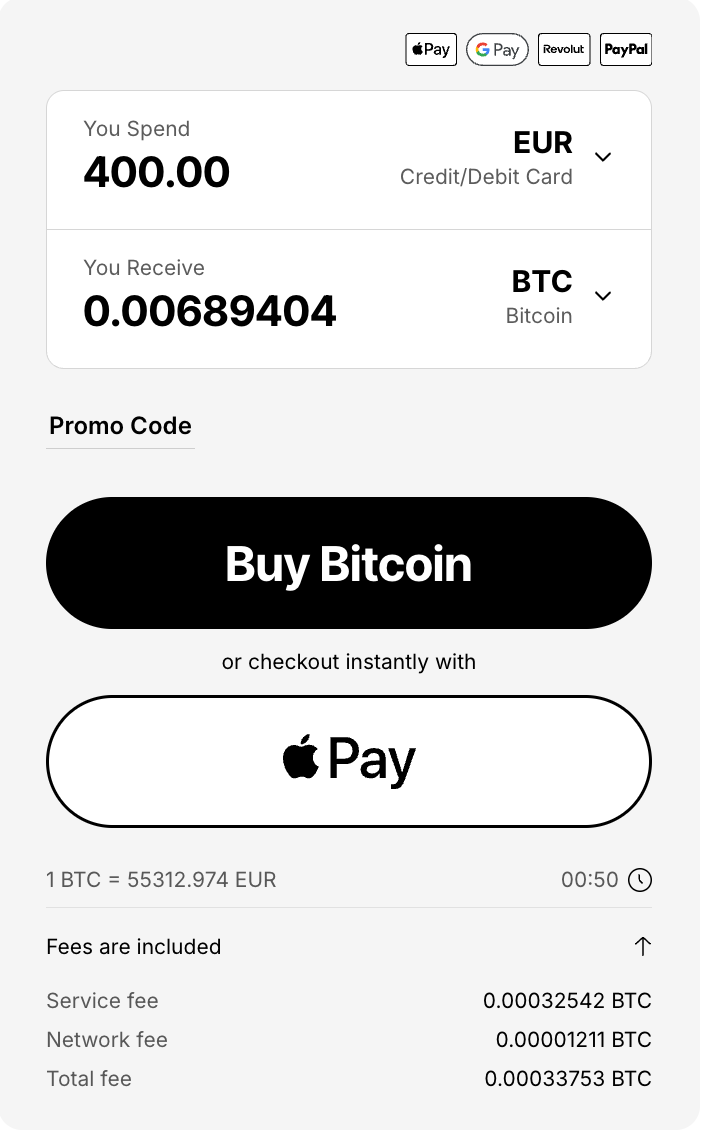
For example, a $500 purchase might include around $7.45 in service fees (0% on the first card purchase of each cryptocurrency, 1.49% thereafter), $22.50 to $42.50 in processing fees, and $1.50 to $5.00 in network fees. In that illustrative case, the total acquisition cost would be approximately $531.45 to $555.45, not $500.
Network Fees and Cost Basis
Network fees (also called gas fees) paid in direct connection with acquiring crypto may be added to your cost basis. However, fees incurred simply to transfer crypto between your own wallets (for example, paying a $5 network fee to move newly purchased Bitcoin from an exchange to your personal wallet) likely provide no tax benefit, because they are not incurred in direct connection with the acquisition or disposition of property. Per the IRS FAQ, transfers between your own wallets are non-taxable except for any crypto used to pay transaction fees (IRS Digital Asset FAQ, A81).
If you pay a network fee in Bitcoin to transfer Bitcoin you already own between your wallets, that fee may create a small taxable disposal. According to the IRS, transfers between your own wallets are generally non-taxable events, but the tax treatment is less clear-cut when you pay fees in crypto. For example, if you pay 0.0001 BTC as a network fee, you may need to report a disposal of that 0.0001 BTC, measured at its fair market value at the time of payment.
Which Accounting Method Should You Use for Crypto Cost Basis?
Choose one method before you file your first return and document that choice in writing. The method determines which specific coins you are selling when you dispose of part of your holdings. Document your chosen method and apply it consistently, and be prepared to identify each unit at the time of disposal, as described in the IRS digital asset FAQ.
How the FIFO Method Calculates Basis
The IRS defaults to FIFO (First In, First Out) unless you specify another method (IRS Digital Asset FAQ, A82). It assumes you sell your oldest coins first. If you bought 1 BTC in 2020 for $10,000 and another 1 BTC in 2023 for $40,000, a sale of 1 BTC in 2025 uses the $10,000 basis from 2020.
This method often results in higher gains during bull markets because it sells your cheapest (oldest) coins first, but it requires no special documentation beyond chronological records.
How LIFO Affects Your Tax Burden
LIFO (Last In, First Out) assumes you sell your newest coins first. In the example above, the most recent purchase was in 2023, so LIFO would assign the $40,000 basis from that 2023 purchase, resulting in a lower gain.
What the IRS Says About Specific Identification and LIFO
The IRS does not mandate specific identification. If you do not identify specific units of virtual currency, the IRS treats them as sold on a first in, first out (FIFO) basis.
Specific identification is optional, and you can document a unit’s unique digital identifier (such as the purchase date and time, the purchase price, or any other identifier sufficient to identify the units). You can also keep records showing transaction details for all units held in a single account, wallet, or address.
FIFO and Specific Identification are among the most widely supported methods. The IRS FAQ recognizes two paths: identify specific units, or fall back on the FIFO default (IRS Digital Asset FAQ, A82 and Q86). LIFO and HIFO only work as lot-selection strategies inside specific identification, so they require the detailed records described there.
How HIFO Works for Crypto Taxes
HIFO (Highest In, First Out) selects the coins with the highest purchase price first, minimizing your taxable gain. This method requires meticulous record-keeping.
HIFO is a lot-selection strategy within Specific Identification. You should be prepared to document the date, time, and specific wallet or account for each unit at the time of disposal. If you cannot substantiate your selection with detailed records, you may be required to fall back to the FIFO default.
Comparing FIFO, LIFO, and HIFO
The table below compares FIFO, LIFO, and HIFO using a hypothetical sample portfolio. In this illustration, you purchased Bitcoin three times, then sold 0.3 BTC in March 2025 for $25,500.
| Acquisition | Date | Quantity | Price Per BTC | Cost Basis |
|---|---|---|---|---|
| Hypothetical Purchase 1 | January 2022 | 0.3 BTC | $40,000 | $12,000 |
| Hypothetical Purchase 2 | June 2023 | 0.3 BTC | $30,000 | $9,000 |
| Hypothetical Purchase 3 | November 2024 | 0.3 BTC | $80,000 | $24,000 |
The next table shows which lot each method selects for the 0.3 BTC sale. Each method subtracts the cost basis of that lot from the $25,500 sale price to get the taxable gain. LIFO and HIFO pick the same lot here because the newest purchase is also the most expensive one.
| Method | Lot Selected | Cost Basis | Taxable Gain | Tax Treatment |
|---|---|---|---|---|
| FIFO | January 2022 | $12,000 | $13,500 | Long-term (LTCG rates apply) |
| LIFO | November 2024 | $24,000 | $1,500 | Short-term* |
| HIFO | November 2024 | $24,000 | $1,500 | Short-term* |
*Note: The November 2024 lot was held only a few months, making the gain short-term and taxed as ordinary income. The prices and figures in this example are hypothetical and provided for illustration only. Consult your tax professional before choosing a method.
FIFO produced a $13,500 long-term gain, while HIFO and LIFO produced a $1,500 short-term gain, a $12,000 difference in taxable income.
How to Calculate Cost Basis for Crypto Transactions
To calculate cost basis, gather every acquisition record, add all fees to each purchase price, and match each disposal to a specific lot using your chosen method.
Step 1: Locating Your Crypto Purchase Data
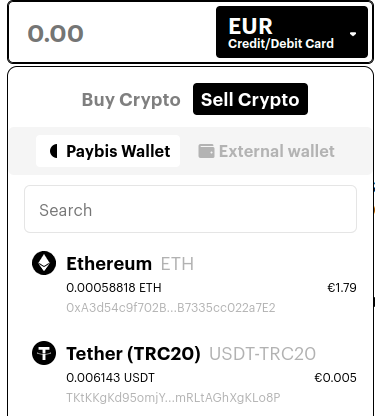
Gather every record of acquisition: exchange trade confirmations, bank statements, email receipts, and wallet transaction histories. If you used Paybis, collect your Paybis purchase confirmations and note the fiat amount spent, the crypto received, and the fees charged.
Step 2: Adding Exchange Fees to Basis
Review each transaction and add all fees to the purchase price. For example, if you bought $500 of Bitcoin with $31.45 in total fees (service, processing, and network), your basis is $531.45, not $500.
Step 3: Calculating Your Crypto Cost Basis
For each acquisition, use this formula:
- Cost Basis = Fiat Purchase Price + Exchange Fees + Network Fees
If you acquired crypto through a trade or swap, the fair market value of the crypto you surrendered is generally used as your purchase price, plus any fees paid to execute the swap.
Step 4: Mapping Costs to Each Exit
When you sell, trade, or spend crypto, match the disposal to a specific acquisition lot based on your chosen accounting method. Subtract the basis of the selected lot from your sale proceeds.
For partial sales, basis is generally allocated proportionally. For example, if you sell half of a lot with a $10,000 basis, you would use $5,000 as your basis for that sale.
How Do You Recover Lost Crypto Cost Basis Records?
If you cannot find your original purchase records, you can reconstruct basis using the best available evidence: exchange statements, bank records showing transfers to exchanges, email confirmations, blockchain timestamps, and third-party price data. Document your reconstruction method and apply it consistently.
Reconstructing Your Crypto Cost Basis
Begin with the date of acquisition, which you can often find in email confirmations or bank statements. You can use historical price data from reputable price aggregators (such as CoinMarketCap or CoinGecko) to estimate the fair market value on that date, and document the pricing source and timestamp.
For example, if your bank statement shows a $1,000 transfer to an exchange on June 15, 2021, and Bitcoin traded at $40,000 that day, your reconstructed basis is $1,000 for 0.025 BTC ($1,000 ÷ $40,000).
Locating Purchase Receipts in Your Inbox
Search your email for exchange confirmation messages containing exact purchase prices, quantities, and timestamps. Try keywords such as “purchase confirmation,” “receipt,” “order filled,” or the exchange name. Save these emails in a dedicated folder.
Auditing Wallet History With Explorers
Blockchain explorers such as Blockchair or Blockstream.info can help you view the transactions associated with your wallet address. Look for incoming transactions from exchanges. The timestamp indicates the acquisition date for cross-referencing with historical prices.
Downloading Historical Exchange Statements
Contact exchanges where you previously held accounts and request complete transaction histories. Many platforms provide CSV exports showing dates, amounts, prices, and fees. If the exchange has closed, check whether it provided a final transaction export before shutting down. You may also find publicly archived information that helps reconstruct historical records.
How to Backfill Missing Purchase Costs
When you cannot determine the exact purchase price, use the fair market value on the acquisition date as your estimated basis. Document the date, the pricing source used, and the calculation clearly.
Keep this documentation with your tax records. If the IRS questions your return, you will need to show how you arrived at each basis figure and why your method is reasonable.
How Does Cost Basis Work for Gifted Crypto and Transfers?
Special rules apply when you receive crypto as a gift or inheritance, or when you move crypto between your own wallets.
Determining Cost Basis for Gifted Crypto
When you receive crypto as a gift during the donor’s lifetime, you generally take over the donor’s original cost basis (carryover basis). Under IRC §1015, the recipient’s basis in a lifetime gift is the same as it would be in the hands of the donor (carryover basis).
If a donor bought Bitcoin for $5,000 and gifts it to a recipient when it is worth $30,000, the recipient’s basis remains $5,000 under the carryover basis rule. If the recipient later sells for $35,000, the taxable gain would be $30,000 ($35,000 minus $5,000), not $5,000.
One possible exception: if the fair market value at the time of the gift is less than the donor’s basis, and you later sell at a loss, your basis may be the fair market value on the date of the gift.
Cost Basis Rules for Wallet Transfers
Transferring crypto between wallets you own generally does not create a taxable event, and your basis does not change. However, if you pay a network fee in crypto to execute the transfer, that fee may be treated as a disposal.
For example, if you transfer 1 BTC from an exchange to a hardware wallet and pay 0.0001 BTC as a network fee, you have disposed of 0.0001 BTC. The disposal amount is based on the fair market value of that crypto at the time. If 1 BTC is worth approximately $30,000, that works out to a disposal of roughly $3 (0.0001 × $30,000).
Determining Tax Basis for Inherited Crypto
Inherited crypto receives a step-up in basis to the fair market value on the date of the decedent’s death. Under IRC §1014, as explained in IRS Publication 559, the basis of inherited property is generally its fair market value at the date of death.
If your parent bought Bitcoin for $10,000 and it was worth $50,000 when they passed away, your basis becomes $50,000. If you sell immediately for $50,000, you would generally owe no capital gains tax. If you sell later for $60,000, your taxable gain would generally be only $10,000.
Document the date of death and the fair market value using historical price data (for example, the closing price on that day or the average of high and low prices).
If you plan to leave crypto to heirs, document your cost basis now while you can still reconstruct it. Create a spreadsheet showing each acquisition date, amount, price, and basis, and store it with your estate documents. Your heirs will receive a step-up in basis to the fair market value on the date of death, but they still need to prove they inherited the crypto and determine that FMV. A clear record of your wallet addresses and acquisition history makes their tax filing straightforward.
Should You Use a Crypto Cost Basis Calculator?
Manual tracking works for a handful of transactions, but complex portfolios require automation.
When to Automate Crypto Cost Basis
Consider automated tools if you have purchased crypto more than a handful of times, used more than one exchange, or want to apply HIFO to minimize your taxable gain.
How Software Logs Your Cost Basis
Crypto tax software connects to your exchange accounts via API or imports CSV files. It can then match disposals to acquisitions using your chosen method and calculate gains, losses, and fees, generating Form 8949 and other required tax documents.
Many crypto tax tools flag transactions missing a price and let you enter it manually or backfill it from their historical price database.
Fixing Missing Cost Basis Data
When software flags missing data, you have three options: import the missing transaction history from the exchange or wallet, manually enter the fair market value on the transaction date, or use the software’s historical price database to backfill the value.
Always review the software’s work. Automated tools make assumptions about transfers and forks that may not match your situation. Verify that the basis assigned to each lot matches your records.
Collect your transaction records today. If you use other platforms, request complete statements from each exchange or wallet and store these files with your tax documents. Complete records let you prove every basis figure if the IRS asks.
Ready to Buy Crypto With Clear Fee Records?
Paybis is a crypto payment gateway that lets you buy crypto with a Visa card or other payment methods. Paybis operates in 180+ countries, supports 35 payment methods and 90+ cryptocurrencies, and is FinCEN-registered (MSB in the US) and PCI DSS Level 1 compliant. Support is available 24/7, and Paybis has had no security breaches since 2014. Trustpilot reviews rate Paybis 4.2 (“Great”) based on 33,505 reviews as of 17 November 2026.
Ready to buy Bitcoin? Create a Paybis account, complete identity verification, and confirm your total cost at checkout (fees start from 1.49%, and the first card purchase of each cryptocurrency has 0% service fee).
Key Terminology
- Cost Basis: The original value of an asset for tax purposes, usually the purchase price plus acquisition fees.
- FIFO: First In, First Out. An accounting method where the oldest coins are sold first. This is the IRS default method.
- HIFO: Highest In, First Out. A lot-selection method where the coins with the highest purchase price are sold first to minimize taxable gains.
- Specific Identification: A method allowing you to choose exactly which units of crypto you are selling, provided you have detailed records of each unit’s acquisition date and basis.
- Step-Up in Basis: An adjustment of the cost basis of an inherited asset to its fair market value on the date of the decedent’s death, reducing capital gains tax for heirs.
- Network Fee: The cost paid to miners or validators to process a transaction on the blockchain, also called gas fee.
- Carryover Basis: The recipient of a gift assumes the donor’s original cost basis rather than the current market value.
- Capital Gain: The difference between the sale price and the cost basis when the sale price is higher. Short-term gains (assets held one year or less) are taxed as ordinary income. Long-term gains (assets held more than one year) receive preferential tax rates (IRS Publication 544).
- Tax Lot: A specific acquisition of cryptocurrency with its own date, amount, and cost basis. Selling part of a lot requires allocating the basis proportionally.
- Blockchain Explorer: A web tool that allows you to view all transactions associated with a public wallet address, useful for reconstructing acquisition dates when exchange records are missing.
- Gas: A unit measuring the computational work required to execute transactions or smart contracts on networks like Ethereum. Gas fees vary based on network demand and transaction complexity.
FAQ
What Is Cost Basis in Crypto?
Cost basis is the total amount you paid to acquire cryptocurrency, including the purchase price, exchange fees, and network fees. You subtract this number from your sale proceeds to calculate taxable gain or loss.
How Do I Calculate Cost Basis for Crypto?
Add the fiat amount paid, exchange fees, and network fees for each purchase. For trades, use the fair market value of the crypto surrendered plus any fees.
What Is the Difference Between FIFO and HIFO?
FIFO (First In, First Out) sells your oldest coins first and is the IRS default method. HIFO (Highest In, First Out) sells your highest-priced coins first to minimize gains, but requires specific identification with detailed records.
What If I Have Missing Cost Basis Records?
Start with your email inbox and bank statements to find acquisition dates. Use blockchain explorers (Blockchair or Blockstream.info) to confirm wallet transactions, then apply historical prices from CoinMarketCap or CoinGecko to those dates. Document every source you use for audit defense.
Do I Pay Taxes When Transferring Crypto Between My Own Wallets?
No. Transfers between wallets you own are non-taxable. However, network fees paid in crypto during the transfer are treated as disposals and must be reported.
What Is the Cost Basis for Gifted Crypto?
For gifts received during the donor’s life, you generally take the donor’s original basis (carryover basis). For inherited crypto, your basis steps up to the fair market value on the date of death.
How Long Should I Keep Crypto Tax Records?
Keep your basis records at least through the IRS limitation periods: 3 years in the standard case, 6 years if you omitted more than 25 percent of gross income (IRS Publication 583, Table 3). Also keep basis documentation for at least 3 years after you file the return reporting the disposal.
Does Paybis Provide Cost Basis Reports?
Paybis is a payment gateway, not tax software, so it does not calculate cost basis for you. Use your Paybis purchase confirmations to record the amounts and fees paid, then apply your chosen accounting method.
Disclaimer: Don’t invest unless you’re prepared to lose all the money you invest. This is a high‑risk investment and you should not expect to be protected if something goes wrong. Take 2 mins to learn more at: https://go.payb.is/FCA-Info