Crypto Payment Trends by Coin and Country: Paybis Weekly Report
- Credit cards remain the leading payment method. On Paybis, credit cards accounted for 86.3% of cryptocurrency purchases across 20 selected markets during November 9–15, 2026.
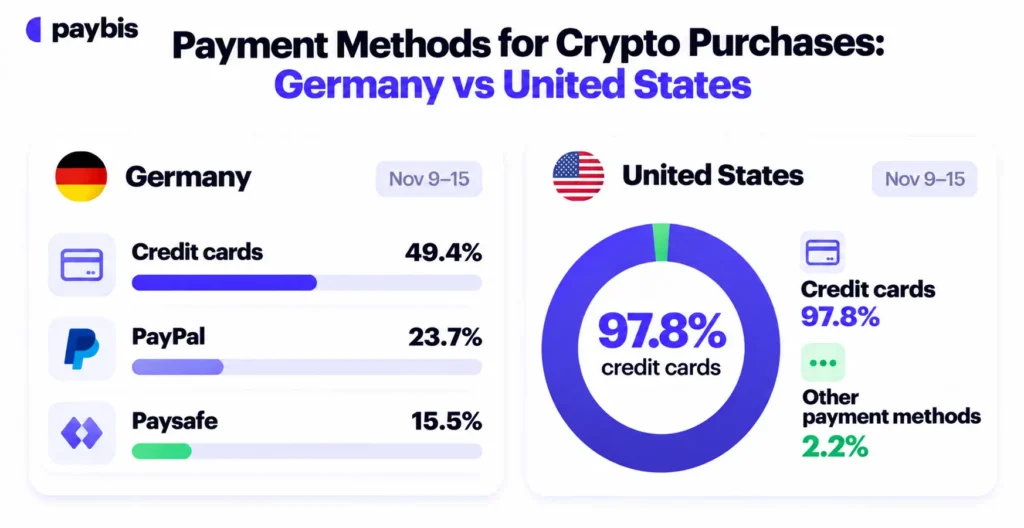
- European payment habits vary considerably. Credit cards represented 49.4% of German purchases, compared with 97.8% in the United States. PayPal accounted for 23.7% of purchases in Germany.
- Local payment methods are gaining visibility. BLIK handled 14.2% of Polish purchases, while iDEAL accounted for 16.9% in the Netherlands.
- Paybis recently expanded its payment options. The company introduced iDEAL | Wero, EPS and Multibanco on October 22, 2026.
- Litecoin purchases increased 6.5% week-on-week, while Bitcoin purchases declined 7.5%. Canada and the United States contributed much of Litecoin’s increase.
- Canada recorded an unusually concentrated Litecoin purchase mix. Litecoin represented 92.5% of Paybis purchases in the country, although broader Canadian research shows Bitcoin remains the dominant cryptocurrency holding.
How do people buy cryptocurrency in 2026?
On Paybis, credit cards accounted for 86.3% of cryptocurrency purchases across 20 selected markets during November 9–15, 2026.
PayPal ranked second with 5.2%, followed by Paysafe at 3.4% and Revolut at 2.9%. Together, these four payment-method categories represented 97.8% of purchases.
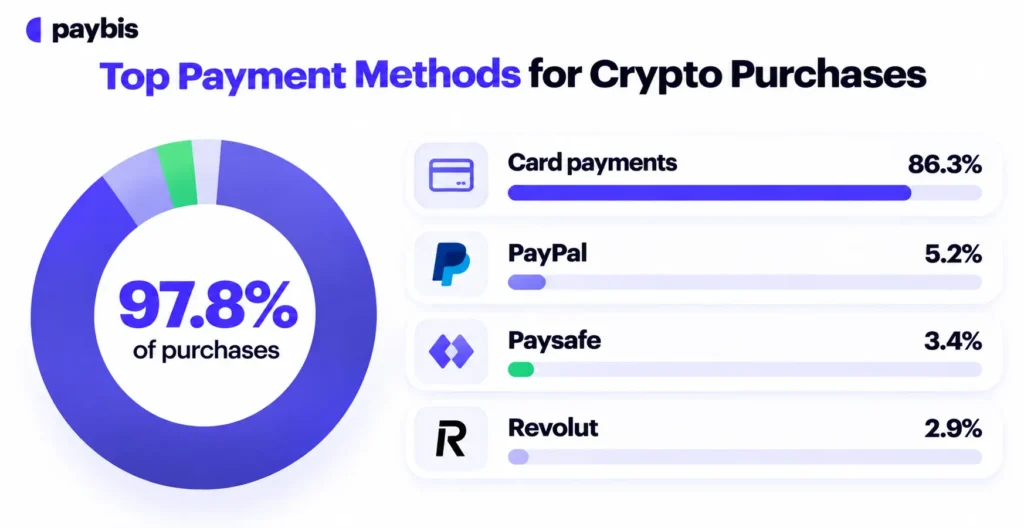
The overall distribution suggests that card-based payments remain central to the cryptocurrency buying experience on Paybis. However, the country-level findings reveal a more varied picture.
Most used crypto payment methods
| Payment method | Purchase share | Weekly change |
|---|---|---|
| Credit card | 86.3% | -5.5% |
| PayPal | 5.2% | -4.9% |
| Paysafe | 3.4% | -5.1% |
| Revolut | 2.9% | +2.4% |
| BLIK | 0.5% | +20.5% |
| Klarna | 0.3% | -1.1% |
| Mollie iDEAL | 0.3% | +20.0% |
| Bank | 0.3% | +9.8% |
| Mollie Swish | 0.3% | -24.1% |
Source: Paybis internal transaction data, November 9–15, 2026. Weekly changes compare purchase counts with November 2–8.
Credit cards recorded a 5.5% decline in purchase count during the latest week. PayPal and Paysafe also declined, while Revolut increased 2.4%.
BLIK recorded a larger percentage increase of 20.5%, although its share across all reporting markets remained small.
The contrast becomes more meaningful when examining individual countries.
Has credit card usage changed over the past 13 weeks?
Credit cards accounted for 88.52% of purchases in the week beginning August 17.
By November 9, their share had fallen to 86.30%.
The difference amounts to 2.22 percentage points.
Credit card share declined during the first five weeks of the period. It then fluctuated within a narrower range.
Across all 13 weeks, credit cards accounted for 86.88% of purchases.
The latest reading was 0.58 percentage points below that baseline.
Why do crypto payment methods differ between countries?
People tend to use payment methods they already know. In Poland, that might be BLIK. In the Netherlands, it’s often iDEAL. German customers are also accustomed to having several ways to pay online.
These habits help explain some of the differences in Paybis transaction data. The payment methods available on Paybis in each country also affect the results.
Crypto payment methods across selected markets
| Country | Credit card share | PayPal share | Other notable method |
|---|---|---|---|
| United States | 97.8% | 1.9% | Revolut |
| Canada | 100.0% | 0.0% | None recorded |
| Germany | 49.4% | 23.7% | Paysafe: 15.5% |
| France | 75.1% | 7.7% | Paysafe: 9.4% |
| Poland | 58.6% | 2.9% | BLIK: 14.2% |
| Italy | 84.8% | 9.8% | Revolut |
| Hungary | 77.8% | 0.0% | Revolut: 18.2% |
| United Kingdom | 68.4% | 15.3% | Revolut: 15.2% |
| Sweden | 50.0% | 25.9% | Swish: 11.5% |
| Netherlands | 56.9% | 8.7% | iDEAL: 16.9% |
Source: Paybis internal transaction data, November 9–15, 2026.
Germany: Almost half of crypto purchases use methods other than credit cards
On Paybis, credit cards accounted for 49.4% of German cryptocurrency purchases during November 9–15. PayPal handled 23.7%, while Paysafe accounted for 15.5%.
Compare that with the US, where 97.8% of purchases used credit cards.
The difference is visible even when customers buy the same cryptocurrency. Solana was the most frequently purchased crypto in Germany during the reporting week. Among those purchases, 47.2% used credit cards, 26.9% used PayPal and 15.2% used Paysafe.
German customers have several established ways to pay online, and Paybis supports multiple options in the market. That gives customers more choice at checkout.
It also helps explain why Germany’s payment mix looks so different from the US.
Poland: BLIK is a small payment method globally, but a major one locally
BLIK accounted for just 0.5% of Paybis purchases across the 20 markets. In Poland, its share reached 14.2%.
That difference makes sense when we consider how widely BLIK is used in the country.
According to the National Bank of Poland, online payments accounted for 46.2% of BLIK transactions in the second quarter of 2025.
Polish consumers already use BLIK for everyday online purchases, so using it to buy cryptocurrency may feel familiar.
On Paybis, BLIK purchases increased 20.5% during November 9–15 compared with the previous week. Solana was the most frequently purchased cryptocurrency through BLIK, followed by USDC.
The increase came from a relatively small number of transactions, but BLIK’s 14.2% share in Poland shows why global rankings alone can be misleading.
Netherlands: iDEAL reaches 16.9% less than a month after launch
On Paybis, iDEAL accounted for 16.9% of cryptocurrency purchases in the Netherlands during November 9–15.
Paybis introduced iDEAL | Wero on October 22, alongside EPS for Austria and Multibanco for Portugal.
The timing is worth paying attention to.
According to De Nederlandsche Bank, iDEAL accounted for 72% of online purchases in the Netherlands in 2024.
Dutch customers were already familiar with iDEAL long before Paybis introduced it. They can now use the same payment method to buy cryptocurrency.
Its 16.9% share less than a month after launch suggests that some customers have started using the new option. However, the data doesn’t tell us whether they switched from credit cards or would otherwise have made no purchase.
We have also published a step-by-step guide to buying crypto with iDEAL following the launch.
Paybis recently introduced more local payment methods. What changed?
On October 22, 2026, Paybis announced three new payment options: iDEAL | Wero in the Netherlands, EPS in Austria and Multibanco in Portugal.
The company also announced plans to add 13 more local payment methods, bringing its total number of supported options above 30.
The Netherlands gives us an early look at what happens after one of these launches.
Less than a month after iDEAL became available, it accounted for 16.9% of Dutch crypto purchases on Paybis.
That’s a meaningful share for a newly introduced payment method, especially in a country where iDEAL is already part of everyday online shopping.
As these payment methods become established on Paybis, their usage will be easier to compare over several months.
Which cryptocurrencies are people buying most often?
Bitcoin remained the most purchased cryptocurrency on Paybis during November 9–15, accounting for 40.6% of purchases across the 20 markets.
Litecoin ranked second with 19.1%, followed by Solana at 13.7% and Ethereum at 9.5%.
Source: Paybis internal transaction data, November 9–15, 2026.
Litecoin was one of the few major cryptocurrencies to record an increase in purchases during the week.
On Paybis, Litecoin purchases rose 6.5%, while Bitcoin purchases fell 7.5%. Overall purchase activity across the selected markets declined 5.0%.
Much of Litecoin’s increase came from Canada and the US.
Canadian Litecoin purchases made using credit cards rose 6.7% from the previous week. In the US, the same combination increased 33.9%.
The Canadian numbers are especially unusual when we look at Litecoin’s share of all purchases in the country.
Why does Litecoin dominate Paybis crypto purchases in Canada?
On Paybis, Litecoin accounted for 92.5% of cryptocurrency purchases in Canada during November 9–15. Bitcoin represented 4.7%, while Solana accounted for 1.9%.
At first glance, the result might suggest that Canadian customers prefer Litecoin over Bitcoin. But broader research tells a different story.
A Bank of Canada study published in March 2025 found that Bitcoin remained the dominant cryptocurrency holding among Canadians surveyed in 2023.
An Ontario Securities Commission survey also found that Bitcoin and Ethereum were more widely owned than Litecoin among surveyed crypto holders.
So why is Litecoin so prominent on Paybis?
One possible reason is how frequently customers buy it.
A customer who purchases Litecoin several times a week contributes more transactions than someone who buys Bitcoin once a month. A relatively small group of frequent buyers can therefore have a large effect on the purchase ranking.
Search traffic may also play a role.
Someone searching Google for a way to buy Litecoin might find Paybis through a Litecoin-specific page. If Paybis attracts a particularly high share of these visitors in Canada, its customer mix could look very different from the wider market.
Litecoin’s technical features may also appeal to frequent users. Its network typically confirms blocks faster than Bitcoin, and transaction fees are generally low. That can make it attractive for people who regularly move cryptocurrency between wallets.
What we can say is that Litecoin accounts for an unusually large share of purchases on Paybis in Canada, while broader ownership research continues to show Bitcoin ahead.
Are credit cards becoming less popular for buying crypto?
On Paybis, credit card share fell from 88.5% in the week of August 17–23 to 86.3% during November 9–15.
Across the full 13-week period, credit cards accounted for 86.9% of purchases.
| Reporting period | Credit card share |
|---|---|
| Aug 17–23 | 88.5% |
| Sep 14–20 | 86.1% |
| Oct 19–25 | 86.9% |
| Nov 2–8 | 86.8% |
| Nov 9–15 | 86.3% |
| 13-week aggregate | 86.9% |
The biggest change happened earlier in the reporting period. Since September, credit card share has stayed within a relatively narrow range.
So far, there’s little evidence of customers moving away from cards on a large scale.
But local payment methods are worth watching.
Paybis introduced iDEAL in October, and it already accounts for 16.9% of Dutch purchases. BLIK also has a meaningful share in Poland.
These country-level changes may become more interesting than small movements in the overall credit card share.
Methodology
- Data source: Paybis internal transaction data.
- Reporting period: November 9–15, 2026.
- Historical comparison: August 17 to November 15, 2026, covering 13 complete weeks.
- Included transactions: Successful business-to-consumer cryptocurrency purchases. Each purchase is counted once using its transaction identifier.
- Countries covered: The research uses a fixed group of 20 markets: United States, Canada, Germany, France, United Kingdom, Italy, Spain, Poland, Hungary, Netherlands, Norway, Sweden, Australia, Israel, Lithuania, Latvia, Switzerland, Romania, Austria and Belgium.
- The same countries are used throughout the 13-week comparison. The available dataset doesn’t document why these particular markets were originally selected, so they shouldn’t be presented as the world’s largest crypto markets.
- Payment methods: The report uses the payment-method labels recorded in Paybis transaction data. credit_card and bank are internal categories. The export doesn’t specify whether credit_card includes debit cards or wallet-funded card payments, or exactly which transfer types fall under bank.
- Purchase share: The percentage of successful purchases made using a particular payment method or for a particular cryptocurrency.
- Weekly change: The percentage change in purchase count compared with the previous complete week.
- Historical baseline: The purchase-weighted share across the full 13-week reporting period.
- Unique buyers: Buyer counts are calculated separately for each country, cryptocurrency and payment-method combination. One customer may appear in multiple groups.
- Limitations: The findings describe purchases made on Paybis. They may be influenced by which payment methods are available, how customers find the platform and how often individual customers buy cryptocurrency.
What can we learn from these findings?
Credit cards still handle the vast majority of cryptocurrency purchases on Paybis. Their share has remained close to 86% to 87% since September.
The more interesting differences appear when we look at individual countries.
In Germany, PayPal handles almost one-quarter of purchases. In Poland, BLIK accounts for more than one in seven. Dutch customers have also started using iDEAL since Paybis introduced it in October.
Canada presents a different story. Litecoin accounts for more than nine in ten Paybis purchases there, even though Bitcoin remains more widely owned according to broader Canadian research.
These differences are worth following over time. A longer history will show whether they remain consistent or change as Paybis adds more payment options.
Disclaimer: Don’t invest unless you’re prepared to lose all the money you invest. This is a high‑risk investment and you should not expect to be protected if something goes wrong. Take 2 mins to learn more at: https://go.payb.is/FCA-Info