Why the Crypto Wallet You Store in Matters More than Where You Got Your Crypto
- Where you store crypto affects how it’s treated by banks, exchanges, and payment providers.
- Blockchain analytics tools read the transaction history of funds, and that history follows your crypto wherever it goes.
- A regulated wallet with deposit screening gives you a verifiable record of your holdings and reduces friction down the line.
- Platform wallets and external wallets work well together. Many experienced users rely on both.
- Practical features like fast settlement, QR transfers, and customer support make a wallet genuinely useful, not just a place to park crypto.
Most people spend a lot of time thinking about where to get crypto. The platform, the fees, the rate. What gets far less attention is where that crypto lives afterward. And it turns out, that choice matters quite a bit more than most people expect.
A wallet is not just a place to park crypto
Think of a crypto wallet the way you’d think of a bank account. You wouldn’t open one without knowing something about the institution behind it. Who runs it, how it’s regulated, what happens if something goes wrong. The same logic applies to crypto wallets. Paybis has 31,000 Trustpilot reviews from people who made exactly that call.
Where your crypto is stored affects how it’s treated when you want to move it, spend it, or convert it. Your wallet is part of your financial history in crypto. It’s not passive, and the choice of where to store isn’t trivial.
How blockchain analytics works, in plain language
Every crypto transaction leaves a trail on the blockchain. That trail is public, permanent, and readable by anyone with the right tools. Blockchain analytics is the process of reading those trails to understand where funds have been and whether they’ve had any contact with high-risk activity.
Financial institutions, exchanges, and regulated platforms use blockchain analytics tools to assess incoming funds. When crypto arrives at a wallet or an exchange, these tools check its history. Funds that have passed through wallets linked to fraud, sanctions, or other flagged activity carry what’s known as risk exposure, even if the current holder had nothing to do with it.
This is not theoretical. Banks increasingly use these tools when customers deposit or transfer crypto. Exchanges run these checks when processing withdrawals or conversions. The history attached to your crypto can quietly affect what you’re able to do with it later, and with which institutions.
Why your choice of wallet is part of this
A regulated crypto wallet that screens deposits through blockchain analytics gives you a layer of protection that most wallets simply don’t offer. When every incoming deposit is checked before it lands, you have a reasonable degree of confidence in what you’re holding and where it came from.
That confidence has practical value. It reduces the chance of running into friction when you later want to move funds to an exchange, convert to fiat, or prove the provenance of your holdings for tax or compliance purposes. The wallet you use is part of your crypto track record, whether you think of it that way or not.
What a good crypto wallet actually looks like
Regulation matters first. A wallet backed by a regulated, KYC-verified platform operates within a legal framework that gives you real recourse if something goes wrong. It also means your holdings are on record, which is increasingly useful for tax reporting and compliance.
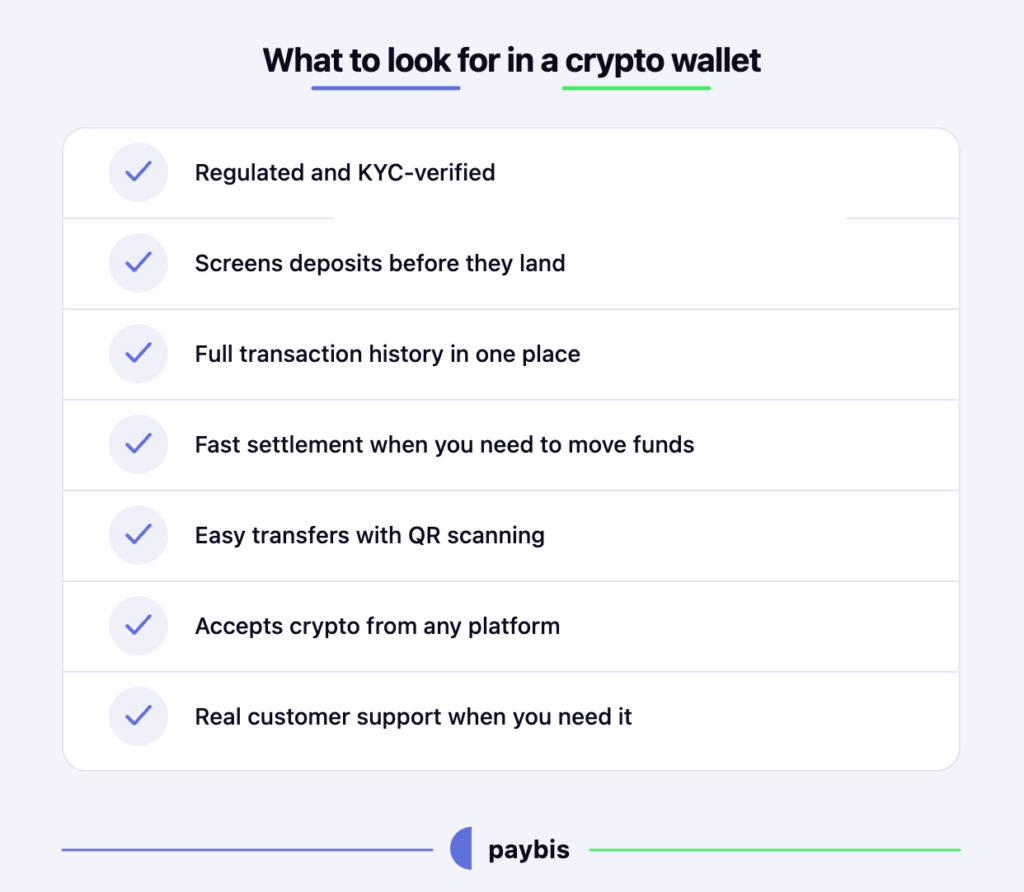
The Paybis wallet was built around exactly this list. It accepts crypto from any platform, so you can consolidate holdings from multiple exchanges into one place. Every deposit is screened through blockchain analytics before it lands. Settlement is fast, transfers are straightforward, and your full transaction history is always visible in one dashboard.
Most wallets stop there. Paybis doesn’t. Because the wallet sits on top of our exchange infrastructure, you can cash out directly to Revolut, PayPal, or Apple Pay without switching platforms or going through KYC again. For anyone sending money across borders, that matters even more: the recipient can convert to local fiat inside the same app, with no extra steps on their end.
For anyone newer to crypto, there is nothing to configure. The wallet is ready from the moment you sign up, with customer support available whenever you need it. For more experienced users, it doubles as a regulated custody layer that holds up for tax reporting and compliance purposes.
You don’t have to choose between convenience and control
Using a platform wallet and an external wallet are not mutually exclusive. A lot of experienced crypto users do both. They keep some holdings in a self-custody wallet for full control, and use a platform wallet for the practical side of crypto life: transfers, conversions, and day-to-day access.
Nearly a quarter of Paybis users move between their Paybis wallet and an external wallet depending on what they need. Long-term holdings in cold storage, everyday crypto in Paybis. Both options stay open, and neither one cancels out the other.
Final Thoughts
Getting crypto is just the first step. Where you store it shapes how useful it is and how smoothly it moves through the financial system. A regulated wallet with deposit screening, clear transaction history, and real customer support is worth thinking about, especially as crypto becomes a more normal part of how people manage money.
The good news is that finding a wallet that does all of this doesn’t have to be complicated. It just has to be deliberate.
FAQ
What is blockchain analytics and why does it matter for my wallet?
Blockchain analytics is the process of reading the transaction history attached to crypto funds. Every transaction on a blockchain is public and traceable. Regulated platforms and financial institutions use analytics tools to assess whether incoming funds have any exposure to high-risk activity. If they do, it can affect how those funds are treated, regardless of how you came to hold them. A wallet that screens deposits through blockchain analytics helps protect you from inheriting someone else’s problem.
Can I use a Paybis wallet alongside my existing external wallet?
Yes. Many users do exactly this. You can store some holdings in your Paybis wallet and continue using an external wallet for self-custody. The two work independently, and you can switch between them whenever it suits you.
Can I transfer crypto I hold on other platforms into my Paybis wallet?
Yes. Your Paybis wallet accepts crypto from any source, not just crypto obtained through Paybis. You can consolidate holdings from multiple platforms into one place.
Is Paybis wallet suitable for someone new to crypto?
It is designed to be. There is no separate setup required and no technical knowledge needed to get started. Everything is visible in one dashboard, and customer support is available if anything is unclear.
Why does it matter that a wallet is regulated?
A regulated wallet operates within a legal framework that provides recourse if something goes wrong. It also means your holdings are on record, which matters for tax reporting, compliance, and proving provenance if you’re ever asked to account for your crypto.
Disclaimer: Don’t invest unless you’re prepared to lose all the money you invest. This is a high‑risk investment and you should not expect to be protected if something goes wrong. Take 2 mins to learn more at: https://go.payb.is/FCA-Info