Fastest Crypto Transaction Speed in 2026: Which Blockchain Actually Wins?
- Solana has the fastest real-world transaction speed of any major blockchain: 2,000-4,000 TPS in practice, with finality dropping to 100-150 milliseconds after the Alpenglow upgrade in 2026.
- XRP is the fastest for consistent, institutional-grade settlement: 1,500 TPS with a reliable 3-5 second finality on every transaction.
- Bitcoin processes 3-7 transactions per second. A confirmed transaction can take 10 to 60 minutes. It is the slowest major blockchain by both metrics.
- TPS and finality are different things. A blockchain with high TPS can still have slow finality. What you actually experience as a user is finality, not throughput.
- Ethereum L1 handles 15-30 TPS, but its Layer 2 networks process thousands of TPS with finality measured in seconds.
- You can buy Solana, buy XRP, and buy Ethereum on Paybis with fees shown before you confirm.
Speed in crypto does not mean what most people assume it means. When someone asks which crypto has the fastest transaction speed, they usually want to know how quickly their transaction will settle. The answer to that question is completely different from the answer to “which blockchain has the highest TPS.”
Transactions per second measures capacity. Finality measures how long until a transaction is truly irreversible. Both matter, but they measure different things, and the blockchain that wins on one does not always win on the other.
This article covers both, with real-world numbers for every major blockchain.
What Does Crypto Transaction Speed Actually Mean?
Two distinct metrics define blockchain speed: TPS and finality. Most comparisons only show TPS. Finality is what you actually experience.
- TPS (Transactions Per Second) measures raw throughput: how many transactions the network can process in a given second. A high TPS number means the network can handle a large volume of activity. It does not tell you how quickly any individual transaction settles.
- Finality is how long until a transaction is considered permanent and irreversible. This is what users actually experience. A blockchain could theoretically process 10,000 TPS but have a finality time of five minutes, meaning your transaction sits in a pending state for five minutes before it cannot be reversed.
- Theoretical vs real-world TPS is the third distinction worth knowing. Theoretical figures represent what a blockchain can do under perfect lab conditions. Real-world figures reflect what actually happens on a live network. The two numbers can differ by orders of magnitude.
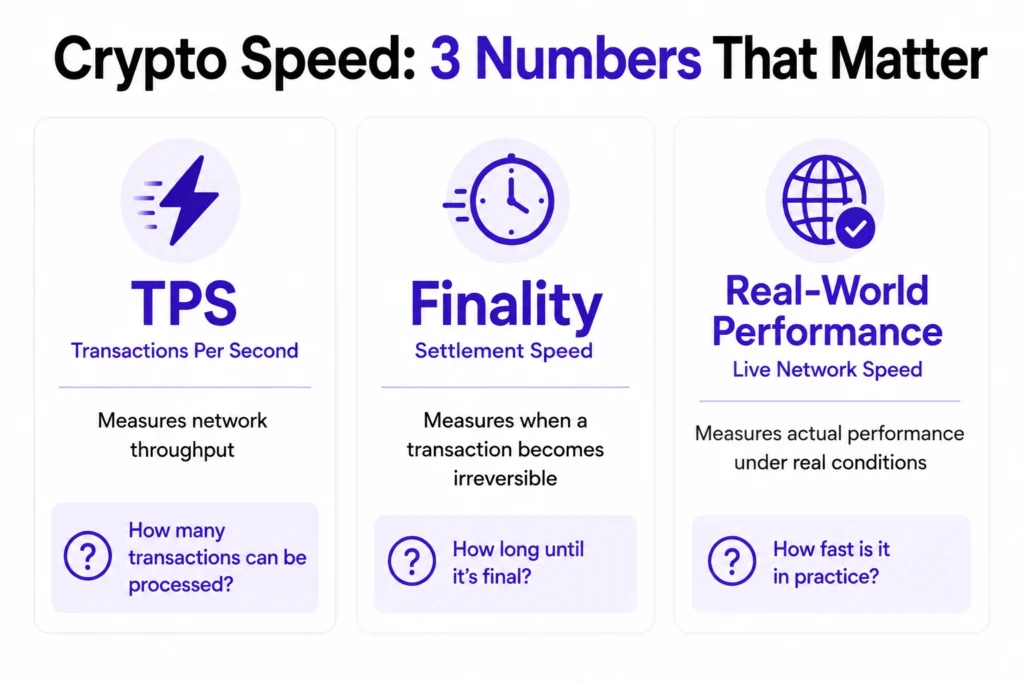
The number that matters for everyday use: real-world finality. How long before you can trust the transaction is done.
Which Crypto Has the Fastest Transaction Speed in 2026?
Here is the full comparison, using real-world figures rather than theoretical maximums:
| Blockchain | Real-World TPS | Theoretical TPS | Finality | Avg Fee |
|---|---|---|---|---|
| Solana | 2,000–4,000 | 65,000+ | 100–150ms (Alpenglow) | $0.00025 |
| XRP | 1,000–1,500 | 1,500 | 3–5 seconds | $0.0002 |
| Hedera | ~10,000 | 10,000 | 3–5 seconds | Very low |
| Avalanche | ~4,500 | 5,000 | <1 second | ~$0.001 |
| Ethereum L2s | Thousands | Variable | Seconds | <$0.05 |
| Stellar | ~1,000 | 1,000 | 2–5 seconds | Very low |
| Cardano | 250–1,000 | 1,000 | 20–60 seconds | Low |
| Ethereum L1 | 15–30 | 100 | Minutes | Variable |
| Bitcoin | 3–7 | 7 | 10–60 minutes | Variable |
For context: Visa processes approximately 1,700 transactions per second. Solana already handles more than that at its sustained rate. Firedancer, Solana’s new validator client released in December 2025, demonstrated over 600,000 TPS in controlled testing with a theoretical ceiling approaching 1 million TPS.
What Is Solana’s Transaction Speed in 2026?
Solana is the fastest major blockchain in 2026 on both throughput and finality. The Alpenglow upgrade cut finality to 100-150 milliseconds, the time it takes a human to blink.
Key numbers:
- Real-world TPS: 2,000-4,000
- Theoretical TPS: 65,000+
- Firedancer tested TPS: 600,000+
- Finality: 100-150ms (post-Alpenglow)
- Average transaction fee: $0.00025
The technical foundation is a combination of Proof of History and Proof of Stake. Proof of History creates a cryptographic clock that timestamps transactions before they reach consensus, removing the coordination overhead that slows other networks. The result is parallel transaction processing at a scale no other major Layer 1 blockchain achieves.
Two practical caveats worth knowing:
- Solana’s performance requires validator hardware that is considerably more powerful and expensive than other networks, which affects decentralization.
- Solana experienced a significant outage in February 2024 lasting approximately five hours. The Firedancer validator client, which provides a second independent software implementation, was designed specifically to prevent a single bug from taking down the entire chain.
You can buy Solana on Paybis with fees shown before you confirm.
What Is XRP’s Transaction Speed?
XRP processes 1,000-1,500 TPS and settles every transaction in 3-5 seconds, consistently. That predictability is its defining advantage over faster but less stable networks.
Key numbers:
- Real-world TPS: 1,000-1,500
- Finality: 3-5 seconds (every time)
- Average transaction fee: $0.0002
- Consensus: Ripple Protocol Consensus Algorithm (trusted validators)
The XRP Ledger uses a curated set of trusted validator nodes rather than competitive mining or open staking. This design allows it to confirm transactions in 3-5 seconds without the energy overhead of proof-of-work systems. Each transaction costs approximately $0.0002. That puts it among the cheapest settlement networks available.
That combination of speed, low cost, and reliability is why financial institutions use XRP for cross-border settlement. Banks and payment providers route international transfers through the XRP Ledger as a bridge currency, settling in seconds rather than the one to three business days that traditional correspondent banking requires.
The architectural trade-off is flexibility. XRP does not support smart contracts in the same way Solana and Ethereum do, which limits its use cases to payment and settlement rather than general-purpose decentralized applications.
Buy XRP on Paybis with 22 payment methods including SEPA, card, Apple Pay, and Klarna.
How Fast Is Ethereum in 2026?
Ethereum’s speed depends entirely on which layer you are using. L1 is slow and can be expensive. L2 networks are fast and cheap. Most activity has migrated to L2.
Ethereum L1:
- Real-world TPS: 15-30
- Finality: several minutes
- Fees: variable, can spike during congestion
Ethereum Layer 2 (Arbitrum, Base, Optimism):
- TPS: thousands
- Finality: seconds (for practical purposes)
- Fees: often under $0.05
The 2026 Pectra and Fusaka upgrades have further reduced L2 transaction costs and expanded the amount of data each block can settle back to L1. Sending ETH directly on L1 is slow and expensive during congestion. Using an L2 application is fast and cheap. The choice of layer determines the entire speed and cost experience.
Buy Ethereum on Paybis and transfer to the network of your choice.
How Fast Is Bitcoin?
Bitcoin is the slowest major blockchain by both TPS and finality. It was designed that way. Speed was never the goal.
Key numbers:
- Real-world TPS: 3-7
- Confirmations required: 6 blocks
- Finality: 10-60 minutes
- Lightning Network: near-instant (off-chain)
The proof-of-work mechanism, where miners compete to solve computational puzzles to add each block, is what makes Bitcoin extraordinarily resistant to attack. The same mechanism is what makes it slow. Higher fees push transactions to the front of the queue during congested periods. Very low fees can leave a transaction waiting for hours.
The Lightning Network is Bitcoin’s Layer 2 answer. It enables payment channels that settle instantly between participants, with final on-chain settlement only when a channel closes. Fast and cheap, but requires both parties to have open channels and is not suited to all scenarios.
For simple transfers, the 10-60 minute timeline is the practical reality on L1.
Buy Bitcoin on Paybis with a card, SEPA, Apple Pay, and 19 other payment methods.
How Do Other Blockchains Compare on Speed?
Beyond the four major networks above, several other blockchains are worth knowing for their speed characteristics.
- Hedera sustains approximately 10,000 TPS in real conditions using its Hashgraph consensus mechanism, which processes transactions in parallel through a directed acyclic graph structure rather than sequential blocks. Finality takes 3-5 seconds. Hedera is less widely known than Solana or XRP but consistently appears at the top of TPS rankings.
- Avalanche sustains around 4,500 TPS with finality under one second on its primary subnet. Its architecture splits activity across three distinct chains (X-Chain, C-Chain, and P-Chain), each optimized for different purposes.
- Stellar processes around 1,000 TPS with finality in 2-5 seconds. Like XRP, Stellar was designed specifically for payments and cross-border transfers at low cost. Its native asset is XLM.
- Cardano processes 250-1,000 TPS depending on network conditions, with finality taking longer than the faster blockchains due to its conservative Ouroboros consensus design. Hydra, its Layer 2 scaling solution, is designed to push this significantly higher.
Which Crypto Is the Fastest to Send Right Now?
For the fastest possible settlement from the moment you send to the moment the recipient can spend, Solana is the answer. With Alpenglow in place, finality is 100-150 milliseconds. By the time you have confirmed the transaction was sent, it is already settled.
For the most consistent, reliable fast settlement in a payment context, XRP is the answer. 3-5 seconds, every single time, without exception. Institutions building payment infrastructure on XRP know exactly what they are getting.
For sending between Ethereum wallets cheaply and quickly, an L2 network beats L1 by a wide margin on both speed and cost.
For Bitcoin, plan around a 10-60 minute timeline unless you are using the Lightning Network.
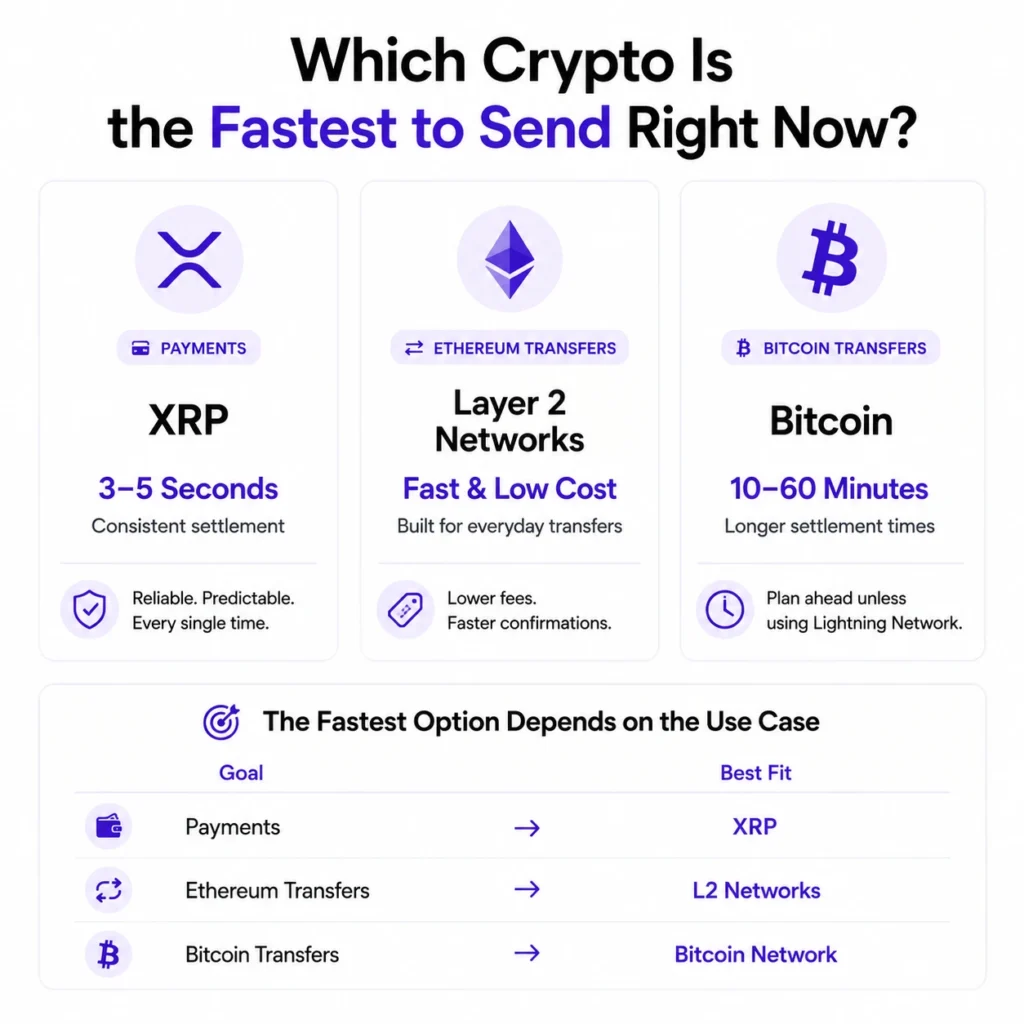
The right answer depends on what you are sending, to whom, and for what purpose. There is no single fastest network that is also right for every use case.
Bottom Line
Transaction speed in crypto covers two distinct things: how many transactions a network can handle per second, and how long until a transaction is truly settled. Solana leads on both in 2026, with 2,000-4,000 real-world TPS and 100-150 millisecond finality after the Alpenglow upgrade. XRP leads on consistency at 1,500 TPS with a guaranteed 3-5 second finality on every transfer. Ethereum’s base layer is slow but its Layer 2 networks process thousands of TPS at low cost. Bitcoin prioritizes security over speed at 3-7 TPS and 10-60 minute confirmation times. The fastest crypto to send depends on what you are sending and what you need from the settlement.
FAQ
What crypto has the fastest transaction speed?
Solana has the fastest real-world transaction speed among major blockchains in 2026. After the Alpenglow upgrade, finality completes in 100-150 milliseconds, and the network sustains 2,000-4,000 transactions per second in live conditions. Theoretical throughput exceeds 65,000 TPS, with the Firedancer client demonstrating over 600,000 TPS in testing. For sheer speed at scale, no other major L1 blockchain comes close.
Is XRP faster than Solana?
No. Solana processes significantly more transactions per second than XRP (2,000-4,000 vs 1,000-1,500 in real conditions) and achieves faster finality (100-150ms vs 3-5 seconds). XRP’s advantage is not raw speed but consistency. XRP has never experienced the kind of network outage that Solana did in February 2024, and its 3-5 second finality is essentially guaranteed. For institutional payment infrastructure where predictability matters more than peak throughput, XRP’s reliability can be more valuable than Solana’s higher ceiling.
How fast is a Bitcoin transaction?
Bitcoin transactions are confirmed after approximately six block confirmations, which typically takes between 10 and 60 minutes. The network processes 3-7 transactions per second. Higher fees move transactions to the front of the queue during congested periods; very low fees can result in transactions waiting hours. For instant settlement, Bitcoin’s Lightning Network creates off-chain payment channels that settle immediately, but it requires specific setup and is not available in all contexts.
What is the difference between TPS and finality?
TPS measures how many transactions a blockchain can process per second, which is a capacity metric. Finality is how long until a transaction is genuinely irreversible. These two numbers are often confused because a high TPS does not imply fast finality. Ethereum L1, for example, can handle 30 TPS but takes several minutes for a transaction to reach finality. Solana handles thousands of TPS and achieves finality in milliseconds. Both metrics matter, but finality is what determines the actual user experience of sending crypto.
Why is Solana faster than other blockchains?
Solana’s speed comes from two architectural innovations. Proof of History creates a cryptographic timestamp for each transaction before it enters consensus, allowing validators to process transactions in parallel without needing to coordinate the order first. This eliminates a major bottleneck present in most other blockchain architectures. Combined with Proof of Stake for block validation, the result is a network that can process thousands of transactions per second with sub-second finality under normal conditions. The Alpenglow upgrade in 2026 further accelerated this by rewriting the consensus protocol itself, cutting finality from 12.8 seconds to under 150 milliseconds.
Disclaimer: Don’t invest unless you’re prepared to lose all the money you invest. This is a high‑risk investment and you should not expect to be protected if something goes wrong. Take 2 mins to learn more at: https://go.payb.is/FCA-Info