Is Staking Crypto Worth It? Advice-Free Look at the Rewards and the Risks
- Staking is a way to earn passive income on proof-of-stake cryptocurrencies without selling or trading them
- Current yields on major coins range from 3% to 10% APY, with Ethereum sitting around 3-4% and Solana around 6-7%
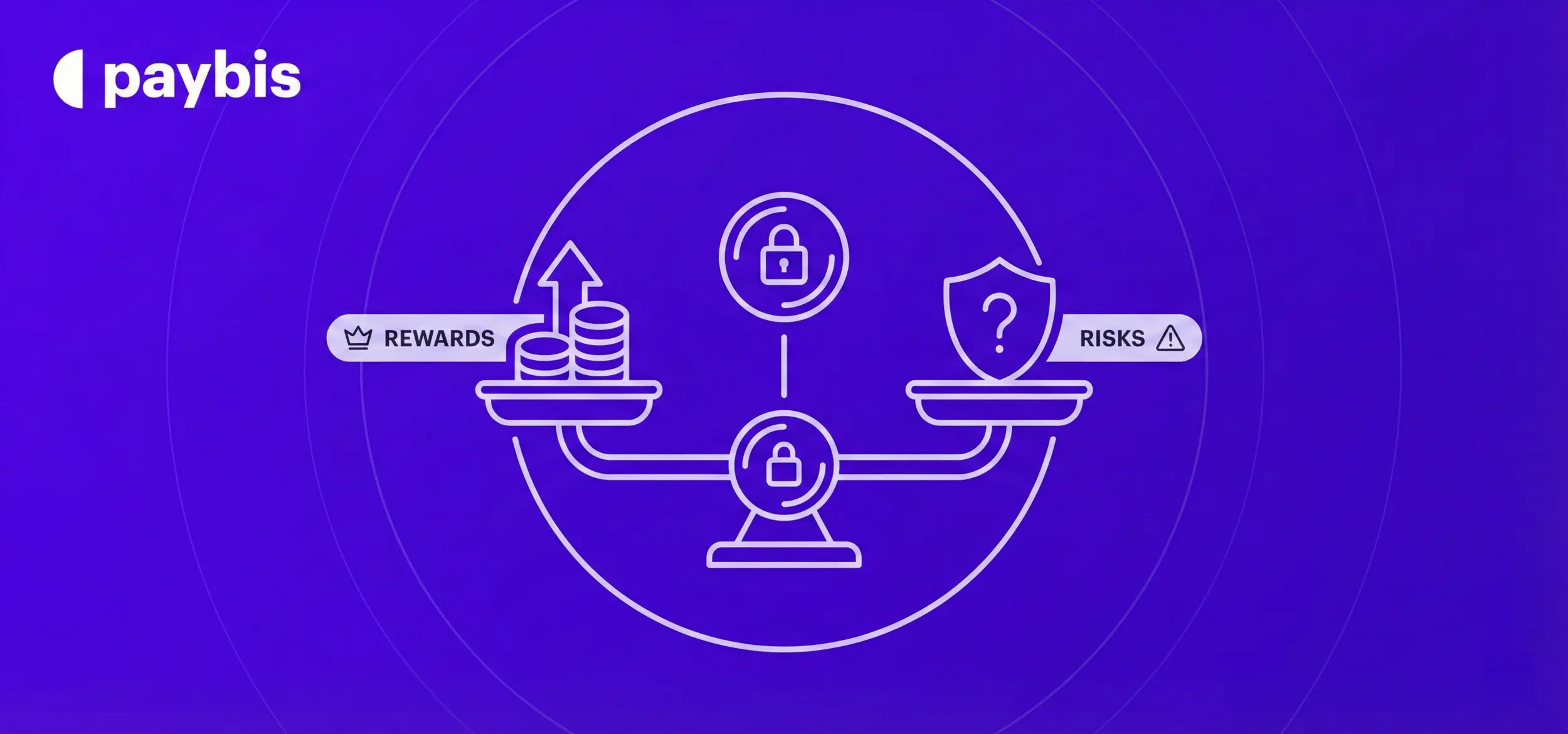
- The biggest risk in staking is the price of the coin you’re staking. It might drop faster than your rewards accumulate
- Lock-up periods on some networks mean you can’t access your funds quickly if the market moves against you
- Staking makes the most sense if you plan to hold a coin long term and want your portfolio working while you wait
Staking sounds like the easiest trade in crypto. You hold a coin, you lock it up, and the network pays you just for keeping it there. You are free of the pressure of timing the market and the technical expertise. So it should be simple. Right?
That’s more or less accurate. But you mostly don’t hear about the part where a 6% annual reward gets completely wiped out by a 40% price drop in the same coin. Or the part where your funds are locked, and the market moves before you can exit.
In this guide, we will try to find an honest answer to the “Is staking worth it?” question.
Table of contents
What Is Crypto Staking?
Staking means locking up your cryptocurrency to help a proof-of-stake blockchain validate transactions. In return for committing your coins, the network pays you rewards, usually in the same cryptocurrency you staked.
Bitcoin runs on proof-of-work, which uses miners and computing power to secure the network. Most other major blockchains, like Ethereum, Solana, Cardano, and Polkadot, use proof-of-stake instead. In this system, validators put up their own coins as collateral to earn the right to confirm transactions. The more coins committed, the more influence and rewards the validator earns.
You don’t need to run a validator yourself. Most people delegate their coins to an existing validator through an exchange or a staking platform, and that validator shares the rewards proportionally. Platforms like Coinbase, Kraken, and Binance have made this a one-click process.
Liquid staking protocols like Lido and Rocket Pool go a step further: they give you a token representing your staked position, so you keep earning rewards while still being able to use that token elsewhere in DeFi.
I do it because it allows me to earn passive income on my long-term tokens. Since they are coins I don’t plan to sell anytime soon, it makes perfect sense to just stake them and earn passive income. Another reason is staking AI predictions (Predictoor Data farming). I predict crypto prices by submitting a price prediction and staking OCEAN to outcompete others and earn rewards.
FutureGoose7 on Reddit
You can think of it as your crypto doing a job for the network while you hold it, and getting paid for that work.
What Are the Actual Staking Returns in 2026?
Current yields on established proof-of-stake coins range from 3% to 10% APY depending on the network and platform. Ethereum sits around 3-4%, Solana around 6-7%, Cardano at 4-6%, and Polkadot at 12-15%, though inflation on that network partially offsets it.
Numbers on a page don’t mean much without context. Let’s look at a realistic snapshot of current staking yields across the major networks:
| Coin | Estimated APY | Lock-up Period |
|---|---|---|
| Ethereum (ETH) | 3-4% | Flexible via liquid staking, or a few days to unstake natively |
| Solana (SOL) | 6-7% | 2-3 day cooldown to unstake |
| Cardano (ADA) | 4-6% | No lock-up, no slashing |
| Polkadot (DOT) | 12-15% | 28-day unbonding period |
| Cosmos (ATOM) | 15-20% | 21-day unbonding period |
One thing you need to understand before you get excited about high APY numbers: they often come with high inflation. Polkadot’s 12-15% yield sounds strong until you factor in that the network inflates at roughly 10% annually. Your real gain shrinks to 2-5%. The headline number and the actual return after inflation are rarely the same thing.
The Real Risks of Staking
Yes. The most common way is price volatility. If the coin you’re staking drops 30% while you earn 6% in rewards, you’ve still lost 24% in real terms. Lock-up periods make this worse, because you may not be able to exit during a sharp downturn.
Staking is not risk-free, and the risks are specific enough to understand before committing your funds. Here’s what can actually hurt you:
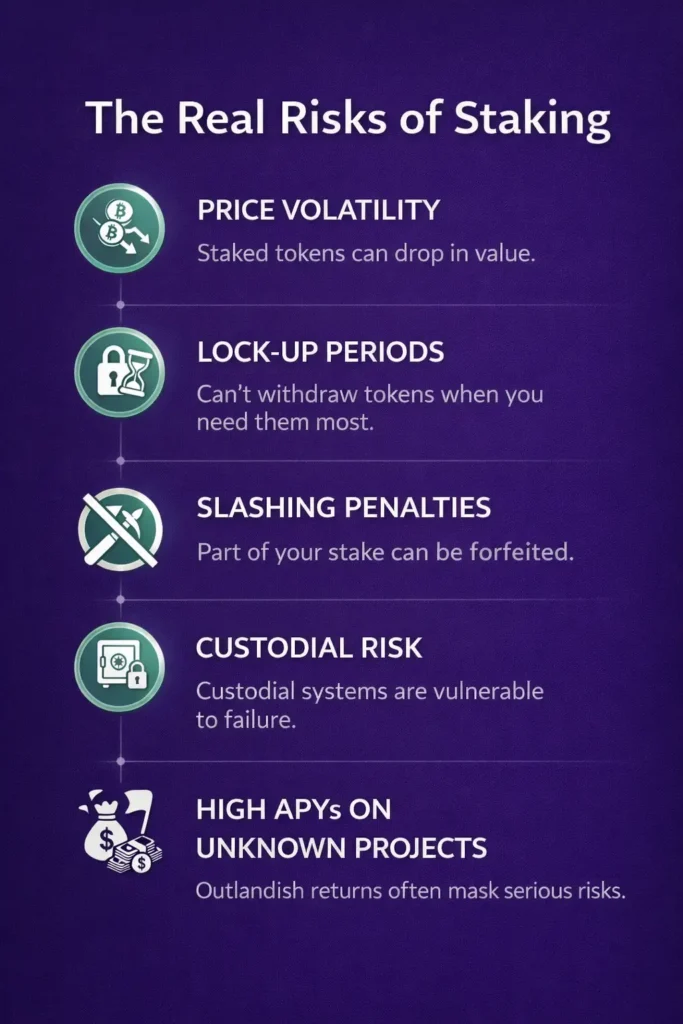
- Price volatility. Staking rewards are paid in the same coin you staked. If that coin drops in value, your rewards drop in value too. Bitcoin holders can relate to this, seeing the recent Bitcoin drop. A 6% APY on a coin that falls 50% in a year leaves you well behind where you started. No amount of staking yield fixes a bad underlying asset.
- Lock-up periods. Many networks require you to wait days or weeks after requesting to unstake before your coins come back. Polkadot’s 28-day unbonding period is a long time in a market that can move 20% in a weekend. You can’t react quickly.
- Slashing penalties. If the validator you delegated to goes offline for extended periods or acts maliciously, you can lose a portion of your staked funds. Cardano doesn’t have slashing; Ethereum and Solana do. Choosing a reputable, established validator matters more than most people realize.
- Custodial risk. Staking through Coinbase or Binance means the exchange holds your coins. If the exchange is hacked or goes under, your staked assets go with it. The collapse of FTX in 2022 wiped out billions in user funds. It’s not a hypothetical.
- High APYs on unknown projects. When a new token offers 50-100% staking yields, those rewards almost always come from token inflation. The network is printing coins to pay you, which dilutes the value of every existing token. Eventually, the math collapses. Stick to established networks with sustainable reward structures.
So, the yield number is only half the picture. What the coin itself does during that time matters just as much.
What You Should Ask Yourself Before Staking
Staking makes sense if you plan to hold a coin long term and want to compound your position while you wait. It makes less sense if you need flexibility, might want to sell quickly, or are considering a coin primarily because of its staking yield.
A useful way to frame this: staking is not an investment strategy by itself. It’s something you layer on top of a decision you’ve already made. The question of whether to stake only makes sense after a prior question is settled first.
Ask yourself these before staking anything:
- Do I believe in this coin’s long-term trajectory?
- Am I comfortable holding it through at least one full market cycle?
- Can I accept the lock-up period without it affecting my ability to respond to the market?
Only you can answer these honestly. And the answers will be different for every coin, every cycle, and every person reading this. That is exactly why they are worth asking before you lock anything up.
Staking vs. Just Holding
For proof-of-stake coins, staking generally beats holding for one specific reason: inflation. If a network continuously issues new tokens as rewards and you’re not staking, your share of the total supply shrinks every year. Stakers offset that dilution. Non-stakers absorb it.
Cardano makes this especially clear. It has no lock-up period, no slashing risk, and a 4-6% staking yield. Holding ADA without staking is straightforwardly worse for a long-term holder. You’re accepting dilution with no upside.
Polkadot and Cosmos work differently because of their higher inflation. The yield sounds bigger, but a chunk of it is just keeping up with the new supply being issued. Your real return is lower than the headline APY suggests.
For Bitcoin, none of this applies. Bitcoin runs on proof-of-work, not proof-of-stake; there’s no staking mechanism. If you’re holding Bitcoin as a long-term investment, staking conversation isn’t relevant to you.
Bottom Line
Staking has matured significantly since Ethereum’s Shanghai upgrade in 2023 removed the withdrawal restrictions that made early staking genuinely risky. It’s now a straightforward, fairly predictable way to compound your holdings on assets you already own and believe in.
What staking is not:
- A substitute for picking a good coin in the first place
- A guaranteed return when measured in fiat
- A safe strategy for high-APY unknown projects
- A reason to buy a coin you wouldn’t buy otherwise
If you’re new to crypto and want to understand the market before committing to staking, you can buy Bitcoin or Ethereum directly, as a reasonable first step. Staking is a layer you add once you know what you’re holding and why.
FAQ
Is staking crypto safe?
Staking on well-known networks through trusted platforms is not reckless, but it is not risk-free either. Prices can fall while your funds are locked up. Some networks will penalise you if your validator misbehaves. And if you stake through an exchange, you are trusting that exchange with your coins. None of these are reasons to avoid staking entirely, but they are worth knowing going in.
How much can I earn staking crypto?
It depends on the coin. Ethereum pays around 3-4% a year right now. Solana sits at 6-7%. Polkadot and Cosmos tend to offer 12-20%. Anything promising significantly more than that deserves a closer look at why.
Can I lose money staking crypto?
Yes. Staking rewards are paid in the coin you are staking. If that coin drops 40% in price, a 7% annual yield does not come close to covering it. Staking works well when you already believe in the coin. It does not protect you if the price falls.
What is the best crypto to stake for beginners?
Cardano is a common first choice. No lock-up, no penalty risk, and a steady 4-6% yield. Ethereum through a platform like Lido is another option worth looking at, since it keeps your funds more accessible than staking directly on the network.
Disclaimer: Don’t invest unless you’re prepared to lose all the money you invest. This is a high‑risk investment and you should not expect to be protected if something goes wrong. Take 2 mins to learn more at: https://go.payb.is/FCA-Info