How to Track Crypto Whale Movements (and What They Actually Signal)
- A crypto whale is typically a wallet holding 1,000+ BTC or 10,000+ ETH, enough to move markets when traded
- Exchange inflows signal potential sell pressure. Exchange outflows to private wallets signal accumulation
- Transactions above 1,000 BTC often precede price moves of 3-5% within 24 hours, according to Nansen data
- Most large transfers are noise: internal moves, custody reshuffles, or OTC settlements that predict nothing
- The five tools worth knowing: Whale Alert, Arkham Intelligence, Nansen, DeBank, Lookonchain
- Once you spot a signal, buying Bitcoin on Paybis or buying Ethereum takes minutes
In early 2026, Bitcoin whales quietly accumulated over 270,000 BTC during a consolidation period that most retail traders read as stagnation. The accumulation was happening on public blockchains the whole time, visible to anyone using the right tools, weeks before it showed up in price. That is what whale tracking is actually about. Not chasing every big transfer, but reading where serious capital is moving before it becomes obvious.
The data is public. Most of the tools are free. The hard part is knowing which signals matter.
What Is a Crypto Whale?
A whale is any wallet large enough to move its market when it trades. On Bitcoin, that typically means 1,000+ BTC (around $65-70 million at current prices). On Ethereum, 10,000+ ETH. On smaller coins, any wallet holding 1%+ of circulating supply gets the label.
Size alone is not the whole story. What makes whales worth following is that large institutional holders, early miners, and funds often act before smaller participants can see why. Their on-chain footprint: where assets move, whether they head to exchanges or cold storage, how that pattern shifts over weeks, is the closest thing to a public record of what sophisticated capital is doing. For context on how Bitcoin’s ownership and supply structure works, the Paybis Bitcoin guide is worth a read alongside this.
The Two Signals That Actually Matter
Everything in whale tracking comes down to two movements. Direction is everything.
Exchange inflows mean large amounts are moving from private wallets into exchange deposit addresses. You cannot sell without moving assets to an exchange first. When sustained inflows spike above the 30-day baseline across multiple large wallets, that pattern has historically preceded sell pressure and price drops. Whale Alert, Glassnode, and Nansen all track this in real time.
Exchange outflows are the opposite: assets leaving exchanges into private wallets or cold storage. This is accumulation. A holder pulling Bitcoin off an exchange is reducing liquid supply and likely has no intention of selling. The 270,000 BTC that moved during the 2026 consolidation went almost entirely off exchanges.
The same logic applies across assets. XRP, Solana, and other major coins all have exchange flow data tracked by Nansen and Whale Alert.
The Five Tools That Cover the Most Ground
- Whale Alert: The starting point. Monitors 25+ blockchains in real time and pushes alerts to Twitter/X and Telegram the moment a large transaction fires, including the value, origin, and destination type (exchange, unknown wallet, known entity). The free version covers most of what individual traders need. Fast and broad, but limited on context. It tells you something moved, not why.
- Arkham Intelligence: The deanonymisation layer. Its AI engine has labelled over 800 million wallets across Bitcoin, Ethereum, Solana, and other chains. When Whale Alert shows an unidentified transfer, Arkham tells you who sent it and where it went. Entity pages show portfolio history, connected wallets, and transaction patterns. The free tier is generous enough for most individual research.
- Nansen: The deepest tool in the stack. Assigns smart money labels to wallets based on historical performance, tracks wallet clusters, and provides 30-day exchange flow baselines so you can see when current movements are unusual rather than routine. Full features run around $150/month, but the smart money labels are the most useful single data point for filtering which large transfers actually matter.
- DeBank: The DeFi lens. Tracks specific wallets across their full DeFi position: lending exposure, liquidity pools, yield farming, cross-chain balances. When a large wallet starts unwinding DeFi positions at scale, it often precedes exchange activity by hours or days, before any exchange flow data picks it up.
- Lookonchain: A Twitter/X account, not a platform, but one of the most useful feeds in the space. It surfaces high-signal whale flows with narrative context: “this wallet bought X before the last rally,” “this fund has been accumulating Y for three weeks.” A curated, interpreted layer on top of the raw data from everything above.
The Noise Problem: What to Ignore
Most large transfers mean nothing. Getting this wrong is what burns people on whale tracking.
Exchange internal moves are the biggest source of false signals. Exchanges constantly shuffle Bitcoin and Ethereum between hot and cold wallets for operational reasons. These show up as huge transfers on Whale Alert. Arkham catches them fast. If both origin and destination are labelled as the same exchange, it is internal and irrelevant.
Custody rebalances happen when institutions move assets between custodians or reorganise their wallet structure. A fund shifting 500 BTC from one cold storage address to another is not selling and is not accumulating. It is routine housekeeping.
OTC settlement shows up on-chain as large transfers between unlabelled wallets with no exchange involvement. By the time the transfer is visible, the trade has already been agreed and any price impact has already happened.
The filter that works: ignore single transactions. Watch trends. Sustained exchange inflows over multiple days from multiple large wallets, running above the 30-day baseline, is the pattern that has historically preceded meaningful sell pressure. A single spike in isolation is usually noise.
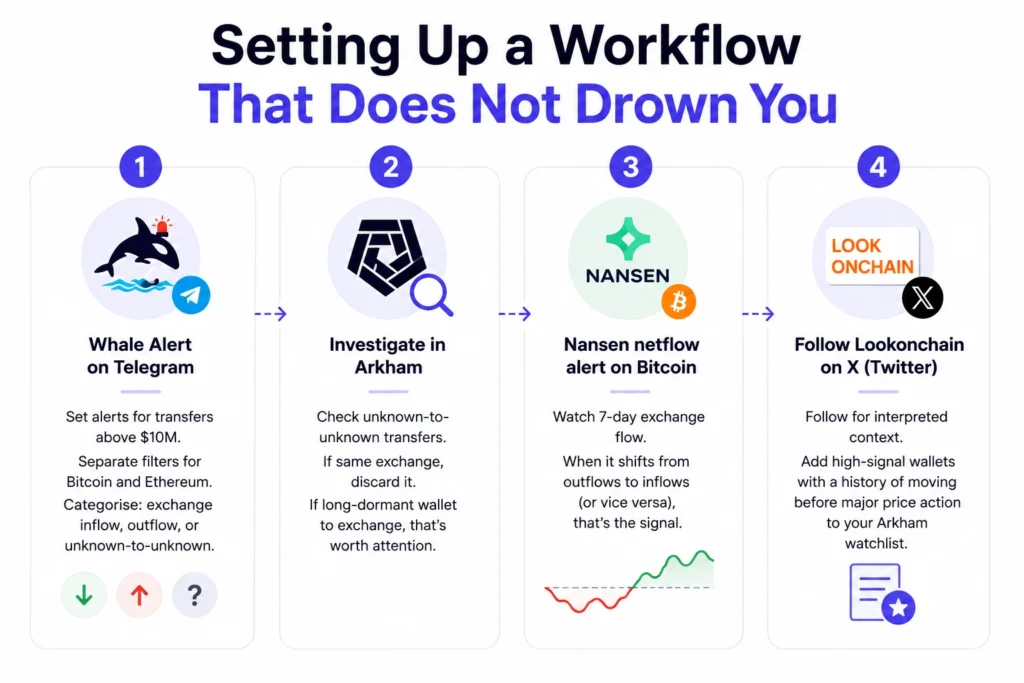
Setting Up a Workflow That Does Not Drown You
Raw Whale Alert notifications on everything produces hundreds of alerts a day, almost all irrelevant. Here is a setup that keeps it manageable:
- Whale Alert on Telegram, filtered to transfers above $10 million. Separate filters for Bitcoin and Ethereum. Categorise each as exchange inflow, exchange outflow, or unknown-to-unknown.
- Investigate unknown-to-unknown in Arkham. If both addresses belong to the same exchange, discard it. If the origin is a long-dormant wallet moving to an exchange, that is worth attention.
- Nansen netflow alert on Bitcoin. When 7-day exchange flow shifts from sustained outflows to sustained inflows (or vice versa), that is the pattern to act on, not individual transactions.
- Follow Lookonchain on Twitter/X for interpreted context. When they flag a wallet with a history of moving before major price action, add it to a custom Arkham watchlist.
What the Data Can and Cannot Tell You
On-chain data gives you context. It does not give you certainty.
Nansen’s research found that transactions above 1,000 BTC precede price moves of 3-5% within 24 hours, but that is a correlation across a large dataset, not something that holds for every individual event. Before acting on any signal, checking live price and volume on the Paybis Bitcoin price page alongside the on-chain data gives you the full picture.
One trader on TradingView reported combining Whale Alert data with RSI divergence raised their backtested accuracy from 52% to 68% across 2024-2025 data. The word is combining. Whale data alone produces too many false positives. Whale data as confirmation for a setup already supported by price structure and volume is a different thing entirely.
There is also a structural caveat for 2026 specifically. Institutional flows through ETFs, corporate treasuries, and sovereign funds do not always leave the same on-chain footprint as earlier whale activity. BlackRock’s Bitcoin ETF flows settle through Coinbase Custody and may not appear as traditional wallet-to-exchange movements on block explorers at all. Reading the full picture now means combining on-chain data with ETF flow data from sources like Farside Investors.
Bottom Line
Whale tracking in 2026 is accessible, mostly free, and produces signals that genuinely correlate with short-term price action when read correctly. Whale Alert catches the movements, Arkham identifies who is moving, Nansen adds smart money context, DeBank covers the DeFi layer, and Lookonchain filters the highest-signal flows with narrative. The actual skill is not finding big transactions. It is knowing which ones are exchange inflows that matter, which are internal moves that do not, and how to read trends rather than reacting to individual events.
When the data signals something worth acting on, buying Bitcoin or buying Dogecoin on Paybis takes minutes. You can sell crypto or swap between assets just as fast. If you are buying to hold, the Paybis crypto wallet keeps everything in one place.
FAQ
What counts as a crypto whale?
Wallets holding 1,000+ BTC on Bitcoin, 10,000+ ETH on Ethereum, or 1%+ of circulating supply on smaller assets. The practical definition is any holder large enough to move the market when they trade.
Is whale tracking legal?
Yes. All the data being tracked is public blockchain information. On-chain analytics tools read publicly available transaction data and apply labelling and context. The SEC’s May 2025 guidance confirmed that tracking public on-chain data for market analysis is acceptable.
Can whales manipulate the market?
Large holders can influence short-term price action, particularly on lower-liquidity assets. A single wallet moving 1,000+ BTC to an exchange creates visible sell pressure. On-chain tracking tools exist partly so retail participants can see these movements in real time rather than after the fact.
How much does whale tracking cost?
Whale Alert core alerts are free. Arkham has a generous free tier. Nansen’s full feature set runs around $150/month. DeBank and Lookonchain are free. A complete workflow costs nothing at entry level and around $150/month if you want Nansen’s smart money labels.
What is the difference between exchange inflows and outflows?
Inflows: assets moving from private wallets to exchange addresses, typically signalling the holder is positioning to sell. Outflows: assets leaving exchanges to private wallets or cold storage, typically signalling accumulation. Direction is the most important variable in reading any whale data.
How do I know if a large transfer is meaningful or just internal?
Check entity labels on both addresses in Arkham. If both belong to the same exchange, it is an internal operational move and means nothing. If the origin is a long-dormant unlabelled wallet and the destination is an exchange deposit address, that is worth attention.
Disclaimer: Don’t invest unless you’re prepared to lose all the money you invest. This is a high‑risk investment and you should not expect to be protected if something goes wrong. Take 2 mins to learn more at: https://go.payb.is/FCA-Info