Your First Market Making Bot: A Step-by-Step Crypto Trading Guide
Key Takeaways:
- Market making profits from the bid-ask spread, not price prediction. Institutional traders account for the majority of exchange volume, but retail traders can use grid bots to capture similar spreads on smaller scale.
- Capital deployment speed determines success. Traditional bank transfers take 1-3 business days, and volatility windows often close in hours. Instant funding becomes infrastructure, not luxury.
- Professional market makers target 15-30% APY. Retail grid bots can deliver similar returns in sideways markets, but only if you master liquidity selection, parameter tuning, and risk management.
- Your bot only works if it has capital to deploy. When Binance rejects your card or your wire is delayed, platforms like Paybis (instant card transactions, 2-minute verification) let you fund opportunities in minutes instead of missing them entirely.
Every time you buy crypto on an exchange, you pay a spread. The person earning that spread? A market maker. For years, this was the exclusive domain of high-frequency trading firms with million-dollar credit lines. Today, automated grid trading bots let retail traders run simplified market-making strategies with a few hundred dollars and a laptop.
But here’s what the bot tutorials won’t tell you: a perfectly configured bot is worthless if you can’t fund it when opportunity strikes. In this guide, I’ll walk you through the mechanics of market making, show you how to set up your first grid bot, and explain why capital deployment speed matters as much as your strategy.
Table of contents
What Are Crypto Market Makers?
A crypto market maker is an individual or firm that provides liquidity to the market by simultaneously placing buy (bid) and sell (ask) orders for a cryptocurrency. Unlike regular traders who speculate on price direction, market makers profit from the bid-ask spread itself, regardless of whether the asset goes up or down.
Here’s the fundamental mechanic: if Bitcoin’s highest buy order is $50,000 and the lowest sell order is $50,050, the market maker places both orders and captures the $50 difference when both execute. Multiply this by thousands of transactions per day across hundreds of pairs, and you understand why major firms operate 24/7 trading operations.
The Role of Liquidity and Spreads
Liquidity measures how easily you can buy or sell an asset without causing significant price impact. High liquidity means tighter spreads, faster execution, and lower slippage.
Market makers create this liquidity by ensuring there are always willing buyers and sellers at quoted prices. For major pairs like BTC/USDT on Binance, spreads can be as low as 0.01-0.05%. For low-cap altcoins with daily volume under $1 million, spreads can widen to 1-5% or more.
The tighter the spread, the less profit per trade but the higher the trading frequency. Professional market makers compensate by trading enormous volume. Retail traders using grid bots need to find the sweet spot: pairs liquid enough for consistent fills, volatile enough to generate frequent trades, but not so wild that the price exits your grid range.
Institutional vs. Retail Market Making
Professional market-making firms operate with advantages retail traders can’t replicate: billion-dollar credit lines, low-latency infrastructure that adjusts quotes in microseconds, exchange fee rebates (Binance requires $20M in 30-day volume for maker programs), and real-time hedging via futures. Firms like Wintermute and GSR handle billions in daily volume across 50+ exchanges simultaneously.
Retail traders can’t match this infrastructure, but we can profit from the same principle using grid bots. You won’t achieve institutional efficiency, but grid bot users have reported strong returns in favorable market conditions. The critical difference: institutional market makers deploy capital instantly from credit facilities. You need a fast on-ramp when your primary exchange fails or when volatility spikes on a weekend and your bank transfer won’t clear until Tuesday.
How Crypto Trading Bots Work
Crypto trading bots are automated software programs that execute trades based on predefined rules. They operate 24/7, removing emotion from trading and reacting faster than humans can.
Grid Trading vs. Scalping Bots
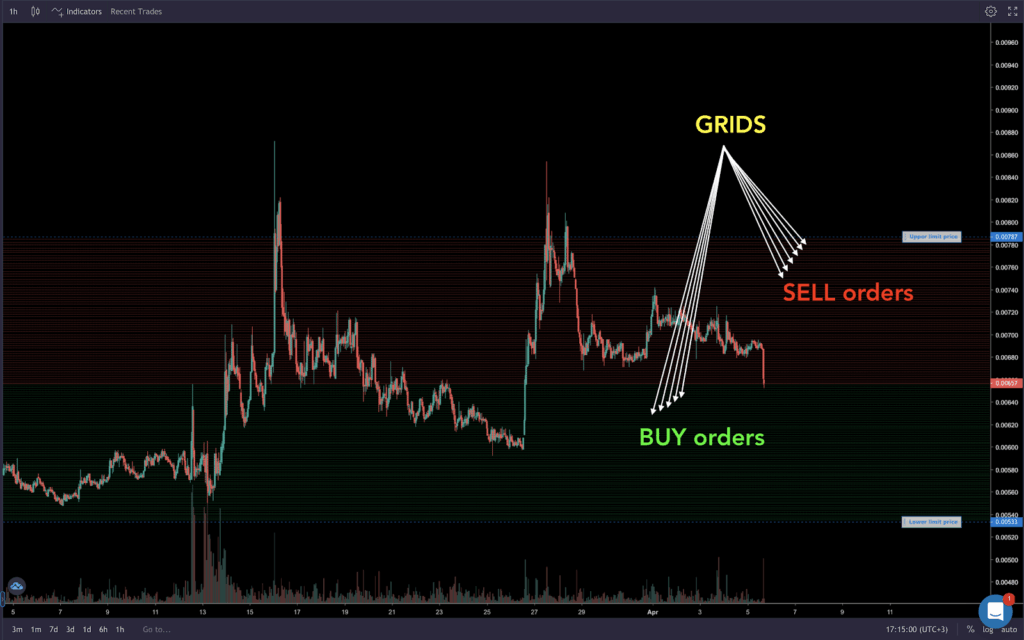
Grid Trading Bots are the most accessible form of retail market making. They place a series of buy and sell orders at predefined intervals above and below a set price, creating a “grid” of orders.
Here’s a simple example:
- Set a grid from $48,000 to $52,000 with 20 levels
- The bot places 10 buy orders from $48,000 to $49,900 (spaced $200 apart)
- It places 10 sell orders from $50,100 to $52,000 (spaced $200 apart)
- When BTC drops to $49,800, a buy order fills
- The bot immediately places a sell order at $50,000
- When BTC rises to $50,000, the sell executes, capturing $200 minus fees
This process repeats continuously as price fluctuates, profiting from volatility without predicting direction.
Scalping Bots aim to make many small trades in very short timeframes, holding positions for seconds or minutes. They require high-speed execution and typically operate on maker-taker fee structures where maker fees are near zero.
For retail traders, grid bots offer the better risk-reward profile. You’re not competing on speed, you’re capturing spread on volatility within a defined range.
| Bot Type | Market Conditions | Trade Frequency | Minimum Capital |
|---|---|---|---|
| Grid Trading | Sideways/volatile | 20-50 trades/day | $300-500 |
| Scalping | High volume | 500+ trades/day | $1,000+ |
| DCA | Bull/accumulation | 1-30 trades/month | $100+ |
| Arbitrage | Price gaps | Seconds to minutes | $2,000+ |
The Role of AI and ML in Modern Bots
Traditional grid bots follow fixed rules: if price hits $50,000, buy. AI and ML-powered bots can learn and adapt their strategies based on market conditions.
The practical difference: A rule-based grid bot stops working if price breaks outside your $48,000-$52,000 range. An AI-powered bot analyzes historical volatility, order book depth, and sentiment data to suggest range adjustments or pause trading during news events.
The trade-off: higher subscription costs ($50-100/month vs. free for basic grid bots on Pionex) and less transparency into decision-making. For your first bot, start with rule-based grid trading. Once you understand spread capture and risk management, evaluate whether AI features justify their cost premium.
Step-by-Step: Setting Up Your First Market Making Bot
The mechanics are simple, but the details matter. A poorly configured bot can turn a profitable strategy into a capital trap.
Step 1: Choose Your Pair and Platform
Platform Selection
Not all exchanges support trading bots, and not all bot platforms support all exchanges. Here’s the current landscape:
| Platform | Free Bots | Monthly Cost | Best For |
|---|---|---|---|
| Pionex | 16 built-in | $0 (0.05% fee) | Beginners |
| 3Commas | 0 | $15-160/month | Multiple bots |
| Cryptohopper | Limited | Free-$107/month | AI & backtesting |
| Coinrule | Basic | Free-$749/month | No-code builder |
For your first bot, I recommend Pionex. It has 16 free built-in bots including grid trading, the interface is beginner-friendly, and you don’t need to manage API keys since trading happens on their exchange.
Pair Selection Criteria
Your trading pair determines everything. Choose wrong, and your bot will either sit idle or trap your capital in a crashing asset.
Minimum requirements:
- 24-hour volume: At least $10 million daily for adequate liquidity
- Bid-ask spread: Below 0.15% for active trading
- Volatility: 3-5% daily range (enough movement for trades, not enough to break your grid)
Good starter pairs: BTC/USDT, ETH/USDT, BNB/USDT. These have deep order books, consistent volume, and moderate volatility.
Avoid: Low-cap altcoins with volume under $1M, newly listed tokens, anything with spreads above 1%.
Step 2: Fund Your Strategy (The Speed Factor)
This is where most bot guides skip the critical detail: your bot can’t trade without capital, and capital deployment speed determines whether you capture opportunity or miss it.
Traditional funding creates execution lag: ACH transfers take 1-3 business days, SEPA 1-2 days, wires 1-2 days plus weekend delays. The real cost shows up during volatility windows. On January 9, 2024, Bitcoin spiked from $45,000 to $48,000 after a fake SEC announcement, then crashed back down in hours. If your capital was stuck in a pending wire transfer, your bot sat idle.
This is where platforms like Paybis become strategic infrastructure, not just another exchange. You’re not running your bot on Paybis, you’re running it on something like Pionex. But when you need to add capital after a flash crash, fund a new bot on a weekend when banks are closed, or take advantage of regional price differences using alternative payment methods like PIX or FPS, instant card transactions mean you move from “I see an opportunity” to “my bot is live” in minutes, not days.
“Very easy and cheap transaction fees. And the purchases are done quickly max 2 to 5 mins” – Verified user review of Paybis
The fee premium for instant funding (Paybis charges 2.49% service fee + 4.5% processing for cards) becomes irrelevant when the alternative is missing a 15% volatility window entirely. You’re not paying for low fees, you’re paying for speed when speed is the only thing that matters.
Funding Workflow:
- Identify bot opportunity (volatility spike, new range, arbitrage)
- Use Paybis instant card purchase to buy USDT or BTC
- Transfer to bot exchange (Pionex, Binance)
- Launch bot (total time: 10-20 minutes vs. 1-3 days)
Step 3: Configure Grids and Risk Limits
Now you’re ready to set parameters. These decisions determine your profit per trade, trade frequency, and risk exposure.
Grid Parameters:
Price Range: Set your upper and lower bounds based on recent price action and support/resistance levels. For a sideways market, ±10-20% from current price works well. For BTC at $50,000, that’s a range of $45,000-$55,000.
Number of Grids: More grids mean smaller profit per trade but more frequent trading. Start with 20-30 grids for major pairs.
Grid Spacing:
- Arithmetic: Each grid separated by the same dollar amount ($200). Good for tight ranges.
- Geometric: Each grid separated by the same percentage (1%). Better for trending markets.
Capital Allocation: Minimum $300-500 is recommended. Remember, your capital is split across all buy orders, so more grids means less capital per order.
Risk Settings (Critical):
Stop-Loss: Set this below your lowest grid level. If BTC crashes from $50,000 to $40,000 and your grid lower bound is $45,000, a stop-loss at $43,000 prevents catastrophic loss. The bot will automatically sell all accumulated BTC to USDT.
Take-Profit: Set this above your upper grid. When hit, the bot stops and takes profits.
Monitoring Schedule: Check daily at minimum. During high volatility, check twice daily. Watch for:
- Price approaching grid boundaries
- Fill rate (are orders executing?)
- Cumulative profit vs. impermanent loss
Top Market Making Strategies for Retail Traders
Grid trading is just one approach to retail market making. Here are proven strategies, when they work, and when they fail.
The Neutral Grid (Sideways Markets)
A neutral grid strategy starts with equal value of base and quote currency. If allocating $1,000, you’d start with $500 in BTC and $500 in USDT.
When it works: Sideways or choppy markets where price oscillates within a 20-30% range for weeks. This was ideal during much of 2019 when BTC traded between $7,000-$13,000 for months.
The mechanic: As price moves up, the bot sells BTC for USDT. As it drops, it buys BTC with USDT. The goal is to maintain roughly equal fiat value while accumulating profits from each trade cycle.
Risk: If price breaks out and trends strongly upward, you’re selling BTC all the way up and underperform simple buy-and-hold. One comparison during the 2022 bear market showed the bot down 28% versus 34% for lump-sum investment, a 6% outperformance due to volatility capture.
Arbitrage and Cross-Exchange Liquidity
Arbitrage exploits price differences for the same asset across exchanges. When BTC trades at $50,000 on Binance but $50,200 on Coinbase, an arbitrage bot buys on Binance and sells on Coinbase for $200 profit minus fees.
Capital requirements: You need holdings on multiple exchanges. For effective arbitrage, $2,000+ split across 2-3 exchanges is minimum.
Regional arbitrage: This is where instant funding via local payment methods creates an edge. If BTC trades 2% higher in Brazil than globally, using PIX to quickly deploy capital lets you capture that regional premium before it normalizes.
For most retail traders, focus on grid trading rather than arbitrage. The capital efficiency is better, and you’re not competing on execution speed with firms spending millions on infrastructure.
The Risks: Low Liquidity and Impermanent Loss
Every market-making strategy carries specific risks. Understanding them is the difference between sustainable profit and catastrophic loss.
Identifying Low Liquidity Traps
Low liquidity means you can’t exit a position without massive slippage. Your bot can place orders, but if nobody fills them or filling them crashes the price, you’re trapped.
Warning signs and metrics to check:
- 24-hour volume under $1 million: Extreme caution required
- Bid-ask spread over 1%: Transaction costs consume profits quickly
- Order book depth: Check within ±2% of mid-price. If total volume is under $50,000, liquidity is dangerously thin
- Sudden volume spikes: Can indicate wash trading or manipulation
- Tools: Use CoinMarketCap’s Liquidity Score (0-1000 scale, aim for 750+), CoinGecko’s liquidity metrics, and exchange order books
Real trap example: A token pumps 50% on low volume, spread widens to 5%, your grid bot accumulates on the way up, then price crashes 70% with no buyers. Your bot is holding a depreciating asset with no exit. This is an “exit liquidity trap” where early holders create artificial hype to dump on retail.
Protection: Only trade pairs with consistent volume over $10M daily. Major pairs like BTC/USDT, ETH/USDT rarely have liquidity issues even in crashes.
Why Speed of Execution Matters
Market conditions change fast in crypto. A profitable grid range at 8 AM might be obsolete by 10 AM if a major announcement hits.
The capital deployment gap: Professional market makers have instant access to credit lines and can deploy millions in seconds. Retail traders relying on 1-3 day bank transfers can’t react.
Without fast funding, you experience:
- Missed volatility windows: A flash crash creates ideal grid trading conditions, but by the time your wire clears, price has recovered
- Inability to add capital: Your bot exhausts buy orders in a prolonged dip, you want to add capital to continue accumulating, but can’t
- Arbitrage gaps close: Regional price differences last hours, not days
You keep your primary capital on low-fee exchanges like Binance (0.1% trading fees). But when you need to quickly fund a new bot after identifying an opportunity, add capital to an existing bot mid-strategy, or capture a weekend arbitrage opportunity when banks are closed, instant funding acts as your emergency capital deployment infrastructure. Yes, you pay a premium (2.49% + 4.5% for cards). But the alternative is missing the opportunity entirely, which costs infinitely more.
“Easy and fast, just how i like it” – Verified user review of Paybis
Think of instant funding as insurance for time-sensitive opportunities. You won’t use it for routine DCA or patient accumulation. You use it when speed is the only variable that determines whether you profit or miss out.
Ready to fund your next bot opportunity in 10 minutes instead of 1-3 days? When volatility spikes and your bank transfer won’t clear, you need infrastructure built for speed. Create a free Paybis account, complete 2-minute verification, and deploy capital via card in under 15 minutes. First purchase waives the Paybis service fee. Don’t let slow funding be the reason your bot sits idle during the next volatility window.
Further reading
- The 12-Point Checklist for Trading Low-Liquidity Crypto
- Your Crypto Market Maker Strategy: Why DEX ‘Low Fees’ Can Cost You More
- For more trading tips check out our Ultimate trading masterclass guide for 2025.
Key Terminology
Bid-Ask Spread: The difference between the highest price a buyer will pay (bid) and the lowest price a seller will accept (ask). Market makers profit from capturing this spread repeatedly.
Grid Trading: An automated strategy that places buy and sell orders at predetermined intervals above and below a set price, profiting from price volatility within a defined range without predicting direction.
Impermanent Loss: The opportunity cost of running a grid bot compared to simply holding the asset. Occurs when price trends strongly in one direction, causing the bot to sell an appreciating asset or accumulate a depreciating one.
Liquidity: The ease with which an asset can be bought or sold without significantly impacting its price. High liquidity means tight spreads, fast execution, and minimal slippage.
Maker Fee: The lower fee charged to traders who place limit orders that add liquidity to the order book. Grid bots typically pay maker fees since they use limit orders.
Order Book Depth: The total volume of buy and sell orders within ±2% of current market price. Deep order books (>$50,000 within 2%) indicate high liquidity and lower slippage risk.
Slippage: The difference between the expected price of a trade and the price at which it actually executes. High slippage indicates low liquidity or high volatility.
FAQ
How much do professional market makers earn?
Professional market-making operations target 15-30% APY. Retail grid bots can achieve similar returns in optimal conditions, though most average 10-20% APY.
Are "market maker signals" services legitimate?
No. Professional market makers guard their strategies as proprietary secrets. Any service claiming to predict market maker moves is likely a scam.
What happens to my grid bot during a market crash?
The bot executes all buy orders as price drops, accumulating the base asset. If price exits below your grid, the bot becomes inactive and holds a depreciated position until price recovers.
How do maker vs. taker fees affect bot profitability?
Grid bots use limit orders, making you a “maker” who pays lower fees (often 0.1% vs. 0.26% for takers). For a bot executing 50 trades/day, this 0.16% savings per round trip compounds significantly.
What is the minimum capital needed to start a grid trading bot?
$300-500 is recommended for meaningful returns. Larger capital ($1,000+) allows for more grids and better capital efficiency.
Disclaimer: Don’t invest unless you’re prepared to lose all the money you invest. This is a high‑risk investment and you should not expect to be protected if something goes wrong. Take 2 mins to learn more at: https://go.payb.is/FCA-Info