
Binance Alternatives in Europe: MiCA-Licensed Platforms After the July 2026 Lockout

- Binance withdrew its MiCA licence application in Greece on 24 June 2026 and suspended most services for EU residents from 1 July 2026.
- Withdrawals stay open, while new orders and deposits are no longer available to EU residents.
- Around 210 firms hold full CASP authorisation across the EEA, out of more than 3,000 that operated under the old national regimes.
- A CASP licence is now the only legal basis for serving EU clients, and ESMA confirmed there is no extension.
- Paybis holds a MiCA CASP licence (ref 27-55/2026/6) from the Bank of Latvia, issued in May 2026 alongside a PSD2 Payment Institution licence (ref 27-55/2026/7).
- Check any platform against ESMA’s public CASP register before you move a single euro.
- Once you have confirmed a platform is licensed, you can buy Bitcoin and buy Ethereum on Paybis under full CASP authorisation.
More than 3,000 crypto firms were operating across Europe under national rules. Around 210 of them cleared MiCA’s authorisation bar before the transition period closed on 1 July 2026. Binance was not one of them.
That left millions of European users needing somewhere else to trade. The question is easier to answer than it looks, because a CASP licence is a matter of public record and takes about a minute to verify. This guide covers which platforms hold one and how to check any of them yourself. If you want to skip ahead, you can buy crypto on Paybis under full CASP authorisation.
What Happened to Binance in the EU?
Binance withdrew its MiCA licence application in Greece on 24 June 2026 and suspended most services for EU residents from 1 July. Without a CASP authorisation from any member state, it has no legal basis to serve EU clients.
The timeline is short and worth reading in order:
- January 2026. Binance filed a CASP application with the Hellenic Capital Market Commission in Greece. The plan was to passport that licence across the bloc.
- June 2026. Reuters reported that Greek regulators were preparing to reject the application, which had been reviewed jointly by authorities in Greece, Ireland, and Latvia.
- 24 June 2026. Binance withdrew the application and cited the status and timeline of the Greek process.
- 1 July 2026. EU services were suspended, six days after the withdrawal.
Binance has said user funds remain safe and that it intends to seek authorisation in another member state. It has not confirmed which one or given a date.
For EU users, the practical position today is what matters:
- Withdrawals remain open. You can still move your assets off the platform.
- New spot orders are unavailable. Buying and selling stopped for EU residents.
- Deposits and sign-ups stopped. New accounts cannot be opened from the EU.
- Earn and staking products are suspended. Yield products fall under the same restriction.
What Does the 1 July 2026 Deadline Actually Mean?
It marks the end of MiCA’s transitional period, after which only exchanges holding a CASP authorization can legally serve EU clients. ESMA confirmed there would be no extension.
Before MiCA, an exchange could operate in Europe on a national registration from a single country. Those registrations carried real weight in places like Spain, Poland, and Italy. On 1 July 2026 they stopped counting for anything.
The scale of the clear-out explains why this hit so hard. More than 3,000 crypto firms operated across Europe under the old national regimes. Around 210 of them secured full CASP authorisation. Everyone else had to wind down EU activities, and in a statement dated 23 June 2026, ESMA told unauthorised providers to take immediate steps to do exactly that.
Binance is the largest name caught by the deadline, and it has company. Several other large exchanges popular with EU traders entered July without a CASP licence in place, KuCoin and MEXC among them.
What Should You Check Before Choosing a Binance Alternative?
Check that the platform appears in ESMA’s public CASP register, and confirm which services its authorisation actually covers. A licence is a specific document rather than a marketing phrase, and it takes about a minute to verify.
Work through these four checks before you move funds:
- Find it in the ESMA register. The register lists every entity authorised by an EU national regulator and updates weekly. If the platform is absent, it is not authorised.
- Check the scope of the licence. MiCA defines ten separate crypto-asset services. An authorisation specifies which ones the firm can provide, so a custody licence does not automatically cover trading.
- Look for the licence reference on the website. A licensed platform usually publishes its authorisation details and issuing regulator somewhere accessible, often in the footer.
- Treat a legacy registration as a warning. If a platform still points to an old national VASP registration without mentioning CASP status, that registration no longer provides legal cover in the EU.
There is one more thing worth understanding. Passporting means a licence from any single member state covers all 27 countries plus the wider EEA, so a platform authorised in Latvia or Malta can legally serve you in Germany or Spain. You do not need to look for a licence issued in your own country.
Which MiCA-Licensed Binance Alternatives Are Available in 2026?
Several major exchanges secured CASP authorisation before the deadline and can serve EU users legally today. The list below covers platforms with publicly confirmed licences, along with the regulator that issued each one.
1. Paybis. Authorised by the Bank of Latvia in May 2026 under CASP reference 27-55/2026/6, with a PSD2 Payment Institution licence issued the same day. It focuses on buying and selling crypto with fiat through cards and bank transfers, with 24/7 live chat support. Both are full licences granted after regulatory review.
2. Kraken. Authorised through Luxembourg’s CSSF, with additional authorisation through Ireland’s central bank for certain entities. It holds the largest share of euro-denominated spot trading volume, which suits users who care about order book depth.
3. Coinbase. Authorised through Ireland’s central bank. A publicly listed company with a widely used interface, often chosen by users who want a simple path from euros into crypto.
4. OKX. Authorised through Malta’s MFSA. Offers a broad asset selection and a wide set of trading features for more active users.
5. Bitvavo. Authorised through the Netherlands’ AFM. Euro-focused and built primarily around the European market rather than adapted to it.
6. Bitpanda. Authorised through Austria’s FMA, with a second authorisation through Luxembourg’s CSSF. Covers crypto alongside other asset classes for users who want both in one place.
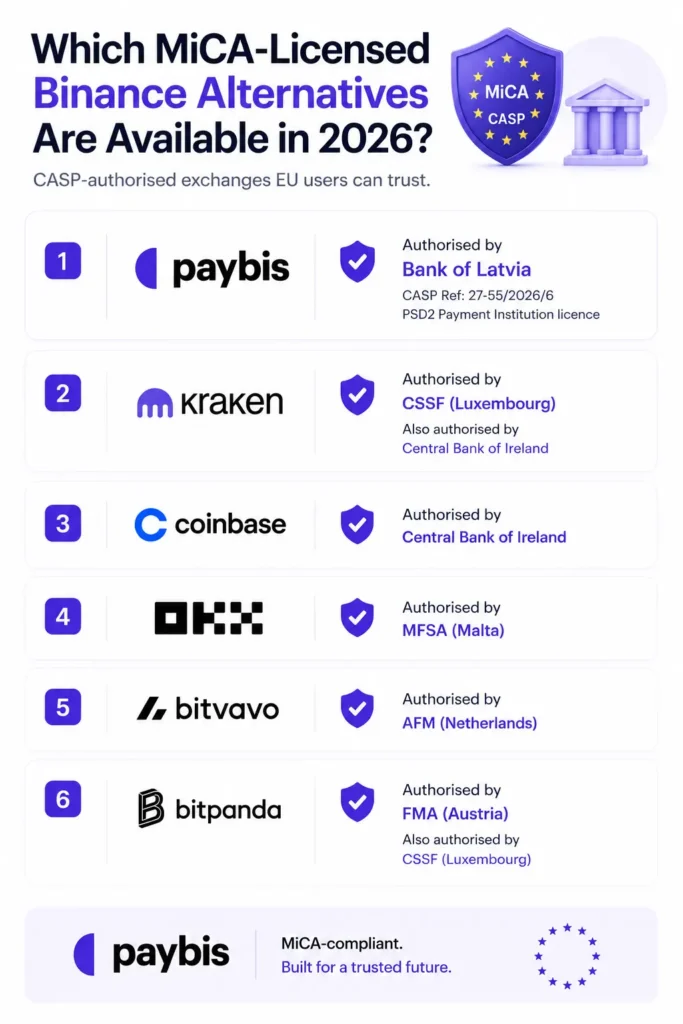
For the wider picture, including which member states have issued the most authorisations, see our full breakdown of MiCA-licensed crypto exchanges.
Once your funds are somewhere licensed, you can carry on as normal. On Paybis you can buy Bitcoin with a bank account, buy Solana, sell crypto back to your bank, or check rates first with the Bitcoin calculator.
Bottom Line
The July 2026 deadline drew a hard line through the European crypto market. Around 210 firms cleared full CASP authorisation out of more than 3,000 that once operated under national rules, and Binance ended up on the wrong side of that line after withdrawing its Greek application six days before the cut-off.
If you are moving, the check is quick. Look the platform up in ESMA’s register and confirm the scope of its licence. Then send a test transfer before you move the rest. That process takes a few minutes and tells you more than any marketing page will.
Paybis holds a MiCA CASP licence and a PSD2 Payment Institution licence from the Bank of Latvia, both issued in May 2026 after full regulatory review. You can buy Bitcoin, buy Ethereum, or sell crypto back to your bank account on a platform supervised under the framework these rules created.
About Paybis
Paybis is a licensed cryptocurrency platform operating since 2014, with a mission to make crypto as accessible as regular money.
Paybis holds a MiCA CASP authorisation from the Bank of Latvia (ref 27-55/2026/6), a full licence that passports across all 27 EU member states, along with a PSD2 Payment Institution licence from the same regulator (ref 27-55/2026/7). It is also registered with FinCEN in the United States (31000272911973), with FINTRAC in Canada (C100000816), and as a VASP in Poland (RDWW-805), and maintains PCI DSS certification.
More than 7 million users have chosen Paybis to buy and sell over 90 cryptocurrencies across 180+ countries. Payment options run to 22 methods, from cards and bank transfers through to PayPal. Support is available 24/7 through live chat with a typical response time of one to two minutes. Paybis is rated 4.1 out of 5 across more than 31,900 reviews on Trustpilot. The first time you buy each crypto with a card, Paybis takes nothing on top.
FAQ
Are all MiCA-licensed exchanges authorised for the same services?
No. MiCA defines ten separate crypto-asset services, and each authorisation specifies which ones a firm is allowed to provide. A platform can hold a licence for custody without holding one for operating a trading platform. ESMA’s register shows the exact scope for every authorised CASP, so it is worth confirming that a platform covers the service you actually need.
Will Binance come back to the EU?
Binance has said it intends to pursue authorisation in another EU member state and described the suspension as temporary. As of late July 2026 it has not confirmed which country it will apply in or given a timeline, and it does not appear in ESMA’s register of authorised CASPs. Until that changes, it cannot legally serve EU clients.
Which crypto exchanges are MiCA licensed?
Around 210 firms hold full CASP authorisation across the EEA. Publicly confirmed names include Paybis, authorised by the Bank of Latvia, along with Kraken, Coinbase, OKX, Crypto.com, Bitstamp, Bitpanda, and Bitvavo, each authorised through a specific member state. The authoritative source is ESMA’s public register, which updates weekly.
Is it illegal for me to use an unlicensed exchange?
The obligation under MiCA falls on the exchange rather than on you as a user. Using an unlicensed platform is not a criminal act on your part. The practical risk is different, since an unlicensed platform sits outside the protections MiCA created, including mandatory fund segregation and fee disclosure before you confirm a transaction.
Does a licence from one EU country cover the others?
Yes. A CASP authorisation from any single member state passports across all 27 EU countries and the broader EEA. A platform licensed in Latvia, Malta, or Ireland can legally serve you wherever you are in the bloc, so there is no need to look for one licensed specifically in your own country.
Disclaimer: Don’t invest unless you’re prepared to lose all the money you invest. This is a high‑risk investment and you should not expect to be protected if something goes wrong. Take 2 mins to learn more at: https://go.payb.is/FCA-Info