
What Does “CASP Authorised” Mean When You See It on a Crypto Platform?

- CASP stands for Crypto-Asset Service Provider. A CASP authorised platform holds a full licence under the EU’s MiCA regulation.
- Authorisation is stronger than registration. A regulator has reviewed the business and approved it to handle your money.
- One CASP licence covers all 27 EU countries through passporting. The platform applies once at home and can then serve clients across the Union.
- You can check any platform’s status yourself on ESMA’s public CASP register in under a minute.
- Paybis holds MiCA CASP authorisation from the Bank of Latvia, so you can buy Bitcoin and buy Ethereum on a licensed platform.
You are on a crypto website, and you spot a line like “CASP authorised” or “MiCA CASP licence.” It sounds official. But what does it actually mean for you and your money?
The short version is simple. It means an EU financial regulator has licensed that platform to offer crypto services. The label comes from MiCA, the European Union’s crypto rulebook. A CASP authorised platform has passed a real review.
This guide explains the term in plain language. You will see what it means and how to check it is genuine before you hand over any money.
What Does “CASP Authorised” Mean?
“CASP authorised” means a crypto platform holds a full licence under MiCA, the EU’s crypto regulation. CASP stands for Crypto-Asset Service Provider. A regulator in one EU country has reviewed the business and approved it to serve clients.
MiCA is the EU’s single rulebook for crypto. Any platform that serves EU crypto users now needs this licence.
The licence is granted by a national regulator, called a competent authority. For Paybis, that regulator is the Bank of Latvia. Another platform might be licensed in Germany or Ireland.
Once a platform holds the licence, it must follow strict rules on how it runs and how it protects your funds. A regulator can inspect it. It can also remove the licence if the platform breaks those rules.
What Is the Difference Between “CASP Authorised” and “Registered”?
Registration and authorisation are two different things. Registration confirmed that a company existed and had signed up to basic anti-money-laundering rules. Authorisation means a regulator has examined the business and approved it to handle client money.
Before MiCA, most EU countries used a system called VASP registration. This was a light-touch process. It put a company on a list. It did not mean a regulator had checked how the business was run.
A CASP licence sits at a higher bar. The regulator reviews the platform’s finances and security. It also checks how the platform safeguards customer funds. Only then does it approve.
So a registered platform and an authorised platform are not the same. When you see “CASP authorised,” a regulator has done real work before granting it. You can read more in our crypto license glossary entry.
| Criteria | CASP authorised | VASP registered |
|---|---|---|
| What it confirms | Regulator reviewed and approved the business | Company exists and signed up to AML rules |
| Client fund protection | Required and supervised | Not guaranteed |
| Works across the EU | Yes, all 27 countries | Home country only |
| Ongoing supervision | Yes | Limited |
Does a CASP Licence Work Across All of Europe?
Yes. One CASP licence covers all 27 EU member states through a system called passporting. A platform applies once in its home country and can then serve clients across the whole Union.
This is the main benefit of MiCA. Before it, a platform needed separate approval in almost every country. Now one licence is enough.
For you, this means a licensed platform can legally serve you anywhere in the EU. The same consumer protections follow you across borders. Paybis is authorised in Latvia and passports across all 27 EU member states.
How Do You Check if a Platform Is Really CASP Authorised?
You can verify any platform on ESMA’s public CASP register. ESMA is the EU’s markets regulator. Its register lists every authorised CASP, and the check takes under a minute.
Here is how to do it:
- Go to the ESMA website and open its register of CASPs.
- Search for the platform’s name.
- Check that the entry shows full authorisation, not a pending or withdrawn status.
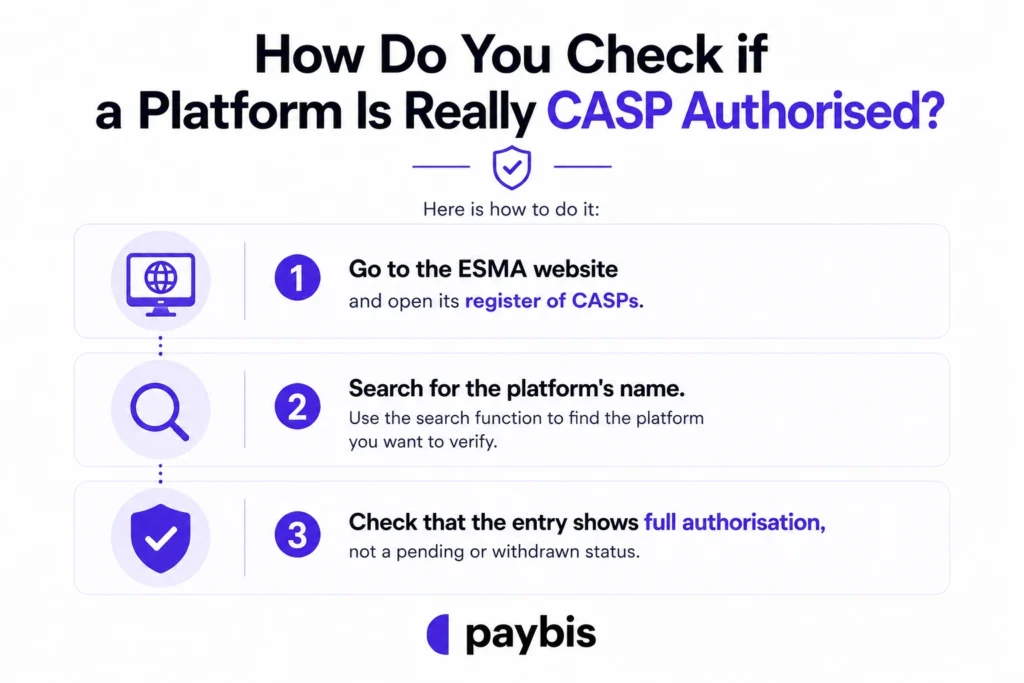
If a platform claims to be licensed but does not appear on the register, treat that as a warning sign. A genuine licence always shows up in the regulator’s own records.
You can also look at the platform’s own site. A licensed platform usually names its regulator and licence clearly. Vague wording like “compliant” with no named regulator means little. For a wider view, see our full list of MiCA-licensed exchanges.
Why Does CASP Authorisation Matter for You?
CASP authorisation matters because it forces a platform to protect your money. Licensed platforms must safeguard client funds and follow strict security rules. They also answer to a regulator that can act if something goes wrong.
An unlicensed platform answers to no one. If it disappears with your funds, you have little to fall back on.
A CASP-authorised platform sits under active supervision. It has to meet capital rules and keep your assets safe. It can lose its licence if it does not. That gives you a layer of protection that unregulated platforms cannot offer.
This is why the label is worth looking for. A quick check for CASP authorisation is one of the simplest safety steps you can take before you buy crypto anywhere.
Is Paybis CASP Authorised?
Paybis has operated since 2014 and serves more than 7 million users across 180+ countries. The CASP licence means EU customers use a platform that a financial regulator has reviewed and approved.
Alongside its EU licences, Paybis is registered with FinCEN in the United States and FINTRAC in Canada. It also holds a VASP registration in Poland and is PCI DSS certified for card security.
For you, that means you can buy Bitcoin and other crypto on a licensed, supervised platform. You can also verify Paybis yourself on the ESMA register in under a minute.
Bottom Line
“CASP authorised” is a signal worth trusting. It means an EU regulator has licensed the platform under MiCA and checks that it protects your money.
Before you buy crypto, take a minute to confirm the licence on the ESMA register. If a platform is authorised, its name will be there.
Paybis holds MiCA CASP authorisation from the Bank of Latvia. You can buy crypto on a platform that meets EU licensing rules.
FAQ
Is "CASP authorised" the same as "MiCA compliant"?
The precise term is CASP authorisation, or MiCA CASP licence. “MiCA compliant” is vague wording. Authorisation means a named regulator has granted a licence under MiCA.
Does CASP authorisation cover the UK?
No. The UK is outside the EU, so MiCA does not apply there. The UK runs its own crypto rules through the FCA.
Can a CASP licence be taken away?
Yes. A regulator can suspend or withdraw a CASP licence if a platform breaks MiCA rules. This is why active supervision matters.
What happens to my money if a CASP platform fails?
MiCA requires CASPs to safeguard client assets and keep them separate from company funds. This improves the chance that you can recover your assets.
Disclaimer: Don’t invest unless you’re prepared to lose all the money you invest. This is a high‑risk investment and you should not expect to be protected if something goes wrong. Take 2 mins to learn more at: https://go.payb.is/FCA-Info