Centralized vs. Decentralized Crypto Swaps Compared
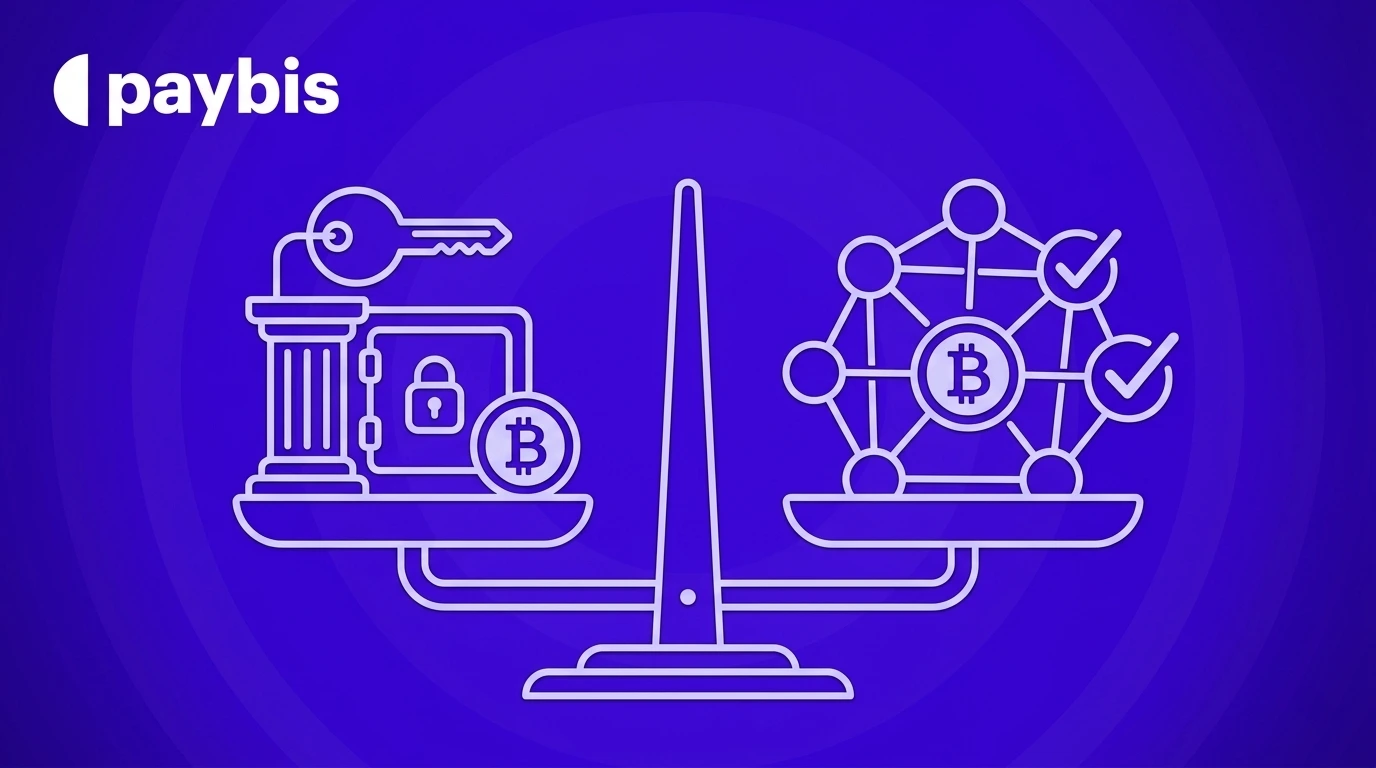
Key Takeaways:The core difference between centralized (CEX) and decentralized (DEX) crypto swaps comes down to one practical barrier: DEXs only accept crypto to pay for transactions. Centralized platforms like Paybis let you swap local fiat currency (PIX, credit cards, bank transfers) directly for crypto in under 15 minutes with 24/7 human support, whether you buy Bitcoin with PayPal, RevolutPay, or Paysafe Card. DEXs are built for advanced users who already hold crypto, want total custody, and are comfortable managing gas fees and smart contract risks with no assistance. For first-time buyers and casual users in Latin America, Africa, and Asia, a regulated CEX is faster, safer, and more practical.
A centralized crypto swap uses a regulated platform to convert your local currency (or one crypto) into another, with fees and steps handled for you. A decentralized swap uses automated code called a smart contract to swap crypto directly from your wallet, but you must already own crypto, manage your own private keys, and absorb unpredictable network fees. We process swaps in under 15 minutes at Paybis, operating in 180+ countries with 20+ payment methods and access to 90+ cryptocurrencies, showing all fees before you confirm. Fees start from 1.49% for the service component, with every charge displayed upfront.
What Is a Crypto Swap?
When you swap crypto, you exchange one asset for another. That could mean converting your local currency (Brazilian reais, US dollars, British pounds) into Bitcoin, or trading Bitcoin for Ethereum once you already hold crypto. You’ll see “swap” used interchangeably with “exchange” or “convert,” and you can execute swaps on two fundamentally different platform types: centralized exchanges (CEX) and decentralized exchanges (DEX). Our guide to how to swap crypto instantly covers the mechanics in more detail for anyone who wants a deeper look before committing to a platform.
Choosing the wrong type for your situation costs time, money, and sometimes your entire transaction.
How Centralized Crypto Swaps Work
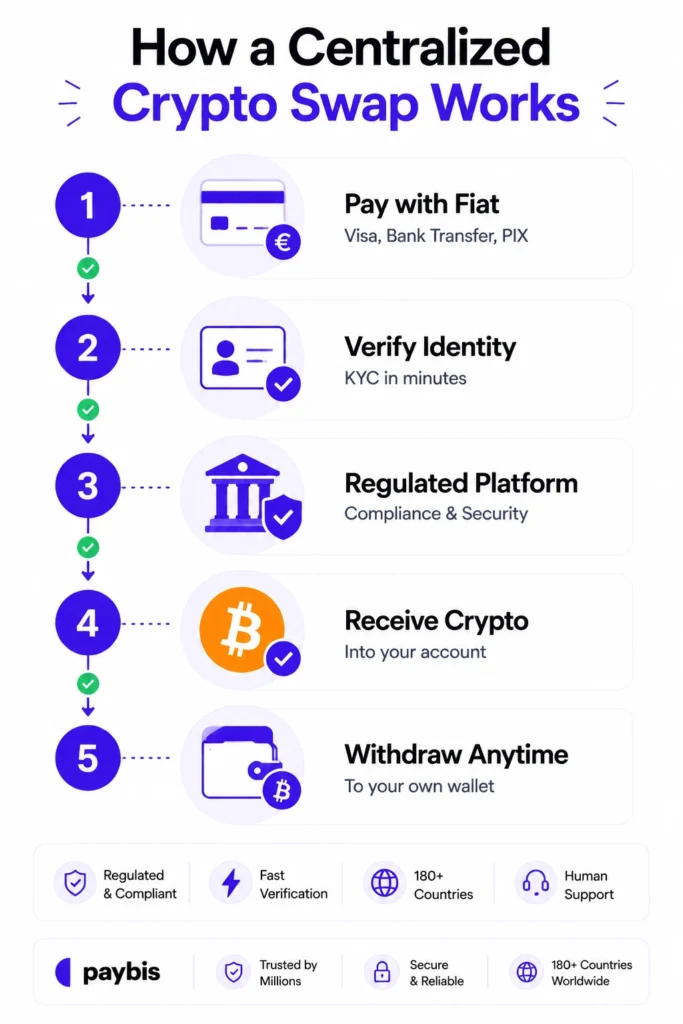
A centralized exchange converts your local currency into crypto using a regulated platform. You tell us how much crypto you want, we show you the total cost including all fees, you pay, and the crypto arrives in your account. A company runs the platform, a compliance team checks identities, and a customer service team is available if something goes wrong.
We hold your crypto in custody until you withdraw it to an external wallet using our wallet withdrawal guide.
The Role of Fiat On-ramps and Off-ramps
A fiat on-ramp converts your local currency into crypto. Without one, you can’t enter the crypto ecosystem unless someone who already owns crypto sends you some. We support 20+ payment methods including PIX (Brazil), Webpay (Chile), FPS (UK), Skrill, and Visa or Mastercard debit cards across 180+ countries. Our step-by-step buying guide shows exactly how the fiat-to-crypto conversion works in practice.
The off-ramp reverses the process: you sell crypto and receive local fiat directly to your bank account or PIX wallet. Our wallet sell guide covers this in full.
KYC Verification and Compliance
KYC (identity verification) confirms you are who you say you are. It’s a legal requirement for regulated platforms and protects users from fraud.
Most platforms make this painful. FXEmpire’s independent review confirms our verification process typically takes under 2 minutes for 80% of users who submit clear documents, compared to 24-hour cooldown periods or multi-day waits elsewhere. You upload a government ID, take a selfie, and the automated system returns approval within 5 minutes in most cases. We’re registered with FinCEN (MSB, US entity 31000272911973) and FINTRAC (MSB, CA entity C100000646), giving you the compliance assurance that verified, regulated platforms provide.
How Decentralized Crypto Swaps Work
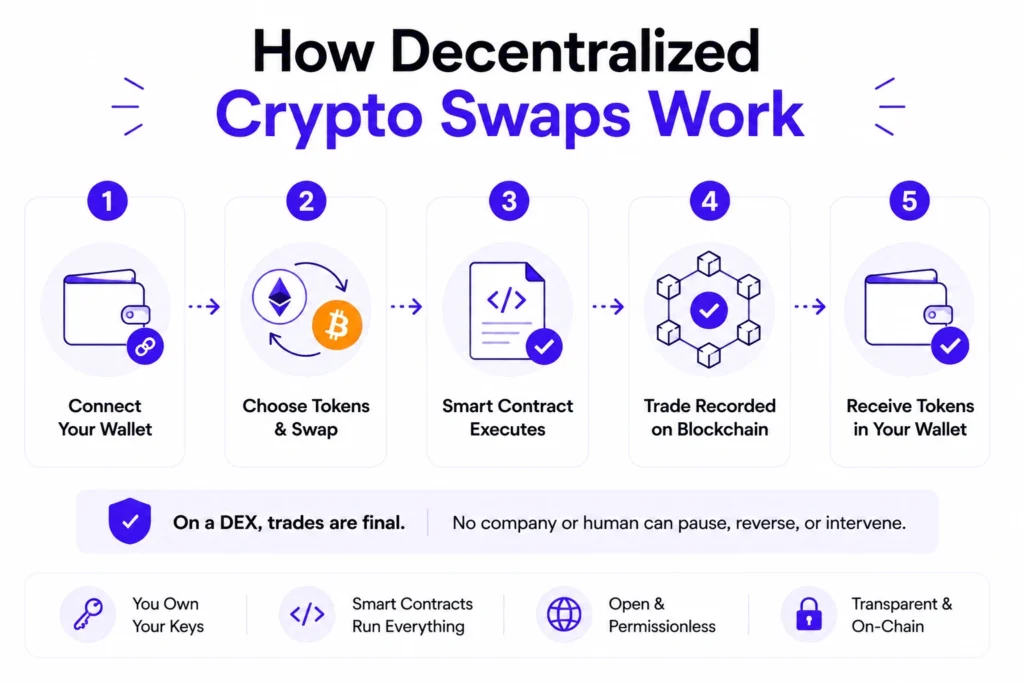
A decentralized exchange (DEX) has no company behind it. Self-executing code deployed on a blockchain runs the platform. When you connect your wallet and execute a swap on Uniswap or SushiSwap, you interact directly with that code. As Galxe’s DEX trading course explains, once a trade executes, it’s final, and no human can intervene, pause, or reverse it.
Non-custodial Wallets and Smart Contracts Explained
A non-custodial wallet is a crypto wallet where only you hold the private keys (the password controlling your funds). No company can recover it if you lose access, which means you carry 100% of the risk, as our guide to custodial wallet risks explains. If you’re new to the concept of blockchain-based wallets, our overview of whether blockchain wallets are safe is a useful primer before you decide which custody model suits you.
A smart contract is automated code that executes when preset conditions are met. Think of it like a vending machine: you put in one token, press the button, and the machine gives you another. Nobody stands behind the counter, and if the machine breaks, nobody fixes it for you.
The Challenge of Buying Crypto with Fiat on a DEX
Here’s the fundamental barrier DEXs create for beginners: you can’t buy crypto with a credit card or PIX payment on a DEX. You must already own crypto before you can do anything on one. You also need to hold the specific network’s native token (like ETH for Ethereum-based DEXs) just to pay the transaction fee, called a gas fee.
Before using any DEX, you must first buy crypto from a centralized exchange, transfer it to a compatible wallet, and only then connect to the DEX. That means the path to a DEX always starts with a CEX, making centralized platforms the unavoidable entry point for anyone without existing crypto.
Centralized vs. Decentralized Swaps: Feature Comparison
The table below covers the five dimensions that matter most when choosing a platform.
| Feature | Centralized (CEX) | Decentralized (DEX) | Why it matters |
|---|---|---|---|
| Fiat support | Yes (cards, PIX, bank transfer) | No (crypto only) | You can’t use local currency on a DEX |
| Speed | Under 15 minutes end-to-end | 15 seconds for the swap, but setup takes hours | DEX setup adds significant friction |
| Fee transparency | All fees shown before confirmation | Gas fees only visible at execution | CEX fees are predictable; DEX fees aren’t |
| Customer support | 24/7 live chat, human agents | None | No one to call when a DEX transaction fails |
| Custody | We hold your funds | You hold your funds | CEX is easier to use; DEX requires full self-responsibility |
Transaction Speed and Small Purchases
We process card transactions instantly, with settlement near-instant depending on the blockchain, and lock your rate for 15 minutes while you complete the purchase.
A $50 swap on an Ethereum-based DEX might cost $10 to $50 in network fees during congestion. Coinlaw’s Ethereum gas fee statistics document that on February 19, 2025, transaction fees surged to $50 per swap, meaning the fee exceeded the value of a small purchase entirely. A Bitget analysis of Ethereum gas fees confirms a single token swap typically consumes 150,000 to 250,000 gas units, translating to $5 to $50 depending on network conditions. For someone swapping $200 in crypto, that’s a 2.5% to 25% fee just to execute the trade, and it’s not shown until you’re already in the transaction. Our cryptocurrency trading guide explains how to factor these costs into your strategy before you commit to any platform.
Fee Structures and Hidden Costs
We charge three fees at Paybis, and all three appear before you confirm a transaction. Our fee structure guide breaks this down:
- Service fee: Starts from 1.49% (0% on your first card transaction)
- Processing fee: 4.5-8.5% for card transactions over $50, depending on currency
- Network fee: Varies by blockchain demand, shown dynamically at checkout
On a $500 purchase after your first transaction, you pay approximately $7.45 in service fees plus $22.50-$42.50 in processing fees plus a network fee, all visible before you click confirm.
DEXs charge 0.20-0.30% per swap, which sounds cheaper. But add unpredictable gas fees plus the cost of acquiring and transferring crypto into a non-custodial wallet first, and the total cost for a first-time user frequently exceeds what a regulated CEX charges.
Security Risks and Custody
Both models carry risk, but the nature of the risk differs. Centralized platforms carry custodial risk: we hold your funds, so our security matters. We’ve maintained a clean security record since 2014, hold PCI DSS Level 1 certification, and use multi-party computation (MPC) technology for wallet security.
DEXs carry smart contract risk and user error risk. Scammers routinely trick users into approving contracts that drain their wallets. And if you send crypto to the wrong network, as our wrong-network support article explains, recovery is rarely possible. There’s no support team to call. For a broader look at how blockchain infrastructure holds up against attacks, our article on whether blockchain can be hacked provides useful context on the underlying risks.
“Paybis offers transactions in a quick and easy format with thorough security measures. I’ve been using their app for quite some time and have had no issues.” – Amanda Stringfellow on Trustpilot
How Paybis Simplifies the Crypto Swap Process
We built Paybis specifically for users who want to buy or swap crypto using local payment methods without learning to navigate trading platforms. Here are three features that make the difference for first-time and casual buyers.
1. Simple calculator interface. Our homepage shows one tool: “You send [amount in local currency] → You get [amount in crypto].” There are no trading charts, no order books, and no “maker/taker” terminology. Our Paybis wallet swap guide and external wallet swap guide walk through the exact steps.
2. 2-minute verification flow. Upload a government-issued ID and take a selfie. For 80% of users who submit clear documents, approval arrives within 2 minutes. Our support team is available to resolve verification questions, and FXEmpire confirms this is among the fastest in the industry.
3. 24/7 live chat with human agents. Our 24/7 support team maintains an average chat response time of approximately 15 seconds. When a transaction shows an unexpected status, there’s a human agent available to investigate immediately. This is the single biggest contrast with DEXs, where there’s no one to contact after a trade executes.
“The Paybis app it’s the easiest I’ve ever used it was the easiest I got to get verified it was the easiest to just complete the account setup and then I did use it one time and it was the easiest.” – Tammy on Trustpilot
“Paybis is so easy to use compared to many other companies in the same field. It is quick and you get your receipt and information right away.” – Tuula Rantanen on Trustpilot
We currently serve 5M+ retail users across 180+ countries, have processed $1.2B+ in annual transaction volume, and hold 30,830+ Trustpilot reviews with a rating of 4.1 or “Great.” The Benzinga Paybis review and the Coin Bureau Paybis review both document these proof points independently.
The FXEmpire video walkthrough gives a complete visual overview:
Our analysis of why users switch platforms documents the most common failure points, and the BitPay support comparison illustrates the gap between automated bots and human-first support.
Ready to swap? Use our Paybis calculator to see the exact upfront cost, complete 2-minute identity verification, and confirm the total before committing.
Key Terminology
- Fiat on-ramp: The process of converting local government-issued currency (USD, BRL, GBP) into cryptocurrency. Centralized platforms like Paybis provide this bridge using payment methods such as credit cards, PIX, and bank transfers.
- Smart contract: Self-executing code deployed on a blockchain that automatically carries out a swap when preset conditions are met. It operates like a vending machine: it dispenses a result when you input the required token, with no human involvement and no ability to reverse a completed transaction.
- Network fee (gas fee): The cost paid to blockchain miners or validators to process your transaction on-chain. On Ethereum, this fee fluctuates with network congestion and can range from under $1 to over $50 per transaction. We display the current network fee before you confirm at Paybis.
- Non-custodial wallet: A crypto wallet where you hold the private keys and carry full responsibility for your funds. No company can recover access if you lose your keys. A Web3 wallet like MetaMask is a common example used to connect to DEXs.
FAQ
Can I swap crypto to cash on a DEX?
No, DEXs only swap one crypto for another. You need a centralized exchange with a fiat off-ramp to withdraw to a bank account, PIX wallet, or other local payment method.
Are crypto swaps taxable?
Yes, in most jurisdictions. The IRS classifies cryptocurrency as property under Notice 2014-21, making swapping one crypto for another a taxable disposal event. Consult a local tax professional for your specific situation.
How long does a crypto swap take on Paybis?
Card transaction processing is instant (under 1 minute), with settlement near-to-instant depending on the blockchain. End-to-end from account creation to receiving crypto takes under 15 minutes for most first-time users.
Disclaimer: Don’t invest unless you’re prepared to lose all the money you invest. This is a high‑risk investment and you should not expect to be protected if something goes wrong. Take 2 mins to learn more at: https://go.payb.is/FCA-Info