
Crypto Adoption Statistics 2026: Europe and Global Data

- 559 million people worldwide hold cryptocurrency in 2026, up from 420 million in 2023.
- Global crypto adoption stands at 9.9% of the internet population. Roughly 1 in 10 internet users holds crypto.
- Europe hosts over 100 million crypto users, with wallet adoption growing 12% year-over-year.
- Asia-Pacific leads globally at 23% adoption, driven by India and Southeast Asia.
- 60% of all crypto users worldwide are under 35. The average global crypto user is 34 years old.
- 78% of users access crypto via mobile. The shift from desktop to mobile is nearly complete.
Half a billion people now hold cryptocurrency. That number cleared 559 million in 2026, up from 420 million just three years ago. To put it in context, that is roughly the combined population of the United States and the European Union. The growth has come from every direction: emerging markets using crypto to hedge against currency instability, developed economies building institutional infrastructure, and younger generations treating digital assets as a normal part of their financial lives.
This article pulls together the key statistics behind that growth: globally, regionally, and across Europe specifically. If you want to buy Bitcoin and join the 559 million, Paybis operates across 180+ countries under the MiCA CASP licence.
How Many People Own Crypto Globally in 2026?
The headline figures for 2026:
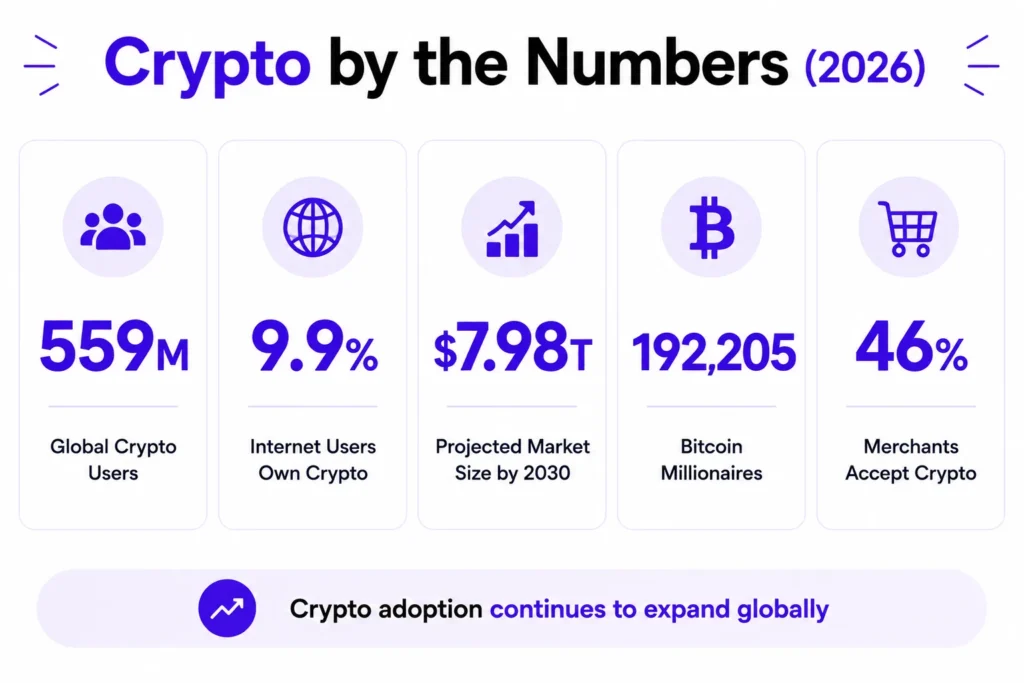
- 559 million people worldwide hold or use cryptocurrency
- 9.9% of the global internet population owns crypto
- Global crypto market projected to reach $7.98 trillion by 2030
- 192,205 Bitcoin millionaires currently exist
- 46% of merchants globally now accept crypto as payment
The growth from 420 million users in 2023 to 559 million in 2026 represents a 33% increase in three years. The pace has accelerated alongside improving regulatory clarity in major markets, the launch of spot Bitcoin and Ethereum ETFs in the US, and the rollout of MiCA across the EU.
Asia-Pacific accounts for the largest share of global users at around 37.6% of the market. But the fastest growth in percentage terms is coming from Africa, where adoption grew 19.4% year-on-year in 2025, and Latin America, where currency instability has made crypto a practical financial tool for tens of millions of people.
Which Regions Have the Highest Crypto Adoption?
Regional adoption rates vary significantly, reflecting different economic conditions, regulatory environments, and demographic profiles.
| Region | Adoption Rate | Active Wallet Users |
|---|---|---|
| Asia-Pacific | 23% | ~350 million |
| Latin America | 15% | ~92 million |
| Africa | 14% | ~75 million |
| North America | 16–17% | ~134 million |
| Europe | 8.9–12% | ~140 million |
| Middle East | 10–11% | 30+ million |
| Oceania | ~10% | — |
A few standout numbers from individual countries:
- Turkey: 25.6% of the internet population owns crypto, one of the highest rates of any country globally
- Philippines: 22–23% ownership, largely driven by remittance activity
- India and the United States: Leading the Chainalysis 2025 Global Adoption Index in absolute terms
- El Salvador: Bitcoin remains legal tender, with 85% of small businesses accepting BTC
Asia’s dominance is structural. Seven of the top 10 countries in the 2025 Chainalysis Global Adoption Index were Asian. Mobile-first infrastructure, large unbanked populations, and strong remittance demand all contribute to the region’s lead.
Africa’s growth rate is the story of the next five years. Mobile wallet integration is the highest of any region globally, and the use cases go well beyond investment. Crypto is actively used for savings, remittances, and hedging against local currency depreciation in several African markets.
How Is Crypto Adoption Growing in Europe?
Europe’s adoption numbers are lower in percentage terms than Asia or Latin America, but the absolute scale is significant, and the regulatory environment is now the most comprehensive in the world.
Key European figures for 2026:
- 100 million+ crypto users across Europe
- 140 million wallet users, up 12% year-over-year
- 8.9–12% of European adults own crypto
- EUR $205 billion in annual crypto trading volume
- Germany, Spain, and Switzerland report the highest adoption rates within the EU
The launch of MiCA in December 2024 changed the regulatory landscape entirely. Europe now has the most comprehensive crypto regulatory framework in the world, covering platform licensing, token issuance, and user protections uniformly across all 27 member states. The effect on adoption has been positive: regulatory clarity tends to bring institutional participation, which in turn deepens liquidity and infrastructure for retail users. The full picture of what changed is covered in the crypto regulation in Europe guide.
The UK sits slightly outside this picture, operating under FCA registration rather than MiCA, but records double-digit ownership rates. A 2025 Deutsche Bank Research survey found that UK adults aged 18 to 34 saw crypto ownership jump from 14% to 26% over the course of 2025, the largest single-year increase recorded in any European market.
Germany has consistently been among the most crypto-forward European economies, partly due to its tax framework: gains on crypto held for more than twelve months are exempt from capital gains tax. That policy has made Germany particularly attractive for long-term holders.
Who Is the Average Crypto User in 2026?
The demographic profile of crypto users has shifted meaningfully from the early days when the community was dominated by technically sophisticated early adopters. The 2026 user base is broader, younger on average, and increasingly mobile-first.
Global demographics:
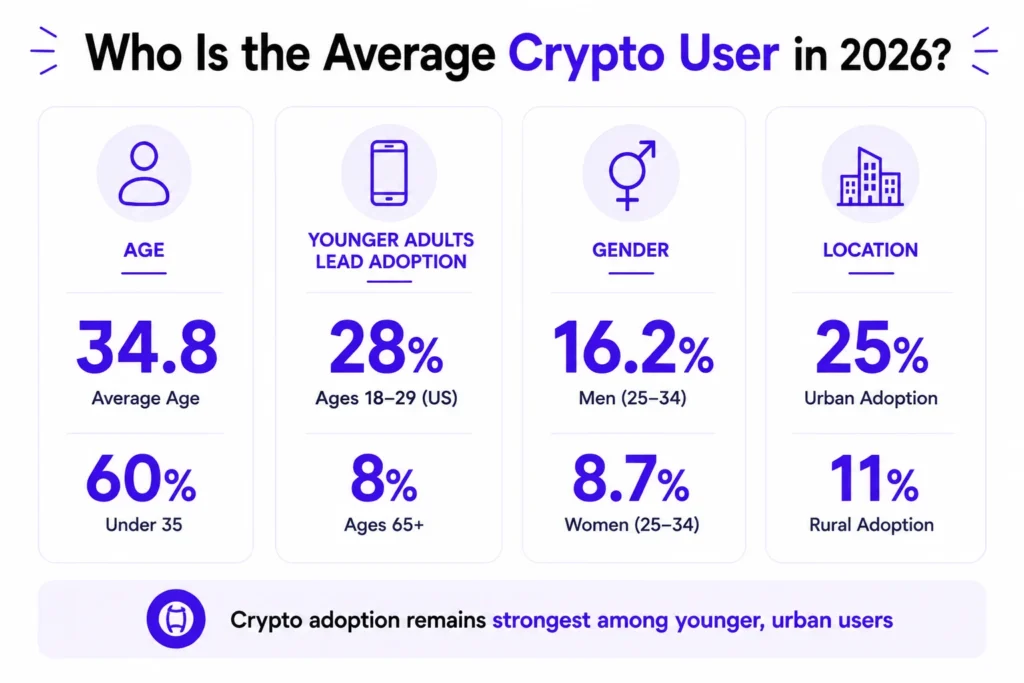
- Average age: 34.8 years old
- Under 35: 60% of all global crypto users
- 18–29 (US): 28% have invested in crypto; only 8% of those 65+ have done the same
- Gender gap: men aged 25–34 show 16.2% adoption; women the same age show 8.7%
- Urban vs rural: adoption is 25% among urban populations and 11% in rural areas
The gender gap is real but narrowing. Women’s crypto ownership grew faster than men’s in 2024 and 2025 across most major markets, particularly in Southeast Asia and Latin America, where mobile payment use cases drive adoption.
The urban-rural divide reflects infrastructure access as much as intent. In markets with reliable mobile internet and accessible exchanges, rural adoption tends to follow urban adoption with a lag of two to three years. That lag is shortening as mobile-first platforms expand coverage.
What Are People Using Crypto For?
The use cases driving adoption in 2026 are more diverse than the “investment only” narrative that dominated earlier cycles.
- Payments and remittances account for a growing share of activity, particularly in emerging markets. Cross-border remittance users reached 56 million globally, with Asia and Africa as the primary corridors. Crypto remittances offer faster settlement and lower fees than traditional wire transfers, which matters significantly for workers sending money home to families in countries with expensive correspondent banking.
- Savings and inflation hedging drive adoption in markets with weak currencies. Turkey’s 25.6% ownership rate reflects this directly. Venezuela, Argentina, and several African markets show similar patterns. For people in these economies, holding Bitcoin or stablecoins is a practical financial decision rather than a speculative one. Understanding how Bitcoin works helps explain why it functions as a savings tool in these contexts.
- DeFi and trading remain significant, particularly in Asia. Solana’s 3.6 million daily active addresses and the overall growth of on-chain DEX volume reflect a population actively using blockchain-based financial tools beyond simple buying and holding. Users looking to participate can buy Ethereum or buy Solana directly on Paybis.
- NFTs and gaming have attracted younger users who entered crypto through digital collectibles and play-to-earn mechanics. While NFT trading volumes are well below their 2021 peak, the user base that entered through these channels has largely stayed in the ecosystem.
- Institutional investment has scaled considerably since the launch of spot Bitcoin and Ethereum ETFs. Family offices, pension funds, and asset managers are allocating to digital assets at volumes that were not present in previous cycles.
What Is Driving Adoption Forward in 2026?
Several structural factors are pushing adoption higher simultaneously.
- Regulatory clarity is the most significant recent driver in developed markets. MiCA in Europe, the approval of spot ETFs in the US, and regulatory frameworks advancing in Asia and the Middle East have all reduced the uncertainty that previously kept institutional capital on the sidelines. Regulated products attract regulated capital. For anyone asking whether crypto is legal in their country, the Is Crypto Legal in Europe guide covers the EU picture in full.
- Mobile infrastructure has lowered the barrier to entry globally. Over 78% of crypto users now access services via mobile apps. In markets where desktop penetration is low but smartphone ownership is high, this has been transformative. Users who would never have set up a desktop exchange account can now buy, store, and send crypto in minutes.
- Stablecoins have become the practical bridge between crypto and everyday finance. Their use in remittances, freelance payments, and savings has introduced crypto to users who have no interest in speculation but do have an interest in a faster, cheaper financial system.
- Generation shift continues to move the demographic needle. As 18-to 34-year-olds become a larger share of the economically active population, their higher baseline crypto ownership translates directly into aggregate adoption growth.
Where Can You Buy Crypto in Europe?
Paybis serves users across 190+ countries and holds the MiCA CASP licence covering all 27 EU member states. The platform has operated since 2014 and has processed transactions for 6.9 million+ users.
European users can buy Bitcoin and Ethereum across 22 payment methods, including SEPA bank transfer, credit and debit card, Klarna, Apple Pay, Google Pay, PayPal, and Skrill. Fees are shown in full before any transaction is confirmed. Verification takes under two minutes for amounts above $1,000, and 24/7 live chat support is available throughout.
Under MiCA requirements, client funds are held separately from Paybis’s own assets. All fees are disclosed upfront.
Bottom Line
559 million people globally now hold cryptocurrency. Europe’s 100 million+ users sit within the world’s most comprehensive regulatory framework following MiCA’s full implementation. The average user is 34 years old, 60% of the user base is under 35, and 78% access crypto on mobile. The use cases have diversified beyond investment into remittances, savings, payments, and institutional allocation. Every data point from 2026 points toward a technology moving from early adoption into mainstream financial participation.
FAQ
How many people own crypto in 2026?
Approximately 559 million people worldwide hold or use cryptocurrency as of 2026, representing 9.9% of the global internet population. This is up from around 420 million users in 2023 and reflects sustained growth across all major regions. Asia-Pacific accounts for the largest share of global users, followed by North America and Europe. The growth rate has been fastest in Africa and Latin America in percentage terms, though developed economies lead in absolute capital flows and institutional participation.
What percentage of Europeans own crypto?
European crypto adoption sits between 8.9% and 12% of the adult population depending on the source and the specific countries measured. Europe hosts over 100 million crypto users and approximately 140 million wallet holders, with wallet adoption growing 12% year-over-year. Germany, Spain, and Switzerland report the highest rates within the EU. The UK, operating under a separate regulatory framework, recorded a significant jump in younger adult ownership during 2025.
Which country has the highest crypto adoption rate?
Turkey reports one of the highest rates globally, with approximately 25.6% of its internet population owning cryptocurrency. The Philippines follows at 22 to 23%. In absolute terms, India and the United States lead the Chainalysis Global Adoption Index. Emerging markets with currency instability and high remittance activity consistently rank among the highest adopters on a percentage basis, while developed markets lead in capital volumes and institutional participation.
Is crypto adoption growing or slowing down?
The data for 2026 shows continued growth. The user base expanded from 420 million in 2023 to 559 million in 2026, a 33% increase over three years. Growth drivers are diverse: regulatory frameworks improving in major markets, mobile infrastructure expanding access, stablecoin adoption increasing in emerging markets, and institutional participation growing through regulated ETF products. Africa recorded 19.4% year-on-year adoption growth, the highest of any region.
What is the total crypto market cap in 2026?
The total crypto market cap sits around $2.6 trillion in mid-2026. Bitcoin accounts for approximately 57 to 59% of that figure. The market is projected to reach $7.98 trillion by 2030 based on current growth trajectories, though crypto markets are volatile and projections at multi-year horizons carry significant uncertainty.
Disclaimer: Don’t invest unless you’re prepared to lose all the money you invest. This is a high‑risk investment and you should not expect to be protected if something goes wrong. Take 2 mins to learn more at: https://go.payb.is/FCA-Info