Crypto Exchange Limits Explained: Daily, Monthly, and Per-Transaction Maximums
– Crypto exchange limits control how much you can buy, sell, or withdraw within a certain timeframe.
– Limits usually depend on your identity verification level and payment method.
– Completing Paybis verification with a photo ID and selfie can unlock card transaction limits up to $20,000 per day; you can buy Bitcoin with a bank account or buy Bitcoin Cash with Paysafe Card once verified.
– Verification typically takes around 2 minutes; use the Binance Coin calculator to check amounts before you start.
– Paybis is FinCEN-registered, FINTRAC-registered, PCI DSS Level 1 compliant, and has served across 180+ countries since 2014 with no security breaches.
Crypto assets can increase or decrease in value. Paybis is a payment gateway, not an investment service. This content is for informational purposes only and does not constitute financial advice.
Crypto exchange limits block more first-time purchases than slow banks or confusing interfaces combined. A $1,000 card transaction can fail silently mid-checkout with no warning, no explanation, and no clear path forward. Whether you want to buy Bitcoin with a bank account or use a prepaid option like buying Bitcoin Cash with a Paysafe Card, understanding limits is the first step to a smooth purchase.
Exchange limits are not permanent barriers. They are security checkpoints that unlock the moment you complete identity verification. This guide explains why limits exist, how they work across daily, monthly, and per-transaction timescales, and how to increase them fast.
What Are Crypto Exchange Purchase Limits?
A purchase limit is a ceiling on the total value of crypto you can buy within a set period. The exchange sets it, not your bank. Hitting a purchase limit does not mean your card was declined or your bank blocked the transaction. It means your account has not been cleared for larger transactions yet.
One important distinction: a “limit order” is a trading tool that lets you set a specific target price at which you want to buy or sell crypto. The SEC defines a limit order as an order to buy or sell a security at a specific price or better. That is completely separate from an account “purchase limit,” which is a compliance-based restriction on transaction volume. Most first-time buyers confuse these terms and waste time looking in the wrong place for answers. For a broader look at how exchanges work and what to expect, this guide on how to choose which exchange to buy Bitcoin from covers the key factors.
Daily and Monthly Buying Limits
A daily buying limit caps how much crypto you can purchase within any rolling 24-hour window. A monthly limit applies the same logic across a 30-day period. Both reset on a rolling basis, not at midnight. HollaEx’s guide to withdrawal limits uses a clear example. A $20,000 daily limit with $10,000 used at 10:00 AM means that $10,000 refreshes exactly 24 hours later — not at midnight. Monthly limits look back exactly 30 days from the moment you transact.
Limits on Selling Your Crypto
Off-ramp limits (selling crypto back to fiat, meaning your local currency) are typically governed by the same KYC verification tiers as purchase limits, since both involve moving significant value through the platform and trigger the same compliance requirements. Paybis applies the same verification framework to both selling cryptocurrency from your wallet. For a full walkthrough of the withdrawal process, the Paybis withdrawal guide covers it step by step. If you prefer to convert holdings directly to cash, how to cash out Bitcoin walks through your options in plain terms.
Per-Transaction Maximums
A single transaction limit is separate from your daily allowance. You might have a $20,000 daily cap but a lower per-transaction ceiling depending on the payment method. Payment processors impose these per-transaction ceilings independently of the exchange’s daily allowance. This is why switching payment methods can sometimes unlock a purchase that a card checkout blocks.
Why Do Crypto Exchanges Have Purchase Limits?
Limits exist because moving large sums without identity checks creates serious risks for both the user and the financial system. This is not a discretionary policy. It is a legal requirement.
ID Checks and AML Compliance
Know Your Customer (KYC) rules require every regulated financial service to verify user identities before allowing significant transactions. As covered in KYC Chain’s compliance guide, regulations require crypto exchanges to implement robust KYC and AML programs, including identity verification, transaction monitoring, and reporting of suspicious activities.
Anti-Money Laundering (AML) rules are the framework behind those KYC checks. AML refers to laws designed to limit money laundering, identity theft, and tax evasion, as defined by Persona’s AML guide for crypto. The Financial Crimes Enforcement Network (FinCEN) sets these requirements for any platform operating in the United States. Paybis is registered with FinCEN and FINTRAC in Canada, which means Paybis’s limits operate within a compliant, legally audited framework. To understand why some buyers are hesitant about this process, why users are reluctant to buy crypto covers common concerns and how to address them.
Fraud Protection and Platform Capacity
Limits also function as a fraud containment layer. If an account’s credentials are compromised, transaction caps reduce the exposure window while the account owner regains control. Transaction limits combined with PCI DSS Level 1 compliance and cold storage protect funds at multiple levels. Paybis has operated since 2014 with no security breaches.
Platforms managing large transaction volumes also need enough crypto reserves to fulfill every order. Paybis processes $1.2B+ in annual transaction volume, which requires careful reserve management. For most buyers spending under $50,000, this is invisible. For very large purchases, it is why OTC desks exist as a separate route.
How to Increase Your Purchase Limits Through Verification
The most direct path to higher limits is completing identity verification.
How Much Can You Buy Without ID?
Almost nothing on a properly regulated platform. Some platforms allow micro-transactions under $50 without full verification, but these are edge cases. While some transactions may complete without full verification depending on payment method and amount, access to higher limits requires completing the full ID process. Anonymous buying at scale is not available on any FinCEN or FINTRAC-registered platform.
Fast ID Upload for Higher Limits
Paybis verification process is designed to take roughly 2 minutes. The steps are:
- Enter a phone number and confirm via SMS code.
- Upload a government-issued ID such as a passport or driver’s license.
- Take a selfie to match your face to the document.
- Receive automatic approval; most submissions are complete within 2 minutes when photo quality is clear.
The better the quality of the submission, the higher the chances of automatic approval. Once approved, Visa and Mastercard limits increase to $20,000 per day and $50,000 per month. For a detailed step-by-step walkthrough, how to create and verify an account covers the full process.
Unlock Higher Tiers with Address Proof
For higher transaction volumes, platforms require proof of address. Acceptable documents include a bank statement, utility bill, or official government letter. Per Paybis’s FAQ, all address documents must clearly show your full name, address, and date, must be complete and readable, and must not be older than 3 months. A blurred screenshot or cropped document will trigger a rejection and add delays.
The highest transaction tiers require a source of funds check for buyers moving tens of thousands of dollars. Acceptable documentation includes payslips, bank statements showing regular income, or business financial records. For first-time buyers spending $300 to $5,000, basic ID plus a selfie is all that is needed.
What Are Paybis’s Daily and Monthly Purchase Limits?
Paybis uses a single, clear verification tier rather than a confusing multi-level upgrade path.
Card, Bank Transfer, and E-Wallet Limits
For verified accounts using Visa or Mastercard, purchases are permitted up to $20,000 per day and $50,000 per month, per Paybis’s FAQ. EUR bank transfers allow up to EUR 100,000 per week, making them the higher-capacity option for large purchases. Skrill and Neteller carry a $200,000 daily and monthly cap, making them the highest-volume option available.
Per-Transaction Minimums and Maximums
The minimum transaction on Paybis is $5. For card transactions, the standard processing fee structure (4.5 to 8.5% depending on currency) applies to amounts over $50. Smaller amounts carry flat fees: $2 for $5 to $20, and $3 for $20.01 to $50. There is no single published per-transaction maximum that applies uniformly. Daily and monthly caps govern overall volume. For purchases exceeding standard limits, the Paybis OTC desk handles large-volume trades with customized pricing.
Paybis Limits: How They Stack Up for You
When comparing limits across platforms, verification speed is the deciding factor. A high daily cap is useless if unlocking it takes three business days.
| Platform | Daily Buy Limit | Monthly Cap | Verification Time | ID Required |
|---|---|---|---|---|
| Paybis | $20,000/day (card), EUR 100,000/week (bank transfer), $200,000/day (Skrill/Neteller) | $50,000/month (card); $200,000/month (Skrill/Neteller) | ~2 minutes (automated approval) | Passport, national ID, or driver’s license + selfie |
| Coinbase | Up to $25,000/day | Varies by method | Hours to days | Government-issued photo ID + selfie + proof of address |
| Binance (Verified Plus) | Unlimited crypto deposits; fiat purchases capped at $2M | Up to $2M fiat (deposits and withdrawals) | 1–3 days | Government-issued photo ID + selfie + proof of address |
| MEXC (Advanced KYC) | 200 BTC/day (withdrawal limit; fiat purchase limits not publicly specified in USD) | No monthly cap; limits denominated in BTC daily amounts | 24–48 hours | Government-issued photo ID + selfie |
How to Raise Limits on Paybis vs. Coinbase
Paybis uses an automated ID system. Submit clear photos and receive approval within 5 minutes. Coinbase uses a combination of automated and manual review. Most Coinbase customers see limits increase following account setup and verification. Higher tiers can involve multi-day waits. Bank transfer methods take 3 to 5 business days to clear, per Coinbase’s official support documentation.
The practical difference: a buyer who wants $5,000 of Bitcoin today can complete verification on Paybis and receive crypto in their wallet within minutes of starting. The same buyer on Coinbase may complete ID verification but then wait several days for a bank transfer to clear before any funds are available. For more context on why these timing differences exist, why instant crypto buys take days explains the mechanics behind settlement delays.
Paybis vs. Binance: Buying Power
Binance uses a multi-tier verification system where higher verification levels unlock larger fiat deposit and withdrawal limits, including up to $2 million for Verified Plus accounts. On paper, those ceilings are higher. In practice, reaching those tiers often means navigating an interface built for active traders, not first-time buyers. For someone who simply wants to buy $1,000 of Bitcoin without learning order books, Paybis removes the learning curve with a single-tier verification process and a simple calculator interface.
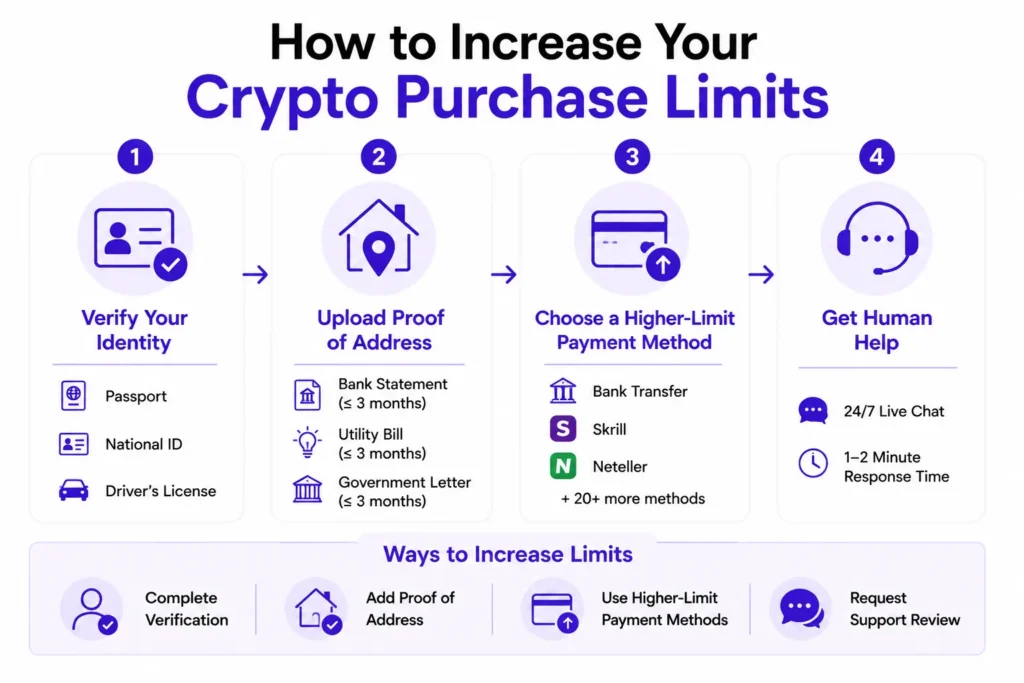
How to Increase Your Crypto Purchase Limits
Here is the exact process for raising limits on Paybis.
Documents Needed to Verify
Acceptable government-issued IDs include:
- Passport
- National ID card
- Driver’s license
The document must be current, fully visible, and photographed without glare or shadow. Take the photo in natural light rather than from a screen, and ensure all four corners of the document are visible. These small steps can mean the difference between a 2-minute automated approval and a 24-hour manual review.
Upload your chosen document through the Paybis verification process to unlock higher limits immediately upon approval.
Upload Proof of Address
For higher tiers, acceptable proof of address documents include:
- Bank statement (no older than 3 months)
- Utility bill (electricity, gas, water, internet)
- Official government letter
Your document must show your full legal name, current address, and an issue date within the last 3 months, per Paybis’s verification documentation.
Switch Payment Methods for Higher Caps
Switching payment methods can change your effective limits immediately without submitting additional documents. EUR bank transfers carry up to EUR 100,000 per week, higher than the card daily cap. Skrill and Neteller carry a $200,000 cap. Paybis supports 20+ payment methods including cards, SEPA bank transfers, Skrill, Neteller, PayPal, and local methods like PIX (Brazil) and FPS (UK). Use the Paybis calculator to test your amount and see exact fees before committing.
Get Human Help for Increased Limits
Paybis offers 24/7 live chat with an average first-response time of 1 to 2 minutes. If a verification submission gets rejected or a limit increase stalls, a support agent can review the account directly and explain exactly which documents are needed.
What to Do When You Hit a Purchase Limit
Why Your Buy Order Was Rejected
A rejected purchase is not always a limit issue. The most common causes include:
- Bank block: Some banks flag crypto purchases as suspicious and decline automatically. Contacting the bank’s fraud line to authorize crypto transactions can clear this.
- Name mismatch: The name on the Paybis account must match the name on the payment card exactly.
- 3D Secure failure: Paybis requires 3D Secure authentication during card checkout, a one-time code sent via text message or a prompt through your banking app. If that step times out or is not completed, the transaction fails.
- Insufficient funds including fees: For a $500 purchase, add the full service fee (1.49% after the first transaction), processing fee (4.5 to 8.5% depending on currency), and network fee before calculating the required card balance.
- Rolling limit reached: Part of your daily or weekly limit may have been used earlier and not yet refreshed.
Limit Reset Schedule
As explained in HollaEx’s withdrawal limits guide, limits on most platforms reset on a rolling basis, not at midnight or on the first of the month. A 24-hour rolling limit looks back exactly 24 hours from the current moment. This means capacity restores gradually as older transactions age out, rather than all at once at a fixed time.
If you transact at 3:00 PM on Monday, that portion of your limit starts refreshing at 3:00 PM on Tuesday.
Fixing a Rejected Purchase
Follow these steps in order:
- Check the transaction history or email notification for a rejection reason.
- Call your bank if the rejection is card-related and ask them to authorize crypto purchases.
- Check your rolling limit in the dashboard to confirm you have remaining daily capacity.
- Contact Paybis live chat (24/7, average response 1 to 2 minutes) for account-specific issues.
- Try a different payment method, such as a bank transfer or Skrill, if the card continues to fail.
Paybis does not charge for rejected transactions. If a transaction fails for security reasons, the funds return to the original payment source. For very large purchases above the standard card caps, the Paybis OTC desk handles trades directly with customized pricing and higher volume capacity.
Bitcoin vs. Altcoin Purchase Limits
Bitcoin has a total supply cap of 21 million coins, built into its protocol. This is called a “hard cap” and refers to the maximum number of Bitcoins that will ever exist. It has nothing to do with the amount of Bitcoin you can buy on an exchange. Exchange purchase limits are platform-specific compliance restrictions. Bitcoin’s 21 million supply cap and your personal purchase limit are completely unrelated concepts. Paybis applies the same purchase limits to Bitcoin and altcoins based on your verification tier and payment method. If you want to understand how much Bitcoin a given dollar amount can actually buy, how many dollars to buy a Bitcoin breaks down current pricing in plain terms.
You now understand how crypto purchase limits work, why they exist, and exactly how to increase them. To get started, create a Paybis account, complete identity verification, and use the calculator to see exact fees before confirming any transaction (fees start from 1.49%). Verified card accounts are eligible for limits up to $20,000 per day.
Key Terminology
- KYC (Know Your Customer): The identity verification process exchanges use to confirm who their users are before processing significant transactions. It typically involves uploading a government-issued ID and taking a selfie. Regulated platforms like Paybis are legally required to complete this process.
- AML (Anti-Money Laundering): Laws and regulations designed to prevent financial crimes including money laundering, tax evasion, and identity theft. These rules determine the limit tiers exchanges must enforce based on your verification level.
- Rolling limit: A time-based spending cap that resets continuously rather than at a fixed point like midnight. A 24-hour rolling limit looks back exactly 24 hours from the current moment, meaning capacity restores gradually as older transactions expire.
- Hard cap: The maximum total supply of a cryptocurrency, such as Bitcoin’s 21 million coin limit, written into the protocol code. This is a blockchain-level feature and is completely unrelated to an individual user’s purchase limit on an exchange.
- OTC (Over-The-Counter) desk: A service for high-volume crypto trades that exceed standard platform limits, offering customized pricing and direct support for large transactions typically starting above $50,000.
FAQ
What Is the Daily Purchase Limit on Paybis?
Verified Paybis accounts can purchase up to $20,000 per day and $50,000 per month using Visa or Mastercard, per Paybis’s FAQ. EUR bank transfers allow up to EUR 100,000 per week, and Skrill or Neteller accounts carry up to $200,000 per day and per month.
How Long Does It Take to Increase a Crypto Purchase Limit?
On Paybis, submitting a clear photo ID and selfie typically results in automatic approval within 5 minutes, per Paybis’s verification guide. On Coinbase, the manual review process can take several days depending on account history and document quality, according to their official support documentation.
Why Do Crypto Exchanges Have Purchase Limits?
Exchanges set purchase limits to comply with AML (Anti-Money Laundering) and KYC (Know Your Customer) regulations enforced by bodies like FinCEN, as required by the KYC Chain AML framework. Limits also reduce the potential impact of account compromises by capping how much can be transacted before a security review can occur.
What Is a Rolling 24-Hour Limit vs. a Calendar Day Reset?
Rolling limits restore on a 24-hour basis from the time of each transaction, not at midnight. If your daily limit is $20,000 and you used $10,000 at 10:00 AM, that $10,000 capacity returns at 10:00 AM the following day.
Disclaimer: Don’t invest unless you’re prepared to lose all the money you invest. This is a high‑risk investment and you should not expect to be protected if something goes wrong. Take 2 mins to learn more at: https://go.payb.is/FCA-Info