Best Crypto Swap Platforms for Emerging Markets: Latin America, Africa & Southeast Asia
Key Takeaways:Local payment methods (PIX, M-Pesa, GCash) fund crypto purchases instantly without slow international bank transfers, bypassing banks that block crypto transactions. You can explore how to get an M-Pesa statement to understand your funding options before you start. Hidden spreads and undisclosed fees drain your funds on complex trading platforms. Demand a full fee breakdown (service, processing, network) before confirming any transaction. Paybis delivers 2-minute verification, instant processing, and 24/7 support across 180+ countries, making it the simplest option for first-time buyers in emerging markets.
Most crypto platforms assume you have a US bank account and days to spare. If you’re in Brazil, Nigeria, or the Philippines, that assumption costs you real money, real time, and often your enthusiasm. This guide breaks down the top crypto swap platforms that actually work in Latin America, Africa, and Southeast Asia, showing you how to bypass slow bank transfers, use local payment methods like PIX and M-Pesa, and avoid hidden fees so you can own crypto quickly.
Tailored Crypto For Local EM Payment Methods
Crypto adoption in emerging markets isn’t slowing down. The challenge has never been demand; it’s access. When platforms don’t support your payment method, crypto stays out of reach no matter how motivated you are.
How Local Payments Drive Platform Choice
Domestic payment rails like PIX (Brazil), M-Pesa (Kenya), and GCash (Philippines) are not convenient alternatives. They’re the primary financial infrastructure for hundreds of millions of people. Connecting these systems directly to a crypto gateway removes the biggest barrier: multi-day international wire transfers. For users protecting purchasing power against inflation or sending remittances abroad, speed isn’t a luxury. It’s the entire point.
Platforms that support these local methods let users convert to stablecoins (crypto designed to hold $1, like USDC) or Bitcoin within minutes, preserving purchasing power before currency devaluation erodes it further. If you’re researching which assets to hold, it’s worth understanding the difference between Bitcoin and Bitcoin Cash before deciding where to start.
Why Local Banks Restrict Crypto
Traditional banks in emerging markets frequently block crypto transactions. According to the IMF, Nigeria’s Central Bank reportedly issued guidance restricting banks from servicing crypto exchanges in 2021, citing concerns about fraud and currency stability. The broader issue is what regulators call “cryptoization” (when people use crypto instead of the local currency for everyday transactions), which can circumvent capital controls and destabilize monetary policy.
This is exactly why alternative local payment methods have become necessary, not optional.
Simple Crypto Swaps: No Complexities
There’s a meaningful difference between token swaps on decentralized finance (DeFi) platforms and the simple fiat-to-crypto process most casual buyers need. DeFi swaps involve smart contracts, gas fees (the cost of running transactions on the Ethereum network), and exposure to price slippage (the difference between your expected price and execution price). You need significant technical knowledge to use them safely.
Direct gateways like Paybis work differently. You enter an amount in your local currency, see exactly how much crypto you receive, and pay with your existing card or local payment method. No order books, no trading jargon, no complexity. The Paybis wallet swap guide and external wallet swap process both reflect this simplicity. For a broader look at how to choose the right platform for your needs, the best crypto app guide is a useful starting point.
Scoring Platforms: Fees, Speed, Support
Evaluating a crypto swap platform for emerging markets requires a different lens than evaluating one for US or EU users. The criteria that matter most: does it support your local payment method, how long does verification take, what are the real total fees, and can you reach a human when something breaks?
Emerging Market Payment Options
The table below compares the two primary methods available to emerging market buyers.
| Method | Speed | Ease of Use | Risk Level |
|---|---|---|---|
| Direct crypto gateway (e.g., Paybis) | Instant to under 1 minute | Simple calculator interface | Low (regulated, compliant) |
| P2P trading (e.g., Binance P2P) | Variable | Requires counterparty trust and negotiation | Higher (chargeback risk, scam exposure) |
P2P platforms like Binance P2P offer low headline fees (takers typically pay no platform fees, though makers may pay a small percentage), but you must trust individual sellers, navigate complex interfaces, and manage escrow release yourself. For a first-time buyer, that complexity introduces real risk.
Evaluating Local Currency Options
Every extra currency conversion costs money. When a platform forces you into USD before crypto, you pay an FX conversion fee that platforms with direct local currency support avoid entirely. Paybis supports 70+ fiat currencies, meaning buyers in most emerging markets can transact in their native currency without a double-conversion penalty. For context on how alternative payment methods stack up against cards, the alternative payment methods vs. credit cards comparison breaks down the trade-offs clearly.
Fast ID Checks & Crypto Delivery
Identity verification (uploading a government ID and selfie so the platform confirms your identity, as required by law) is the first friction point for new buyers. Some platforms face challenges with verification processes and account security measures. On Coinbase, even verified users reportedly face holds before they can withdraw crypto to an external wallet, as documented in the Paybis vs. Ramp vs. Coinbase payment comparison.
Paybis completes verification in under 2 minutes for most users via automated photo recognition. The Coin Bureau Paybis review notes the verification process is typically completed within 15 minutes.
Avoiding Hidden Crypto Fees
“Zero fee” claims are common in crypto and almost always misleading. Platforms advertising no trading fees routinely embed a spread into the exchange rate: if Bitcoin’s true market price is $100,000, the platform shows you a buy price of $100,500 and keeps the difference. The spread is hidden and disclosed nowhere in the checkout flow.
Paybis takes a different approach. Every transaction shows three clearly separated line items before you confirm:
- Service fee: 1.49% (0% on your first card transaction)
- Processing fee: 4.5-8.5% for card transactions over $50, depending on currency
- Network fee: Variable, based on blockchain congestion at the time of your transaction
The 99Bitcoins Paybis fee analysis and the DigiChick Paybis tutorial both confirm this upfront transparency as a consistent platform strength.
“I like how easy it is to buy crypto with my card and send it directly to my wallet. The interface is clear, transactions are fast, and support has been helpful whenever I had questions.” – Elizar S. on G2
24/7 Human Support Access
Automated chatbots fail at the exact moment they’re needed most: when a transaction is stuck, a payment bounces, or crypto doesn’t arrive. Binance support queues can stretch for hours with responses that default to “check with your bank.” Coinbase routes users through automated systems with no access to a human decision-maker. If you’ve ever encountered a locked Coinbase account, you’ll understand exactly why responsive support matters.
Paybis runs 24/7 live chat with an average initial response time of approximately 15 seconds, with support available in 9 languages. Multiple verified users reference this directly:
“Paybis is a very good crypto exchange, and they have very good customer support and I am glad I can do business with them when I need to use crypto for certain business I need to take care of.” – Douglas Weaver on Trustpilot
Trusted Crypto Swap Apps For Latin America Payments
Latin America is one of the fastest-growing regions for crypto adoption, driven by currency instability, remittance demand, and rapid expansion of instant payment infrastructure. For a deeper look at the landscape, the crypto exchanges in Latin America guide covers regional platform options in detail.
1. Buy Crypto With Brazil PIX
PIX is Brazil’s central bank instant payment system, reportedly available 24/7 with no fees for individuals and settlement measured in seconds. With widespread adoption across Brazil, it has become the country’s dominant payment method.
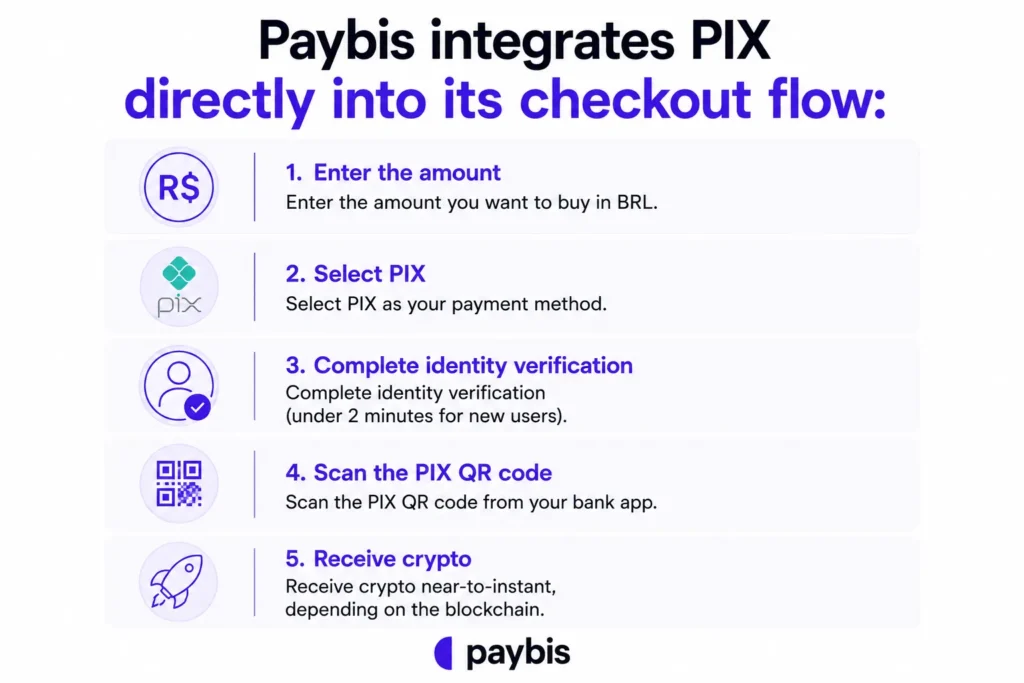
Paybis integrates PIX directly into its checkout flow:
- Enter the amount you want to buy in BRL
- Select PIX as your payment method
- Complete identity verification (under 2 minutes for new users)
- Scan the PIX QR code from your bank app
- Receive crypto near-to-instant, depending on the blockchain
Compared to Binance P2P in Brazil (where you must find a verified seller, negotiate, wait for escrow confirmation, and manage the transaction manually), Paybis’s PIX integration reduces the process to a straightforward purchase. Watch the Paybis crypto exchange guide for a full walkthrough:
2. Fund Crypto Via Regional Banks
Outside Brazil, Paybis supports regional payment options including Chile’s Webpay and Mexico’s SPEI for transfers between Mexican bank accounts. Both eliminate the need for international wires or USD-denominated cards. The Paybis sell crypto guide documents the process for connecting local accounts.
Platform 3: Payments Across Latin America
Crypto.com reportedly operates across several Latin American markets and offers card-based crypto purchases with a well-designed mobile interface. The trade-off is complexity: Crypto.com’s fee structure requires staking the platform’s native token (CRO) to unlock reduced rates, creating a learning curve that first-time buyers often find overwhelming. For the simplest experience without reward tiers, a direct gateway like Paybis processes faster with fully transparent fees.
Africa’s Top Crypto Swap Apps Explored
Mobile money has replaced traditional banking for hundreds of millions of Africans. According to IMF research on Sub-Saharan Africa, M-Pesa and similar mobile money services have reportedly achieved significant penetration across Kenya, Tanzania, Ghana, Egypt, and beyond, making mobile wallet integration essential for any platform serving the continent.
Platform 4: M-Pesa & African Mobile Swaps
Crypto exchanges like Paybis support M-Pesa as a payment method, letting users transfer funds from their mobile wallet to a broker and complete a crypto purchase, no traditional bank account required. The flow is familiar: enter your mobile number, confirm the push notification, receive crypto. Binance P2P also covers M-Pesa transactions, but the P2P model requires finding, evaluating, and trusting individual sellers. Dedicated gateways eliminate that friction entirely.
Platform 5: Cross-Border Crypto In Africa
Yellow Card reportedly operates specifically in African markets, offering direct fiat-to-crypto using local currencies. The platform supports mobile money integration and local fiat currencies including the Nigerian naira and Ghanaian cedi. The practical limitation is that Yellow Card typically serves more experienced users who already understand wallet addresses and blockchain confirmations. Support availability outside business hours also varies.
Platform 6: Buy Crypto With Local Fiat
Quidax reportedly serves West African markets with direct purchase support and a localized interface built for first-time buyers. The trade-off is geographic coverage: Quidax focuses on select West African markets, while global platforms like Paybis (covering 180+ countries) offer broader regional access.
“The best platform for making crypto transfers, even buying directly to your preferred crypto wallet. Congratulations to the creator!” – HICHAM EL HORMI on Trustpilot
Southeast Asia’s Easiest Crypto Swap Apps
Southeast Asia combines high mobile adoption with complex, country-specific payment rails. Thailand’s PromptPay, the Philippines’ InstaPay, and regional super-apps like GCash each serve distinct user bases with different regulatory environments.
Platform 7: Fast Local Bank Deposits
In Thailand, PromptPay reportedly enables real-time transfers between participating Thai bank accounts using a phone number or national ID. In the Philippines, InstaPay reportedly processes real-time transfers 24/7, while PESONet handles larger-value batch transactions. Platforms integrating these rails let Filipino and Thai users fund crypto purchases from existing bank apps without additional payment service signup. Settlement speed reportedly matches the underlying network characteristics.
Platform 8: Pay With Your Local Currency
GCash in the Philippines and GrabPay across Southeast Asia function as digital wallets pre-loaded with local currency, used daily for groceries to utility bills. Platforms connecting to these wallets remove the credit card requirement entirely, which matters in markets where card penetration remains low. Paybis supports 70+ fiat currencies globally, so users in the Philippines, Indonesia, and Vietnam can transact in native currency without conversion penalties.
Local Crypto Payment Options Explained
Brazil’s PIX For Fast Crypto Swaps
PIX reportedly uses QR codes and instant bank-to-bank transfers managed by Banco Central do Brasil. Transactions reportedly settle in seconds, 24/7, with no fees for individuals. Its security model ties registered keys (phone number, CPF, or email) to verified bank accounts, making it significantly harder to intercept than international wire instructions.
Africa’s M-Pesa For Crypto Payments
M-Pesa reportedly bypasses traditional bank accounts through a network of agents who convert cash to digital balance and back. For crypto platforms, mobile money integration means a user with only a phone number and SIM card can fund a purchase, which is transformative for financial inclusion in underserved areas. The IMF Sub-Saharan Africa fintech report confirms this as the critical enabler for legitimate crypto access across the continent.
Easy Local Bank Transfers For Crypto
Open banking frameworks across Southeast Asia have reduced domestic bank transfer times from days to seconds. PromptPay (Thailand) and InstaPay (Philippines) both operate on 24/7 real-time rails. Fee structures for both networks vary by provider and transaction amount; users should confirm current rates with their bank or payment app before transacting. Both remove the need for international card processing, which carries higher fees and more frequent declines in the region.
Choose The Right Crypto Swap App For You
Before selecting a platform, verify:
- Does it support your local payment method (PIX, M-Pesa, GCash, PromptPay, InstaPay)?
- Does it show all fees before you confirm, not after?
- How long does identity verification take?
- Can you transfer crypto to an external wallet immediately?
- Is 24/7 human support available in your language?
Hidden Fees And Exchange Rate Spreads
The spread is the gap between the market price of crypto and the price you’re actually quoted. If Bitcoin trades at $100,000 and you’re quoted $101,500, the platform earns $1,500 from you before any advertised fee applies. The safest check: compare the “You Get” amount against the real-time price on CoinMarketCap before confirming. Paybis’s calculator shows service, processing, and network fees explicitly, with no spread added on top.
Avoiding Verification Delays
To avoid delays on any platform:
- Use a valid, unexpired government-issued ID
- Photograph in good lighting with no glare
- Ensure the ID name exactly matches your payment method name
- Take selfies in well-lit rooms against plain backgrounds
Paybis uses automated verification, processing clear photos in under 2 minutes for most users. The Paybis ID verification guide covers preparation steps that apply across all fiat-to-crypto platforms.
Withdrawal Limits & Holds
Some platforms hold your crypto for 3-10 days after purchase even after payment clears. Coinbase’s standard practice reportedly involves holds after bank-funded purchases before allowing external wallet transfers, as detailed in the Ramp vs. Paybis vs. Coinbase payment analysis. Paybis reportedly processes card transactions with no hold on external wallet withdrawals, so you can send crypto to any wallet address immediately.
Common Crypto Swap Issues & Solutions
Transparent Fees By Country
Processing fees vary by local payment method and currency. Here’s how Paybis structures it:
- Card transactions over $50 (USD, EUR, GBP, JPY): 4.5-8.5% processing fee
- SEPA bank transfers (EU): 0.99% + 0.05% (minimum €2)
- Skrill/Neteller: 0.49% + 0.05%
Paybis applies the service fee (1.49%) on top of processing, waiving it entirely for your first card transaction. The DigiChick first-transaction tutorial walks through the exact flow. For corporate and SEPA purchases, the Paybis SEPA guide documents the process step by step.
Avoid ID Verification Delays
The most common verification failure causes:
- Expired ID documents
- ID names that don’t match payment method names exactly
- Blurry, glare-affected, or cropped photos
- Poor lighting in selfies
Fixing these before starting saves significant time. If manual review is triggered, expect up to 15 minutes.
Transfer Crypto To Your Private Wallet
A custodial wallet (like the Paybis wallet) holds your crypto on your behalf and manages security keys, making it easier to recover access if you forget your password. A non-custodial wallet means only you hold the keys, requiring more responsibility but giving full personal control. To understand the full distinction, the guide to how custodial and non-custodial wallets differ is worth reading before you decide where to store your funds. After purchasing on Paybis, you can send crypto to any external wallet address immediately with no holds. The Paybis withdrawal guide and external wallet swap guide both cover this step by step.
What If My Payment Method Isn’t Supported?
If your preferred local payment method isn’t available on your chosen platform, Visa is the broadest fallback option. Paybis accepts both Visa and Mastercard, but Mastercard is only available in approved countries. If your country is not on the Mastercard approved list, use a Visa Credit/Debit card instead, as Visa is accepted without those regional restrictions across Paybis’s 180+ operating countries. If your bank blocks crypto card transactions (common in markets with restrictive banking regulations), call the bank’s fraud line directly and request approval for the crypto merchant category before trying again. Paybis’s 24/7 support can also troubleshoot payment blocks in real time. The PayPal vs. credit card comparison helps narrow down the best option by speed and cost.
Avoiding Crypto Swap App Scams
Scam platforms are a real threat in emerging markets, where fraudulent apps can convincingly mimic legitimate ones. Watch for these red flags identified by consumer protection authorities:
- Requests for your seed phrase (the 12-24 word recovery key that no legitimate platform ever needs)
- Requests to move support conversations to WhatsApp or Telegram
- Urgency tactics demanding immediate deposits
- No verifiable registration number or regulatory disclosure
- Guaranteed returns on any investment or trade
- Requests for your seed phrase (the recovery key that no legitimate platform ever needs)
- Requests to move support conversations to WhatsApp or Telegram
- Urgency tactics demanding immediate deposits
- No verifiable registration number or regulatory disclosure
Paybis has operated since 2014 and holds verified regulatory registrations: FinCEN MSB in the US, FINTRAC MSB in Canada (M22061209), and VASP registration in Poland. It is also PCI DSS Level 1 compliant, the highest certification for payment data security. All registrations are publicly verifiable and linked from the Paybis homepage.
Finding Your Best Crypto Swap Platform
The best platform for any buyer in an emerging market supports your local payment method, shows the total cost before you commit, verifies your identity in under 5 minutes, and connects you to a human when something breaks. That combination is rarer than it should be.
Paybis operates in 180+ countries, supports 20+ payment methods including PIX (Brazil), Webpay (Chile), and FPS (UK), covers 90+ cryptocurrencies, and holds 31,000+ Trustpilot reviews with a rating of 4.1 or “Great.” The FXEmpire Paybis exchange review and 99Bitcoins Paybis analysis both confirm it as one of the most accessible and transparent options available for first-time buyers globally. If you’re still weighing your options, the how to choose which exchange to buy Bitcoin from guide offers a structured framework for making the final call.
“Paybis offers transactions in a quick and easy format with thorough security measures. I’ve been using their app for quite some time and have had no issues.” – AMANDA STRINGFELLOW ON TRUSTPILOT
Ready to buy crypto now? Create a Paybis account, verify your identity in under 2 minutes, and see your exact total cost before paying. Your first card transaction has a 0% Paybis service fee.
Key Terminology
- Network fee: The cost miners or validators charge to process and confirm your transaction on the blockchain. This fee fluctuates based on network demand and is set by the blockchain itself, not by Paybis.
- Custodial wallet: A wallet where the platform (like Paybis) holds your crypto and manages the security keys. It’s easier to recover access if you forget your password compared to a non-custodial wallet where only you hold the keys.
- Spread: A hidden markup added to the exchange rate by some platforms instead of, or in addition to, an advertised fee. Paybis avoids this by displaying the exact service fee, processing fee, and network fee separately before you confirm any transaction.
- Stablecoin: A cryptocurrency designed to hold a fixed value, typically $1 USD. Stablecoins are commonly used in emerging markets to protect savings from local currency devaluation without the price volatility of Bitcoin.
- Identity verification (KYC): The process of uploading a government-issued ID and taking a selfie so the platform confirms your identity, as required by anti-money laundering regulations in most countries. On Paybis, this takes under 2 minutes for most users.
FAQ
How Fast Can I Buy Crypto With PIX?
PIX transactions fund your purchase instantly (under 1 minute). Settlement into your crypto wallet is near-to-instant, depending on the blockchain network’s current confirmation speed.
Do I Need A Bank Account To Buy Crypto In Africa?
No. On Paybis, M-Pesa works as a payment method: transfer funds from your mobile wallet to purchase crypto, no traditional bank account required.
Can I Send Crypto To An External Wallet Immediately After Buying On Paybis?
Yes. Paybis places no hold on external wallet transfers after card purchases. Once the transaction confirms (instant for cards), you can send crypto to any wallet address without waiting.
Is Paybis Available In My Country?
Paybis operates in 180+ countries. The Paybis country availability page lists all supported markets. Exceptions include sanctioned countries and certain US states (New York and Louisiana) due to local regulatory requirements.
Disclaimer: Don’t invest unless you’re prepared to lose all the money you invest. This is a high‑risk investment and you should not expect to be protected if something goes wrong. Take 2 mins to learn more at: https://go.payb.is/FCA-Info