Best Crypto Exchanges for Day Trading in 2026: Fees, Liquidity and Tools Compared
- The best crypto exchange for day trading is not the same as the best exchange for buying and holding. Fees, order book depth, execution speed, and API access matter more than ease of onboarding.
- OKX has the lowest advanced trading fees among major regulated exchanges: 0.08% maker, 0.10% taker. A $10,000 maker trade costs $8.
- Binance has the deepest liquidity and broadest trading pair selection. Spot maker/taker fees start at 0.10%, with BNB discounts available.
- Kraken Pro has the strongest security track record of any major exchange, but spot maker fees of 0.25% make it more expensive than OKX or Binance for high-frequency traders.
- Coinbase Advanced is the most expensive option on this list at 0.60% maker / 1.20% taker. A $10,000 maker trade costs $60, versus $8 on OKX.
- Day traders also need a fast, low-fee on-ramp to fund their accounts and cash out profits. Paybis handles that side, with 22 payment methods, 1.49% fees, and MiCA CASP authorization across the EU.
Day trading crypto is won or lost on details that most exchange comparison guides underweight. The fee difference between 0.08% and 0.60% on a $10,000 trade is $52. Run ten trades a day at that size and the platform choice costs or saves over $500 daily before a single market position plays out. On top of fees, execution speed during a volatile moment, the depth of the order book on your trading pairs, and whether the API stays stable during high-volume periods all determine whether a strategy that works on paper actually works in practice.
This guide covers the five exchanges that consistently appear at the top of day trading comparisons in 2026, what each one does well, and where each one has a real limitation.
What Makes a Good Crypto Exchange for Day Trading?
The factors that matter for day trading are different from the ones that matter for buying and holding.
- Maker/taker fees. Day traders place many orders. Even a fraction of a per cent compounds across dozens of trades daily. Maker fees (for limit orders that add liquidity to the order book) are typically lower than taker fees (for market orders that remove it). The difference between a platform charging 0.08% maker and one charging 0.60% maker is enormous over a month of active trading.
- Order book depth. A deep order book means large orders fill at or close to the quoted price. Thin liquidity causes slippage: your order fills at a worse price because there is not enough demand at the level you entered. For active traders, slippage can cost more than the visible fee.
- Execution speed and stability. When Bitcoin moves 3% in four minutes, the speed of order execution and the reliability of the platform under load both directly affect whether a position opens and closes at the intended price.
- Advanced order types. Stop-loss, take-profit, trailing stops, OCO (One Cancels the Other). These are the tools that let traders manage risk on open positions without being glued to the screen. Not every exchange supports all of them.
- API access and bot support. Serious day traders automate. Whether through algorithmic strategies or simple grid bots, API access determines how much of the trading workflow can run without manual input. API quality and reliability differ significantly between platforms.
- TradingView integration. Most professional traders use TradingView charts. Exchanges that embed TradingView directly in the interface, rather than requiring a separate tab and window, reduce friction in fast-moving sessions.
Which Crypto Exchanges for Day Trading Have the Lowest Fees?
Here is the fee comparison that actually matters for day traders. All figures are the starting rates at the lowest volume tier:
| Exchange | Spot Maker | Spot Taker | Futures Maker | Futures Taker | $10K Maker Trade |
|---|---|---|---|---|---|
| OKX | 0.08% | 0.10% | 0.02% | 0.05% | $8 |
| MEXC | 0.00% | 0.05% | 0.00% | 0.01% | $0 |
| Binance | 0.10% | 0.10% | 0.02% | 0.05% | $10 |
| Bybit | 0.10% | 0.10% | 0.02% | 0.055% | $10 |
| Kraken Pro | 0.25% | 0.40% | 0.02% | 0.05% | $25 |
| Coinbase Advanced | 0.60% | 1.20% | N/A | N/A | $60 |
The gap between OKX and Coinbase Advanced on a $10,000 maker trade is $52. A trader placing ten such trades daily pays $520 more per day on Coinbase Advanced than on OKX, before any volume discounts apply. Most active traders on OKX and Binance also qualify for further reductions through their native tokens (OKB and BNB respectively) or volume tiers.
MEXC’s 0% maker fee is technically the lowest on the list, but MEXC is not available in the US or UK and has a thinner compliance record than the established exchanges. For regulated markets or traders who require platform reliability during high-volume periods, OKX and Binance are the practical leaders on cost.
What Are the Best Crypto Exchanges for Day Trading in 2026?
OKX: Best for Low Fees on a Regulated Platform
OKX consistently comes out on top in fee comparisons for serious day traders. At 0.08% maker and 0.10% taker for spot trading, it is the most cost-efficient option among exchanges with genuine CASP authorization in the EU and a strong compliance track record. TradingView charts are integrated directly into the trading interface. API access is robust and well-documented. The order book depth on major pairs is sufficient for most retail day trading volume without significant slippage.
OKX also publicly discloses its fee structure clearly, which is rarer than it should be across the industry.
The downside: User experience for newcomers is dense. OKX is built for traders, not beginners, and the interface reflects that. Users moving from a simpler platform who are not yet comfortable with order book interfaces may find the learning curve steeper than expected.
Binance: Best for Liquidity and Trading Pair Depth
Binance is the largest crypto exchange in the world by trading volume, and that liquidity advantage is real for day traders. On major pairs like BTC/USDT, ETH/USDT, and SOL/USDT, Binance order books are deep enough that most retail-scale trades execute with minimal slippage even during volatile sessions.
Spot and futures fees start at 0.10% for both makers and takers. Paying fees in BNB reduces this by 25%. Futures maker fees start at 0.02%, among the lowest in the industry. The platform supports advanced charting, customizable dashboards, API access, and a full derivatives ecosystem including perpetuals, options, and margin trading across 1,500+ trading pairs.
The downside: US traders cannot access the global Binance platform. Binance.US operates separately with a significantly reduced feature set and fewer trading pairs. Regulatory history in several jurisdictions adds reputational complexity for traders who care about compliance standing.
Kraken Pro: Best for Security-First Day Traders
Kraken has been operating since 2011 without a security incident that put customer funds at risk. That track record sets it apart from nearly every other exchange in this comparison. For traders who hold significant balances on-exchange, or who operate in jurisdictions where exchange reliability and regulatory standing matter most, that history carries real weight.
Spot maker fees on Kraken Pro start at 0.25% and drop to 0.00% at higher volume tiers. Futures maker fees start at 0.02%. The platform supports advanced order types, TradingView integration, and a well-regarded API. Over 900 trading pairs are available.
The downside: The starting spot maker fee of 0.25% is more than three times higher than OKX. For high-frequency traders who do not qualify for volume discounts, the cost difference versus OKX or Binance is meaningful. Kraken is also unavailable in New York and Maine.
Bybit: Best for Derivatives-Focused Day Traders
Bybit built its reputation in the derivatives market and remains the exchange of choice for traders whose primary activity is perpetual futures and margin trading. Spot maker fees start at 0.10%, but futures maker fees drop to 0.02%, among the lowest in the industry. The derivatives interface is purpose-built, with advanced order controls, position management tools, and high-leverage options that go up to 100x on certain pairs.
Built-in trading bots, copy trading, and a strong API make Bybit a practical choice for traders who want to automate strategies or follow the setups of successful traders on the platform.
The downside: Bybit is not available to US traders. Regulatory coverage in the EU is more limited than OKX or Kraken. Traders in markets with stricter licensing requirements should check availability carefully before funding an account.
Coinbase Advanced: Best for US Traders Who Need Regulatory Certainty
Coinbase is the only exchange on this list available in all 50 US states with full regulatory compliance and FDIC coverage on USD balances. For US traders who need that regulatory certainty above everything else, Coinbase Advanced is the practical answer regardless of fee disadvantage.
The trading interface on Coinbase Advanced is cleaner and more accessible than Binance or OKX for traders moving up from simpler platforms.
The downside: Fees are the highest of any exchange on this list by a significant margin. At 0.60% maker and 1.20% taker at the base tier, the same $10,000 trade that costs $8 on OKX costs $60 on Coinbase Advanced. For frequent traders, that gap compounds to a substantial amount over a month of active trading.
Which Crypto Exchange for Day Trading Is Best in the US?
For US traders, the choice narrows significantly due to regulatory requirements.
Kraken is available in most US states (not New York or Maine) and has the strongest security track record combined with reasonable fee tiers for volume traders. It is the most credible full-featured trading platform for most US day traders.
Coinbase Advanced covers all 50 states and has the clearest regulatory standing in the US market. The fee premium is real, but for high-volume traders who qualify for volume discounts, the difference narrows. For traders who prioritize being on the most compliant platform available in the US, Coinbase Advanced is the answer.
Binance.US is a limited alternative for cost-conscious US traders, but the reduced feature set and fewer trading pairs compared to the global platform limit its usefulness for serious day traders.
Which Crypto Exchange for Day Trading Is Best in Europe?
In Europe, the MiCA CASP authorization question matters. Since December 2024, exchanges serving EU users are required to hold CASP authorization. Of the exchanges reviewed here, OKX (through Malta’s MFSA) and Kraken (through Luxembourg) hold confirmed EU CASP authorization. Both offer the full maker-taker fee structures described above for EU traders.
OKX is the stronger choice for EU day traders on pure cost efficiency, with CASP authorization in place and the lowest starting fees of any regulated option. Kraken is the stronger choice for EU traders who prioritize the longer operating history and security track record.
For EU traders using either platform, checking MiCA compliance status is now a standard part of due diligence. The crypto regulation in Europe guide covers what CASP authorization means in practice.
What Do Day Traders Need Beyond a Trading Exchange?
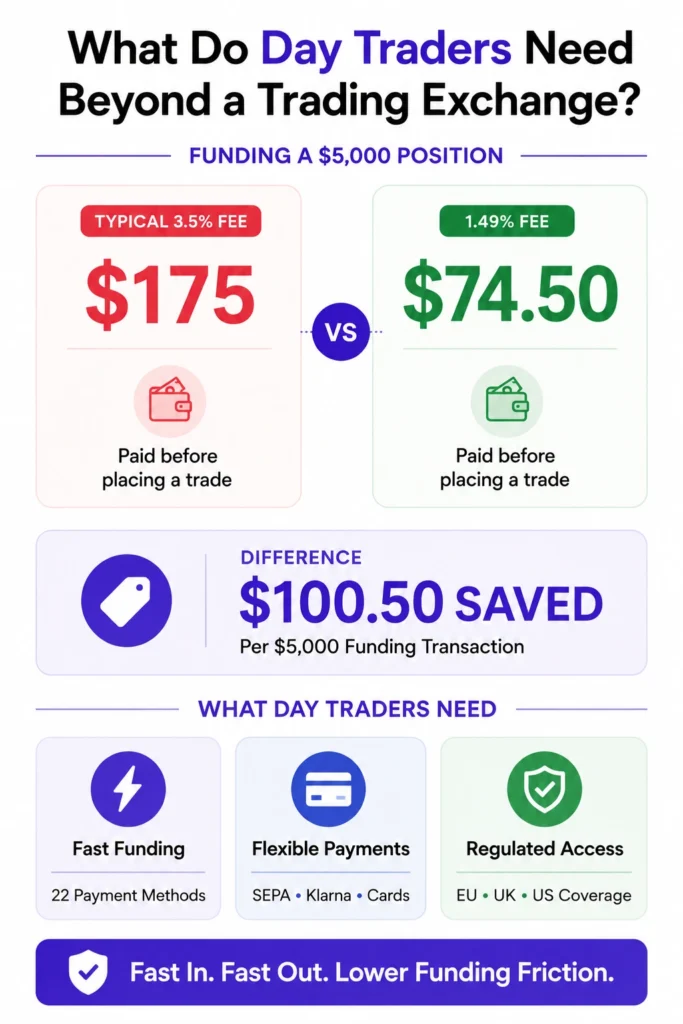
A trading exchange handles the active trading side. But every day trader also needs to move fiat in when funding a position and move profits out when taking them. That is where the on/off-ramp matters as much as the trading platform itself.
Moving $5,000 into a trading account via a platform that charges 3.5% costs $175 before a single trade is placed. Moving the same amount through Paybis at 1.49% costs $74.50. Run that in and out twice a week and the difference exceeds $800 per month in funding friction alone.
Paybis is built for exactly this use case. The 22 supported payment methods, including SEPA bank transfer for EU traders, Klarna Pay by Bank in key European markets, and card payments that settle in under 10 minutes, give day traders a fast and low-cost route in and out of the market.
The MiCA CASP licence issued by the Bank of Latvia in May 2026 covers all 27 EU member states. FCA authorization covers the UK. FinCEN registration covers the US. For traders who need regulatory certainty on their on-ramp as well as their trading platform, buying Bitcoin, buying Ethereum, and converting profits back to fiat on Paybis sits comfortably within a fully licensed framework.
The first purchase of each cryptocurrency on Paybis carries a 0% service fee. After that, the standard 1.49% applies, with all costs shown before confirmation.
Bottom Line
The best crypto exchange for day trading in 2026 depends on your priority. OKX leads on fee efficiency among regulated platforms, at $8 per $10,000 maker trade. Binance leads on liquidity. Kraken Pro leads on security track record. Bybit leads on derivatives. Coinbase Advanced leads on US regulatory certainty, at a significant cost premium. Every serious day trader also needs a reliable, low-fee on-ramp: the exchange you trade on is not always the cheapest place to move fiat in and out. That is where Paybis fits, with 22 payment methods, 1.49% fees, and CASP authorization across the EU, handling the funding and cashout side of the trading operation.
FAQ
What is the best crypto exchange for day trading in 2026?
For most day traders, OKX offers the best combination of low fees, deep liquidity, CASP authorization in the EU, and robust trading tools. At 0.08% maker and 0.10% taker for spot trading, it is the most cost-efficient regulated platform available. Binance is the better choice for traders who need the deepest possible liquidity or who trade a very wide range of pairs. Kraken Pro suits traders who prioritize security record over minimizing fees. For US traders who need full coverage across all 50 states, Coinbase Advanced is the regulatory-safe option despite significantly higher fees.
How much do crypto day trading fees matter?
They matter significantly. A difference of 0.50% per trade across 20 trades daily on $5,000 per trade amounts to $500 in additional fees per day compared to a lower-fee platform. Over a month that is $10,000. Most professional day traders consider fee efficiency one of the top three factors when choosing a platform, alongside liquidity and execution speed. Volume tiers on most major exchanges reduce fees substantially for high-frequency traders, so the published base rates are a starting point rather than a fixed cost.
What order types do day traders need?
At minimum: limit orders, market orders, and stop-loss orders. Beyond those, stop-limit orders, take-profit orders, and OCO (One Cancels the Other) orders give traders meaningful control over position management without requiring manual monitoring of every open trade. For futures traders, trailing stops are also important. OKX, Binance, Kraken Pro, and Bybit all support the full range of these order types. Coinbase Advanced supports a more limited set.
Is Coinbase good for day trading?
Coinbase Advanced is available for day trading and has sufficient liquidity for major pairs. The fee structure, however, is significantly higher than alternatives. At 0.60% maker and 1.20% taker at the base tier, a trader placing the same orders on OKX pays roughly seven times less per trade. For US traders who need full regulatory coverage and cannot use other platforms in their state, Coinbase Advanced is a viable choice. For traders without those constraints, the fee premium is difficult to justify against the alternatives.
Do I need a separate platform to buy crypto for day trading?
Most day traders use a dedicated on/off-ramp separate from their trading exchange to move fiat in and out. This is both cheaper and operationally cleaner than relying on the trading exchange’s own fiat rails, which are often limited in payment method support. Paybis, with 22 payment methods and a 1.49% service fee, is designed specifically for this purpose. EU traders benefit from SEPA as the lowest-cost funding method, settling in one business day at lower processing fees than card options.
Disclaimer: Don’t invest unless you’re prepared to lose all the money you invest. This is a high‑risk investment and you should not expect to be protected if something goes wrong. Take 2 mins to learn more at: https://go.payb.is/FCA-Info