How Crypto Exchanges Work: A Complete Guide to Buying, Selling, and Settlement
– A crypto exchange converts fiat currency into digital assets like Bitcoin
– The process includes four steps: verify identity, choose a payment method, confirm the order, and receive crypto.
– Paybis verification typically completes in under 2 minutes.
– Card purchases are processed near-to-instantly, depending on blockchain conditions.
– Fees include a Service Fee (from 1.49%), Processing Fee, and Network Fee.
Crypto assets can increase or decrease in value. Paybis is a payment gateway, not an investment service. This content is for informational purposes only and does not constitute financial advice.
Most first-time buyers focus on which cryptocurrency to buy while ignoring the hidden exchange fees and multi-day bank delays that quietly eat their investment. Understanding how the underlying mechanics work, from fee structures to blockchain settlement, lets you spot those traps before they cost you money. Whether you prefer to buy Bitcoin with a credit or debit card or buy Bitcoin with a bank account, the mechanics described here apply regardless of which method you choose.
This guide breaks down exactly how cryptocurrency exchanges work, from the moment you upload your ID to the second your crypto settles in your wallet. By the end, you’ll know how to spot hidden fees, avoid complex trading screens, and buy digital assets in under 10 minutes.
Where to Buy and Sell Digital Currencies
Three types of platforms let you buy and sell digital assets: centralized exchanges (CEXs), decentralized exchanges (DEXs), and direct payment gateways or brokers. Each works very differently, and the choice matters for a first-time buyer.
CEX vs. DEX: Trust and Control
A centralized exchange (CEX) is a company-operated platform that matches buyers and sellers. Think Coinbase or Binance. CEXs are user-friendly, have customer support, and the law requires them to collect your personal information when you sign up.
A decentralized exchange (DEX) runs on software with no company behind it. You connect a crypto wallet directly and trade peer-to-peer. DEX platforms often don’t invest in user-friendly design, making them a poor choice for beginners. If you make a mistake on a DEX, there is no support team to call.
How Exchanges Differ from Brokers
A trading exchange shows you an order book: a live list of buyers and sellers. You place orders, navigate “maker/taker” fee structures, and work through dashboards with dozens of trading pairs. That architecture is built for active traders.
A direct broker or payment gateway works differently. You enter how much you want to spend, the platform shows exactly what you get and what it costs, and you pay. Paybis operates this way, converting fiat currency directly to crypto without order book interaction. The calculator-style interface removes trading jargon entirely. If you’re weighing your options, the Paybis vs BitPay comparison is a useful starting point for first-time buyers.
ID Checks for Legal Compliance
Every regulated crypto platform must verify your identity before you buy. This is called KYC (Know Your Customer), and it is a legal requirement under anti-money laundering laws. Paybis’s KYC documentation confirms it accepts over 6,500 document types from more than 220 countries and territories.
Verification speed varies significantly between platforms. Coinbase has improved its process considerably, and most users now verify within a few minutes to a few hours. Paybis automates the check and completes it typically within 15 minutes, with most users approved in under 2 minutes via photo ID and selfie.
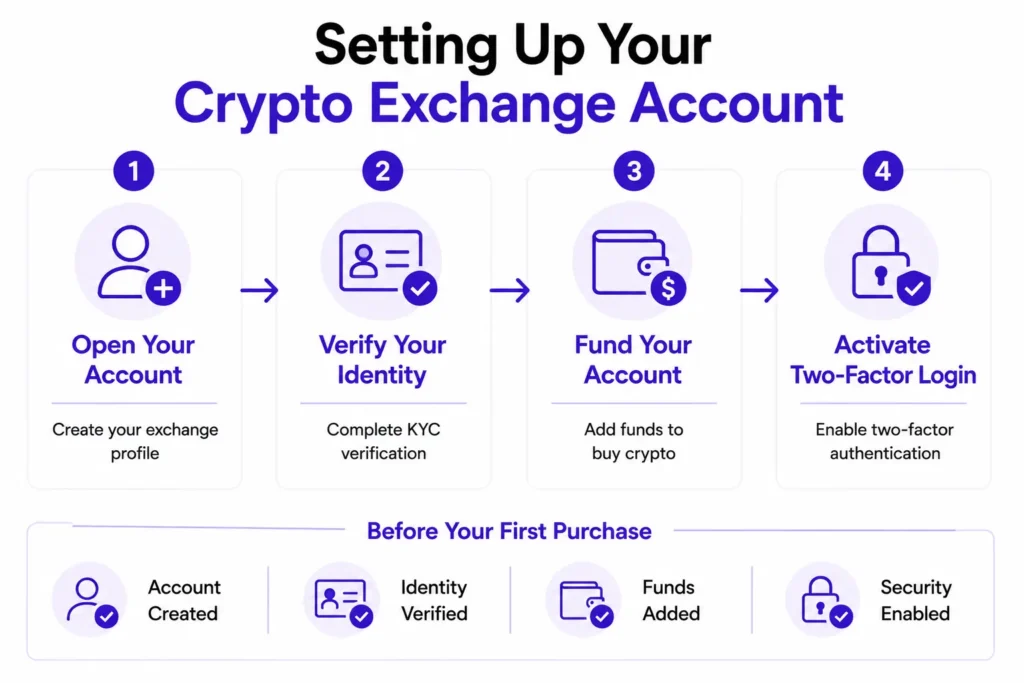
Setting Up Your Crypto Exchange Account
Getting your account ready is faster than most people expect on the right platform.
Open Your First Crypto Account
To create a Paybis account, you need a working email address and a mobile phone number. To complete identity verification and make your first purchase, you also need a government-issued photo ID (passport, national ID card, or driver’s license). International passports are accepted in the vast majority of cases from any country. Paybis supports accounts across 48 US states.
Quick ID Verification Steps
The verification process has three steps:
- Enter personal details: Full name, date of birth, and country of residence.
- Upload your ID: Take a clear photo of your chosen document.
- Complete a selfie: A quick liveness check to confirm your identity matches the document.
The system typically approves your account automatically within minutes when you meet all requirements.
Fund Your Account to Buy Crypto
Paybis supports 20+ payment methods, including Visa and Mastercard credit and debit cards, Apple Pay, Google Pay, PayPal for US customers (see the PayPal buying guide), SEPA bank transfers for EU users, PIX for Brazil, and Skrill or Neteller. This range matters because many platforms only support bank transfers that take days to clear, making same-day purchases impossible. For a deeper look at how ACH and bank-based funding compare, the ACH solution for crypto purchases guide explains the trade-offs in detail.
Activate Two-Factor Login
Two-factor authentication (2FA) adds a second security check beyond your password. When you log in, you confirm with a one-time code from your phone or an authenticator app. Paybis also supports passwordless login via a single OTP (one-time password), making the login process fast without sacrificing security. Enabling 2FA is one of the most important steps you can take to protect your account from unauthorized access.
Confirming Your Crypto Buy: What to Expect
Market Orders vs. Limit Orders
On a traditional exchange, a market order buys crypto immediately at the current best price. A limit order sets a target price and waits for the market to reach it. On Paybis, you don’t need either. You enter the amount you want to spend, the platform locks the price for 15 minutes while you complete payment, and that’s it. No order types, no charts.
Understanding the Bid-Ask Spread
The bid-ask spread is the gap between what buyers will pay and what sellers will accept. Exchanges profit by sitting in the middle. This spread acts as a hidden transaction cost that some platforms embed into the quoted exchange rate without disclosing it separately. When a platform shows “$500 purchase” at checkout but charges $537, part of that gap is often a hidden spread. Paybis shows each cost component separately before you confirm, so nothing is buried inside the exchange rate.
How to Avoid Slippage Costs
Slippage happens when a trade settles at a different price than expected. According to CryptoHopper’s analysis of slippage, slippage is most common in low-liquidity markets during high volatility, and can sometimes exceed 10% of the expected price for smaller or obscure tokens. Sticking to high-liquidity assets like Bitcoin and Ethereum, and using a fixed-quote gateway that locks the price before payment, significantly reduces slippage risk because the rate is confirmed before you commit. If you’re curious about how frequently prices shift, the guide on how often Bitcoin value changes provides useful context.
Know Your Exact Crypto Fees
Every crypto purchase carries three potential costs:
| Fee Type | What It Is | Who Sets It |
|---|---|---|
| Service Fee | Paybis’s fee for the transaction | Paybis (from 1.49%) |
| Processing Fee | Charged by the payment provider | Payment network (4.5–8.5% for cards over $50) |
| Network Fee | Paid to blockchain miners to confirm the transaction | Blockchain miners (fluctuates) |
The first card transaction on Paybis carries a 0% Service Fee. All three figures appear on screen before you click “confirm.”
Payment Processing Times
Card purchases through Paybis process in under 1 minute. Coinbase ACH bank transfers in the US take 2-4 business days. For anyone who needs crypto today, a card purchase versus a bank transfer is the difference between owning Bitcoin before dinner and waiting until next week.
How Price Discovery Works on Exchanges
An order book is a real-time list of every open buy and sell order on an exchange, organized by price. The highest price a buyer offers is the “bid.” The lowest price a seller will accept is the “ask.” When a new order arrives, the exchange’s matching engine pairs it with an existing order on the opposite side and executes a trade. This constant interaction between bids and asks produces the live market price you see quoted everywhere. Prices can differ slightly between platforms because each has its own pool of buyers and sellers, but major exchanges stay closely aligned. For more on how frequently you can act on those prices, see the guide on how often you can buy and sell Bitcoin on exchanges.
Where Your Crypto Is Stored and Protected
Exchange Wallets vs. Personal Wallets
When you buy crypto on an exchange, the exchange holds it in a wallet linked to your account. This is called a custodial model: the exchange controls the private key (the password that proves ownership of the crypto). A personal or non-custodial wallet means you hold the private key yourself, with no third party involved.
The trade-off is straightforward: a custodial wallet lets you reset your password if you forget it, but means you depend on the exchange’s security and policies. A non-custodial wallet is generally safer from exchange breaches, but losing the private key means losing access to your funds permanently. The Paybis wallet functionality guide covers how the built-in wallet works for users who want a managed option. For a broader look at how crypto wallets function, the guide on how Bitcoin wallets work is a helpful primer.
The Crypto Settlement Timeline
Here is how the timeline compares across platforms for a standard purchase:
| Platform | Verification | Processing | Settlement |
|---|---|---|---|
| Paybis (card) | Under 2 minutes | Instant / under 1 minute | Near-instant |
| Coinbase (bank transfer) | Minutes to a few hours | Initiated immediately | 2–4 business days |
| Binance | Minutes (basic); days for advanced or entity accounts | Varies by payment method | Varies |
Once Paybis processes payment, the transaction is broadcast to the blockchain where miners verify it. Bitcoin’s first confirmation typically takes around 10 minutes under normal network conditions, with full confirmation (six blocks) averaging around one hour, as Zendwallet’s confirmation guide details. You receive an email confirmation with a blockchain explorer link to track the transaction yourself.
Custodial vs. Non-Custodial Options
Most major exchanges are custodial by default, holding your crypto until you withdraw it. Paybis gives buyers the option to send purchased crypto directly to a wallet they control, or to hold it in the built-in Paybis wallet. The crypto payout security guide details how multi-party computation (MPC) technology protects assets held on-platform.
How to Withdraw and Sell Your Cryptocurrency
Selling Crypto to Your Bank Account
Paybis lets users sell directly from the built-in wallet or from an external wallet. Funds go to your bank account or back to your Visa or Mastercard. The guide for selling to a card walks through each step. Bank transfer payouts typically arrive within a few business days depending on the destination bank.
Sending Crypto to Your Personal Wallet
Moving crypto off an exchange to a personal wallet means you hold the private key yourself, with no third party involved. You need the wallet address of the destination (a long string of letters and numbers) and enough crypto to cover the Network Fee. The Paybis withdrawal guide covers the full process.
How to Avoid Surprise Network Fees
Network Fees are charged by blockchain miners to process transactions, and the cost changes depending on how busy the network is at the time. During periods of heavy activity, fees can rise significantly. Paybis shows the live Network Fee before you confirm your purchase, so you can review the exact transaction cost upfront with no hidden surprises.
Avoid Hidden Fees: See Your Real Costs
How Exchanges Charge for Trades
Traditional exchanges use a maker/taker fee model. “Maker” orders add liquidity by setting a target price and waiting. “Taker” orders remove liquidity by buying immediately at the current price. Binance charges as low as 0.1% for makers but requires navigating complex trading interfaces. Coinbase embeds undisclosed spreads into the quoted price on its simple buy interface, meaning the fee is hidden inside the exchange rate rather than shown as a separate line item. If you’re looking for help choosing the right app for your needs, the guide to choosing the best crypto app breaks down what to look for.
Credit/Debit Card Surcharges
Card purchases carry higher fees than bank transfers because card networks charge more to process them. On Paybis, the Processing Fee for card purchases is 4.5-8.5% depending on the currency used, for amounts over $50. Your first card purchase carries a 0% Paybis Service Fee. For subsequent purchases, the Service Fee starts from 1.49%.
Why You Pay Blockchain Network Fees
The Network Fee goes directly to the miners who verify and add your transaction to the blockchain. No exchange sets or profits from this fee. It fluctuates based on how many transactions are competing for block space at any given moment.
The True Cost of Your Crypto Buy
Here is a real-cost example for a $500 Bitcoin purchase with a Visa card on Paybis (not the first transaction):
- Service Fee: $7.45 (1.49%)
- Processing Fee: $22.50-$42.50 (4.5-8.5% for USD over $50)
- Network Fee: Variable based on current blockchain conditions (shown live at checkout)
- Total charged to your card: approximately $530-$550 before the live Network Fee is added
All figures appear on your screen before you click “confirm payment.”
Exchange Security: Keeping Your Crypto Safe
How to Check Exchange Licenses
Regulatory registration is the first thing to verify before depositing money on any platform. In the US, money services businesses (MSBs) must register with FinCEN (Financial Crimes Enforcement Network, US Treasury). In Canada, registration with FINTRAC (Financial Transactions and Reports Analysis Centre of Canada) is required. Paybis holds both: FinCEN and FINTRAC registration. You can verify any MSB registration directly on the FinCEN website. The Paybis safety review video walks through the compliance credentials.
Safeguarding Your Crypto from Hacks
Exchanges store the vast majority of customer assets in cold storage (offline and disconnected from the internet), removing the risk of remote hacking. Paybis holds PCI DSS (Payment Card Industry Data Security Standard) Level 1 certification, the highest tier of payment security for large-volume card processors, alongside SSL encryption across all data transmissions and mandatory 2FA. As confirmed in the Paybis security overview, the platform has had no security breaches since 2014.
Is Your Crypto Account Insured?
Cryptocurrency is not covered by FDIC (Federal Deposit Insurance Corporation) protection. Most major exchanges confirm that crime insurance covers theft from platform-level breaches but not unauthorized access to individual accounts. The Securities Investor Protection Corporation (SIPC) does not cover crypto either. This makes strong account security (2FA, unique passwords) your primary protection.
Losing Your Crypto in an Exchange Failure
The FTX collapse in 2022 left millions of customers unable to access funds because the exchange commingled customer assets and operated without proper oversight. Platforms registered with FinCEN and FINTRAC operate under anti-money laundering controls and suspicious activity reporting requirements that create accountability. A clean operational track record since 2014, combined with regulatory registration and PCI DSS Level 1 certification, represents a meaningful baseline of trustworthiness that unregulated platforms cannot match.
For more on buying safely in specific regions, the Paybis UK crypto guide, Canada guide, and France guide cover local regulatory requirements in detail.
Create a Paybis account now to see your exact cost in the fee calculator before you buy. Your first card transaction carries a 0% Paybis Service Fee. Complete identity verification in under 2 minutes.
Key Terminology
- Blockchain: A decentralized, distributed digital ledger, either public or private, that records crypto transactions in sequence. Each block contains a batch of transactions linked to the one before it, creating a tamper-resistant chain of records.
- Network Fee: The cost paid to miners (the computers that verify transactions) to include your transaction in the blockchain. This fee fluctuates based on how congested the network is and is not controlled by exchanges.
- Cold Storage: A security method where crypto assets are held offline, on hardware devices or air-gapped systems, removing them from internet connectivity and the risk of remote hacking. Exchanges typically store the majority of customer assets in cold storage.
- KYC (Identity Verification): The legal requirement for regulated financial platforms to confirm who their users are, typically via photo ID and a selfie. Required under anti-money laundering laws in the US, EU, and most jurisdictions.
- Bid-Ask Spread: The gap between the highest price a buyer is willing to pay and the lowest price a seller will accept. Some platforms embed this gap as an undisclosed fee inside the quoted exchange rate.
- Settlement: The stage when a crypto transaction is confirmed on the blockchain and the funds become accessible in the recipient’s wallet. Settlement speed depends on the specific blockchain network being used.
FAQ
How Long Does It Take to Get Verified and Buy Crypto?
On Paybis, identity verification is typically completed within 15 minutes and most users finish in under 2 minutes via photo ID and selfie upload. From account creation to Bitcoin in your wallet, the total process takes under 10 minutes for most card purchases.
What Are the Credit Card Fees for Crypto Purchases?
Paybis charges a Processing Fee of 4.5-8.5% (depending on currency) for card purchases over $50, plus a Service Fee starting from 1.49% on all purchases after your first. The first card transaction carries a 0% Paybis Service Fee, and the minimum purchase is $5.
What Is the Difference Between Exchange Fees and Network Fees?
Exchange fees (Service Fee and Processing Fee) are set by the platform and go to Paybis and the payment processor. Network fees go to blockchain miners and fluctuate based on blockchain traffic. Paybis controls the first two and displays the live Network Fee at checkout, but does not profit from it.
Who Controls My Crypto on an Exchange?
On a custodial exchange, the platform holds your private key, meaning the platform technically controls your crypto until you withdraw it to a wallet you own. Paybis gives users the option to send crypto directly to a wallet they control, removing the exchange from the equation after settlement.
How Do You Check Whether a Crypto Exchange Is Legitimate?
Look for FinCEN registration (for US operations) and FINTRAC registration (for Canada) on the platform’s legal or compliance page. Verify the registration numbers directly on the FinCEN website. Paybis holds FinCEN registration and FINTRAC, along with PCI DSS Level 1 certification and a clean security record since 2014.
Disclaimer: Don’t invest unless you’re prepared to lose all the money you invest. This is a high‑risk investment and you should not expect to be protected if something goes wrong. Take 2 mins to learn more at: https://go.payb.is/FCA-Info